COMPARISON · OSCILLOSCOPES
FNIRSI DSO-510 vs DSO152: Portable Oscilloscopes Compared
Both of these are single-channel, pocket-sized FNIRSI scopes aimed at quick diagnostics rather than bench work. The DSO-510 is the more capable of the two — 50 times the bandwidth and a built-in signal generator — while the DSO152 undercuts it on price for the most basic checks.
By the OhmSavvy Research Team ·
Disclosure: OhmSavvy earns a commission from qualifying Amazon purchases made through these links, at no extra cost to you. How we're funded.

FNIRSI DSO-510
4.0★★★★☆A 1-channel pocket scope with a built-in signal generator, though its own listing disputes its name.
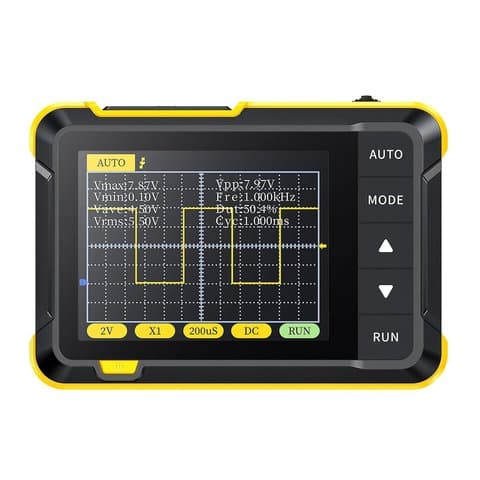
FNIRSI DSO152
4.1★★★★☆A genuinely pocket-sized scope for quick diagnostics — not a bench replacement.
Specs side by side
| FNIRSI DSO-510 | FNIRSI DSO152 | |
|---|---|---|
| Rating | 4.0★★★★☆ | 4.1★★★★☆ |
| Bandwidth | 10MHz | 200kHz |
| Channels | 1 | 1 |
| Sample rate | 48 MS/s | 2.5 MSa/s |
| Best for | Quick single-channel checks with a built-in generator | Basic diagnostics, learning the fundamentals |
| Bandwidth | 10MHz | 200kHz |
| Channels | 1 | 1 |
| Sample rate | 48 MS/s | 2.5 MSa/s |
| Display | 2.8-inch, 320 × 240 | Not stated at the same detail in this Pick's sourcing |
| Built-in signal generator | 0-50kHz DDS, 13 waveforms | None |
| Input range | ±400V with included 10X probe | Not stated in this Pick's sourcing |
| Power | 1000mAh battery (~4 hrs), USB-C | Not stated in this Pick's sourcing |
| Model-name caution | Listing's own graphic disputes "DSO-510" vs "DSO-153" | None noted |
Specs checked against manufacturer documentation and official Amazon listings. Desk research, not bench testing. How we research.
Key differences
- →Bandwidth: the DSO-510 is rated 10 MHz, 50 times the DSO152's 200 kHz — a large practical gap, not a marginal one.
- →Sample rate: 48 MS/s on the DSO-510 against 2.5 MSa/s on the DSO152, keeping pace with the bandwidth difference.
- →Signal generator: only the DSO-510 has one built in (0-50 kHz DDS, 13 waveforms); the DSO152 has none.
- →Documentation: this Pick's DSO-510 sourcing (FNIRSI's own product page) is considerably more detailed than what's available for the DSO152, which is documented mainly through its own listing.
- →Naming: the DSO-510's own listing carries an internal naming inconsistency (a marketing graphic calls it "DSO-153"); the DSO152 has no equivalent caution.
Spec by spec
These aren't close on the numbers that matter most for a pocket scope: bandwidth and sample rate. The DSO-510 isn't a modest step up from the DSO152 — it's a different class of tool entirely.
Bars use a logarithmic scale: each step is ten times the last.
Bars use a logarithmic scale: each step is ten times the last.
At 200 kHz, the DSO152 is really only suited to audio-range and basic low-speed logic signals. The DSO-510's 10 MHz opens up a much wider range of general electronics and automotive diagnostic work, and its built-in generator adds a capability the DSO152 simply doesn't have at any frequency.
Where each pocket scope runs out of road
A rated bandwidth is the frequency where a sine wave already displays about 30% short of its true height (the −3 dB point), so it marks the edge of the usable range rather than its middle. A common rule of thumb is to keep your signal at or below roughly a fifth to a third of that figure if you want amplitudes to read within a few percent. The map below plots both inputs on one log-frequency axis with that rule applied.
Read that way, the DSO152 is comfortable up to roughly 40–67 kHz: fine for the audio band, slow PWM and sensor outputs, but square waves lose their sharp corners well before that, because a clean edge needs several odd harmonics above the fundamental. The DSO-510's comfortable zone reaches roughly 2–3 MHz, enough to show the edges of a few-hundred-kilohertz PWM drive or a slow serial line with recognizable shape. The sample rates follow the same pattern: at 2.5 MSa/s the DSO152 gets about 25 points across one cycle of a 100 kHz signal, while the DSO-510's 48 MS/s gets 480.
Notice too where the DSO-510's generator sits: it covers the audio band and a little beyond, which is the right range for injecting a test tone into an amplifier stage or a filter and watching the result on the same screen. It isn't meant for clock or RF work. For more on how bandwidth and sample rate relate, see what GSa/s means.
FNIRSI DSO-510 vs DSO152: portable scopes compared
Despite both being marketed as pocket oscilloscopes, these serve different purposes once you look past the form factor.
If you need a genuinely useful diagnostic tool: the DSO-510
10 MHz bandwidth and a built-in generator make the DSO-510 workable for real diagnostic tasks — checking a sensor signal, a PWM line, or a basic automotive waveform — in a device that still fits in a pocket. The generator doubles as a way to inject a known test signal without separate equipment.
If you just want the cheapest possible single-channel scope: the DSO152
For strictly audio-range or very slow signals — and only when price is the deciding factor — the DSO152 still does the basic job of showing a waveform on a screen. It's a learning tool more than a diagnostic one at 200 kHz.
Check the actual model name before buying the DSO-510
Which should you buy?
| Buyer or job | Better fit | Why |
|---|---|---|
| Real diagnostic work: sensors, PWM, automotive signals | FNIRSI DSO-510 | 10 MHz and 48 MS/s actually resolve these signals |
| Need a signal source in the same device | FNIRSI DSO-510 | Built-in 0-50 kHz DDS generator |
| Strictly audio-range signals on the tightest budget | FNIRSI DSO152 | Lower price for a job that doesn't need more bandwidth |
| First exposure to what an oscilloscope even shows | FNIRSI DSO152 | Simpler, cheaper tool for learning the basics |
| Want the better-documented of the two | FNIRSI DSO-510 | FNIRSI's own product page gives detailed specs |
Want a pocket scope with more bandwidth still? The beginner oscilloscope roundup ranks both of these alongside bench-style options, and the oscilloscope buying guide explains every spec from scratch.
Neither replaces a bench scope
Choose the FNIRSI DSO-510 if…
- ✓You want to check signals well above basic audio range
- ✓You want a built-in signal generator in the same pocket device
- ✓You're doing automotive or general electronics diagnostics, not just toy projects
- ✓You want USB-C charging and a lithium battery rated for about 4 hours
Choose the FNIRSI DSO152 if…
- ✓Your signals are strictly low-frequency: audio, basic control logic
- ✓Price is the only thing that matters for an occasional-use tool
- ✓You want the smallest possible footprint and don't need a generator
- ✓You're learning basic waveform concepts for the first time, not diagnosing a specific fault
The bottom line
The FNIRSI DSO-510 and DSO152 both fit in a pocket, but they're not really competing for the same job. The DSO-510's 10 MHz bandwidth, faster sampling and built-in generator make it the far more useful diagnostic tool; the DSO152 only makes sense if price is the only consideration and your signals are strictly low-frequency.
Frequently asked questions
Is the FNIRSI DSO-510 much better than the DSO152?+
Yes, substantially — 10 MHz bandwidth against 200 kHz (50x), and 48 MS/s against 2.5 MSa/s (about 19x), plus a built-in signal generator the DSO152 doesn't have. The DSO152 only makes sense when price is the deciding factor and your signals are strictly low-frequency.
Does the FNIRSI DSO152 have a signal generator?+
No. Only the DSO-510 includes one in this site's sourcing — a basic DDS generator covering 0-50 kHz across 13 waveform types.
Why does the DSO-510 have a naming caution on this site?+
The DSO-510's own Amazon listing includes a seller-made comparison graphic that labels the matching spec column "DSO-153" rather than "DSO-510", even though the listing title and FNIRSI's current product page both call it "DSO-510" with identical specs. It's worth checking the current listing yourself before buying.
Can either of these replace a benchtop oscilloscope?+
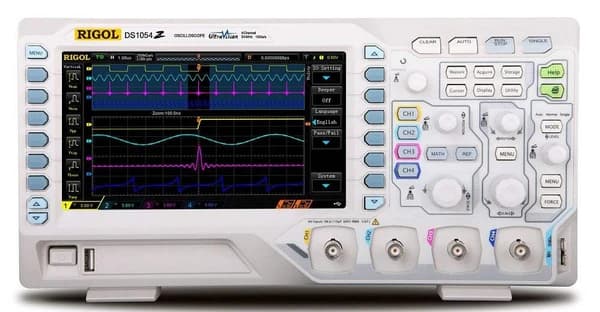
No — both are single-channel pocket tools meant for quick checks, not a substitute for a multi-channel benchtop scope with deep memory and serial decoding, such as the Rigol DS1054Z.
Is 200 kHz of bandwidth enough to see a square wave?+
Only a slow one. A square wave's sharp edges are built from odd harmonics well above its fundamental, so a 200 kHz scope like the DSO152 visibly rounds the corners once the fundamental climbs into the tens of kilohertz. The DSO-510's 10 MHz keeps edges recognizable into the hundreds of kilohertz, which is why it suits PWM and slow serial lines better.
Related