COMPARISON · OSCILLOSCOPES
OWON HDS272S vs FNIRSI 2C53T: Handheld Scope Comparison
Both of these pack an oscilloscope, a true-RMS multimeter and a signal generator into a handheld device. The OWON is the more capable of the two across almost every spec that matters — bandwidth, record depth, and especially generator output — while the FNIRSI wins on weight, at a documented 300 g against OWON's roughly 0.6 kg before batteries.
By the OhmSavvy Research Team ·
Disclosure: OhmSavvy earns a commission from qualifying Amazon purchases made through these links, at no extra cost to you. How we're funded.

OWON HDS272S
4.2★★★★☆A two-channel 70 MHz handheld with a 20,000-count meter and a 25 MHz signal generator.
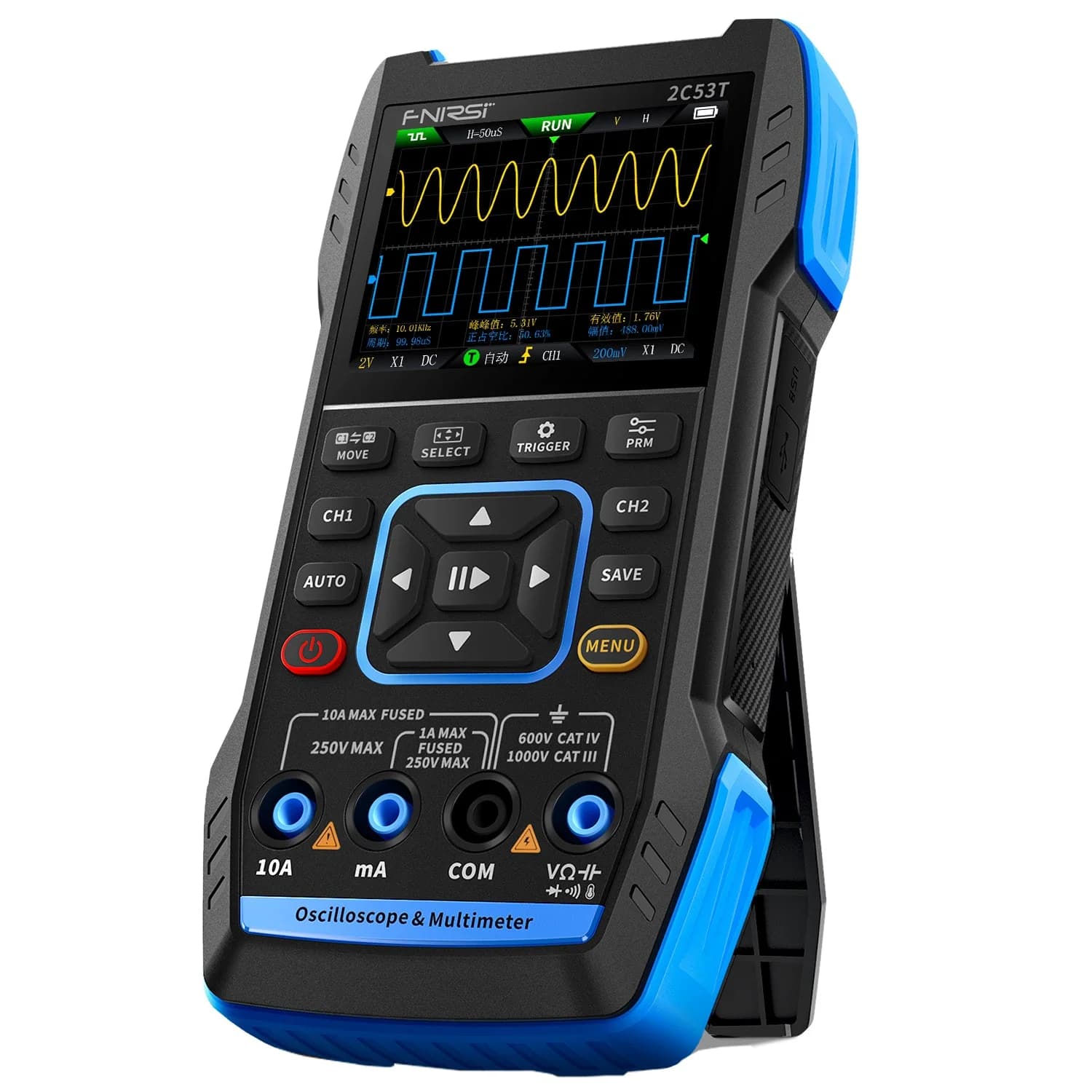
FNIRSI 2C53T
4.1★★★★☆A low-cost two-channel handheld scope with a 19,999-count True RMS multimeter and a basic generator.
Specs side by side
| OWON HDS272S | FNIRSI 2C53T | |
|---|---|---|
| Rating | 4.2★★★★☆ | 4.1★★★★☆ |
| Bandwidth | 70MHz | 50MHz |
| Channels | 2 | 2 |
| Sample rate | 250 MSa/s (1 ch); 125 MSa/s (2 ch) | 250 MSa/s |
| Best for | Portable work that needs a scope, meter and signal source | Beginners who want a meter and scope in one |
| Bandwidth | 70MHz | 50MHz |
| Channels | 2 | 2 |
| Sample rate | 250 MSa/s (1 ch); 125 MSa/s (2 ch) | 250 MS/s |
| Record length | 8K points | 1K points |
| Signal generator | Sine to 25MHz, square/pulse to 5MHz, 14-bit | Up to 50kHz |
| Multimeter | 20,000-count true-RMS, 1000V DC / 750V AC / 10A | 19,999-count True RMS, 1000V DC / 750V AC |
| Waveform capture rate | 10,000 wfms/s | Not stated |
| Screen | 3.5-inch, 320 × 240 | 2.8-inch, 320 × 240 |
| Power | Two 18650 cells (2 × 2,200 mAh), 3-6 hrs, USB-C (power bank OK) | Built-in 3,000 mAh battery |
| Extras | Fold-out stand | Not called out in this Pick's sourcing |
| Weight | About 0.6 kg without battery | 300 g |
Specs checked against manufacturer documentation and official Amazon listings. Desk research, not bench testing. How we research.
Key differences
- →Generator: the HDS272S reaches 25 MHz sine (and 5 MHz square/pulse); the 2C53T tops out at 50 kHz — a 500x difference in sine-wave capability.
- →Record length: the HDS272S documents 8K points against the 2C53T's 1K, meaning roughly 8x more detail per capture at the same sample rate.
- →Bandwidth: 70 MHz on the HDS272S against 50 MHz on the 2C53T.
- →Battery: the HDS272S runs on two standard 18650 cells (OWON quotes 3-6 hours); the 2C53T has a built-in 3,000 mAh battery.
- →Screen size: 3.5-inch on the HDS272S against 2.8-inch on the 2C53T.
- →Weight: the 2C53T is documented at 300 g; OWON lists the HDS272S at about 0.6 kg before its batteries go in, so it's the heavier tool by at least double.
- →Multimeters are close: both are rated 1000V DC and 750V AC maximum, at 20,000 counts (OWON) against 19,999 (FNIRSI), and OWON adds a fused 10A current range.
Spec by spec
The OWON leads on nearly every scope-side spec. The chart below highlights the two biggest gaps: generator output and record length.
Bars use a logarithmic scale: each step is ten times the last.
A 25 MHz generator can produce genuinely useful test signals for RF-adjacent and higher-speed digital work; a 50 kHz generator is limited to slow test tones. Combined with 8x the record length, the HDS272S is the clearly more capable instrument on the scope side of these 3-in-1 devices.
What 1K versus 8K points means on screen
Record length sounds abstract until you turn it into time. A capture lasts as long as the number of stored points divided by the sample rate. With one channel at the 250 MSa/s both makers quote, that works out to:
- FNIRSI 2C53T: 1,000 points ÷ 250,000,000 per second = 4 µs of signal per capture
- OWON HDS272S: 8,000 points ÷ 250,000,000 per second = 32 µs of signal per capture
In practice the 2C53T has to choose: keep the full sample rate and see a single short slice, or stretch the timebase and let the sample rate fall so the 1K points cover a longer stretch, at the cost of edge detail. The HDS272S faces the same trade-off but eight times later, so it can show several cycles of a switching or PWM signal and still have the resolution to measure a rise time or spot ringing on one edge. If you want to understand why sample rate falls as you zoom out, our guide to GSa/s walks through it.
OWON HDS272S vs FNIRSI 2C53T: handheld scope comparison
Despite the similar form factor and feature set on paper, these two aren't evenly matched once you look past the headline "scope + meter + generator" pitch.
If you need genuine test capability: the HDS272S
The combination of 70 MHz bandwidth, 8K record length and a 25 MHz generator makes the HDS272S useful for real diagnostic and bench work, not just basic checks. The fold-out stand and larger screen also help if you use it at a bench rather than purely in the field.
If you want the lighter, simpler device: the 2C53T
At a documented 300 g, the 2C53T is the more pocketable option, and its meter carries the same 1000V DC and 750V AC maximums as the OWON's. If your use case is mostly basic continuity and voltage checks with an occasional simple test tone, it covers that without paying for capability you won't use.
The meter is a tie; the scope and generator are not
Which should you buy?
| Buyer or job | Better fit | Why |
|---|---|---|
| Need a usable signal generator above basic test tones | OWON HDS272S | 25 MHz sine vs. 50 kHz |
| Want more detail per capture | OWON HDS272S | 8K record length vs. 1K |
| Want to run from a power bank in the field | OWON HDS272S | OWON states USB-C power-bank charging |
| Want the lightest, most pocketable device | FNIRSI 2C53T | Documented 300 g vs about 0.6 kg |
| Mostly meter work with an occasional waveform | FNIRSI 2C53T | Same 1000V DC / 750V AC meter ceilings, lighter body |
| Want a larger screen and a fold-out stand | OWON HDS272S | 3.5-inch screen, stand included |
Want to see the 2C53T against a different FNIRSI alternative? See FNIRSI 2C53T vs WESTOBiG 2C53P Plus. The beginner oscilloscope roundup ranks both handhelds, and the oscilloscope buying guide explains every spec from scratch.
Both are field tools, not bench replacements
Choose the OWON HDS272S if…
- ✓You need a generator that can actually drive real test signals (up to 25 MHz)
- ✓You want deeper memory for more detailed captures (8K vs 1K points)
- ✓You want a larger 3.5-inch screen and a fold-out stand for bench use
- ✓You're fine recharging via USB-C, including from a power bank
Choose the FNIRSI 2C53T if…
- ✓You want the lighter device at a documented 300 g
- ✓A basic generator (up to 50 kHz) is all you'll ever need
- ✓You want a built-in battery with no separate cells to source
- ✓Budget is the main constraint and you don't need more than the basics
The bottom line
The OWON HDS272S outperforms the FNIRSI 2C53T on nearly every scope-side spec — more bandwidth, 8x the record length, and a 25 MHz generator against 50 kHz — while the 2C53T weighs at most half as much and matches it on multimeter voltage ratings. For most buyers who want genuine test capability, the HDS272S is the better choice; pick the 2C53T only if weight or basic simplicity matters more than capability.
Frequently asked questions
Is the OWON HDS272S better than the FNIRSI 2C53T?+
On nearly every documented scope-side spec, yes — more bandwidth (70 MHz vs 50 MHz), 8x the record length (8K vs 1K points), and a far more capable generator (25 MHz sine vs 50 kHz). The 2C53T's main advantage is weight: 300 g against OWON's roughly 0.6 kg before batteries. Both meters share the same 1000V DC and 750V AC limits.
Can the FNIRSI 2C53T's generator drive a real test circuit?+
Yes, for low-frequency work. Its generator tops out at 50 kHz, which covers audio tones and slow control signals, so you can inject a test tone into an amplifier or filter. For clock-like square waves, faster filters or anything RF-adjacent, the OWON HDS272S's 25 MHz sine and 5 MHz square output reach far higher.
What batteries do the OWON HDS272S and FNIRSI 2C53T use?+
OWON's spec sheet lists two 18650 lithium cells of 2,200 mAh each, good for 3 to 6 hours, charged over USB-C or from a power bank. FNIRSI fits a built-in 3,000 mAh battery. OWON doesn't say whether its cells are meant to be user-swapped, and the Amazon listing notes no standalone batteries are sold with it, so check before counting on spares.
Which is lighter and more pocketable?+
The FNIRSI 2C53T, clearly. FNIRSI documents it at 300 g with a 2.8-inch screen, while OWON lists the HDS272S at about 0.6 kg without its batteries and 198 × 96 × 38 mm, with a 3.5-inch screen and a fold-out stand. The OWON is built to sit on a bench as well as travel; the FNIRSI is the one for a jacket pocket.
How long a signal can each handheld capture at full sample rate?+
Divide record length by sample rate. At 250 MSa/s on one channel, the 2C53T's 1K points hold about 4 microseconds and the HDS272S's 8K points hold about 32 microseconds. Set a slower timebase and both scopes lower their sample rate to cover more time, but the OWON keeps eight times as many points to describe it.
Related