HOW-TO GUIDE
When to Use an Oscilloscope vs a Multimeter
By the OhmSavvy Research Team ·
Safety: the two tools are not interchangeable on mains
- For checking outlets, household wiring and other mains circuits, the usual tool is a multimeter whose CAT rating covers that circuit, used with leads rated to match.
- A bench scope's probe ground clip is normally connected to mains earth through the power cord. Clipping it to a point that isn't at earth potential, such as anywhere on a mains-connected, non-isolated circuit, creates a short through the ground lead that can cause damage, fire or injury.
- Never remove or defeat the scope's earth to work around this. If you genuinely need to see a mains-side waveform, use an isolation transformer on the device under test, a differential probe, or an isolated-channel or handheld scope rated for the job.
- Check the maximum input and CAT rating on both the scope and the probe. Standard 1x/10x probes are not for mains work unless their rating explicitly covers it.
The short answer
Rule of thumb
Put another way: start from the question you are asking. If the answer is one steady value, use the meter; if the answer depends on what the signal does over time, use the scope. The guide below sorts common questions that way.
| What you need to know | Steady or changing? | Reach for |
|---|---|---|
| Is this supply rail at 5 V? | Steady value | Multimeter |
| What is this resistor's value? | Steady value | Multimeter |
| Is this fuse or cable continuous? | Steady value | Multimeter |
| How much current does the circuit draw? | Steady value | Multimeter |
| Is there ripple or noise on the rail? | Changing in time | Oscilloscope |
| Are this square wave's edges clean? | Changing in time | Oscilloscope |
| Is the PWM duty cycle what I set? | Changing in time | Oscilloscope |
| Does a brief dropout ever happen? | Changing in time | Oscilloscope |
Side by side
The details vary by model, but the general split between the two instruments looks like this:
| Multimeter | Oscilloscope | |
|---|---|---|
| What it shows | A single number per measurement | A graph of voltage against time |
| Measures | Voltage, resistance, continuity, usually current; often frequency, capacitance and more | Voltage over time; time and frequency are derived from the trace |
| Steady DC voltage | Usually the more precise tool | Works, but vertical accuracy is typically coarser |
| Resistance and continuity | Yes | No |
| Current | Yes, wired in series (or a clamp meter) | Only indirectly, e.g. via a shunt resistor or current probe |
| Fast or changing signals | Shows an average or RMS value, or an unstable reading | Shows the actual waveform |
| Comparing two signals | No | Yes, on a 2- or 4-channel scope |
| Mains work | Yes, with an appropriate CAT rating | Only with isolation or differential probing |
| Portability | Pocket-sized and battery powered | Mostly bench units; handhelds exist |
Jobs where the multimeter is the right tool
Plenty of everyday electronics work never needs a scope. These are the measurements a multimeter does better, faster or more safely:
Battery and supply checks
Is this rail at 5 V? One precise DC number is all you need.
Resistance
Checking resistor values and wiring, with the circuit unpowered.
Continuity
The beep test for fuses, cables, switches and solder joints.
Current draw
In series on low-voltage circuits, or a clamp meter for larger loads.
Outlets and mains wiring
With a CAT-rated meter and leads suited to the circuit.
Quick field checks
Pocketable, battery powered and fast to set up.
Our multimeter how-to covers each of these modes step by step, and the multimeter comparison lists spec-checked options.
Jobs where you need the oscilloscope
The scope earns its place whenever the answer depends on what happens within a fraction of a second. A classic example is PWM, the rapid on-off switching a microcontroller uses to dim an LED or control a motor:
Other jobs that call for a scope:
- Ripple and noise on a power rail. A meter may read a tidy 5.0 V while the scope shows switching noise riding on top.
- Signal shape: whether a square wave has clean edges, ringing or slow, rounded transitions.
- Digital communication: seeing UART, I2C or SPI activity, or confirming a clock line is actually toggling.
- Timing between signals: on a multi-channel scope, how one edge lines up against another.
- Intermittent faults: a single-shot capture can catch a brief dropout that a meter would never register. See how to trigger an oscilloscope.
Where the two tools overlap
Some measurements can be made with either instrument, and knowing the difference helps you pick the right one:
- DC voltage. Both read it. The multimeter is usually the more precise instrument for a steady value; the scope tells you whether the value is actually steady. Many entry-level scopes have a vertical accuracy of a few percent, so check your model's datasheet before relying on a scope for precise DC readings.
- AC voltage. A True RMS multimeter gives the RMS value directly. A scope shows peak-to-peak and shape, and most digital scopes can calculate RMS too. For a pure sine, Vrms = Vpk ÷ √2; for other shapes, the relationship differs. Read more in how to measure voltage with an oscilloscope.
- Frequency. Many multimeters have a Hz mode that works on clean, repetitive signals within the meter's rated range. A scope lets you see the waveform you are measuring, which matters when the signal is noisy or irregular. See how to measure frequency with an oscilloscope.
The figure below shows the AC case. The same 100 Hz sine wave goes to both instruments. The meter boils it down to one RMS number; the scope shows the whole wave, from which you can read the peak-to-peak voltage and the period, and check that it really is a clean sine before trusting the RMS conversion.
Why most benches have both
A typical debugging session uses the two together. The multimeter confirms the basics (power is present, the rail is the right voltage, a connection is continuous), and the scope then answers the harder question of what the signal is doing. They are also cheap insurance against each other's blind spots: a meter can't show you noise, and a scope can't measure resistance. If you are starting out, a multimeter usually comes first because it covers more everyday jobs. Add a scope once your projects involve anything that switches, oscillates or communicates.
Two tools, two jobs

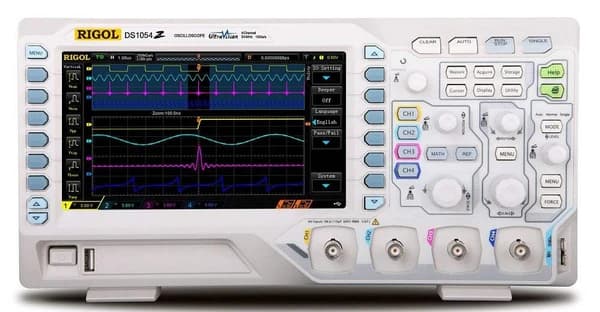
50MHz, 4 channels, 1 GSa/s, with a 7-inch display.
As an Amazon Associate I earn from qualifying purchases. Prices and availability are shown on Amazon.
Choosing a scope to go with your meter
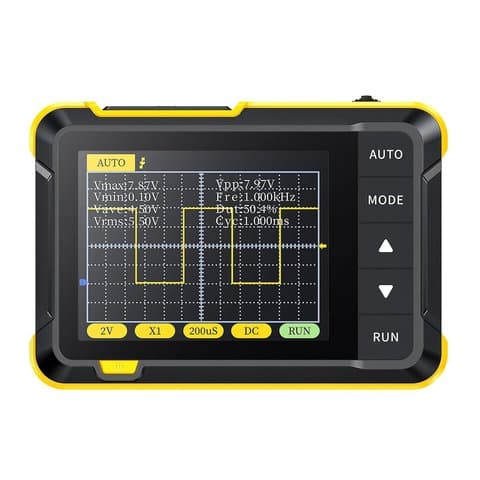
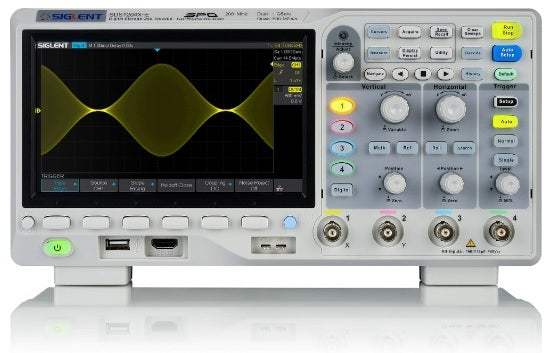
For hobby and repair work, an entry-level digital bench scope is the usual next step. The Rigol DS1054Z (4 channels, 50MHz, 1 GSa/s) and Siglent SDS1104X-E (4 channels, 100MHz, 1 GSa/s) are common choices, while the Hantek DSO2D10 adds a built-in waveform generator to a 2-channel, 100MHz scope. If you only need to look at slow or audio-range signals, the pocket-sized FNIRSI DSO152 (1 channel, 200kHz) is a much smaller step. The oscilloscope buying guide explains how much bandwidth and sample rate you really need. Once it arrives, how to use an oscilloscope and how to read the screen will get you to your first measurement.
Frequently asked questions
Can an oscilloscope replace a multimeter?
Not fully. A scope can read DC and AC voltage and work out frequency, but it cannot measure resistance or continuity, it only measures current indirectly through a shunt or current probe, and its vertical accuracy is typically coarser than a meter's. Bench scopes are also unsuited to direct mains work without isolation. Most people keep a multimeter even after buying a scope.
Why does my multimeter show a different AC voltage than my oscilloscope?
Usually because they are reporting different things. A meter on AC volts shows RMS, while a scope often displays peak-to-peak by default. A 10 Vpp sine is 5 V peak and about 3.54 V RMS, so both can be correct. Other causes are a meter that is not True RMS reading a non-sine wave, or a signal above the meter's rated AC frequency range.
Can a multimeter measure frequency?
Many can, through a Hz mode, as long as the signal is clean, repetitive and within the meter's rated frequency and voltage range. The meter simply counts cycles, so noise or extra edges can make the reading jump or come out wrong, and you cannot see why. A scope shows the waveform behind the number, which is the deciding factor on noisy or irregular signals.
Should a beginner buy a multimeter or an oscilloscope first?
A multimeter first, for almost everyone. It covers the checks most projects need, such as supply voltages, resistor values, continuity and current draw, and it is small and quick to use. An oscilloscope becomes worth adding once your projects involve signals that switch, oscillate or communicate, such as PWM, clocks, audio or serial data, where the shape over time matters.
What does a multimeter show when measuring a PWM signal?
On DC volts a meter typically settles near the average of the waveform, which is the high level multiplied by the duty cycle: a 5 V signal high 20% of the time averages about 1 V. The exact reading depends on how the meter filters a fast-changing input. It tells you nothing about the pulse height, frequency or edges, which only the scope shows.