COMPARISON · OSCILLOSCOPES
FNIRSI 2C53T vs 2C53P Plus: Features and Differences
These two 3-in-1 handhelds share identical oscilloscope headline specs — 50 MHz, two channels, 250 MS/s — and a similar true-RMS multimeter. What separates them is everything around that core: screen type and size, generator capability, battery size, and what's in the box.
By the OhmSavvy Research Team ·
Disclosure: OhmSavvy earns a commission from qualifying Amazon purchases made through these links, at no extra cost to you. How we're funded.
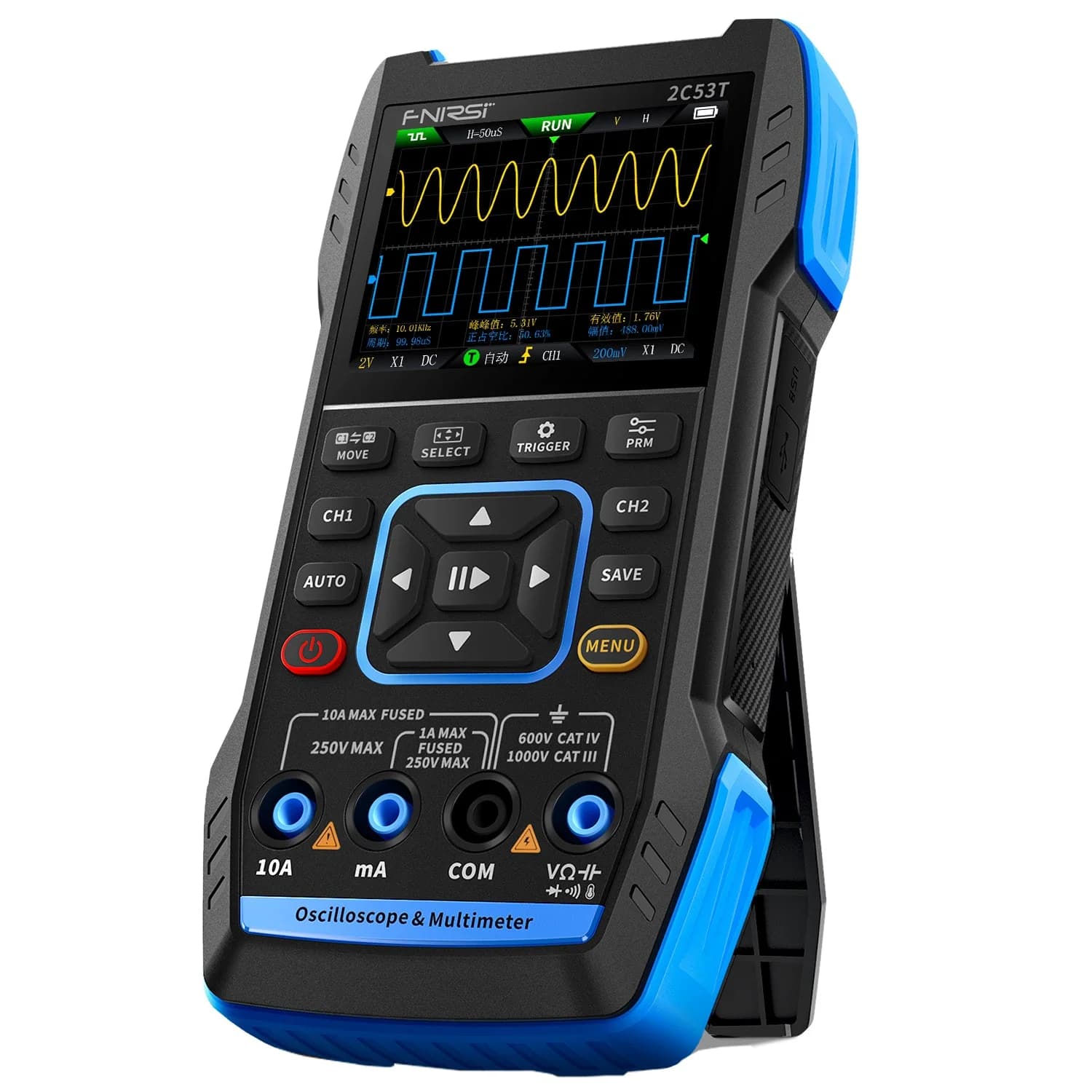
FNIRSI 2C53T
4.1★★★★☆A low-cost two-channel handheld scope with a 19,999-count True RMS multimeter and a basic generator.

WESTOBiG 2C53P Plus
4.2★★★★☆A 3-in-1 scope/multimeter/generator handheld bundled with a carrying case.
Specs side by side
| FNIRSI 2C53T | WESTOBiG 2C53P Plus | |
|---|---|---|
| Rating | 4.1★★★★☆ | 4.2★★★★☆ |
| Bandwidth | 50MHz | 50MHz |
| Channels | 2 | 2 |
| Sample rate | 250 MSa/s | 250 MS/s |
| Best for | Beginners who want a meter and scope in one | Field work needing a scope, meter and generator together |
| Bandwidth | 50MHz | 50MHz |
| Channels | 2 | 2 |
| Sample rate | 250 MS/s | 250 MS/s |
| Screen | 2.8-inch, 320 × 240, button controls | 4.3-inch, 480 × 272, IPS touchscreen |
| Signal generator | Up to 50 kHz | 12 waveforms, up to 10 MHz |
| Multimeter | 19,999-count True RMS, 1000V DC / 750V AC | 4.5-digit, 19999-count |
| Analysis features | Not called out in this Pick's sourcing | FFT, Lissajous |
| Record depth | 1 Kpts (documented) | Not stated in this Pick's sourcing |
| Battery | 3,000 mAh | 4,000 mAh (~4 hrs) |
| Weight | 300 g (documented) | Not stated in this Pick's sourcing |
| In the box | Standard accessories | Includes a carrying case |
Specs checked against manufacturer documentation and official Amazon listings. Desk research, not bench testing. How we research.
Key differences
- →Generator: the 2C53P Plus reaches 10 MHz across 12 waveforms; the 2C53T tops out at 50 kHz — a 200x difference that matters if you need to drive anything beyond very slow signals.
- →Screen: the 2C53P Plus has a larger 4.3-inch 480 × 272 IPS touchscreen; the 2C53T has a smaller 2.8-inch 320 × 240 screen operated with physical buttons.
- →Analysis: only the 2C53P Plus's sourcing calls out FFT and Lissajous analysis modes.
- →Battery: 4,000 mAh on the 2C53P Plus against 3,000 mAh on the 2C53T.
- →Included accessories: the 2C53P Plus bundles a carrying case; the 2C53T's listing doesn't.
- →The oscilloscope core — bandwidth, channel count, sample rate — and the basic multimeter count are effectively identical between them.
Spec by spec
Because the scope hardware is a tie, the chart below focuses on the generator — the single biggest functional gap between these two devices.
Bars use a logarithmic scale: each step is ten times the last.
A 50 kHz ceiling still clears the audio band, so the 2C53T can feed a test tone into an amplifier or a speaker crossover, but it stops well short of clock-rate signals and higher-speed digital test points. The 2C53P Plus's 10 MHz generator opens up a much wider range of real test and diagnostic signals from the same handheld.
Plotted on a log axis, the gap is easier to judge than a raw 200x ratio. Both generators cover audio work: checking an amplifier's frequency response, a tone-control stage or a passive filter tuned to a few kilohertz. Past 50 kHz only the 2C53P Plus continues, through ultrasonic sensor frequencies, the 100 kHz and 400 kHz clock rates used by standard and fast-mode I2C, and on to 10 MHz, where you can inject a stand-in clock or test a switching stage's input. Neither generator gets close to the 50 MHz bandwidth both scopes share, which is normal for handhelds in this class: the scope can see faster signals than the built-in source can create. Also keep in mind that a generator's rated top frequency usually applies to sine output, and square edges near the limit look rounder than the label implies.
FNIRSI 2C53T vs 2C53P Plus: features and differences
With the scope section tied, this decision is really about the surrounding feature set — generator reach, screen type, and what's included.
If you need a real test-signal source: the 2C53P Plus
Being able to generate a useful waveform up to 10 MHz, with FFT and Lissajous analysis on top, makes the 2C53P Plus a considerably more complete field-diagnostic tool — you can both measure a signal and create one to test a circuit, from the same device.
If you want the lighter, simpler device: the 2C53T
At 300 g with physical buttons, the 2C53T is the more compact, simpler-to-operate option when you mainly need the scope and multimeter functions and don't have a specific need for a built-in signal source beyond very basic test tones.
Same scope, different accessory tier
Which should you buy?
| Buyer or job | Better fit | Why |
|---|---|---|
| Need to generate test signals above 50 kHz | WESTOBiG 2C53P Plus | 10 MHz generator vs. 50 kHz |
| Want FFT or Lissajous analysis | WESTOBiG 2C53P Plus | Only this Pick's sourcing lists these modes |
| Prefer physical buttons over a touchscreen | FNIRSI 2C53T | 2.8-inch button-controlled display |
| Want the lightest device | FNIRSI 2C53T | Documented 300 g weight |
| Want a carrying case included | WESTOBiG 2C53P Plus | Bundled with this listing |
| Just need scope + multimeter, nothing else | FNIRSI 2C53T | Simpler device for the core job |
Want a small benchtop alternative to these handhelds? See Hantek DSO2C10 vs FNIRSI 1014D. The beginner oscilloscope roundup ranks both handhelds, and the oscilloscope buying guide explains every spec from scratch.
Both are field tools, not bench replacements
Choose the FNIRSI 2C53T if…
- ✓You want the lighter, smaller device (300 g) with physical button controls
- ✓A basic generator up to 50 kHz is all you need
- ✓You don't need a touchscreen or a bundled carrying case
- ✓You want the documented 1 Kpts record depth figure upfront
Choose the WESTOBiG 2C53P Plus if…
- ✓You want a touchscreen rather than physical buttons
- ✓You need a generator with real reach: 10 MHz against the 2C53T's 50 kHz
- ✓You want FFT and Lissajous analysis built in
- ✓You want a carrying case included and a larger 4000 mAh battery
The bottom line
The FNIRSI 2C53T and WESTOBiG 2C53P Plus share an identical 50 MHz, 250 MS/s oscilloscope core and a similar multimeter, so the decision comes down to everything around it. Choose the 2C53P Plus for its far stronger 10 MHz generator, touchscreen, FFT/Lissajous analysis and bundled case; choose the 2C53T if you want the lighter, simpler, button-controlled device and don't need more than a basic 50 kHz test signal.
Frequently asked questions
Is the WESTOBiG 2C53P Plus just an upgraded FNIRSI 2C53T?+
Functionally, yes — both are FNIRSI-made 3-in-1 scope/multimeter/generator handhelds with an identical 50 MHz, 250 MS/s scope core. The 2C53P Plus adds a much stronger generator (10 MHz vs 50 kHz), a larger IPS touchscreen, FFT/Lissajous analysis, a bigger battery, and a bundled carrying case.
Why is the generator frequency so different between these two?+
This site's sourcing documents the FNIRSI 2C53T's generator at up to 50 kHz and the WESTOBiG 2C53P Plus's at up to 10 MHz across 12 waveforms — a 200x difference per the official listings for each device. If a stronger signal source matters to your work, this is the deciding spec.
Does either of these have serial decoding?+
No — neither this site's 2C53T nor 2C53P Plus sourcing lists serial trigger or decode support. For that, look at a benchtop model like the Hantek DSO2C10 instead.
Which is lighter and more portable?+
The FNIRSI 2C53T is documented at 300 g with a smaller 2.8-inch screen and physical buttons, making it the more compact of the two. The 2C53P Plus's weight isn't stated in this Pick's sourcing, but its larger 4.3-inch touchscreen suggests a bigger device overall.
Can the FNIRSI 2C53T's 50 kHz generator test audio circuits?+
Yes. Its stated 50 kHz upper limit sits above the 20 Hz to 20 kHz audio band, so it can supply test tones for amplifiers, filters and crossovers. It runs out for anything faster, such as I2C-rate clocks or switching stages. This site's sourcing doesn't list its lowest frequency or amplitude range, so check those on the device before planning precise response measurements.
Related