COMPARISON · OSCILLOSCOPES
Rigol DHO924S vs Siglent SDS1202X-E: Which Is Better?
These two trade channel count and resolution against bandwidth and documentation. The DHO924S doubles the channel count and adds 12-bit resolution with a higher 250 MHz rating; the SDS1202X-E counters with a faster waveform capture rate and clearly documented standard serial decode.
By the OhmSavvy Research Team ·
Disclosure: OhmSavvy earns a commission from qualifying Amazon purchases made through these links, at no extra cost to you. How we're funded.

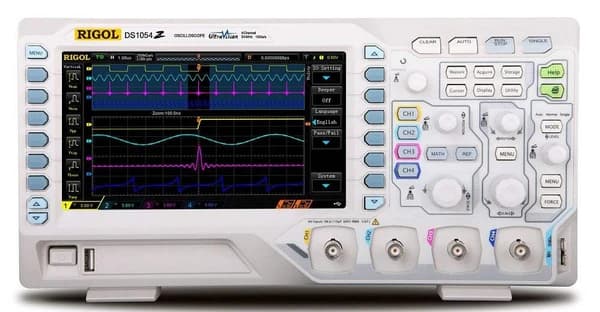
Rigol DHO924S
4.6★★★★★250MHz and four channels with optional logic analysis, Rigol's step up from the DHO800 series.

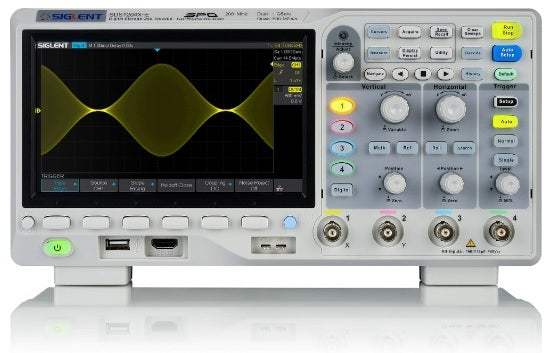
Siglent SDS1202X-E
4.5★★★★★200 MHz on two channels with a fast 100,000 wfm/s update rate and standard serial decoding.
Specs side by side
| Rigol DHO924S | Siglent SDS1202X-E | |
|---|---|---|
| Rating | 4.6★★★★★ | 4.5★★★★★ |
| Bandwidth | 250MHz | 200MHz |
| Channels | 4 | 2 |
| Sample rate | 1.25 GSa/s | 1 GSa/s (1 ch); 500 MSa/s (2 ch) |
| Best for | Four-channel work that wants more bandwidth than the DHO800 series | Faster digital and switching work on two channels |
| Bandwidth | 250MHz | 200MHz |
| Channels | 4 | 2 |
| Vertical resolution | 12-bit | 8-bit |
| Sample rate, 1 channel | 1.25 GSa/s | 1 GSa/s |
| Memory depth | 50 Mpts | 14 Mpts (1 ch) |
| Waveform capture rate | Up to 1 Mwfms/s (UltraAcquire) | 100,000 wfm/s (400,000 sequence mode) |
| Serial trigger and decode | Not called out as standard in this Pick's sourcing | I2C, SPI, UART, CAN, LIN (standard) |
| Digital channels | 16, with optional PLA2216 probe | Not applicable |
| Display | Touchscreen (size not stated in this Pick's sourcing) | 7-inch, 800 × 480 |
Specs checked against manufacturer documentation and official Amazon listings. Desk research, not bench testing. How we research.
Key differences
- →Channel count: 4 on the DHO924S against 2 on the SDS1202X-E — the single biggest practical difference.
- →Resolution: 12-bit on the DHO924S against 8-bit on the SDS1202X-E, giving finer amplitude detail per sample.
- →Bandwidth: 250 MHz against 200 MHz, a moderate edge for the DHO924S.
- →Memory: 50 Mpts documented for the DHO924S against 14 Mpts for the SDS1202X-E — more than 3x deeper.
- →Waveform capture rate: the SDS1202X-E's documented 100,000-400,000 wfm/s is a clearly stated, fast figure; the DHO924S's 1 Mwfms/s figure applies specifically to UltraAcquire mode.
- →Serial decode: only the SDS1202X-E lists standard serial trigger/decode (I2C, SPI, UART, CAN, LIN) in this Pick's sourcing.
- →Digital channels: only the DHO924S supports an optional 16-channel logic probe (PLA2216, sold separately).
Spec by spec
The DHO924S wins on channel count, resolution, bandwidth and memory depth; the SDS1202X-E counters with clearly documented serial decode and a fast capture rate. Neither is a strict upgrade of the other.
More channels and deeper memory help when you need to capture several signals at once or hold a longer event at full detail. A fast, clearly documented capture rate plus built-in serial decode helps when you're chasing an intermittent digital-bus fault. Which matters more depends on the shape of your typical debugging session.
The 8-bit versus 12-bit line in the spec table is easy to skim past, so here is the arithmetic behind it. An 8-bit converter splits the vertical span into 2⁸ = 256 levels; a 12-bit one splits it into 2¹² = 4,096. If the screen spans eight vertical divisions at 1 V/div, that 8 V range gives steps of about 31 mV on the SDS1202X-E and roughly 2 mV on the DHO924S, assuming the converter covers exactly the visible screen. You notice the difference when you zoom into a small detail riding on a bigger signal: power-supply ripple on a 12 V rail, a sensor output that moves by a few millivolts, or the tail of a slow settling waveform. In those cases the coarser scope often forces you to change the volts-per-division setting just to see the detail; the finer one can keep the whole signal on screen and still resolve it. Analog noise and the front-end amplifier set the practical floor, so 12 bits does not guarantee a 16x cleaner trace.
Rigol DHO924S vs Siglent SDS1202X-E: which is better?
With both scopes pulling in different directions on channel count versus documented decode, the right pick depends on what your bench actually needs.
If you need four channels or finer resolution: the DHO924S
Multi-rail power supplies, multi-point digital debugging, or any work that benefits from 12-bit vertical detail over 8-bit point toward the DHO924S. Its 50 Mpts of memory also means a longer capture window at full sample rate.
If two channels are enough and you want confirmed decode: the SDS1202X-E
When your work is mostly two-signal comparisons on digital buses, the SDS1202X-E's clearly documented standard serial trigger/decode and fast capture rate make it the more straightforward, lower-cost choice.
More channels and resolution come with less-detailed documentation here
Which should you buy?
| Buyer or job | Better fit | Why |
|---|---|---|
| Need four channels at once | Rigol DHO924S | 4 channels vs. 2 |
| Want confirmed standard serial decode | Siglent SDS1202X-E | I2C/SPI/UART/CAN/LIN documented as standard |
| Want finer vertical detail | Rigol DHO924S | 12-bit vs. 8-bit |
| Hunting rare glitches, want a fast capture rate | Siglent SDS1202X-E | 100,000-400,000 wfm/s documented |
| Want the deepest memory for long captures | Rigol DHO924S | 50 Mpts vs. 14 Mpts |
| Want the lower-cost option | Siglent SDS1202X-E | Fewer channels, 8-bit, simpler platform |
Want to see the SDS1202X-E against a two-channel Rigol rival instead? See Rigol DS1202Z-E vs Siglent SDS1202X-E. The beginner oscilloscope roundup ranks both, and the oscilloscope buying guide explains every spec from scratch.
Confirm the AWG claim before relying on it
Choose the Rigol DHO924S if…
- ✓You need four channels rather than two
- ✓You want 12-bit vertical resolution for finer amplitude detail
- ✓Your signals run up toward 250 MHz
- ✓You want the deepest documented memory (50 Mpts)
Choose the Siglent SDS1202X-E if…
- ✓Two channels are enough for your work
- ✓You want standard serial trigger and decode confirmed out of the box
- ✓You're hunting rare glitches and want a faster waveform capture rate
- ✓You want the lower-cost option in this pair
The bottom line
The Rigol DHO924S and Siglent SDS1202X-E pull in different directions: more channels, finer resolution and deeper memory on the DHO924S, against confirmed standard serial decode and a faster documented capture rate on the SDS1202X-E. Choose based on channel count and resolution needs first, then decode requirements.
Frequently asked questions
Is the Rigol DHO924S better than the Siglent SDS1202X-E?+
It has more channels (4 vs 2), finer resolution (12-bit vs 8-bit), more bandwidth (250 MHz vs 200 MHz) and deeper memory (50 Mpts vs 14 Mpts). The SDS1202X-E counters with confirmed standard serial decode and a faster documented waveform capture rate, so 'better' depends on what you need.
Does the Rigol DHO924S include a built-in signal generator?+
This Amazon listing's title adds "with AWG," but Rigol's own product page doesn't confirm a built-in generator for the DHO924S specifically. Verify with the seller or Rigol's current documentation before assuming one is included.
Can the DHO924S do logic analysis?+
Yes, with the separate PLA2216 logic probe, which adds 16 digital channels. It's not confirmed to be bundled with this Amazon listing, so check before assuming it's included.
Which has the faster waveform capture rate?+
The Siglent SDS1202X-E documents a clear figure: up to 100,000 wfm/s in normal mode and 400,000 in sequence mode. The DHO924S's 1 Mwfms/s figure applies specifically to its UltraAcquire mode, which works differently from a standard capture rate.
Does 12-bit resolution matter for a beginner oscilloscope?+
It matters most when the detail you care about is small compared with the whole signal, such as millivolt ripple on a supply rail or a slowly drifting sensor. With 4,096 levels instead of 256, the DHO924S can resolve that detail without zooming in. For logic signals and general waveform checks, the SDS1202X-E's 8 bits are usually enough.
Related