COMPARISON · MULTIMETERS
Fluke 107 vs Fluke 101
Fluke 107 vs Fluke 101 pits the two most capable pocket Flukes for electronics against each other. They share a 6,000-count display, CAT III 600V, identical voltage and resistance accuracy, frequency, duty cycle and diode test. What separates them is current measurement, a backlight, data hold and a two-year warranty, all listed only for the 107, against the 101's smaller, lighter body. For most buyers the 107 is the one to get.
By the OhmSavvy Research Team ·
Disclosure: OhmSavvy earns a commission from qualifying Amazon purchases made through these links, at no extra cost to you. How we're funded.
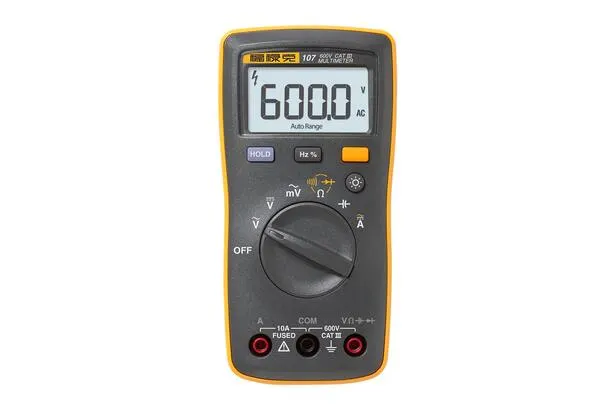
Fluke 107
4.3★★★★☆A palm-sized Fluke with CAT III 600V and a 6,000-count display, but not True RMS.
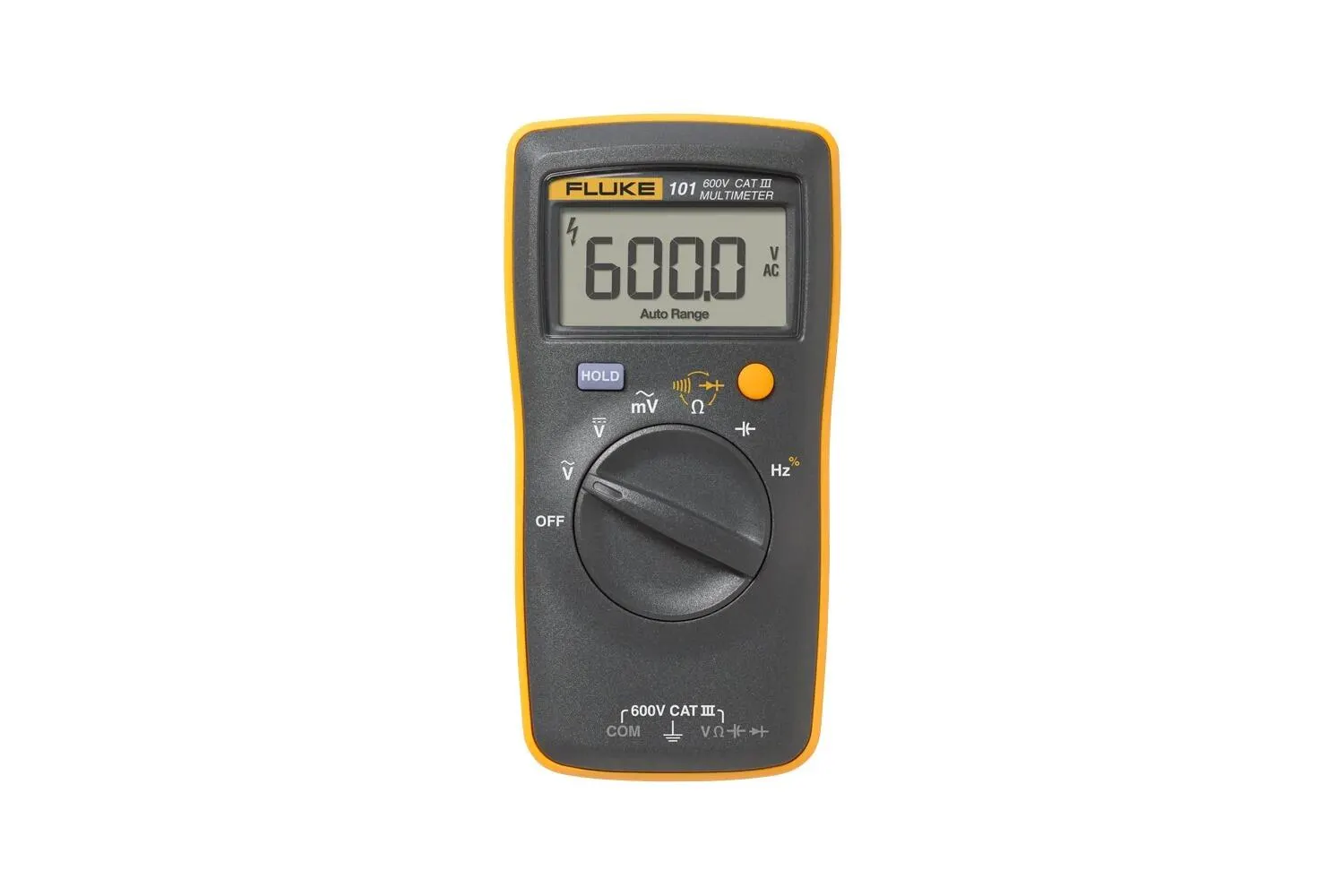
Fluke 101
4.1★★★★☆Fluke's smallest, simplest meter: volts, ohms, capacitance and frequency in 160 g, but no current measurement at all.
Specs side by side
| Fluke 107 | Fluke 101 | |
|---|---|---|
| Rating | 4.3★★★★☆ | 4.1★★★★☆ |
| Accuracy | Average-responding (not True RMS) | Not stated as True RMS by Fluke |
| Safety rating | CAT III 600V | CAT III 600V |
| Auto-ranging | Yes (per display) | Yes |
| Best for | A compact second meter, home and auto checks | Voltage and continuity checks only |
| Current | 4A and 10A ranges, AC/DC, ±(1.5% + 3) | None |
| Backlight | Yes | Not listed by Fluke |
| Data hold | Yes | No (per Fluke's India page) |
| DC volts accuracy | ±(0.5% + 3) | ±(0.5% + 3) |
| Frequency / duty cycle | 10 Hz to 100 kHz; 1–99% | 10 Hz to 100 kHz; 1–99% (another Fluke page says 0.1–99.9%) |
| Diode test | Yes, 2.000 V | Yes |
| Capacitance | 50 nF to 1,000 µF ranges | Fluke's sources conflict: 100 µF or 1,000 µF |
| Max voltage | 600V AC/DC | 600V AC/DC |
| Size | 142 × 69 × 28 mm | 130 × 65 × 27 mm |
| Weight | 200 g | 160 g |
| In the box | TL75 leads, SmartStrap magnetic lanyard, 2 × AAA | Not stated |
| Fluke US product page | Yes | No (regional pages only) |
| Drop rating | 1 m | 1 m |
| Battery | 2 × AAA, 200 hours minimum | 2 × AAA, 200 hours minimum |
| Warranty | 2 years | 1 year |
Specs checked against manufacturer documentation and official Amazon listings. Desk research, not bench testing. How we research.
Key differences
- →The 107 measures AC and DC current up to 10A; the 101 has no current jack at all.
- →Fluke lists a backlight and data hold for the 107; its India page lists hold as absent on the 101 and no document mentions a backlight.
- →The 101 weighs 160 g to the 107's 200 g and is 12 mm shorter.
- →Voltage, resistance, frequency, duty cycle and diode functions match, with the same published voltage and resistance accuracy.
- →The 107 is on Fluke's US site with a two-year warranty; the 101 is sold in Asia, reaches the US through import listings and carries one year.
What each meter covers
Both
600V AC/DC, resistance, continuity, capacitance, frequency, duty cycle, diode test, CAT III 600V.
107 only
AC/DC current to 10A, a backlit display and data hold.
101 only
A smaller 130 × 65 × 27 mm body at 160 g.
This is desk research: OhmSavvy hasn't bought either meter, so every figure below comes from Fluke's product pages. Where Fluke's documents disagree about the 101, the table says so rather than picking a side.
Fluke 107 vs 101 spec by spec
Lay the two spec sheets side by side and most lines are copies. The measuring core is shared; the 107 simply adds a fused current input and a few conveniences on top of it.
| Spec | Fluke 107 | Fluke 101 | Same? |
|---|---|---|---|
| Display | 6,000 counts, 3 updates/s | 6,000 counts | Same |
| DC volts | 6.000 to 600.0 V, ±(0.5% + 3) | 6.000 to 600.0 V, ±(0.5% + 3) | Same |
| AC volts, 40–500 Hz | ±(1.0% + 3) | ±(1.0% + 3) | Same |
| AC millivolts | 600.0 mV, ±(3.0% + 3) | 600.0 mV, ±(3.0% + 3) | Same |
| Resistance | 400.0 Ω to 40.00 MΩ | 400.0 Ω to 40.00 MΩ | Same |
| Frequency | 10 Hz to 100 kHz, ±(0.1% + 3) | 10 Hz to 100 kHz | Same range |
| Current | 4.000 A and 10.00 A, AC/DC | None | 107 only |
| Backlight | Yes | Not listed | 107 only |
| Data hold | Yes | No | 107 only |
| Drop rating | 1 m | 1 m | Same |
| Safety rating | CAT III 600V | CAT III 600V | Same |
| Warranty | 2 years | 1 year | Differs |
Range by range: resolution and accuracy for every function
The summary table above hides how each function is split into ranges, and the range decides the last digit you see. Below is every range Fluke publishes for both meters, with the resolution (one count) and the tolerance. Where the 101's page gives ranges but no accuracy, the cell says so instead of borrowing the 107's figure.
| Function and range | Resolution | Fluke 107 accuracy | Fluke 101 accuracy |
|---|---|---|---|
| DC V: 6.000 / 60.00 / 600.0 V | 1 mV / 10 mV / 0.1 V | ±(0.5% + 3) | ±(0.5% + 3) |
| AC V, 40–500 Hz: 6.000 / 60.00 / 600.0 V | 1 mV / 10 mV / 0.1 V | ±(1.0% + 3) | ±(1.0% + 3) |
| AC mV: 600.0 mV | 0.1 mV | ±(3.0% + 3) | ±(3.0% + 3) |
| Ohms: 400.0 Ω | 0.1 Ω | ±(0.5% + 3) | ±(0.5% + 3) |
| Ohms: 4.000 kΩ to 4.000 MΩ (four ranges) | 1 Ω to 1 kΩ | ±(0.5% + 2) | ±(0.5% + 2) |
| Ohms: 40.00 MΩ | 10 kΩ | ±(1.5% + 3) | ±(1.5% + 3) |
| Capacitance: 50.00 nF / 500.0 nF | 0.01 nF / 0.1 nF | ±(2% + 5) | Ranges listed, accuracy not stated |
| Capacitance: 5.000 µF to 1000 µF (four ranges) | 0.001 µF to 1 µF | ±(5% + 5) | Ranges listed, accuracy not stated |
| Frequency: 50.00 Hz to 100.0 kHz (five ranges) | 0.01 Hz to 0.1 kHz | ±(0.1% + 3) | Ranges listed, accuracy not stated |
| Duty cycle | 0.1% | 1–99%, 1% typical | 0.1–99.9% (India page) |
| DC and AC amps: 4.000 / 10.00 A | 1 mA / 10 mA | ±(1.5% + 3); AC 40–200 Hz | No current function |
| Diode: 2.000 V | 1 mV | 10%; under 0.6 mA test current | Diode test listed, no figures |
Turning those percentages into real numbers shows how close the pair sits. A car battery reading 12.60 V lands on the 60.00 V range, so either meter is allowed 0.5% × 12.60 + 3 × 0.01 = ±0.093 V: anything from 12.51 to 12.69 V is in spec. A 4.7 kΩ resistor autoranges to 40.00 kΩ, giving 0.5% × 4.70 + 2 × 0.01 = ±0.044 kΩ, about ±44 Ω. On the 107, a 100 µF electrolytic reads on the 500.0 µF range to ±(5 + 0.5) = ±5.5 µF, and a 1 kHz signal on the 5.000 kHz range to ±4 Hz. The 101 would show the same digits for those last two, but Fluke's page doesn't commit to how close they are.
One footnote applies to both: the published tolerances hold from 18 to 28 °C. Outside that band Fluke adds 0.1 times the spec for every degree. In a 38 °C summer car, 10 degrees over, that is a full extra helping, so the 12.60 V reading's window doubles to ±0.19 V. Both meters are rated to operate from 0 to 40 °C, so a glovebox in a parked car in July can sit outside the working range altogether.
How the 107 reads current, and why the 101 can't
Voltage is measured across a component, with the meter in parallel. Current has to be measured through it: you open the circuit and let the current flow into the meter's A jack, across an internal shunt and out through COM. The 107 has that third jack, protected by an 11 A, 1000 V fast fuse. The 101 has only COM and V/Ω, so there is nowhere for current to go.
The 107's lowest range is 4.000 A with 1 mA steps, so small currents read coarsely. Take a 25 mA microcontroller board: the reading is 0.025 A with a tolerance of 1.5% × 0.025 + 3 × 0.001 = ±0.0034 A, about ±14% of the reading. That is enough to spot a board drawing ten times what it should, not to tune sleep current. For that, see how to measure milliamps with a meter that has a mA range.
Is current worth 40 grams?
A current job, worked on both meters
Picture a 12 V cooler box or a bilge pump that seems to flatten its battery faster than it should. On the 107 you break the positive lead, put the meter in series on the A jack and read the draw directly. Suppose it shows 3.20 A (an illustrative figure, not a test result): that sits on the 4.000 A range, so the window is 1.5% × 3.20 + 3 × 0.001 = ±0.051 A. If the load climbs past 4 A, the 107 moves to its 10.00 A range, where a 6.50 A reading carries ±0.13 A because each count is now 10 mA. AC current is specified from 40 to 200 Hz, which covers 50 and 60 Hz household loads but not 400 Hz aircraft or generator test supplies.
The 101 can still get you an answer, just indirectly. Wire a low-value resistor of known value in series as a shunt, read the DC voltage across it, and divide: I = V / R. With a 0.10 Ω shunt and 2 A flowing you would see 0.200 V, which the 101 resolves to 1 mV on its 6.000 V range, a meter tolerance of about ±0.004 V or ±2% before the resistor's own tolerance is added. The shunt dissipates I² × R = 0.4 W at that current, so it needs a 1 W part, and the method only works for DC. Our guide to testing a shunt resistor covers the setup. If you would do this more than once, the 107's A jack is the simpler tool; for mains appliances, a clamp avoids breaking the circuit at all, as explained in measuring current without breaking the circuit.
| Load current (illustrative) | Fluke 107 range | Tolerance | Fluke 101 |
|---|---|---|---|
| 25 mA (dev board) | 4.000 A | ±3.4 mA, about ±14% | Shunt method only |
| 3.20 A (12 V cooler) | 4.000 A | ±0.051 A, about ±1.6% | Shunt method only |
| 6.50 A (inverter load) | 10.00 A | ±0.13 A, about ±2.0% | Shunt method only |
Size and pocketability
Both are true pocket meters, but the numbers favor the 101. Multiply Fluke's dimensions and the 107 occupies about 274 cm³ (142 × 69 × 28 mm) against the 101's 228 cm³ (130 × 65 × 27 mm), so the 101 takes up roughly 17% less space and weighs 20% less. The thickness is almost the same, 27 vs 28 mm; the saving is in length and width, which is what decides whether a meter disappears into a shirt pocket or pokes out of it.
The 107 claws back some convenience in the box: Fluke ships it with TL75 test leads and a SmartStrap magnetic lanyard, so it can hang off a steel panel door while you work. Fluke's 101 page lists no box contents. Both are IP40, rated to 2,000 m and drop-tested from 1 m, and the 101 page adds a MIL-PRF-28800F Class 2 vibration rating. Neither ships with a calibration certificate; Fluke's 107 FAQ says so outright.
Buying in the US: availability and import notes
The two meters are aimed at different markets. When we checked on 2026-10-27, Fluke's US address for the 101 opened the general digital-multimeter category page with no 101 on it, while the 107 has a full US product page with specs, documents and a two-year warranty. The 101's specs live on Fluke's regional pages, such as India, which list a one-year warranty.
In practice a US buyer gets a 101 through an import or third-party listing. Before ordering one, check that the listing names the exact model, ask where warranty claims are handled, and remember that a one-year term on an imported unit may mean shipping it abroad. None of that is a problem with the meter; it simply makes the 107 the lower-friction purchase in the US, on top of its extra functions.
Fluke 107 vs 101: which should you buy?
| You are… | Better fit | Why |
|---|---|---|
| Arduino or Raspberry Pi hobbyist | Fluke 107 | Reads supply current as well as voltage and PWM |
| Tracking a car's parasitic drain | Fluke 107 | Current in series; the 101 can't |
| Working in dim cabinets or footwells | Fluke 107 | Backlit display and data hold |
| Wants the smallest, lightest Fluke | Fluke 101 | 160 g and 130 mm long |
| Only checks voltages, diodes and signals | Fluke 101 | Same accuracy on those functions |
| Buying in the US with warranty in mind | Fluke 107 | Sold by Fluke US, 2-year warranty |
| Needs True RMS for drives or LED drivers | Neither | Look at the Fluke 115 or 117 |
Use cases in practice
Both meters read a PWM fan or servo signal's frequency and duty cycle, both test LEDs and rectifier diodes at 2 V, and both check resistors up to 40 MΩ. On a bench where the power supply already shows current, the 101 gives up very little.
Away from the bench the 107 pulls ahead. Data hold lets you take a reading under a dashboard and look at it afterward, the backlight helps in a dim panel, and the amps jack answers the commonest car question of all: what is draining the battery overnight. Neither meter is True RMS, so on distorted AC waveforms readings can drift; our budget True RMS multimeters list covers that need.
Safety: never leave the leads in the A jack
Choose the Fluke 107 if…
- ✓You want one small meter that also reads current up to 10A
- ✓You work under dashboards, in cabinets or other dim spaces and want a backlight
- ✓You want a model Fluke lists on its US site, with a two-year warranty
Choose the Fluke 101 if…
- ✓You never measure current and want the lightest Fluke
- ✓You want the smallest body: 130 × 65 × 27 mm
- ✓You mainly read voltages, PWM signals and diodes on hobby projects
The bottom line
The Fluke 107 is the better all-rounder: it matches the 101 on voltage, resistance and signal functions, then adds 10A current, a listed backlight, data hold and a two-year US warranty. The Fluke 101 is worth choosing only if you never measure current and want the lightest Fluke you can carry.
Frequently asked questions
Do the Fluke 107 and 101 both test diodes?+
Yes. Both have a diode test and continuity buzzer, plus frequency to 100 kHz and duty cycle. Fluke specifies the 107's diode function at 2.000 V with about 2 V open-circuit, enough to check rectifier and signal diodes in both directions and to read the forward voltage of many LEDs.
Does the Fluke 101 have a backlight?+
None of Fluke's 101 documents we checked mention a backlight, and its product photo shows no backlight button. Fluke does describe a backlit display on the 107. If you often read a meter in a panel, footwell or under a sink, that difference matters more than the 40 g weight gap.
How heavy are the Fluke 107 and 101?+
Fluke lists the 107 at 200 g and 142 × 69 × 28 mm, and the 101 at 160 g and 130 × 65 × 27 mm. Both fit a shirt pocket or glovebox; the 101 is the smallest meter Fluke makes. Each runs on two AAA cells, which keeps the weight down compared with a 9V or AA meter.
Are the Fluke 107 and 101 True RMS?+
No. Fluke's 107 page states plainly that it is not a true-RMS meter, and Fluke makes no True RMS claim for the 101. Both are accurate on clean sine waves, but on variable-speed drives, LED drivers or switch-mode supplies their AC readings can be off, so choose a True RMS meter for that work.
Which is better for Arduino and hobby electronics?+
The 107, because it can read a project's supply current through its 4 A range with 1 mA steps. That's coarse for sleep-mode currents, which need a meter with mA or µA ranges. If you only probe voltages, PWM signals and diodes, the 101 covers those with identical accuracy in a smaller body.
Can you buy the Fluke 101 in the United States?+
Not from Fluke's US site: when we checked in October 2026, its US address for the 101 opened the general multimeter category with no 101 listed. The meter is documented on Fluke's regional pages, such as India, with a one-year warranty, and US buyers usually find it through import listings. Confirm the exact model and where warranty claims go before ordering.
Does heat affect the accuracy of the Fluke 101 and 107?+
Yes, in the same way on both. Fluke's tolerances apply from 18 to 28 °C; outside that band you add 0.1 times the stated accuracy for every degree. At 38 °C the allowance on DC volts effectively doubles. Both meters are rated to operate from 0 to 40 °C, so don't leave either baking in a parked car before use.
Related



