Disclosure: OhmSavvy earns a commission from qualifying Amazon purchases made through the links below, at no extra cost to you. How we're funded.
At a glance
Our top picks
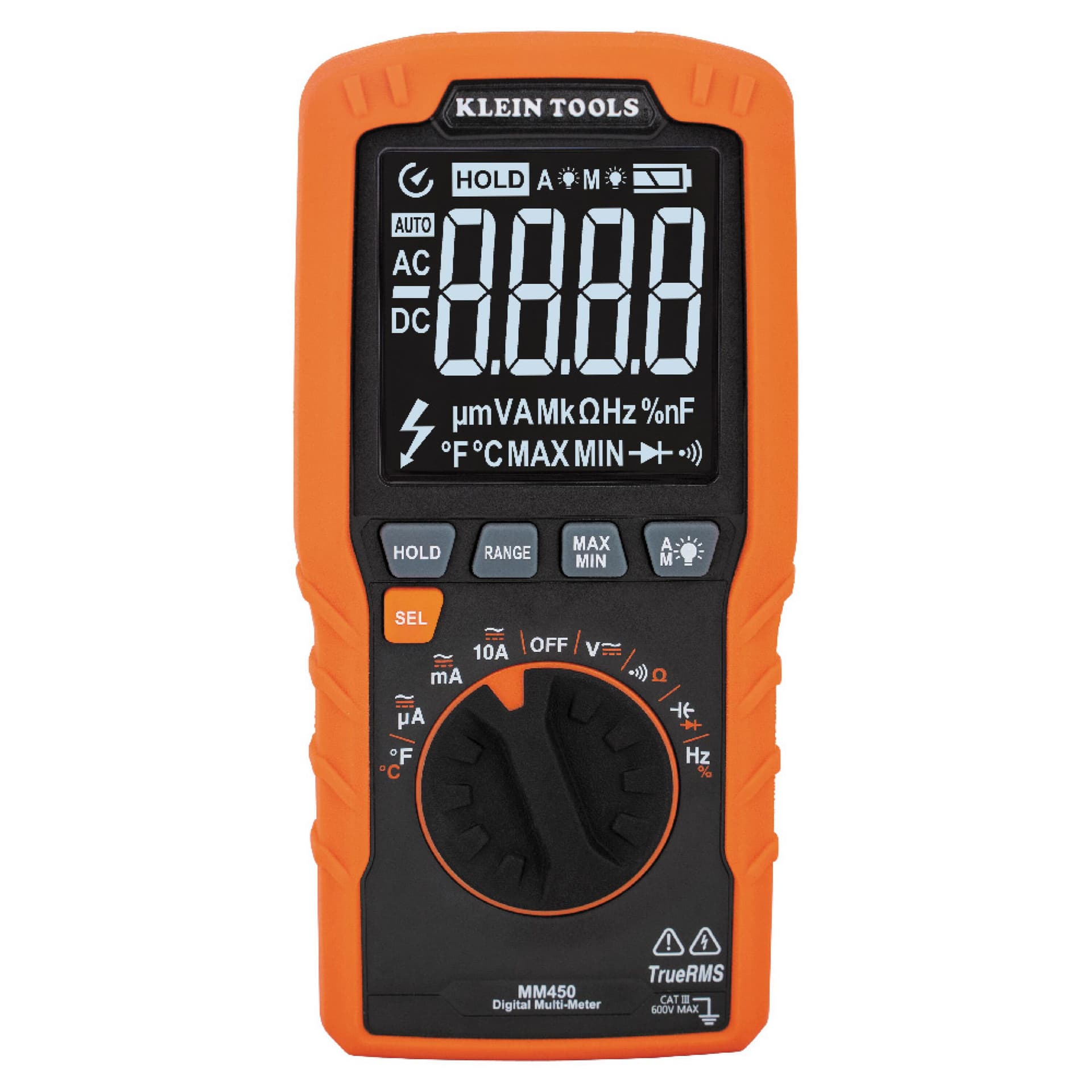
Klein Tools MM450
A slim, current Klein True RMS meter with a reverse-contrast display and wide temperature range, rated CAT III 600V.
Check price on Amazon →Why we picked it ↓
Fluke 88V
Fluke's top automotive meter: CAT IV 600V, 0.1% DC accuracy, 250 µs peak capture and a lifetime warranty.
Check price on Amazon →Why we picked it ↓
Fluke 87V
The step-up pick for anyone who needs CAT IV protection and high-resolution readings daily.
Check price on Amazon →Why we picked it ↓Also great
- 4
 KAIWEETS HT118ACheck pricePrice →Best Low-Cost True RMS4.4★★★★☆
- 5
 Power Probe DM600MAXCheck pricePrice →Most Rugged4.5★★★★★
- 6
 Klein Tools MM420Check pricePrice →Best Budget Klein True RMS4.5★★★★★
- 7
 BTMETER BT-770KCheck pricePrice →Best Budget Engine Analyzer4.2★★★★☆
- 8
 Innova 3340Check pricePrice →Best Value Automotive4.5★★★★★
- 9
 Innova 3320Check pricePrice →Best Budget Battery Checker4.2★★★★☆
- 10
 AstroAI AM33DCheck pricePrice →Cheapest Glovebox Meter3.8★★★★☆
Quick shopping
Compare at a glance
Swipe sideways on mobile to see every spec.
| Model | Award | Rating | Accuracy | Safety rating | Auto-ranging | |
|---|---|---|---|---|---|---|
| #1Klein Tools MM450 | Best Slim True RMS | 4.5★★★★★ | True RMS | CAT III 600V | Yes | Check price → |
 #2Fluke 88V | Best Professional Automotive | 4.7★★★★★ | Average-responding, ±(0.1% + 1) DC | CAT III 1000V / CAT IV 600V | Yes (manual override) | Check price → |
| #3Fluke 87V✓ Tested | Best for Professionals | 4.8★★★★★ | True RMS | CAT III 1000V / CAT IV 600V | Yes | Check price → |
| #4KAIWEETS HT118A | Best Low-Cost True RMS | 4.4★★★★☆ | True RMS, 6,000-count | CAT III 1000V / CAT IV 600V | Yes | Check price → |
| #5Power Probe DM600MAX | Most Rugged | 4.5★★★★★ | True RMS, ±(0.03% + 1) DC | CAT III 1000V / CAT IV 600V | Yes | Check price → |
| #6Klein Tools MM420 | Best Budget Klein True RMS | 4.5★★★★★ | True RMS, 4,000-count | CAT III 600V | Yes (manual RANGE button) | Check price → |
| #7BTMETER BT-770K | Best Budget Engine Analyzer | 4.2★★★★☆ | True RMS | CAT III 1000V (marked on meter) | Yes (manual override) | Check price → |
| #8Innova 3340 | Best Value Automotive | 4.5★★★★★ | True RMS not stated | CAT II 600V (marked on meter) | Yes | Check price → |
| #9Innova 3320 | Best Budget Battery Checker | 4.2★★★★☆ | True RMS not stated | CAT I (marked on meter) | Yes | Check price → |
| #10AstroAI AM33D | Cheapest Glovebox Meter | 3.8★★★★☆ | Average-responding (not True RMS) | CAT II 600V / CAT III 300V | No (manual) | Check price → |
In depth
Detailed reviews
Klein Tools MM450
A slim, current Klein True RMS meter with a reverse-contrast display and wide temperature range, rated CAT III 600V.
Best for:Home electrical, appliance and HVAC work
The MM450 is Klein's current slim True RMS meter: CAT III 600V, auto-ranging, with a reverse-contrast 4,000-count display that adjusts its own backlight, Lead-Alert lights that show where the test leads belong, and temperature from −40°F to 1832°F. At 258 g and 2.8 cm thick it carries easily, and it is drop-rated to 2 m. It lacks a low-impedance mode and NCV, so it suits home electrical and appliance work more than panel troubleshooting.
Why it fits: It takes first place because it packs True RMS AC volts for stator legs, current from a 400.0 µA range to 10 A for small-battery drains and temperature measurement into a 2.8 cm, 262 g body with a 2 m drop rating. Klein lists no Min/Max for it and rates it only CAT III 600V, neither of which matters much on a bike.
- Accuracy
- True RMS
- Safety rating
- CAT III 600V
- Auto-ranging
- Yes
- Best for
- Home electrical, appliance and HVAC work
Reasons to buy
- +Slim 2.8 cm body and 258 g
- +Lead-Alert lights guide test lead placement
- +Temperature from −40°F to 1832°F
Reasons to avoid
- −CAT III 600V only (the CAT IV figure on listings is the leads)
- −No low-impedance mode or NCV
- −4,000-count display
Fluke 88V
Fluke's top automotive meter: CAT IV 600V, 0.1% DC accuracy, 250 µs peak capture and a lifetime warranty.
Best for:Professional and hybrid-vehicle work
The 88V adds the automotive functions to Fluke's 80-series core: millisecond pulse width for injectors, duty cycle to 99.9%, RPM with an inductive pickup and temperature with a probe. Min/Max/Average recording with a 250 µs Peak Min/Max catches cranking dips and intermittent dropouts, and it's rated CAT III 1000V / CAT IV 600V, which matters on hybrid systems. Two things to know: it's average-responding, not True RMS, and Fluke lists the inductive pickup and temperature probe as optional for the bare 88V.
Why it fits: For a workshop it is the strongest meter here: 250 µs Peak Min/Max for charging dropouts, a 600.0 µA range, millisecond pulse width for fuel injection, and RPM for 4-stroke and 2-stroke or waste-spark engines with an inductive pickup. It ranks second because it is heavy and expensive to carry on the bike, and it is average-responding rather than True RMS.
- Accuracy
- Average-responding, ±(0.1% + 1) DC
- Safety rating
- CAT III 1000V / CAT IV 600V
- Auto-ranging
- Yes (manual override)
- Best for
- Professional and hybrid-vehicle work
Reasons to buy
- +250 µs Peak Min/Max catches fast glitches
- +10 A continuous, 20 A for 30 seconds
- +Limited lifetime warranty
Reasons to avoid
- −Not True RMS
- −Expensive, and the RPM pickup and temperature probe are sold separately
Fluke 87V
The step-up pick for anyone who needs CAT IV protection and high-resolution readings daily.
Best for:Industrial technicians, daily professional use
The 87V is Fluke's industrial-grade step up from the 117 — a 1000V CAT III / 600V CAT IV rating, a 6,000-count main display with a 19,999-count high-resolution mode, and a 32-segment analog bar graph for watching signals change in real time.
Why it fits: It carries our Hands-on Tested badge, reads stator output in True RMS, resolves charging voltage in its 19,999-count high-resolution mode and covers drains from a 600.0 µA range. At 355 g without the holster it is portable, but it costs several times more than the meters below and lacks the 88V's engine functions.
- Accuracy
- True RMS
- Safety rating
- CAT III 1000V / CAT IV 600V
- Auto-ranging
- Yes
- Best for
- Industrial technicians, daily professional use
Reasons to buy
- +Joint-highest CAT rating in this list (CAT IV 600V / CAT III 1000V)
- +19,999-count high-resolution mode
- +Analog bar graph tracks fast-changing signals
Reasons to avoid
- −Among the most expensive picks here
- −Overkill for casual home use
KAIWEETS HT118A
True RMS, CAT III 1000V and µA current with NCV and temperature at a low price.
Best for:Budget all-rounder for home, car and hobby
The HT118A is a 6,000-count, auto-ranging True RMS meter with an analog bar. KAIWEETS's manual rates it CAT III 1000V / CAT IV 600V for up to 1000V DC and 750V AC, and current runs from a 600 µA range (0.1 µA) to 10 A. It also measures resistance to 60 MΩ, capacitance, frequency to 10 MHz, duty cycle and temperature, and adds NCV, a Live-wire test, Min/Max, jack lights, a flashlight and a kickstand. KAIWEETS gives a 3-year warranty. Its own product page lists 600V AC/DC, which disagrees with the manual and the meter face.
Why it fits: At a budget price you get True RMS AC volts, a 600 µA to 10 A current span, Min/Max/Average, temperature, a kickstand and a flashlight, which covers every common motorcycle charging and drain test. Amazon lists it at 0.55 kg, bulky for a tail pack, and KAIWEETS's product page and manual disagree on maximum voltage.
- Accuracy
- True RMS, 6,000-count
- Safety rating
- CAT III 1000V / CAT IV 600V
- Auto-ranging
- Yes
- Best for
- Budget all-rounder for home, car and hobby
Reasons to buy
- +µA, mA and 10 A ranges
- +NCV, temperature and Min/Max included
- +3-year warranty
Reasons to avoid
- −Maker's product page and manual disagree on max voltage
- −Bulky compared with slim meters
Power Probe DM600MAX
An IP67, True RMS shop meter with 0.03% DC accuracy, LoZ, Bluetooth logging and temperature to 1,200 °C.
Best for:Pro techs who need a tough meter
The DM600MAX is a high-end general meter that Power Probe sells to automotive techs. It's IP67 and drop-rated to 4 ft, True RMS, with a 4,000-count (40,000 high-resolution) color screen, DC voltage accuracy as good as ±(0.03% + 1), a 400.0 µA range for parasitic-draw work, LoZ for ghost voltages, frequency and duty cycle to 100 kHz, Min/Max/Average, Peak Hold, 40,000-reading memory and Bluetooth to the Power Probe Link app. It has no RPM or dwell, and the 30 A probe is listed as optional in the manual even though the Amazon listing says it's included.
Why it fits: An IP67 seal, a 4 ft drop rating, True RMS, a 400.0 µA range and Bluetooth logging suit a rider who diagnoses at the roadside in the rain or logs a drain during storage. It is one of the priciest meters here, and with no RPM or dwell its feature list is aimed at general shop work.
- Accuracy
- True RMS, ±(0.03% + 1) DC
- Safety rating
- CAT III 1000V / CAT IV 600V
- Auto-ranging
- Yes
- Best for
- Pro techs who need a tough meter
Reasons to buy
- +IP67 and 4 ft drop rating
- +µA range, LoZ and Bluetooth logging
- +Temperature to 1,200 °C with included thermocouple
Reasons to avoid
- −Costs more than most automotive meters
- −No RPM or dwell functions
Klein Tools MM420
Klein's everyday True RMS, auto-ranging meter: µA to 10 A, temperature and capacitance, rated CAT III 600V.
Best for:Home electrical, HVAC and appliance work
The MM420 is a 4,000-count, True RMS, auto-ranging meter rated CAT III 600V. It measures AC/DC current from a 400.0 µA range (0.1 µA resolution) up to 10 A, resistance to 50 MΩ, capacitance to 400 µF, frequency to 50 kHz and temperature from -40 to 1832°F with the included thermocouple. Lead-Alert lights show which jacks to use, it has Min/Max, a backlight and a 2 m drop rating. There's no LoZ mode or NCV, and Klein rates it for indoor use only.
Why it fits: A True RMS, 4,000-count meter with Min/Max, current from 400.0 µA to 10 A, diode test and temperature, weighing 232 g by Klein's page or 250 g by its manual, makes a light garage meter. Klein's manual rates it for indoor use only, which rules it out as a meter you leave on the bike.
- Accuracy
- True RMS, 4,000-count
- Safety rating
- CAT III 600V
- Auto-ranging
- Yes (manual RANGE button)
- Best for
- Home electrical, HVAC and appliance work
Reasons to buy
- +µA, mA and 10 A ranges on AC and DC
- +Temperature, capacitance and frequency included
- +Lead-Alert jack lights help beginners
Reasons to avoid
- −No LoZ mode or non-contact voltage detection
- −CAT III 600V only, not for service-entrance work
BTMETER BT-770K
True RMS plus dwell, pulse width, duty cycle and RPM (with an extra clamp) at a budget price.
Best for:Budget engine diagnostics
The BT-770K packs automotive functions into a 6,000-count True RMS meter: dwell for 4/5/6/8 cylinders, 0.1–10 ms injector pulse width, duty cycle, temperature with the included thermocouple, 20 A current, Min/Max with peak hold and NCV, plus a rear magnet and auto backlight for under-hood work. RPM needs BTMETER's BT-705A inductive clamp, which isn't in the box, and the listing gives two different RPM ranges. It's marked CAT III 1000V. All specs come from the Amazon listing because BTMETER has no product page.
Why it fits: Dwell, 0.1 to 10 ms pulse width and duty cycle help on older ignitions and early fuel injection, and the rear magnet sticks to a steel frame while you work. Its lowest current range is 60 mA, coarse for a motorcycle's milliamp-level drains, RPM needs an extra clamp, and the specs come only from Amazon.
- Accuracy
- True RMS
- Safety rating
- CAT III 1000V (marked on meter)
- Auto-ranging
- Yes (manual override)
- Best for
- Budget engine diagnostics
Reasons to buy
- +Dwell, pulse width and duty cycle
- +20 A current and temperature
- +Magnet and auto backlight for under-hood use
Reasons to avoid
- −RPM clamp sold separately
- −Specs come only from the Amazon listing, which contradicts itself in places
Innova 3340
A proper engine-analyzer meter (RPM, dwell, duty cycle, pulse width, temperature) with the inductive pickup in the box.
Best for:DIY engine diagnostics
The Innova 3340 is built for car work: it reads RPM from 0 to 10,000 with the included inductive clamp (conventional, DIS and coil-on-plug), plus dwell, duty cycle, millisecond pulse width, frequency and temperature with the supplied probe. It's auto-ranging with Min/Max and Hold and a 10 MΩ input that's safe around ECUs. Innova doesn't claim True RMS, the meter face shows only CAT II 600V, and the 15 A input is unfused (15-second tests with a 15-minute rest).
Why it fits: The included inductive RPM pickup, dwell and temperature probe help with carburetor and ignition tuning, and its fused 40 mA range handles drain checks. It ranks low because Innova makes no True RMS claim for stator readings and the 15 A jack is unfused.
- Accuracy
- True RMS not stated
- Safety rating
- CAT II 600V (marked on meter)
- Auto-ranging
- Yes
- Best for
- DIY engine diagnostics
Reasons to buy
- +Inductive RPM pickup and temperature probe included
- +RPM, dwell, duty cycle and pulse width
- +Min/Max and Hold for catching drops
Reasons to avoid
- −Only CAT II 600V: not for household panel work
- −15 A input is unfused and limited to 15-second tests
Innova 3320
A simple auto-ranging meter with green/yellow/red battery-load LEDs that make quick battery checks easy.
Best for:Quick battery and fuse checks
The 3320 keeps things simple: auto-ranging DC/AC volts, resistance, diode and continuity, AC/DC milliamps and a 10 A DC input, plus a battery-load test with color LEDs (Innova calls it a "small battery load test"; the dial has 1.5, 6, 9 and 12 V positions). The 10 MΩ input is ECU-safe. It has no RPM, temperature or Min/Max, it's marked only CAT I, and the 10 A input is unfused (15 seconds on, 15 minutes off).
Why it fits: Its battery-load LEDs include a 6 V position, handy for classic 6 V machines, along with auto-ranging volts, diode test and mA ranges. The LED test is a light load rather than a real load test, and Innova publishes no Min/Max or True RMS.
- Accuracy
- True RMS not stated
- Safety rating
- CAT I (marked on meter)
- Auto-ranging
- Yes
- Best for
- Quick battery and fuse checks
Reasons to buy
- +Color LED battery-load test
- +Auto-ranging and easy for beginners
- +ECU-safe 10 MΩ input
Reasons to avoid
- −CAT I only: keep it off mains wiring
- −No RPM, temperature or Min/Max
AstroAI AM33D
A basic manual-range meter for checking battery voltage, fuses and continuity on the road.
Best for:Glovebox battery and fuse checks
The AM33D is a 2,000-count manual-ranging meter for basic checks: DC and AC voltage to 600 V, DC current from a 2000 µA range up to 10 A, resistance, diode and continuity, with a backlight and data hold. That covers resting battery voltage, charging voltage and blown fuses. It can't measure AC current and has no auto-ranging, Min/Max, temperature or automotive functions. AstroAI rates it CAT II 600V / CAT III 300V.
Why it fits: Cheap and small enough to leave under the seat, it reads DC volts, AC volts on 200 V and 600 V ranges, diode and continuity, and current from a 2000 µA range up to 10 A. Manual ranging, no Min/Max and no True RMS make it an emergency meter rather than a diagnostic one.
- Accuracy
- Average-responding (not True RMS)
- Safety rating
- CAT II 600V / CAT III 300V
- Auto-ranging
- No (manual)
- Best for
- Glovebox battery and fuse checks
Reasons to buy
- +Very low price
- +Backlit display with data hold
- +2000 µA range for small current checks
Reasons to avoid
- −Manual ranging with no Min/Max to catch cranking dips
- −No AC current or automotive functions
Before you buy
Buying advice
Start with the charging system triangle
Most motorcycle electrical complaints come back to the battery, the stator or the regulator/rectifier. Every meter here reads resting battery voltage, charging voltage at the battery with the engine at a fast idle and AC output from the stator legs, and most add a diode test for the rectifier. Buy for the extras only once you know you will use them: fine current ranges for drains, Min/Max for intermittent faults, or engine functions for older bikes.
Small batteries make current resolution matter
A car battery can absorb a 30 mA draw for weeks; a small motorcycle battery may not. That makes a µA or low mA range more valuable here than on a car. The Klein MM450 and MM420 and the DM600MAX start at 400.0 µA, the Flukes and HT118A at 600 µA. Meters whose lowest range is 40 or 60 mA can confirm a large drain but struggle to measure the small one that kills a battery over winter.
Think about where the meter will live
A meter that lives in the garage can be any size. One that rides with you needs to be slim, tough and cheap enough to lose. The MM450 is the best balance of size and ability here, the DM600MAX is the one to choose if it must survive rain, and the AM33D is the budget under-seat option. Keep spare fuses for the meter itself in the same bag.
Pair the meter with a wiring diagram
Motorcycle harnesses pack connectors into tight spaces under tanks and fairings, and color codes vary between makers. A continuity beeper and a wiring diagram find most chafed wires and corroded plugs. For faults that come and go with vibration, a Min/Max reading taken while you wiggle the harness is more telling than a single reading.
Methodology
How we chose
We ranked these ten for motorcycle charging, starting and wiring faults: AC volts for stator legs, diode and continuity tests, current ranges fine enough for small-battery drains, then size, toughness and Min/Max for intermittent faults. Specifications come from maker pages, manuals or official Amazon listings; the ranking is desk research, and only the Fluke 87V carries our Hands-on Tested badge.
Picks marked "Hands-on Tested" have been bought and tested by us; the rest are desk research. A pick only carries that badge once we have actually bought and tested that unit. More on how we research.
Questions
Frequently asked questions
How do I test a motorcycle stator with a multimeter?+
With the engine off, measure resistance between each pair of stator output wires and check that none has continuity to the engine case. Then start the engine, set the meter to AC volts and measure between each pair of wires at idle and at a few thousand rpm. The readings should be close to each other and rise with engine speed; one low pair points to a damaged winding.
What charging voltage should a motorcycle battery show?+
A rested, fully charged 12 V battery reads about 12.6 V or a little higher. With the engine running above idle, a working regulator usually holds the battery somewhere around 13.5 to 14.5 V; check your service manual for the exact figure. Voltage that stays near resting level points to the stator or regulator, and voltage well above the range suggests a failed regulator.
Do I need a True RMS multimeter for a motorcycle?+
It is useful but not essential. Stator output is AC whose shape and frequency change with engine speed, and True RMS meters read non-sinusoidal waveforms more faithfully. For the usual comparison of three stator legs against each other, any meter gives a fair answer because you are looking for one leg that differs. For battery, charging and draw checks, which are DC, it makes no difference.
How much parasitic draw is too much for a motorcycle?+
It depends on battery size. Many motorcycle batteries hold only a fraction of a car battery's amp-hours, so a draw of a few milliamps from an alarm, clock or tracker can flatten one over a few weeks of storage. Measure in series with the negative cable after the bike has settled, then compare the reading against the battery's capacity to estimate how many days it will last.
Can a multimeter test a regulator/rectifier?+
Partly. The diode test checks the rectifier diodes between the stator inputs and the output terminals, and a running test shows whether battery voltage is held in the correct band. Many modern regulators use components that do not read like simple diodes, so follow the manufacturer's test table where one exists. A meter cannot test regulation under load as completely as a running-bike check.
What size multimeter fits on a motorcycle?+
A slim meter like the Klein MM450, 2.8 cm thick and 262 g with batteries, or the lighter Klein MM420, slips into a tank bag or tail pack. For under-seat storage on a small bike, a basic 2,000-count meter such as the AstroAI AM33D gives you voltage, continuity and DC current for checking a flat battery or a blown fuse on the roadside.


