COMPARISON · MULTIMETERS
Fluke 17B+ vs Fluke 101
Fluke 17B+ vs Fluke 101 is less a contest than a question of scope. The 101 has only two input jacks and cannot measure current at all, so it is a voltage, resistance and frequency checker; the 17B+ is a full meter that adds current from microamps to 10A, temperature and MIN MAX. Fluke calls neither True RMS.
By the OhmSavvy Research Team ·
Disclosure: OhmSavvy earns a commission from qualifying Amazon purchases made through these links, at no extra cost to you. How we're funded.
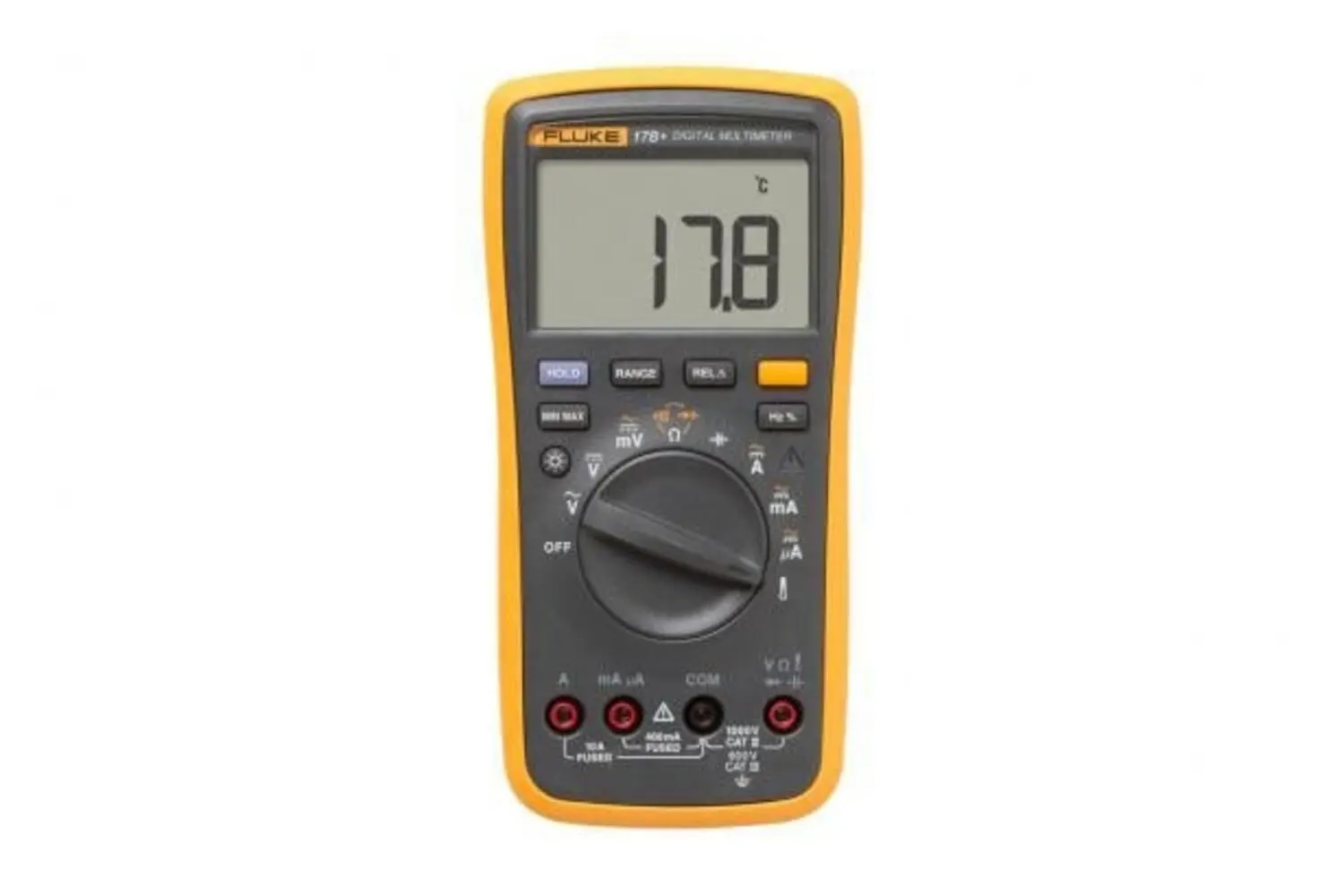
Fluke 17B+
4.5★★★★★A full-size Fluke with temperature, frequency, MIN MAX and relative mode, but not True RMS.
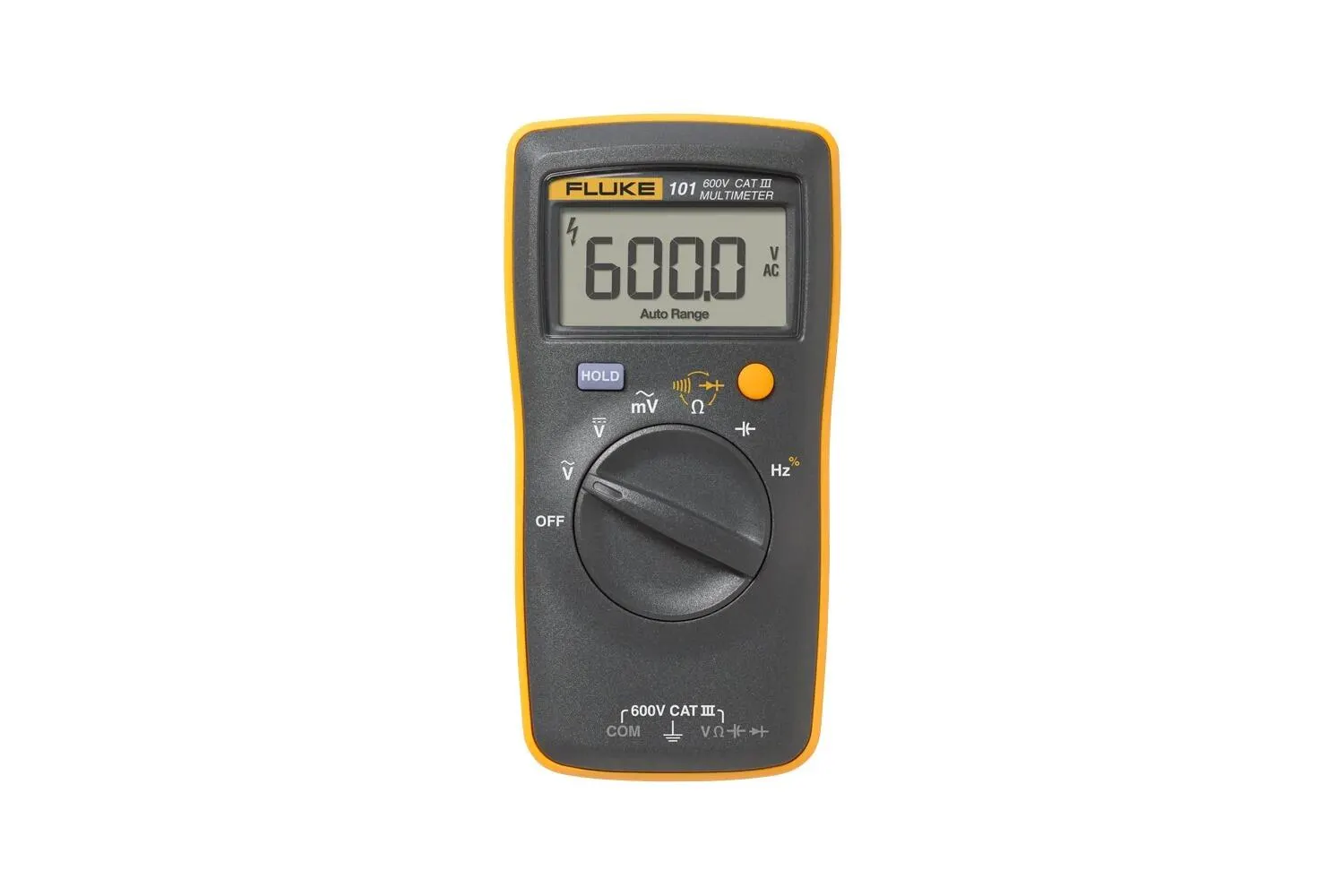
Fluke 101
4.1★★★★☆Fluke's smallest, simplest meter: volts, ohms, capacitance and frequency in 160 g, but no current measurement at all.
Specs side by side
| Fluke 17B+ | Fluke 101 | |
|---|---|---|
| Rating | 4.5★★★★★ | 4.1★★★★☆ |
| Accuracy | Not stated as True RMS by Fluke | Not stated as True RMS by Fluke |
| Safety rating | CAT III 600V / CAT II 1000V | CAT III 600V |
| Auto-ranging | Yes (manual override) | Yes |
| Best for | Electronics hobbyists, students, appliance repair | Voltage and continuity checks only |
| Input jacks | Current inputs fused at 440 mA and 11 A | Two: COM and one shared input |
| Current | 400 µA to 10A AC/DC | None |
| Display | 4,000 counts | 6,000 counts |
| Volts ranges | 4.000 V to 1000 V | 6.000 V to 600.0 V |
| DC volts accuracy | ±(0.5% + 3) | ±(0.5% + 3) |
| Capacitance | Up to 1,000 µF | Fluke sources conflict: 100 µF or 1,000 µF |
| Frequency / duty cycle | To 100 kHz / 1–99% | To 100 kHz / 0.1–99.9% per Fluke's 101 page |
| Temperature | −55 °C to 400 °C, probe included | No |
| Battery | 2 × AA, 500 h minimum | 2 × AAA, life not stated |
| Size / weight | 183 × 91 × 49.5 mm, 455 g | 130 × 65 × 27 mm, 160 g |
| Drop rating | Not stated | 1 m, tested at −10 °C |
| Warranty | 1 year (users manual) | 1 year |
| US availability | Sold on fluke.com US | Not on fluke.com US; Amazon listing is a third-party import |
Specs checked against manufacturer documentation and official Amazon listings. Desk research, not bench testing. How we research.
Key differences
- →The 101 can't measure current: it has only two jacks, so any job involving amps needs the 17B+.
- →The 17B+ adds temperature, MIN MAX, relative mode and a 30V hazardous-voltage LED.
- →Both read frequency to 100 kHz and duty cycle; the 101 does it in a body roughly a third of the 17B+'s weight.
- →The 101 has a 6,000-count display against the 17B+'s 4,000 counts, and the same ±(0.5% + 3) DC volts accuracy.
- →Both carry a one-year warranty, but the 17B+ is sold by Fluke US while the 101 reaches the US as an import.
What the 101 leaves out
Fluke built the 101 as a minimal tester. Its two-jack layout is the giveaway: there is nowhere to plug a lead for current. These are the 17B+ functions it doesn't have.
Current
No amps, milliamps or microamps on the 101.
Temperature
The 17B+ includes a Type K probe.
MIN MAX
The 17B+ records highs and lows.
Relative
The 17B+ can zero a reference reading.
1000V range
The 101 stops at 600V.
Warning LED
The 17B+ lights at 30V or more.
Fluke 17B+ vs 101 spec by spec
For the functions both meters have, Fluke publishes the same accuracy: ±(0.5% + 3) on DC volts and the same three resistance bands, from ±(0.5% + 3) on the 400 Ω range to ±(1.5% + 3) on 40 MΩ. The 101's 6,000-count display moves its range breaks to 6 V and 60 V, so on a 5 V rail it shows one more digit.
| Spec | Fluke 17B+ | Fluke 101 | Same? |
|---|---|---|---|
| DC volts ranges | 4.000, 40.00, 400.0, 1000 V | 6.000, 60.00, 600.0 V | Differ |
| DC volts accuracy | ±(0.5% + 3) | ±(0.5% + 3) | Same |
| Resistance | 400.0 Ω to 40.00 MΩ | 400.0 Ω to 40.00 MΩ | Same |
| Frequency | 10 Hz to 100 kHz | 10 Hz to 100 kHz | Same |
| Current | 400.0 µA to 10.00 A | None | 17B+ only |
| Temperature | −55 °C to 400 °C | None | 17B+ only |
| Safety rating | CAT III 600V | CAT III 600V | Same |
| Weight | 455 g | 160 g | Differ |
The sums: 0.5% of 5 V is 0.025 V. Three counts on a 40.00 V range is 0.03 V, giving ±0.055 V; on a 6.000 V range it is 0.003 V, giving ±0.028 V. At 12.6 V the two meters tie, because both are on a range with a 0.01 V step and land at ±0.093 V.
Why two jacks means no current
A meter reads voltage in parallel with a circuit but has to sit in series to read current: you open the circuit and let the current flow through the meter's fused shunt. The 17B+ has dedicated current jacks fused at 440 mA and 11 A for that. The 101 has only COM and a combined volts and ohms input, so there is no path that could carry load current safely.
That design is also a safety feature: you can't accidentally short an outlet by leaving a lead in an amps jack. If you like that idea but need occasional current, a clamp meter covers it without breaking the circuit; see measuring current without breaking the circuit.
Fluke 17B+ vs 101: which should you buy?
| Job | Better fit | Why |
|---|---|---|
| Outlet and battery voltage | Either | Same DC accuracy; both CAT III 600V |
| Wire and fuse continuity | Either | Both beep on continuity and read ohms to 40 MΩ |
| Parasitic battery drain | 17B+ | Needs a mA range; the 101 has no current input |
| Appliance current draw | 17B+ | 4.000 A and 10.00 A ranges |
| Fan PWM duty cycle | Either | Both read duty cycle and frequency to 100 kHz |
| Pipe or heatsink temperature | 17B+ | Type K probe included |
| A spare meter in the car | 101 | 160 g, 27 mm thick, 1 m drop rating |
The import question
The 17B+ is a current Fluke US product with a one-year warranty. The 101 is sold by Fluke in markets such as India and Malaysia, and the Amazon US listing comes from a third-party importer, with a one-year warranty. Its own Fluke page also contradicts itself on capacitance: the range table runs to 1,000 µF while the general specs say 100 µF. Treat 100 µF as the safe ceiling until Fluke clears it up.
Who the 101 is really for
Safety on household circuits
Choose the Fluke 17B+ if…
- ✓You will ever need to measure current, from microamps to 10A
- ✓You want temperature with the included Type K probe
- ✓You want a meter sold and supported by Fluke US
Choose the Fluke 101 if…
- ✓You only ever check voltage, continuity, resistance and frequency
- ✓You want the smallest, lightest Fluke: 160 g
- ✓You accept a third-party import listing
The bottom line
For almost everyone the 17B+ is the right buy: it does everything the 101 does except fit in the smallest pocket, and adds current, temperature and logging. The 101 only makes sense as a deliberately simple voltage and continuity tester, and its US listing is an import with a one-year warranty.
Frequently asked questions
Can the Fluke 101 measure amps?+
No. The 101 has only a COM jack and one shared input, and Fluke's datasheet lists no current function. To read amps a meter must sit in series through a fused current jack. Use the 17B+, which measures from 400 µA to 10A AC and DC on inputs fused at 440 mA and 11 A.
Is the Fluke 101 sold in the US?+
Not by Fluke US: its product page isn't on fluke.com US, and the model is listed on Fluke's India and Malaysia sites. The Amazon listing is fulfilled by Amazon but sold by a third-party importer, so warranty support may run through the seller. The 17B+ is a regular Fluke US product.
What capacitance can the Fluke 101 measure?+
Fluke's own documents disagree: the datasheet gives a 100 µF maximum, while the users manual and the range table on Fluke's 101 page go to 1,000 µF. Plan around 100 µF to be safe. The 17B+ is consistently listed at 1,000 µF, with ±(5% + 5) accuracy on the microfarad ranges.
Do both meters read frequency and duty cycle?+
Yes. Both read frequency from 10 Hz to 100 kHz. Fluke lists duty cycle from 1% to 99% on the 17B+ and from 0.1% to 99.9% on its 101 page. For checking a PWM fan, a dimmer or a small generator's output, the 101 keeps up with the 17B+.
Do the 17B+ and 101 have the same warranty?+
Yes, on paper: the 15B+/17B+/18B+ users manual gives one year, and the 101's manual, datasheet and Fluke India page also give one year. The difference is support. Because the 101 reaches the US through an importer, check the Amazon seller's return and warranty terms before ordering, since Fluke US doesn't list the model.
Related



