HOW-TO GUIDE
Can You Measure Current Without Breaking the Circuit With a Multimeter?
By the OhmSavvy Research Team ·
Why the amp jack needs the circuit open
A multimeter's current function measures the tiny voltage that develops across an internal shunt resistor while the circuit's current flows through it. For that current to pass through the meter, the meter must replace a section of wire: disconnect a lead, lift a component leg or remove a fuse, then bridge the gap with the probes. There is no way around this with the A or mA input. Placing those probes across a voltage source instead of in series is one of the classic ways to blow a meter's fuse, or worse on high-energy circuits.
Breaking in is fine for a low-voltage project on the bench, and our guides to measuring milliamps and measuring microamps cover it. It is impractical, and often unsafe, on household circuits, motors, car starting circuits and anything carrying tens of amps. That is where the no-break methods earn their place.
The no-break options compared
| Situation | Best method | How to check it works | Limits |
|---|---|---|---|
| AC load current on a wire or appliance | AC clamp around one conductor | Reading rises when the load switches on | Needs a single conductor; low resolution at small currents |
| DC current in a battery, solar or vehicle cable | Hall-effect AC/DC clamp | Zero the DC reading with the jaw empty, then clamp | Drift and offset at low DC currents |
| Plug-in appliance with a two- or three-wire cord | Clamp on a line splitter | Use the splitter's 1x loop, not the whole cord | Splitter rating sets the maximum current |
| Circuit with a known current-sense or shunt resistor | Voltmeter across it, then I = V ÷ R | Confirm the resistor value with power off | Needs a resistor of known value and enough voltage to resolve |
| Sleep or standby current in µA to low mA | Meter in series on a µA/mA range | Compare awake and asleep readings | Must break the circuit; watch burden voltage |
Mains and high-current safety
- Use a meter rated for the measurement category and voltage, with intact jaws and leads.
- Clamp only insulated conductors you can reach without removing covers or guards. Never open a panel or a cord to get at a single wire; opening a panel is a job for a licensed electrician.
- Do not put a multimeter's A jack in series with a mains circuit or a circuit that can exceed the meter's fused current rating.
- On vehicles and battery banks, keep metal jewelry and tools away from terminals; short-circuit currents are enormous even at 12 V.
1Using a clamp meter
A clamp senses the magnetic field that current produces around a conductor. The most common type uses a current transformer in the jaw, which only responds to changing fields and therefore reads AC. Clamps that also read DC use a Hall-effect sensor, which responds to steady fields as well; they usually have a zero or DC-zero button to cancel residual magnetism and the earth's field before you clamp. Close the jaw fully around one conductor, keep it roughly centered, and read the display. The full technique is in how to measure AC current with a clamp meter.
Some multimeters accept a clamp accessory that plugs into the voltage inputs and outputs a signal proportional to current, such as a millivolt per amp. That gives a multimeter owner the no-break ability for the price of the accessory, provided the accessory's ratings and conversion factor are matched to the meter range you read it on.
2Appliance cords and line splitters
An appliance cord carries the current out on one conductor and back on another, so a clamp around the whole cord reads close to zero. A line splitter is a short adapter that plugs into the outlet and gives you a loop around one conductor, often with a second loop that multiplies the reading by ten for small loads. Plug the appliance into it and clamp the marked loop. It is the safe way to watch a refrigerator, space heater or power tool without touching the wiring, and it pairs naturally with an inrush function if your clamp has one.
3The shunt and Ohm's law method
Any resistor carrying the current you want develops a voltage proportional to it. If you know the resistance, a voltage reading across its ends gives the current directly: current equals voltage divided by resistance. Many circuits already include one, such as a current-sense resistor next to a regulator or motor driver, a meter shunt in a battery monitor, or an emitter or source resistor in an amplifier. Measure the resistor with the power off, or read the value printed on it, then power up and measure millivolts across it with the probes on the resistor's own pads.
The catch is resolution. Small shunts produce small voltages, so a meter that resolves 0.1 mV on its lowest DC range gives a much finer current reading than one that only shows whole millivolts. Lead resistance does not matter much here, because the voltmeter draws almost no current, but probe placement does: measure on the resistor itself, not a few centimeters of copper away. Estimating a current from the resistance of a wire or a PCB trace is possible but rough, since their resistance is small, uncertain and changes with temperature. Our guide to testing a shunt resistor shows how to confirm the value before you rely on it.
4Sleep currents and microamps
The no-break methods run out of resolution at the bottom end. A general-purpose clamp is designed for amps, and the microamps of a sleeping microcontroller or the few milliamps of a parasitic drain sit well below its useful range. Shunt measurements struggle too, unless the circuit happens to have a large-value sense resistor. For these jobs, breaking the circuit and putting a meter in series on its µA or mA range is still the most dependable approach, with attention to the meter's burden voltage; see measuring standby current. Note that HVAC clamps with a microamp range, made for flame-sensor checks, take that reading through their test leads in series, not through the jaw.
Pick the method by current size and type
Tools for each method
These clamps are all from our verified roster. Choose AC-only if you work on household and HVAC loads, AC/DC if you also measure batteries, vehicles or solar.
Clamp meters: no-break current
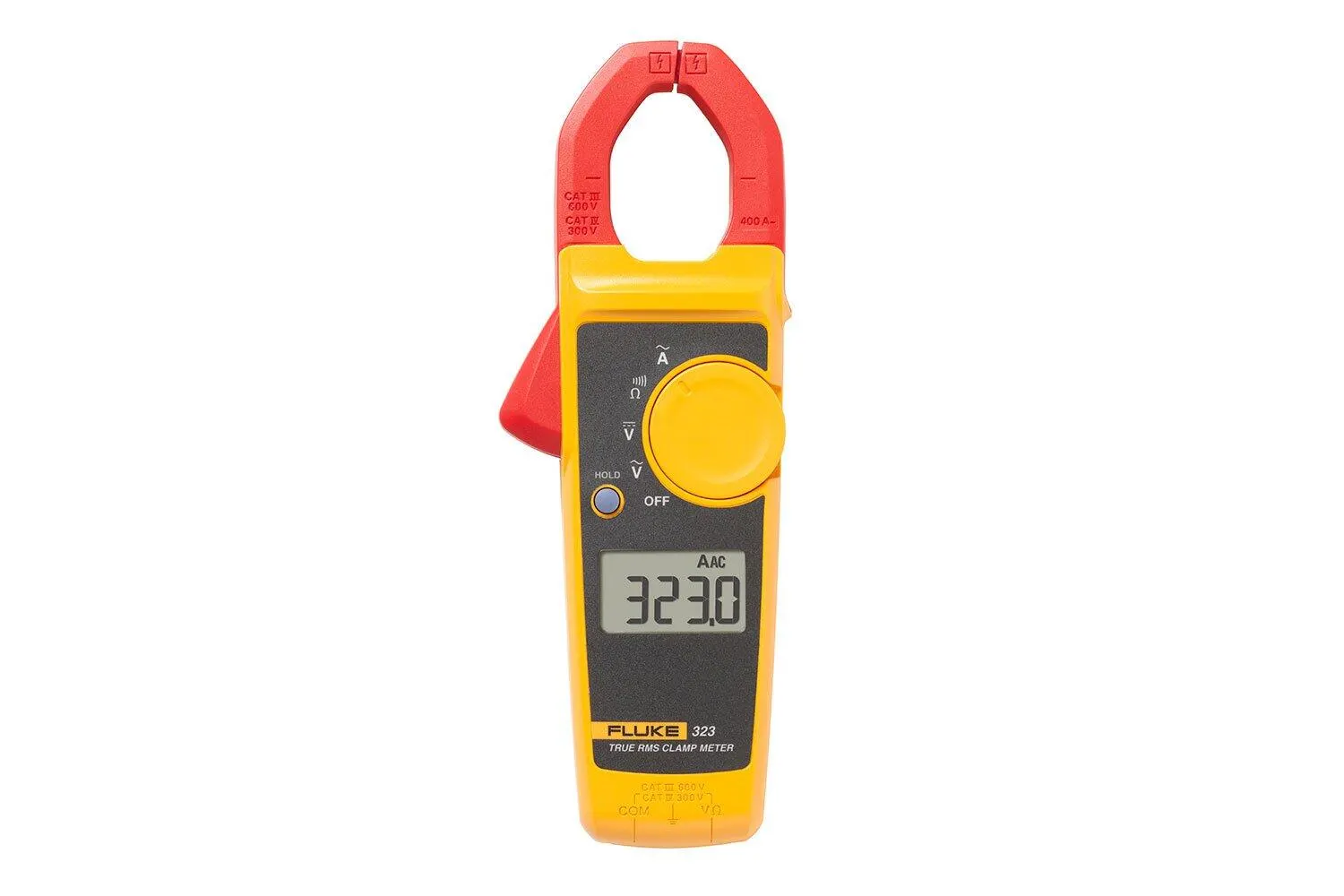
True RMS AC clamp to 400 A, CAT III 600V / CAT IV 300V. AC current only, no DC.

AC clamp to 600 A with inrush mode, plus a 600.0 µA DC range through the test leads. Can't clamp DC current.

True RMS 600 A AC clamp with a 200 µA DC range for flame sensors and Fluke Connect logging. No DC amps listed.

Budget AC and DC clamp to 1000 A with inrush and LoZ, CAT IV 600V / CAT III 1000V.

AC/DC clamp to 999.9 A with a DC zero function, rated CAT III 1500V for PV work.
As an Amazon Associate I earn from qualifying purchases. Prices and availability are shown on Amazon.
Multimeters for the shunt method

Hands-on tested by OhmSavvy. 19,999-count high-resolution mode for small shunt voltages, CAT III 1000V / CAT IV 600V.

22,000 counts and ±(0.05%+5) DC voltage accuracy, plus a 220.00 µA range for series sleep-current checks.
As an Amazon Associate I earn from qualifying purchases. Prices and availability are shown on Amazon.
Frequently asked questions
Can a regular multimeter measure amps without disconnecting anything?
Not through its current jacks. Those measure the current passing through the meter, so the meter has to be inserted into the circuit. Without opening anything you can measure the voltage across a known resistor and calculate the current, or add a clamp accessory that converts current to a voltage or millivolt signal the multimeter can read.
Can a clamp meter measure DC current?
Only if it is designed for it. Many clamps use a current transformer that responds to changing magnetic fields and reads AC only. AC/DC clamps use a Hall-effect sensor that also senses the steady field around a DC conductor. Check the specification for DC amps; for example, the Fluke 323 is AC-only while the KAIWEETS HT208D lists AC and DC.
Why does my clamp meter read zero around an extension cord?
The jaw is around both the outgoing and returning conductors. Their currents are equal and opposite, so the magnetic fields cancel and the meter sees almost nothing. Clamp a single conductor instead. For plug-in appliances, a line splitter separates the conductors safely so you never have to cut or strip the cord.
Can a clamp meter measure the standby current of a battery device?
Generally no. General-purpose clamp jaws are built for amps, and sleep currents of microamps or a few milliamps are far below what they resolve. Measure standby current in series on a meter's µA or mA range, or with a dedicated low-current tool. Some HVAC clamps have a µA range, but it works through the test leads, not the jaw.
How do I calculate current from the voltage across a resistor?
Divide the voltage across the resistor by its resistance. For example, 50 mV across a 0.1 Ω resistor means 0.5 A. Measure the resistor's value with the power off first, measure the voltage directly across its two ends with the circuit running, and remember that small resistances and small voltages make lead placement and meter resolution matter.
Where to go next
How to Measure AC Current With a Clamp Meter →
Jaw technique, the single-conductor rule and catching inrush.
Clamp Meter Buying Guide →
AC-only vs AC/DC, jaw size, resolution and safety ratings.
How to Test a Shunt Resistor With a Multimeter →
Checking the low-value resistor you plan to measure across.
How to Measure Standby Current in an Electronic Device →
When the current is too small for any clamp.


