COMPARISON · MULTIMETERS
Fluke 17B+ vs Fluke 107
Fluke 17B+ vs Fluke 107 is closer than it looks: unlike most pocket meters, the 107 reads frequency, duty cycle, capacitance and diodes, so it covers much of what the 17B+ does. What the bigger meter adds is temperature, microamp and milliamp ranges, MIN MAX, relative mode and a higher voltage ceiling, while the 107 counts to 6,000 in a 200 g case.
By the OhmSavvy Research Team ·
Disclosure: OhmSavvy earns a commission from qualifying Amazon purchases made through these links, at no extra cost to you. How we're funded.
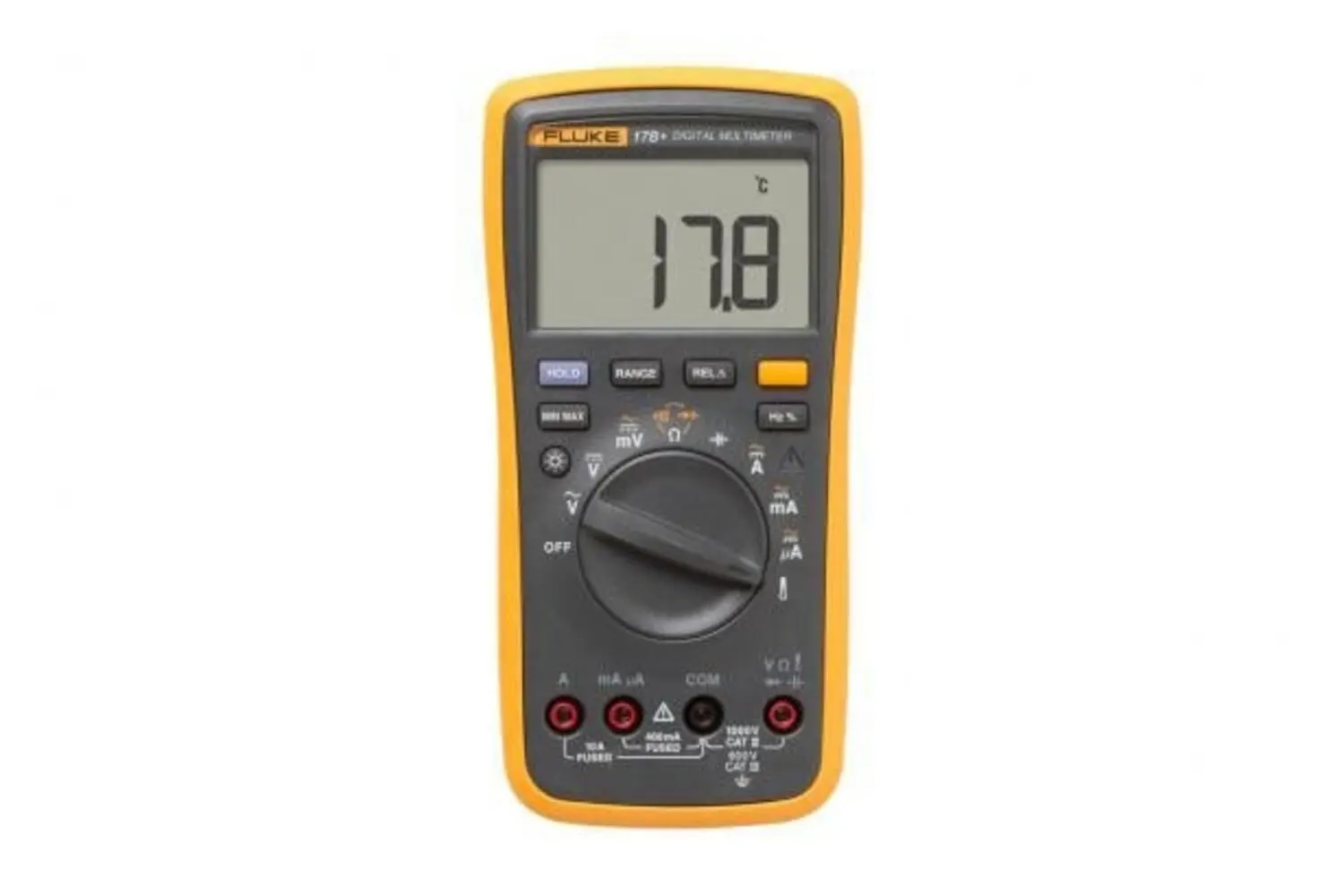
Fluke 17B+
4.5★★★★★A full-size Fluke with temperature, frequency, MIN MAX and relative mode, but not True RMS.
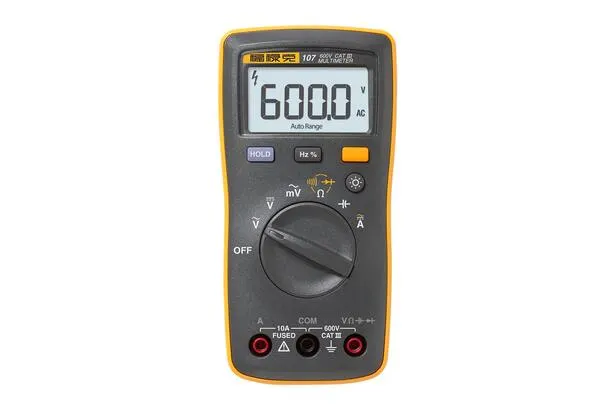
Fluke 107
4.3★★★★☆A palm-sized Fluke with CAT III 600V and a 6,000-count display, but not True RMS.
Specs side by side
| Fluke 17B+ | Fluke 107 | |
|---|---|---|
| Rating | 4.5★★★★★ | 4.3★★★★☆ |
| Accuracy | Not stated as True RMS by Fluke | Average-responding (not True RMS) |
| Safety rating | CAT III 600V / CAT II 1000V | CAT III 600V |
| Auto-ranging | Yes (manual override) | Yes (per display) |
| Best for | Electronics hobbyists, students, appliance repair | A compact second meter, home and auto checks |
| Display | 4,000 counts, backlit | 6,000 counts, backlit |
| Max voltage | 1000V AC/DC | 600V AC/DC |
| Safety rating detail | CAT III 600V; 1000V max to earth | CAT III 600V |
| Current ranges | 400.0 µA to 10.00 A AC/DC | 4.000 A and 10.00 A AC/DC only |
| Millivolts | 400.0 mV AC and DC | 600.0 mV AC |
| Frequency / duty cycle | 10 Hz to 100 kHz / 1–99% | 10 Hz to 100 kHz / 1–99% |
| Temperature | −55 °C to 400 °C, probe included | No |
| MIN MAX / relative | Yes / Yes | Not stated / Not stated |
| Drop rating | Not stated | 1 m |
| Size / weight | 183 × 91 × 49.5 mm, 455 g | 142 × 69 × 28 mm, 200 g |
| Battery | 2 × AA, 500 h minimum | 2 × AAA, 200 h minimum |
Specs checked against manufacturer documentation and official Amazon listings. Desk research, not bench testing. How we research.
Key differences
- →Both measure frequency, duty cycle, capacitance, diodes and continuity with the same frequency accuracy, ±(0.1% + 3), so the 107 loses less than most pocket meters.
- →The 17B+ adds a temperature function with a Type K probe, plus MIN MAX recording and relative mode.
- →The 17B+ has µA and mA current ranges on a 440 mA fused input; the 107's current starts at its 4.000 A range.
- →The 107's display reaches 6,000 counts; the 17B+ stops at 4,000.
- →The 17B+ reads up to 1000V; the 107 is limited to 600V. Both are rated CAT III 600V.
- →The 107 is 142 × 69 × 28 mm and 200 g, less than half the 17B+'s 455 g, and Fluke rates it for a 1 m drop.
- →Neither is True RMS: Fluke states the 107 is not, and makes no True RMS claim for the 17B+.
At a glance
Shared core
Volts, 4 A and 10 A, ohms, capacitance, diode, frequency and duty cycle.
17B+ extra: temperature
Type K probe included, −55 °C to 400 °C.
17B+ extra: small current
400.0 µA to 400.0 mA ranges the 107 lacks.
17B+ extra: MIN MAX
Captures highs and lows, plus relative zeroing.
107 extra: portability
200 g, 28 mm thick, rated for a 1 m drop.
Verdict
HVAC, appliance and electronics: 17B+. Pocket and glovebox: 107.
Fluke 17B+ vs 107 spec by spec
Fluke's spec tabs give the two meters identical accuracy on every function they share: ±(0.5% + 3) on DC volts, ±(1.0% + 3) on AC volts, ±(1.5% + 3) on current and ±(0.1% + 3) on frequency. What differs is where each one switches ranges, which functions exist at all, and the box they come in.
| Function | Fluke 17B+ | Fluke 107 | Same? |
|---|---|---|---|
| Volts ranges | 4.000 V to 1000 V | 6.000 V to 600.0 V | Differ |
| DC volts accuracy | ±(0.5% + 3) | ±(0.5% + 3) | Same |
| AC volts, 40–500 Hz | ±(1.0% + 3) | ±(1.0% + 3) | Same |
| Current ranges | 400.0 µA to 10.00 A | 4.000 A and 10.00 A | Differ |
| AC current bandwidth | 40 to 400 Hz | 40 to 200 Hz | Differ |
| Resistance | 400.0 Ω to 40.00 MΩ | 400.0 Ω to 40.00 MΩ | Same |
| Capacitance | 40.00 nF to 1000 µF | 50.00 nF to 1000 µF | Near |
| Frequency | 10 Hz to 100 kHz, ±(0.1% + 3) | 10 Hz to 100 kHz, ±(0.1% + 3) | Same |
| Duty cycle | 1% to 99% | 1% to 99% | Same |
| Diode test | 2.000 V | 2.000 V | Same |
| Temperature | −55 °C to 400 °C | No | 17B+ only |
| Battery life | 500 h minimum, 2 × AA | 200 h minimum, 2 × AAA | Differ |
Bars use a logarithmic scale: each step is ten times the last.
What the temperature function is worth
The 17B+ ships with a Type K probe and reads −55 °C to 400 °C. Fluke's accuracy is banded: ±2 °C from 0 to 50 °C, 2% ±1 °C above 50 °C, and 9% ±2 °C below freezing. Worked through, that is the spread below. It is plenty for a supply-air check, a heatsink or a freezer, though a dedicated thermometer is better for refrigerant superheat.
The 107 has no thermocouple input at all, so for temperature you'd carry a separate thermometer. Our guide to checking a thermocouple with a multimeter shows the millivolt side of the same job, which the 107 can only do on AC.
Fluke 17B+ vs 107: which should you buy?
| You are… | Better fit | Why |
|---|---|---|
| Appliance or HVAC hobbyist | Fluke 17B+ | Temperature probe included, plus mA for small control circuits |
| Car owner chasing a battery drain | Fluke 17B+ | Its 400.0 mA range reads the 20–50 mA a drain test needs |
| Checking PWM fans and dimmers | Either | Both read frequency to 100 kHz and duty cycle 1–99% |
| Glovebox or backpack meter | Fluke 107 | 200 g, 28 mm thick, 1 m drop rating |
| Electronics with 5 V rails | Fluke 107 | Its 6.000 V range shows the millivolt digit |
| Watching a drifting reading | Fluke 17B+ | MIN MAX captures the highs and lows for you |
| Solar or DC above 600 V | Fluke 17B+ | Reads to 1000 V; the 107 stops at 600 V |
For the pocket line-up, see Fluke 106 vs 107; for the full-size step up to True RMS, see Fluke 17B+ vs 117.
Use cases in practice
On a workbench the 17B+ earns its size. Relative mode zeros a reference reading so you see only the change, MIN MAX holds the dip when a motor starts, and the microamp range reads sleep current on a battery-powered board. Its two AA cells are rated for at least 500 hours, so it rarely dies mid-job.
Away from the bench the 107 makes more sense. It reads the frequency of a generator, the duty cycle of a fan controller and the capacitance of a start capacitor, which covers most quick field checks, and Fluke rates it to survive a 1 m drop. What it can't do is read a current below a few tens of milliamps with useful resolution: on its 4.000 A range one count is 1 mA.
A note on True RMS
Safety: both are CAT III 600V meters
Choose the Fluke 17B+ if…
- ✓You want temperature readings with a probe included
- ✓You measure small currents in µA or mA, such as standby or sensor loops
- ✓You log fluctuating readings with MIN MAX or need relative mode
Choose the Fluke 107 if…
- ✓You want frequency and duty cycle in something that fits a pocket
- ✓You value a 6,000-count display over extra functions
- ✓You want a meter Fluke rates for a 1 m drop
The bottom line
Pick the 107 if you want frequency and duty cycle in a pocket-size meter with a finer display; it covers most everyday electronics checks. Pick the 17B+ if temperature, milliamp ranges, MIN MAX logging or readings above 600V matter, and you don't mind a full-size meter.
Frequently asked questions
Does the Fluke 107 measure frequency like the 17B+?+
Yes. Fluke lists frequency from 10 Hz to 100 kHz and duty cycle from 1% to 99% on both meters, with the same ±(0.1% + 3) frequency accuracy. Its sibling, the Fluke 106, lacks both functions, which is the main reason to choose the 107 over the 106.
Is the Fluke 107 True RMS?+
No. Fluke states plainly that the 107 is not a True RMS meter, and it makes no True RMS claim for the 17B+ either. Both read pure sine-wave mains accurately, but on variable-speed drives, LED drivers and dimmers their AC readings can be off. For that work, look at a True RMS Fluke such as the 115 or 117.
Can the Fluke 107 measure milliamps?+
Not usefully. The 107 has only 4.000 A and 10.00 A current ranges on a single 11 A fused input, so its smallest step is 1 mA and its accuracy band on a 50 mA load is several milliamps wide. The 17B+ has dedicated 40.00 mA and 400.0 mA ranges, plus microamp ranges.
Can the Fluke 107 measure temperature?+
No. Temperature is a 17B+ feature here, using its included Type K probe across −55 °C to 400 °C. Fluke rates it at ±2 °C between 0 and 50 °C and 2% ±1 °C above that, which suits supply-air, pipe and heatsink checks. The 107 has no thermocouple input.
Which has more resolution, the 17B+ or the 107?+
The 107, with a 6,000-count display against the 17B+'s 4,000 counts. In practice that matters between 4 V and 6 V, and between 400 V and 600 V, where the 107 stays on a finer range. A 5 V rail reads to 0.001 V on the 107 and 0.01 V on the 17B+.
Related



