REVIEW · MULTIMETERS
Fluke 115 Review
The same Fluke reliability as the 117, in the same body, without the electrician-specific extras (NCV, AutoVolt, LoZ).
By the OhmSavvy Research Team ·
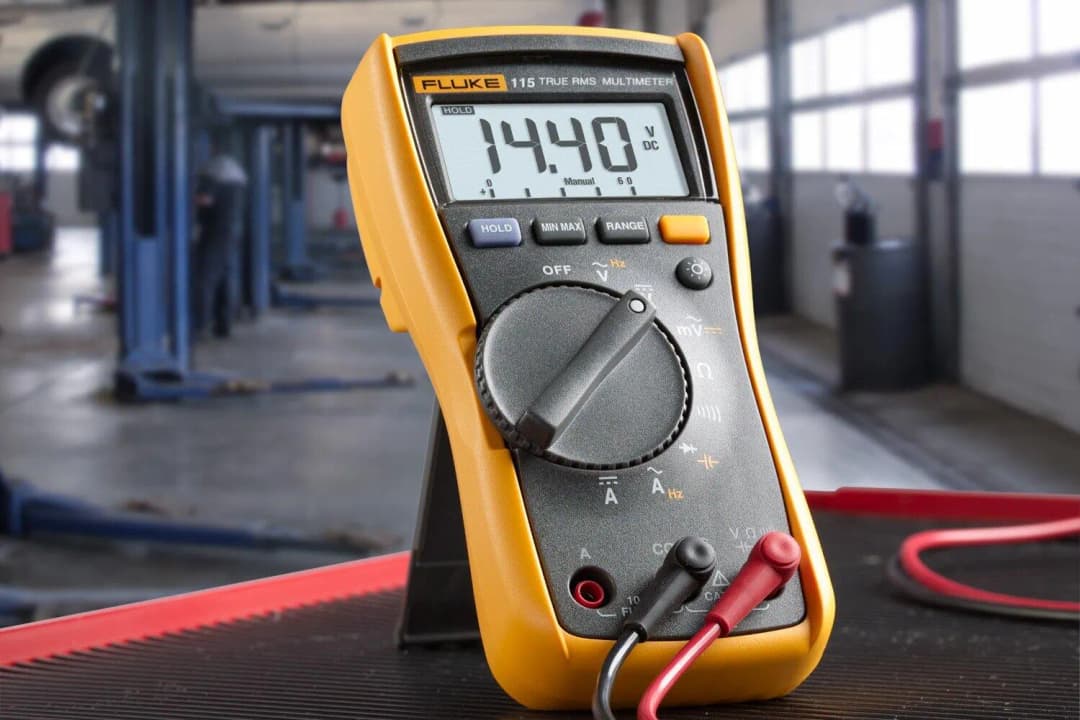
| Model | Fluke 115 |
|---|---|
| Accuracy | True RMS |
| Safety rating | CAT III 600V |
| Auto-ranging | Yes |
| Best for | Field technicians and general electrical/electronics work |
| Review status | Hands-on tested by OhmSavvy |
Disclosure: OhmSavvy earns a commission from qualifying Amazon purchases made through these links, at no extra cost to you. How we're funded.
The verdict
The Fluke 115 is Fluke's field-service meter — True RMS, CAT III 600V, and a 6,000-count backlit display, like the 117, but without non-contact voltage detection or the AutoVolt AC/DC auto-selector. A strong pick if you want Fluke's reliability without the electrician-focused extras.
Consider it if
- ✓You want Fluke's reliability record without paying for electrician-specific extras
- ✓You work across general electrical and electronics tasks, not exclusively panel work
- ✓You don't need non-contact voltage detection or a low-impedance mode and would rather not pay for them
Skip it if
- ✕You specifically want non-contact voltage (NCV) detection built in — that's the Fluke 117
- ✕You want the AutoVolt AC/DC auto-selector or a low-impedance (LoZ) mode
The trade-off: The 115 and 117 share the same core True RMS accuracy, CAT III 600V rating, and 6,000-count display. The 117 adds NCV detection and AutoVolt/LoZ for electrician-specific work; the 115 is the more general-purpose field meter and typically costs less.
Key specifications
- Accuracy
- True RMS
- Safety rating
- CAT III 600V
- Auto-ranging
- Yes
- Best for
- Field technicians, general electrical and electronics work
Checked against the manufacturer's official product page or datasheet and the official Amazon listing when this model was added to our guide.
Strengths and limitations
Reasons to buy
- +Same Fluke reliability and accuracy as the 117
- +Same size and weight as the 117 at a lower price
- +Includes capacitance and frequency measurement
Reasons to avoid
- −No non-contact voltage (NCV) detection
- −No AutoVolt AC/DC auto-selector or LoZ mode the 117 has
Performance assessment
Safety and accuracy
CAT III 600V and True RMS put the 115 on equal footing with the 117 for household panels, fixed building wiring, and general electrical troubleshooting. Auto-ranging and a 6,000-count backlit display keep operation quick and readable.
The same core measurements, without the electrician extras
The 115 measures everything the 117 does apart from NCV and AutoVolt: resistance, continuity, diode test, capacitance from 1 nF to 9,999 µF, frequency from 99.99 Hz to 50.00 kHz, 6 A and 10 A current ranges, and Min/Max/Avg with display hold, all on a 6,000-count display with a 33-segment bar graph. What it leaves out is the 117's VoltAlert non-contact detection and AutoVolt with its low-impedance (LoZ) input. If you work on electronics, motors and drives more than live panels, you give up little and typically pay less. Neither meter measures temperature (that's the Fluke 116) or has µA/mA ranges.
What the published accuracy means on real readings
Fluke specifies DC volts at ±(0.5% + 2 counts) and AC volts at ±(1.0% + 3 counts) from DC to 500 Hz, widening to ±(2.0% + 3) between 500 Hz and 1 kHz. Worked through on illustrative readings: a 12.00 V car battery on the 60.00 V range can be off by 0.5% of 12 V (0.06 V) plus two counts of 0.01 V (0.02 V), so the true value sits within about ±0.08 V. A 120.0 V outlet on the 600.0 V AC range allows 1.2 V plus three counts of 0.1 V, or about ±1.5 V. Both are tight enough for diagnosing batteries, chargers and branch circuits, though not for calibrating a reference.
Current: 6 A and 10 A only
The current jack covers a 6.000 A range with 1 mA resolution and a 10.00 A range, AC or DC, and Fluke allows a 20 A overload for no more than 30 seconds. That suits motor running current, heater elements and automotive loads. What it can't do is resolve small currents well: there are no µA or mA ranges, so standby drain on a circuit board, a 4–20 mA loop or a parasitic draw in the tens of milliamps is better handled by a meter with dedicated low-current ranges or a clamp with a DC milliamp mode.
Resistance, continuity and the 500 µs catch
Resistance runs from a 600.0 Ω range with 0.1 Ω resolution up to 40.00 MΩ. The continuity beeper turns on below about 20 Ω and Fluke states it catches opens or shorts lasting 500 µs or longer, which is what makes it useful for wiggling a harness or a cord while listening for a dropout. The diode test runs to 2.000 V, enough for ordinary silicon diodes and most LEDs, though some blue and white LEDs need more than that to light.
Display, battery and build
The 6,000-count display updates four times a second, and the 33-segment bar graph updates 32 times a second, so it shows a drifting or fluctuating value faster than the digits do. Min/Max/Avg records with elapsed time, handy for catching a sag while a load cycles. Power comes from a single 9 V alkaline battery, rated at about 400 hours without the backlight. Fluke lists the meter at 167 × 84 × 46 mm and 550 g, an operating range of -10 to +50 °C, and a 3-year warranty.
Limitations to weigh
Beyond the missing NCV and LoZ, the 115 tops out at CAT III 600V, so it isn't rated for service-entrance or CAT IV work, and its 1 kHz upper limit on AC volts means it isn't a tool for audio or switching-frequency voltage measurements. There's no temperature input, no low-current ranges and no data logging or Bluetooth. If temperature or microamps matter, the Fluke 87V adds both; for current without breaking the circuit, look at a clamp meter.
Bought and tested on our bench
We bought this unit and used it directly rather than relying only on Fluke's published specifications, which is why it carries a "Hands-on Tested" badge. We're not publishing specific bench measurements yet — our hands-on testing program is still early — but direct use didn't turn up anything that contradicts Fluke's reliability record or the 115's positioning as a general field-service meter.
Alternatives to consider
Fluke 117
Adds non-contact voltage detection and AutoVolt/LoZ — worth the extra cost if you specifically do electrician-focused panel work.
Klein Tools MM400
The same CAT III 600V rating plus temperature measurement, but not True RMS, and Klein has discontinued it.
KAIWEETS KM200s
A budget True RMS meter if you don't need Fluke's reliability record or CAT III headroom.
Where to buy the Fluke 115
We link to the official Amazon listing. Prices change often, so check the current price at the retailer before you buy.
Frequently asked questions
What is the Fluke 115 used for?+
General electrical and electronics field work: checking voltage at outlets and panels (CAT III 600V), testing continuity, resistance and diodes, measuring 6A/10A current on motors and heaters, and reading capacitance and frequency. It's built for technicians who need Fluke's True RMS accuracy without the 117's electrician-specific VoltAlert and LoZ extras.
What's the real difference between the Fluke 115 and Fluke 117?+
According to Fluke's own comparison, the two are identical for voltage, current, resistance, capacitance, and frequency measurement. The 117 adds non-contact voltage (NCV) detection and an AutoVolt AC/DC auto-selector with a low-impedance (LoZ) mode; the 115 doesn't have either. Fluke markets the 117 specifically to electricians and the 115 as a more general field-service meter.
Is the Fluke 115 True RMS?+
Yes. Like the 117, it measures True RMS on AC voltage and current, so readings stay accurate on the non-sinusoidal waveforms common with variable-speed drives and modern electronics.
Does the Fluke 115 measure capacitance?+
Yes — from 1 nF to 9,999 µF, along with frequency from 99.99 Hz to 50.00 kHz and a diode test. The Fluke 117 has exactly the same capacitance and frequency ranges, so this isn't a reason to pick one over the other; the 115's case is getting those measurements without paying for the 117's NCV and AutoVolt/LoZ.
Can the Fluke 115 measure milliamps?+
Not with useful resolution. Its current ranges are 6.000 A and 10.00 A, so the smallest step it shows is 1 mA and there are no dedicated µA or mA ranges. For Arduino projects, standby current or a car's parasitic drain, pick a meter with a microamp range, such as the Fluke 87V (0.01 µA DC resolution per Fluke), or a clamp meter that reads DC milliamps.
What battery does the Fluke 115 use, and how long does it last?+
It runs on one 9 V alkaline battery (IEC 6LR61), which ships installed. Fluke rates battery life at about 400 hours typical with the backlight off. Leaving the backlight on shortens that, so switch it off when you don't need it, and keep a spare 9 V in the case for long jobs.
Is the Fluke 115 safe for household electrical panels?+
It's rated CAT III 600V under IEC 61010, which covers fixed building wiring, distribution panels and branch circuits in a home or light-commercial building. It isn't rated CAT IV, so it shouldn't be used at the meter base or service drop. Use it with intact CAT III-rated leads, and call a licensed electrician for anything inside a panel you aren't qualified to open.
Related
Fluke 115
4.8★★★★★



