COMPARISON · MULTIMETERS
Fluke 15B+ vs Fluke 101
Fluke 15B+ vs Fluke 101 compares Fluke's two most basic meters, and each lacks something the other has. The 15B+ measures current from microamps to 10A but has no frequency range; the 101 reads frequency and duty cycle to 100 kHz but cannot measure current at all. Size, warranty and US availability split them further.
By the OhmSavvy Research Team ·
Disclosure: OhmSavvy earns a commission from qualifying Amazon purchases made through these links, at no extra cost to you. How we're funded.
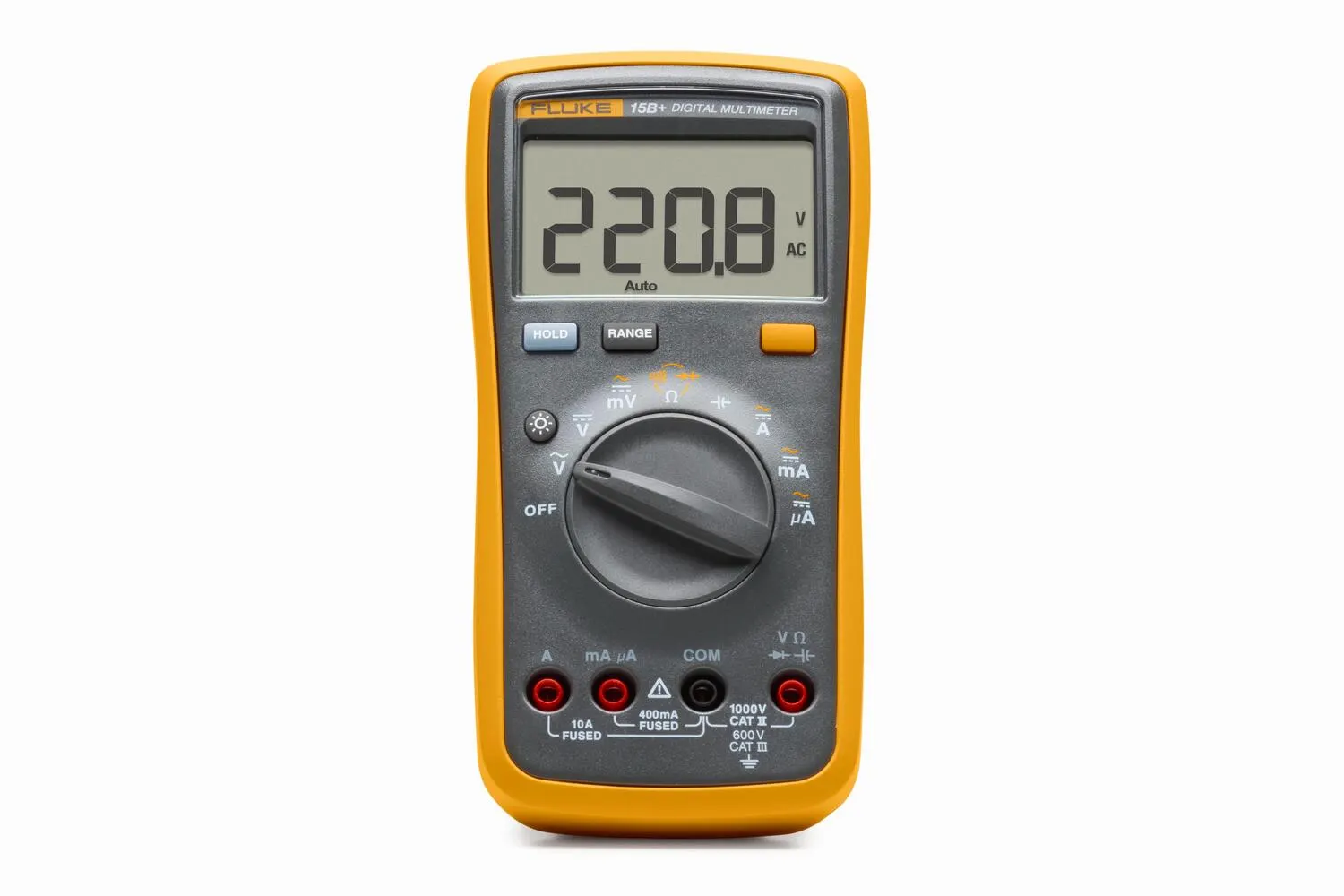
Fluke 15B+
4.3★★★★☆The 17B+ body and safety rating without frequency, temperature or MIN MAX: a plain, tough Fluke for volts, amps and ohms.
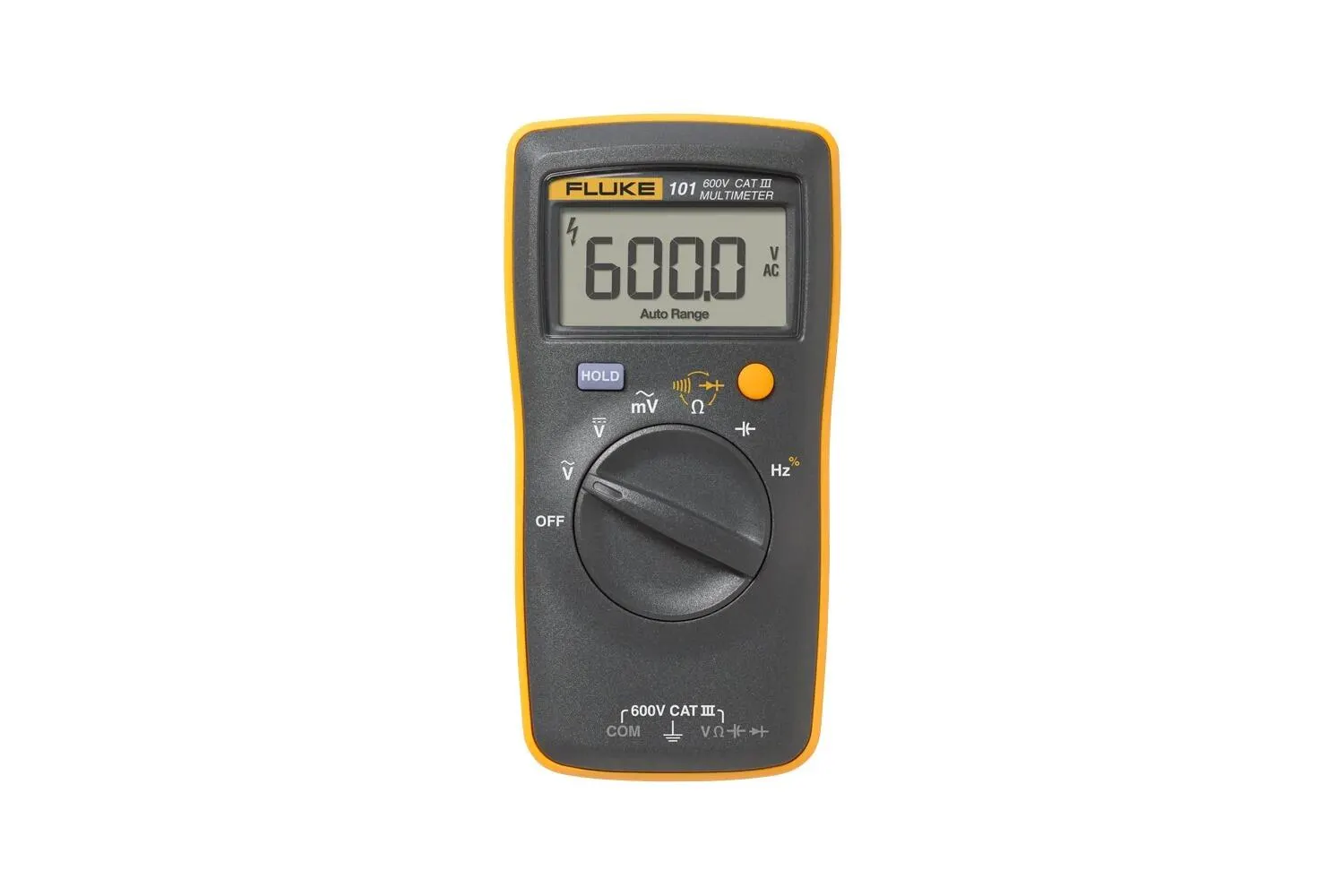
Fluke 101
4.1★★★★☆Fluke's smallest, simplest meter: volts, ohms, capacitance and frequency in 160 g, but no current measurement at all.
Specs side by side
| Fluke 15B+ | Fluke 101 | |
|---|---|---|
| Rating | 4.3★★★★☆ | 4.1★★★★☆ |
| Accuracy | Not stated as True RMS by Fluke | Not stated as True RMS by Fluke |
| Safety rating | CAT III 600V / CAT II 1000V | CAT III 600V |
| Auto-ranging | Yes (manual override) | Yes |
| Best for | Basic electrical and electronics checks | Voltage and continuity checks only |
| Current | µA, mA and A ranges to 10A AC/DC | None |
| Frequency / duty cycle | No / No | To 100 kHz / 0.1–99.9% |
| Display | 4,000 counts, backlit | 6,000 counts |
| Max voltage | 1000V AC/DC | 600V AC/DC |
| Capacitance | Up to 1,000 µF | Fluke sources conflict: 100 µF or 1,000 µF |
| Diode / continuity | Yes / Yes | Yes / Yes |
| Size / weight | 183 × 91 × 49.5 mm, 455 g | 130 × 65 × 27 mm, 160 g |
| Battery | 2 × AA, 500 h minimum | 2 × AAA, 200 h minimum |
| Warranty | 1 year (users manual) | 1 year |
| Sold by Fluke US | Yes | No (third-party import on Amazon) |
Specs checked against manufacturer documentation and official Amazon listings. Desk research, not bench testing. How we research.
Key differences
- →Current is the dividing line: the 15B+ covers µA to 10A, and the 101 has no current function at all.
- →The 101 reads frequency to 100 kHz and duty cycle; the 15B+ reads neither.
- →The 101 counts to 6,000, the 15B+ to 4,000.
- →The 101 is 160 g against the 15B+'s 455 g, and is rated for a 1 m drop.
- →Both carry a one-year warranty, but the 15B+ has a Fluke US listing while the 101 is imported.
Pick by the measurement you can't do without
01
Need current?
Only the 15B+ measures amps
02
Need frequency?
Only the 101 reads Hz
03
Need both?
Look at the 17B+ or 107
Most first-time buyers underestimate how often they will want amps. Checking what a USB gadget draws, a 4–20 mA sensor loop, or whether a 12 V pump is pulling more than its label says all need a current range. Frequency, on the other hand, matters mainly for checking a generator's output, a fan's PWM signal or a sensor that reports by pulse rate. If you can't name a frequency job you have now, the current ranges are the more useful half of the trade.
Fluke 15B+ vs 101 spec by spec
Fluke publishes accuracy for both in the same ±(% of reading + digits) format, specified for one year after calibration. On the functions they share, the numbers are the same: neither meter is more precise than the other at volts or ohms. The differences are which functions exist and how far the ranges reach.
| Spec | Fluke 15B+ | Fluke 101 |
|---|---|---|
| DC volts | 4 V to 1000 V, ±(0.5% + 3) | 6 V to 600 V, ±(0.5% + 3) |
| AC volts, 40 to 500 Hz | 4 V to 1000 V, ±(1.0% + 3) | 600 mV to 600 V |
| Volts input impedance | >10 MΩ | Not stated on the page we checked |
| Smallest current step | 0.1 µA on the 400.0 µA range | No current function |
| Largest current range | 10.00 A, ±(1.5% + 3) | No current function |
| Resistance | 400.0 Ω to 40.00 MΩ | 400.0 Ω to 40.00 MΩ |
| Frequency | No | 10 Hz to 100 kHz |
| Duty cycle | No | 0.1% to 99.9% |
| Display updates | 3 per second | Not stated |
| Current fuses | 440 mA and 11 A, 1000 V | None (no current inputs) |
| Ingress rating | IP40 | IP40 |
The count difference has one practical effect. The 101's lowest DC range is 6.000 V, so a 5 V USB rail reads to the millivolt, while the 15B+ has to step up from its 4.000 V range to 40.00 V and shows the same rail to the nearest 10 mV. For a 12 V battery both land on a range with 0.01 V steps, so the difference disappears. On capacitance, Fluke's current 101 page lists ranges up to 1,000 µF, but another Fluke document gives 100 µF; if large electrolytics matter to you, the 15B+'s 1,000 µF is the figure you can rely on.
Why the 101 can't measure current
Measuring current means routing the whole circuit current through the meter, which needs a dedicated low-resistance input and a fuse to protect it. The 15B+ has two such inputs, each behind its own 1000 V-rated fuse. The 101 was designed with only a COM jack and a volts jack, so there is no path for current at all; no setting or accessory changes that.
There is an upside to that design. The most common way to destroy a cheap meter, or blow its fuse, is to leave a lead in the amps jack and then probe a voltage. With no current jack, the 101 can't be set up that way. If you choose the 15B+, make a habit of moving the red lead back to the V Ω jack after every current reading; our guide to why a multimeter fuse blows when measuring current explains the failure in detail.
Which should you buy?
| You are… | Better fit | Why |
|---|---|---|
| Electronics student or hobbyist | Fluke 15B+ | µA and mA ranges for LED, Arduino and sensor current |
| Car owner chasing a battery drain | Fluke 15B+ | The 101 has no current function at all |
| Technician wanting a glovebox voltage checker | Fluke 101 | 160 g and 130 × 65 × 27 mm |
| Checking generator output or PWM signals | Fluke 101 | Frequency to 100 kHz and duty cycle |
| Working on equipment above 600 V | Fluke 15B+ | Ranges to 1000 V; the 101 stops at 600 V |
| Buyer who wants US warranty support | Fluke 15B+ | Sold by Fluke US; the 101 is an import |
If you need both current and frequency, neither meter is the right one. The Fluke 17B+ adds frequency, duty cycle and temperature to the 15B+'s body, and the Fluke 107 keeps a pocket size while adding 4A and 10A ranges. For more beginner options, see the best multimeter for beginners guide.
Neither is True RMS
Safety: match the meter to the circuit
Choose the Fluke 15B+ if…
- ✓You need current readings of any size
- ✓You want a meter sold and supported by Fluke US
- ✓You may measure above 600V on CAT II equipment
Choose the Fluke 101 if…
- ✓You want frequency and duty cycle in the smallest possible Fluke
- ✓You only check voltage, resistance and continuity, never current
- ✓Low weight matters more than US support
The bottom line
For most people the 15B+ is the safer buy: it measures current and is sold by Fluke US. The 101 suits only someone who wants a very small voltage, continuity and frequency checker and will never need to measure amps.
Frequently asked questions
Which Fluke is cheaper to run, the 15B+ or 101?+
The 15B+. Fluke quotes at least 500 hours from its two AA cells against at least 200 hours from the 101's two AAA cells, so you change batteries less than half as often. AA cells also hold more energy per cell, which is why the larger meter goes further between changes.
Can the Fluke 101 measure current?+
No. It has only two input jacks, COM and volts, and no current function or current fuse. Not even milliamps can be read. If you need amps, the Fluke 15B+ measures from 0.1 µA resolution up to 10 A, and the pocket-sized Fluke 107 adds 4 A and 10 A ranges.
Does the Fluke 15B+ read frequency?+
No. Fluke's datasheet lists frequency and duty cycle as not available on the 15B+; they are features of the 17B+, which shares its body and safety rating. The Fluke 101 reads frequency from 10 Hz to 100 kHz and duty cycle from 0.1% to 99.9%, so it is the one of these two for signal checks.
Which has the better display, the 15B+ or the 101?+
The 101 counts to 6,000 against the 15B+'s 4,000, so it shows an extra digit on readings between 4 and 6 volts, such as a 5 V USB rail. The 15B+ has a backlight, which helps in panels and under dashboards; Fluke's 101 documents don't mention one, so plan on a flashlight in dark spaces.
Is the Fluke 101 a good first multimeter?+
Only if you are sure you won't need current. It is small, tough and simple, with frequency and capacitance, but most beginners eventually want to measure what a circuit draws. The 15B+ covers that and is sold by Fluke US, so it is the better single first meter for most people.
Related



