COMPARISON · MULTIMETERS
Fluke 106 vs Fluke 101
The Fluke 106 vs Fluke 101 decision turns on one question: do you need to measure current? The 106 has 4A and 10A ranges; the 101 has only two input jacks and cannot read current at all. In return the 101 is smaller and lighter and adds frequency, duty cycle and a diode test that the 106 lacks. Both are CAT III 600V, 6,000-count meters that Fluke doesn't describe as True RMS.
By the OhmSavvy Research Team ·
Disclosure: OhmSavvy earns a commission from qualifying Amazon purchases made through these links, at no extra cost to you. How we're funded.
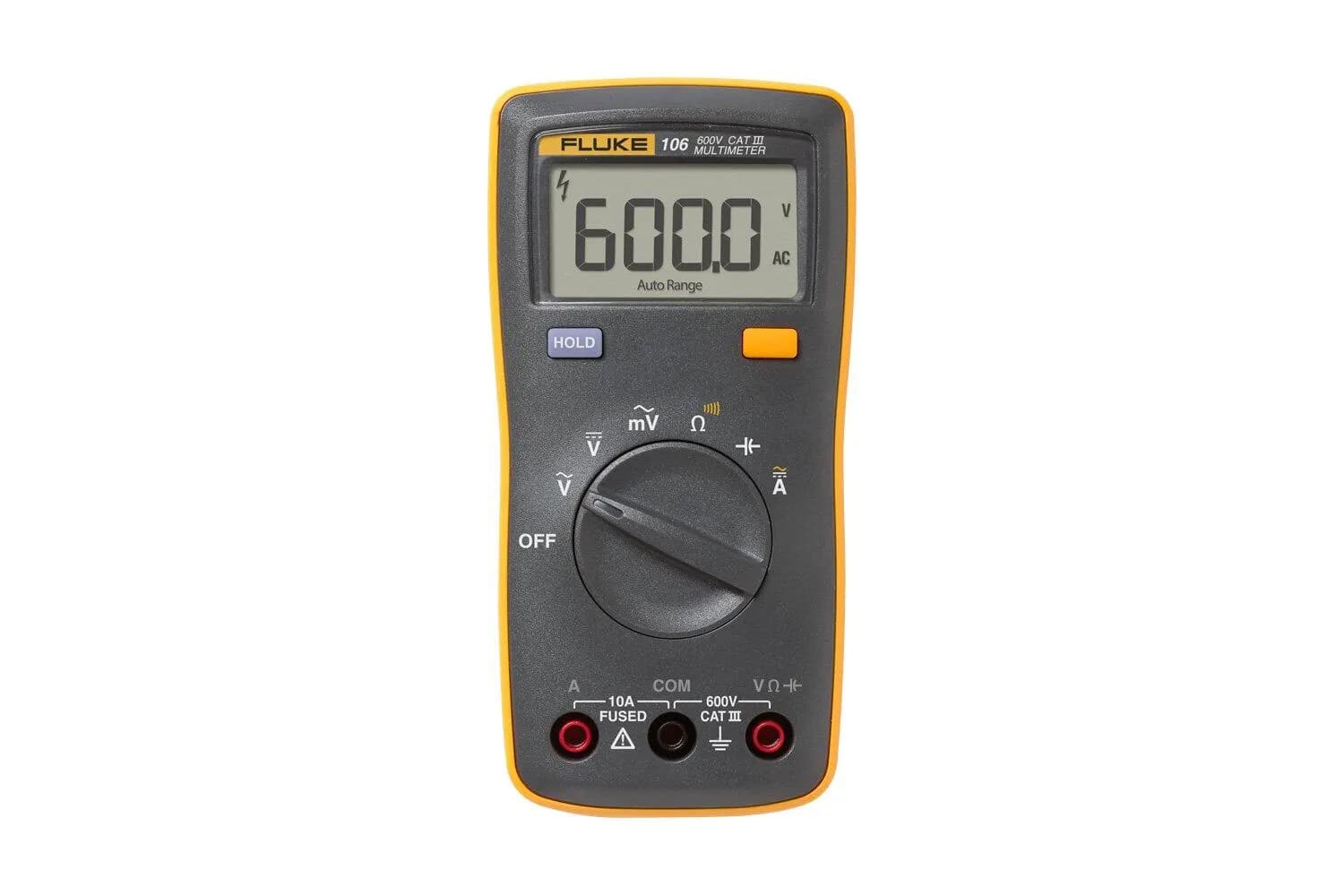
Fluke 106
4.2★★★★☆The 107's palm-sized body for less, without diode test, frequency or duty cycle.
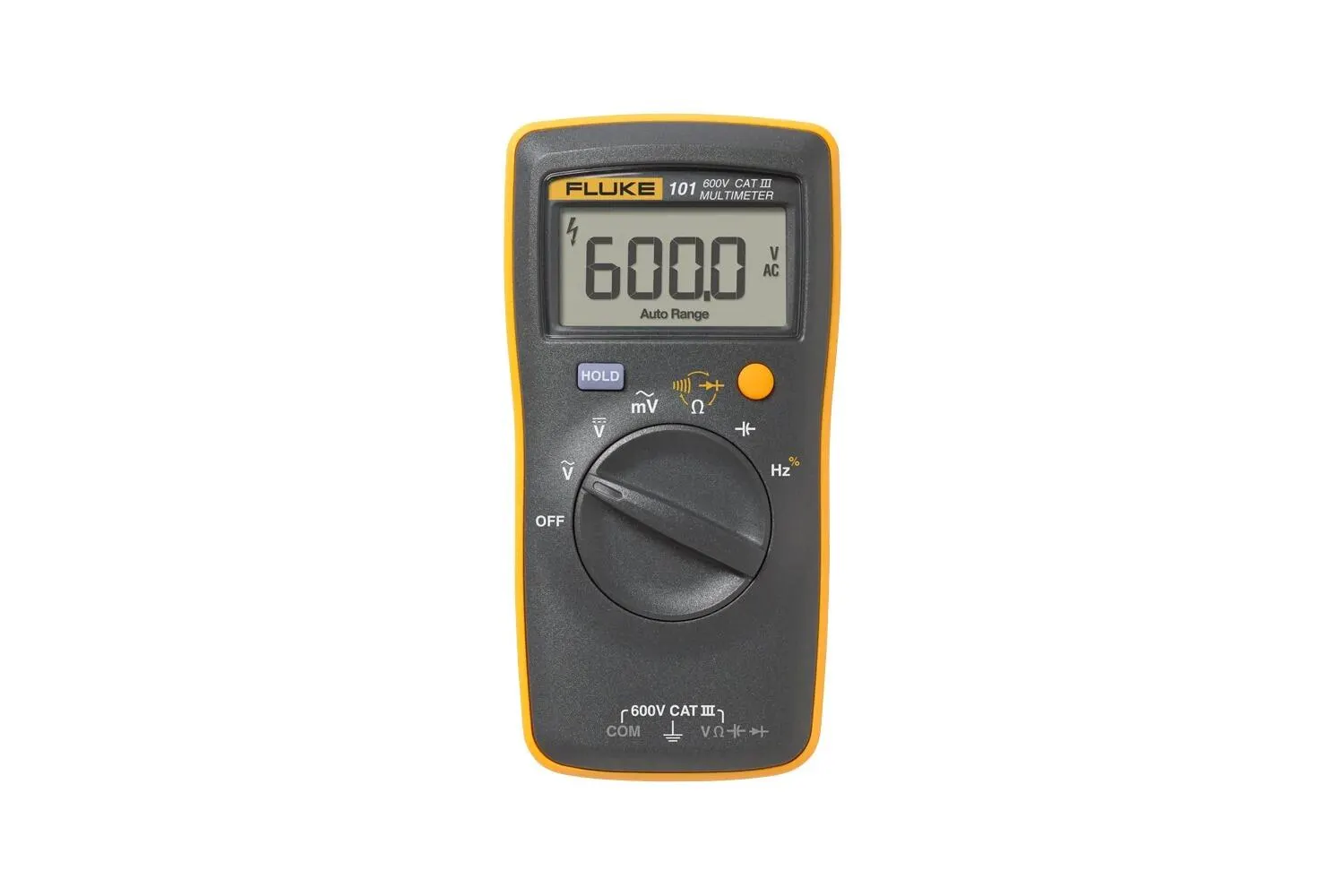
Fluke 101
4.1★★★★☆Fluke's smallest, simplest meter: volts, ohms, capacitance and frequency in 160 g, but no current measurement at all.
Specs side by side
| Fluke 106 | Fluke 101 | |
|---|---|---|
| Rating | 4.2★★★★☆ | 4.1★★★★☆ |
| Accuracy | Average-responding (not True RMS) | Not stated as True RMS by Fluke |
| Safety rating | CAT III 600V | CAT III 600V |
| Auto-ranging | Yes | Yes |
| Best for | A small, cheap backup meter | Voltage and continuity checks only |
| Current | 4.000A and 10.00A ranges, AC/DC, ±(1.5% + 3) | None (two jacks only) |
| Max voltage | 600V AC/DC | 600V AC/DC |
| DC volts accuracy | ±(0.5% + 3) | 0.5% + 3 |
| Resistance | Up to 40 MΩ | Up to 40 MΩ |
| Capacitance | 50 nF to 1,000 µF | Fluke's sources conflict: 100 µF or 1,000 µF |
| Frequency / duty cycle | No | 10 Hz to 100 kHz; duty cycle 0.1% to 99.9% |
| Diode test | No | Yes |
| Size | 142 × 69 × 28 mm | 130 × 65 × 27 mm |
| Weight | 200 g | 160 g |
| Battery | 2 × AAA, 200 h minimum | 2 × AAA (life not stated) |
| Warranty | 2 years | 1 year |
| US availability | Sold on fluke.com US | Not on fluke.com US; Amazon listing is an import |
Specs checked against manufacturer documentation and official Amazon listings. Desk research, not bench testing. How we research.
Key differences
- →Only the 106 measures current; the 101 has a COM jack and a single input for everything else.
- →The 101 adds frequency to 100 kHz, duty cycle and a diode test, none of which the 106 has.
- →The 101 is 40 g lighter and a little smaller in every dimension.
- →Fluke gives the 106 a two-year warranty and the 101 one year.
- →Fluke's own 101 documents disagree on maximum capacitance (100 µF vs 1,000 µF); the 106 is listed to 1,000 µF.
- →The 101 isn't sold on Fluke's US site, so US buyers get it through an import listing.
Why the 101 can't read current
Measuring current means routing it through the meter, which needs a dedicated, fused current jack. The 106 has a 10A jack beside COM; the 101 has none, so no setting on its dial can read amps.
A separate jack isn't a design quirk. In current mode the meter is deliberately close to a short circuit: a low-value shunt that drops only a small voltage while the full load current flows through it. Fluke protects that path on the 106 with an 11 A, 1000 V fast fuse. Sharing one jack between that shunt and the high-impedance voltage input would leave a dangerous short a single dial click away, so a two-jack meter like the 101 simply omits current.
Fluke 106 vs 101 spec by spec
Where both meters measure the same thing, Fluke's figures barely differ: 600 V on a 6,000-count display, 0.5% basic DC accuracy and resistance to 40 MΩ. The decision comes from the functions each one leaves out and from the practical details of size, warranty and where you can buy it.
| Spec | Fluke 106 | Fluke 101 |
|---|---|---|
| Volts | 6.000 to 600.0 V AC/DC | 6.000 to 600.0 V AC/DC |
| AC millivolts | 600.0 mV, ±(3.0% + 3) | 600.0 mV, 3.0% + 3 |
| Current | 4.000 A and 10.00 A, AC and DC | None |
| Resistance | 400.0 Ω to 40.00 MΩ | 400.0 Ω to 40.00 MΩ |
| Capacitance | 50.00 nF to 1,000 µF | 50.00 nF up; top range 100 µF or 1,000 µF |
| Frequency | No | 10 Hz to 100 kHz |
| Duty cycle | No | 0.1% to 99.9% |
| Diode test | No | Yes, with buzzer |
| Continuity | Beeps below 70 Ω | Yes, with buzzer |
| Drop rating | Not stated | 1 m |
| Battery life | 200 h minimum | Not stated |
Real jobs, and which meter handles them
The 106 suits people whose questions are about loads: is the space heater drawing what its label says, is a motor pulling more than normal, or is a battery charger actually delivering current? With 4.000 A at 1 mA resolution and a 10.00 A range, it answers those directly, which the 101 cannot do at any price.
The 101 suits people whose questions are about signals and parts: is this LED or rectifier good, what frequency is this sensor putting out, what duty cycle is this fan controller commanding? Its diode test and 100 kHz frequency range cover those, and the 1 m drop rating helps a meter that lives loose in a bag.
| Task | Fluke 106 | Fluke 101 |
|---|---|---|
| Outlet or battery voltage | Yes | Yes |
| Appliance current draw | Yes, to 10 A | No |
| Continuity of a cable or fuse | Yes | Yes |
| PWM or fan signal frequency | No | Yes |
| Diode or LED check | No | Yes |
| Charger output current | Yes, in series | No |
Need current without a current jack?
Fluke 106 or 101: which should you buy?
| You are… | Better fit | Why |
|---|---|---|
| Homeowner checking appliances | Fluke 106 | Reads running current; US warranty support |
| Car owner with a glovebox meter | Fluke 101 | Diode test for alternator diodes, duty cycle for injectors, 160 g |
| Electronics hobbyist | Fluke 101 | Frequency, duty cycle and diode test matter more than amps |
| Solar or battery tinkerer | Fluke 106 | DC current to 10 A for charge and load checks |
| Electrician wanting a backup | Fluke 106 | Current plus 2-year warranty; neither is True RMS |
| Buyer who wants every function | Neither | The Fluke 107 has current and the 101's signal functions |
That last row is worth a look: the Fluke 107 keeps the 106's body and current ranges and adds diode, frequency and duty cycle. Compare it in Fluke 106 vs Fluke 107 and Fluke 107 vs Fluke 101.
Safety: never leave leads in the current jack
Choose the Fluke 106 if…
- ✓You need to measure a load's current up to 10A
- ✓You want a two-year warranty and a model Fluke sells in the US
- ✓You don't need diode or frequency readings
Choose the Fluke 101 if…
- ✓You only check voltage, resistance and continuity, never current
- ✓You want frequency, duty cycle and a diode test in the smallest Fluke
- ✓Every gram counts: it weighs 160 g
The bottom line
Pick the Fluke 106 if you will ever measure current: it's the only one of the two that can, and it carries a longer warranty and US availability. Pick the Fluke 101 only as an ultra-light voltage, continuity and signal checker, where its frequency and diode functions matter more than amps.
Frequently asked questions
Can the Fluke 101 measure current?+
No. The 101 has only two input jacks, COM and one input for voltage, resistance and its other functions, and Fluke's documents list no current function. Measuring current in series needs a separate fused jack and shunt, which the 106 has. A 101 owner who needs AC current would pair it with a clamp meter.
Which is smaller, the Fluke 101 or 106?+
The 101, at 130 × 65 × 27 mm and 160 g, against the 106's 142 × 69 × 28 mm and 200 g. The difference is mostly length; both fit a jacket pocket. The 101 also carries a 1 m drop rating on Fluke's spec page, while Fluke's 106 page doesn't list one.
Does the Fluke 106 measure frequency?+
No. Fluke's 106/107 manual lists frequency and duty cycle as 107-only functions, along with the diode test. The 101 measures frequency from 10 Hz to 100 kHz and duty cycle, so for signal checks it is the more capable of these two, despite having no current function.
What warranty do the Fluke 101 and 106 have?+
Fluke's 106 datasheet gives two years, while Fluke's 101 page gives one year. Because the 101 isn't sold through Fluke's US site, warranty service for a US buyer may also be less straightforward than for the 106, so check the importer's terms on the Amazon listing before you buy.
Is the Fluke 101 sold in the US?+
Fluke's US site doesn't offer it; it's listed on Fluke's Indian and Malaysian sites. US Amazon listings come from third-party importers. If you want a palm-sized Fluke that Fluke sells and supports in the US, the 106 and 107 are the models to look at.
Related



