REVIEW · MULTIMETERS
Fluke 179 Review
Fluke's do-everything bench-and-field meter: CAT IV 600V, True RMS, temperature and a 6,000-count display with bar graph.
By the OhmSavvy Research Team ·
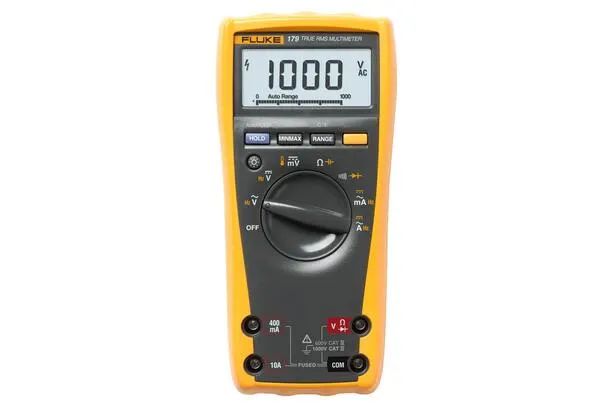
| Model | Fluke 179 |
|---|---|
| Accuracy | True RMS |
| Safety rating | CAT III 1000V / CAT IV 600V |
| Auto-ranging | Yes (manual override) |
| Best for | Maintenance techs, HVAC and electronics users who want temperature in a CAT IV meter |
| Review status | Desk research, not bench-tested |
Disclosure: OhmSavvy earns a commission from qualifying Amazon purchases made through these links, at no extra cost to you. How we're funded.
The verdict
The Fluke 179 is the full-featured member of Fluke's 170 series: True RMS, CAT III 1000V and CAT IV 600V, a 6,000-count backlit display with an analog bar graph, and temperature measurement with the supplied thermocouple. It adds Min/Max-Average recording and both manual and automatic ranging, so it suits industrial maintenance and electronics work where the 117's electrician-focused extras matter less than range and resolution.
Consider it if
- ✓You work at or near the service entrance, where Fluke's CAT IV 600V rating applies
- ✓You want temperature readings from the same meter, using the 80BK thermocouple Fluke ships with it
- ✓You read 4–20 mA loops or other milliamp signals and 0.01 mA resolution is enough
- ✓You like a backlit 6,000-count display with an analog bar graph for watching a value move
- ✓You want a meter you buy once, covered by Fluke's lifetime warranty
Skip it if
- ✕You need microamps for flame sensors or sleep current: the finest step is 0.01 mA, and there's no µA range
- ✕You want a built-in non-contact voltage detector or a LoZ mode for ghost voltage; the Fluke 117 has both
- ✕You troubleshoot variable-speed drives and want a low-pass filter or peak capture, which point to the 87V
- ✕You want to log readings over hours or days on the meter itself
The trade-off: Compared with the Fluke 117, you give up VoltAlert and LoZ and gain CAT IV 600V, a mA range, temperature and a lifetime warranty. Compared with the 87V, you give up the 19,999-count mode, µA resolution, peak capture and the drive filter. Fluke's own 177 is the same meter without the thermocouple input, so the 179 only makes sense if you'll actually use temperature.
Key specifications
- Accuracy
- True RMS
- Safety rating
- CAT III 1000V / CAT IV 600V
- Auto-ranging
- Yes (manual override)
- Best for
- Industrial maintenance, electronics, HVAC
Checked against the manufacturer's official product page or datasheet and the official Amazon listing when this model was added to our guide.
Strengths and limitations
Reasons to buy
- +CAT IV 600V for service entrances and outdoor feeds
- +Temperature, capacitance to 10,000 µF and frequency to 100 kHz
- +Min/Max-Average recording and analog bar graph
Reasons to avoid
- −Costs more than the 117 for features many electricians won't use
- −No non-contact voltage detection
Performance assessment
We haven't bench-tested this unit. This assessment is based on its published specifications and on what those specifications mean in practice. How we research.
Where the 179 sits in Fluke's 170 series
The 175, 177 and 179 share one 43 × 90 × 185 mm, 420 g body, the same 6,000-count display with a 33-segment bar graph, and the same CAT III 1000V / CAT IV 600V rating. The 175 has no backlight and a looser DC volts spec of ±(0.15% + 2). The 177 tightens that to ±(0.09% + 2) and adds the backlight. The 179 keeps everything the 177 has and adds a temperature function with the 80BK thermocouple in the box. That makes the buying question simple: if you'd otherwise carry a separate thermometer, the 179 is worth it; if not, the 177 is the same instrument.
Accuracy, worked through
On a 12.00 V DC reading the spec allows 0.09% of reading plus 2 counts: about 0.011 V plus 0.02 V, so roughly ±0.03 V, which is tight enough for battery state-of-charge and control-voltage checks. On 120.0 V AC the ±(1.0% + 3) figure gives 1.2 V plus 0.3 V, about ±1.5 V. A 20.00 mA loop signal is allowed ±(1.0% + 3), or 0.20 mA plus 0.03 mA, about ±0.23 mA, roughly 1.4% of a 16 mA span. These use Fluke's best-accuracy lines, so treat them as best-case figures rather than per-range guarantees.
Temperature: what the probe changes
Fluke rates the meter's temperature function from −40 to 400 °C at ±(1.0% + 10) with 0.1 °C resolution. At 60.0 °C that's 0.6 °C plus 1.0 °C, so about ±1.6 °C, before anything the probe adds. The included 80BK is a bead thermocouple, and its own range isn't stated on the 179 page; another Fluke figure cited on our site puts it at −40 to 260 °C, so check the probe before measuring anything near the meter's 400 °C limit. Fluke's comparison table also prints the upper limit as "400 °F"; the spec table says 400 °C, and that's the figure we use.
Current: milliamps yes, microamps no
The 179 measures up to 10 A, with 0.01 mA as its finest current step. That's enough for 4–20 mA loops and relay coil current, but it is 10 µA per digit. A flame-rectification signal of a few microamps would display as 0.00 or 0.01 mA, which tells you almost nothing. Fluke's comparison table lists µA as an extra function, but the spec table does not support that, so don't buy the 179 for microamp work; the 87V and 289 both resolve 0.01 µA.
Display, ranges and recording
Six thousand counts means 6.000 V, 60.00 V and 600.0 V ranges, so a 230 V reading shows one decimal place. The bar graph is the useful part for tuning or watching a fluctuating value, and the backlight helps in panels and crawl spaces. Resistance reaches 50 MΩ at ±(0.9% + 1), capacitance runs from 1 nF to 10,000 µF at ±(1.2% + 2) (Fluke's comparison table says 9,999 µF), and frequency reaches 100 kHz at ±(0.1% + 1). Min/Max-Average records the extremes while you work, and you can override auto-ranging when it hunts.
Battery, size and warranty
One 9 V battery is rated for about 200 hours without the backlight, half the 117's figure, so keep a spare in the case. At 420 g the 179 is lighter than the 117's 550 g. Fluke covers it for life, compared with three years on the 117. Fluke's pages don't state an IP rating or drop height for the 179, so we can't compare its ruggedness on paper. We haven't bench-tested this unit; everything above is desk research against Fluke's published specifications.
Alternatives to consider
Fluke 117
For residential electricians: VoltAlert, AutoVolt and LoZ, but CAT III 600V only and no mA range or temperature.
Fluke 87V
Same CAT IV 600V rating, plus 0.01 µA resolution, peak capture, a low-pass filter and a 19,999-count mode.
Fluke 177
The 179 without temperature: same display, accuracy, ranges and lifetime warranty.
Fluke 289
50,000 counts, µA and milliohm ranges and on-meter logging, at a much higher price and 871 g.
Where to buy the Fluke 179
We link to the official Amazon listing. Prices change often, so check the current price at the retailer before you buy.
Frequently asked questions
Is the Fluke 179 still worth buying?+
Yes, if you'll use what separates it from cheaper meters: CAT IV 600V, a mA range and the thermocouple input. If you only do house wiring, the Fluke 117's LoZ and non-contact detector are more useful day to day.
Does the Fluke 179 measure microamps?+
No. Fluke's spec table gives 0.01 mA as the finest current resolution, which is 10 µA per digit. The comparison table on the same Fluke page lists µA, but that conflicts with the spec table. For HVAC flame sensors or battery sleep current, choose a meter with a real µA range such as the 87V.
What temperature probe comes with the Fluke 179?+
Fluke ships the 80BK bead thermocouple with the 179, along with test leads, a 9 V battery and a quick reference guide. The meter reads −40 to 400 °C, but the probe has its own rating, which the 179 page doesn't state. Another Fluke figure we cite puts the 80BK at −40 to 260 °C.
What's the difference between the Fluke 177 and 179?+
Only temperature. Both have the same body, 6,000-count backlit display with bar graph, DC accuracy of ±(0.09% + 2), 10 A and 0.01 mA current, 50 MΩ, 10,000 µF, 100 kHz, CAT IV 600V and a lifetime warranty. The 179 adds the thermocouple function and the 80BK probe.
Can the Fluke 179 be used on a service entrance?+
It's rated CAT IV 600V, the category for the origin of an installation such as the meter base and service conductors, and CAT III 1000V for distribution work. The rating covers the meter; your test leads must carry a matching rating, and the usual PPE and live-work rules still apply.
How long does the Fluke 179 battery last?+
Fluke rates the single 9 V battery at about 200 hours without the backlight. Heavy backlight use cuts that, so a meter that lives in a dark panel or attic will need batteries more often. The 117 is rated for about 400 hours, if long runtime matters more than the 179's extra functions.
Related
Fluke 179
4.7★★★★★


