COMPARISON · MULTIMETERS
Fluke 107 vs Fluke T5-600
Fluke 107 vs Fluke T5-600 sets a pocket electronics meter against a job-site tester. The 107 fits in a shirt pocket yet tests diodes, reads frequency and duty cycle, and measures capacitance. The T5-600 gives those up for a 100A open jaw, automatic AC/DC voltage and a body rated to survive a 3 m drop.
By the OhmSavvy Research Team ·
Disclosure: OhmSavvy earns a commission from qualifying Amazon purchases made through these links, at no extra cost to you. How we're funded.
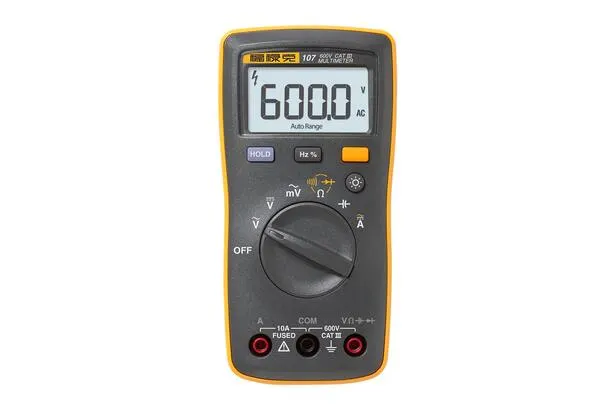
Fluke 107
4.3★★★★☆A palm-sized Fluke with CAT III 600V and a 6,000-count display, but not True RMS.
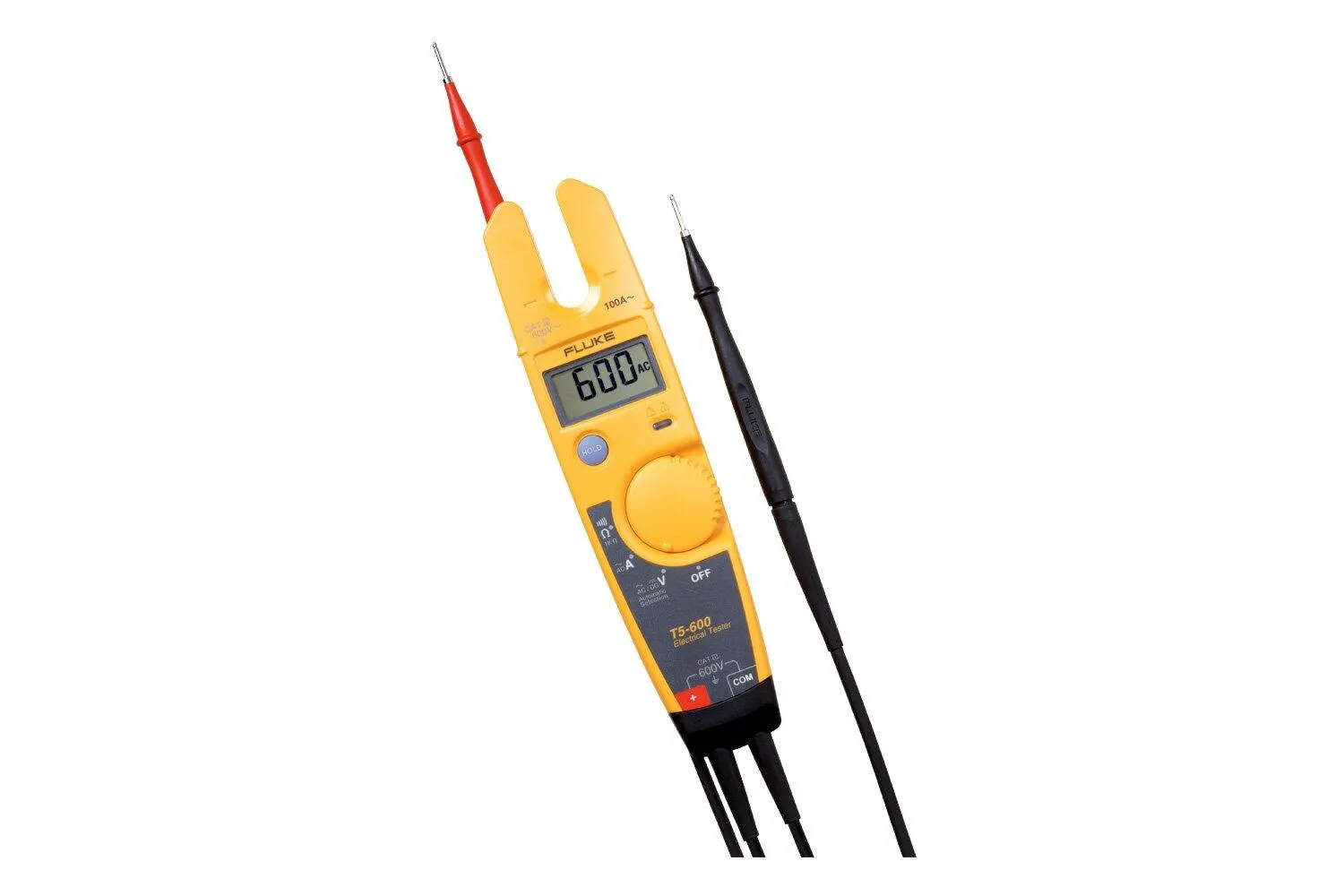
Fluke T5-600
4.4★★★★☆Not a multimeter but an electrician's tester: volts, continuity and up to 100A AC through an open jaw, no leads in the circuit.
Specs side by side
| Fluke 107 | Fluke T5-600 | |
|---|---|---|
| Rating | 4.3★★★★☆ | 4.4★★★★☆ |
| Accuracy | Average-responding (not True RMS) | Average-responding (not True RMS) |
| Safety rating | CAT III 600V | CAT III 600V |
| Auto-ranging | Yes (per display) | Automatic AC/DC voltage selection |
| Best for | A compact second meter, home and auto checks | Electricians' quick voltage and current checks |
| Instrument type | Pocket digital multimeter | Electrical tester |
| Display | 6,000 counts, backlit | Digital LCD (count not stated) |
| Voltage | To 600V AC/DC | To 600V AC/DC, automatic AC/DC |
| DC volts accuracy | ±(0.5% + 3) | ±(1% + 1), 1 V resolution |
| Current | 4A and 10A AC/DC via leads | To 100A AC via open jaw, 0.1 A resolution |
| Diode test | Yes, 2.000 V | Not listed |
| Frequency / duty cycle | 10 Hz–100 kHz; 1–99% | No |
| Capacitance | 50 nF to 1,000 µF | No |
| Resistance | 400 Ω to 40 MΩ | To 1,000 Ω |
| Continuity | Yes | Beeps below 25 Ω |
| Input impedance | >10 MΩ | Low (Fluke: shouldn't show ghost voltage) |
| Battery | 2 × AAA, 200 h minimum | 2 × AA, 400 h alkaline |
| Size | 142 × 69 × 28 mm | 30.5 × 51 × 203 mm |
| Weight | 200 g | 300 g |
| Drop rating | 1 m | 3 m (10 ft) |
Specs checked against manufacturer documentation and official Amazon listings. Desk research, not bench testing. How we research.
Key differences
- →Diode test, frequency, duty cycle and capacitance are on the 107; Fluke lists none of them for the T5-600.
- →The T5-600's open jaw reads AC current to 100A without breaking the circuit; the 107 reads to 10A through its leads, including DC.
- →Fluke rates the T5-600 for a 3 m drop against the 107's 1 m.
- →The 107 is shorter and lighter at 200 g; the T5-600 is a long, narrow 203 mm tool at 300 g with probe storage in the back.
- →The T5-600 selects AC or DC voltage itself and has a low input impedance; the 107 has a backlit 6,000-count display and a high-impedance input above 10 MΩ.
Electronics functions side by side
| Function | Fluke 107 | Fluke T5-600 | Typical use |
|---|---|---|---|
| Diode test | Yes | — | Rectifiers, LEDs, transistor junctions |
| Frequency | Yes | — | Fan tach, oscillator, mains frequency |
| Duty cycle | Yes | — | PWM fans, injectors, dimmers |
| Capacitance | Yes | — | Filter and motor-run capacitors |
| DC current | Yes, to 10A | — | Battery drain, DC motors, LED strips |
| AC current above 10A | — | Yes | Motors, heaters, compressors |
Read across the table and the split is clean: everything a circuit board needs sits in the 107's column, and the one thing a building-wiring job needs that a pocket meter can't do, heavy AC current, sits in the T5-600's. Resistance shows the same pattern. The 107 reads to 40 MΩ, enough for pull-up resistors and insulation leaks on low-voltage gear; the T5-600 stops at 1,000 Ω, which covers continuity, heater elements and motor windings but not much else.
How each one measures current
This is the difference that decides most purchases. To read current, the 107 must become part of the circuit: you switch off, open the circuit, connect the leads in series and switch on again. All the load current flows through the meter and its 11 A fuse, which is why Fluke caps it at 10A. In return it reads DC as well as AC, so it can check a car's parasitic drain or a DC motor.
The T5-600 never enters the circuit. Its OpenJaw slips around one conductor, up to 1/0 THHN in a 12.9 mm opening, and senses the magnetic field the current creates. That reaches 100A AC with 0.1 A resolution, but it can't see DC, because a steady current gives the jaw's sensor nothing to pick up. Fluke also warns it won't read a whole extension cord: the hot and neutral currents flow in opposite directions and cancel, so you need to get the jaw around a single wire. Our guide to measuring AC current with a clamp meter explains the same principle.
Built for different abuse
Duty cycle in practice
Resolution and ghost voltage
The 107 resolves 0.001 V on its 6 V range, so a 3.3 V logic rail or a coin cell shows to the millivolt. The T5-600 reads volts in 1 V steps: fine for confirming 120V or 240V at a receptacle, useless for a sensor output. Its input impedance pulls the other way. Fluke says the T5-600's low input impedance means it shouldn't show ghost voltages on disconnected wires, while the 107's input above 10 MΩ can display a phantom reading on a dead conductor running beside a live one. Our guide to spotting phantom voltage shows how to check.
Fluke 107 vs T5-600: which should you buy?
| You are… | Better fit | Why |
|---|---|---|
| Electronics hobbyist or repair tech | Fluke 107 | Diode, capacitance, frequency and millivolt resolution |
| Electrician checking motor and heater loads | Fluke T5-600 | 100A AC through the jaw without opening the circuit |
| Car owner chasing a battery drain | Fluke 107 | Reads DC current; the T5-600 can't |
| Maintenance tech on ladders all day | Fluke T5-600 | 3 m drop rating and probe storage |
| Homeowner wanting one cheap Fluke | Fluke 107 | Covers batteries, outlets and electronics in a pocket |
| Tracing dead circuits in old wiring | Fluke T5-600 | Low input impedance sheds ghost voltage |
Neither is True RMS. If you need that, or a meter that does both jobs, compare the Fluke 115 and 117, or pair a pocket meter with a clamp meter using our clamp meter buying guide.
Safety: both stop at CAT III 600V
Choose the Fluke 107 if…
- ✓You fix electronics and need diode, frequency or duty-cycle readings
- ✓You want the smallest tool: 142 × 69 × 28 mm
- ✓You need DC current as well as AC
Choose the Fluke T5-600 if…
- ✓You work on building wiring and motors rather than circuit boards
- ✓You want AC current above 10A without opening the circuit
- ✓Your tools get dropped from ladders: it's rated for 3 m
The bottom line
Buy the Fluke 107 if circuit boards, sensors or vehicles are part of your work: its diode, frequency, duty-cycle, capacitance and DC current functions have no equivalent on the T5-600. Buy the T5-600 if you work on building wiring and motors, where its 100A open jaw, low-impedance voltage input and 3 m drop rating matter more than electronics functions.
Frequently asked questions
Can the Fluke T5-600 test diodes?+
Fluke doesn't list a diode test for it, and its resistance range stops at 1,000 Ω, so it isn't a tool for checking semiconductors. The 107 has a 2.000 V diode test, along with frequency, duty cycle and capacitance, which makes it the better choice for any electronics repair.
Which is more rugged, the 107 or the T5-600?+
The T5-600. Fluke rates it for a 3 m (10 ft) drop and describes it as dust and water resistant, while the 107 is rated for a 1 m drop and IP40, which means protection against small solid objects but not water. For ladder work and wet job sites, the T5-600 is built to take more punishment.
Can the Fluke 107 measure 20 amps?+
No. Its current ranges are 4A and 10A, protected by an 11 A fuse. For higher AC currents, the T5-600's open jaw reaches 100A without breaking the circuit, or use a clamp meter. Never put a 107 in series with a load that may draw more than 10A.
Is either one True RMS?+
No. Fluke states the 107 is not True RMS and lists the T5-600's AC response as averaging. Both read a clean sine wave correctly, but readings on variable-speed drives, LED drivers and other distorted loads will drift. For True RMS in a Fluke, look at the 115 or 117.
Can the Fluke T5-600 measure DC current?+
No. Its OpenJaw sensor reads AC current only, up to 100A at 50/60 Hz, and Fluke points buyers who need DC amps to a multimeter. The 107 reads DC current to 10A through its leads, which covers car parasitic-drain checks, DC motors and battery-powered equipment.
Related



