COMPARISON · MULTIMETERS
Fluke 106 vs Fluke 107
Fluke 106 vs Fluke 107 is a choice between two meters that share one body. Both are 142 × 69 × 28 mm, 200 g, CAT III 600V and 6,000-count, and Fluke documents them in a single users manual. The difference is a short list of functions the 107 adds, so the right pick depends on whether you work on electronics or only on wiring.
By the OhmSavvy Research Team ·
Disclosure: OhmSavvy earns a commission from qualifying Amazon purchases made through these links, at no extra cost to you. How we're funded.
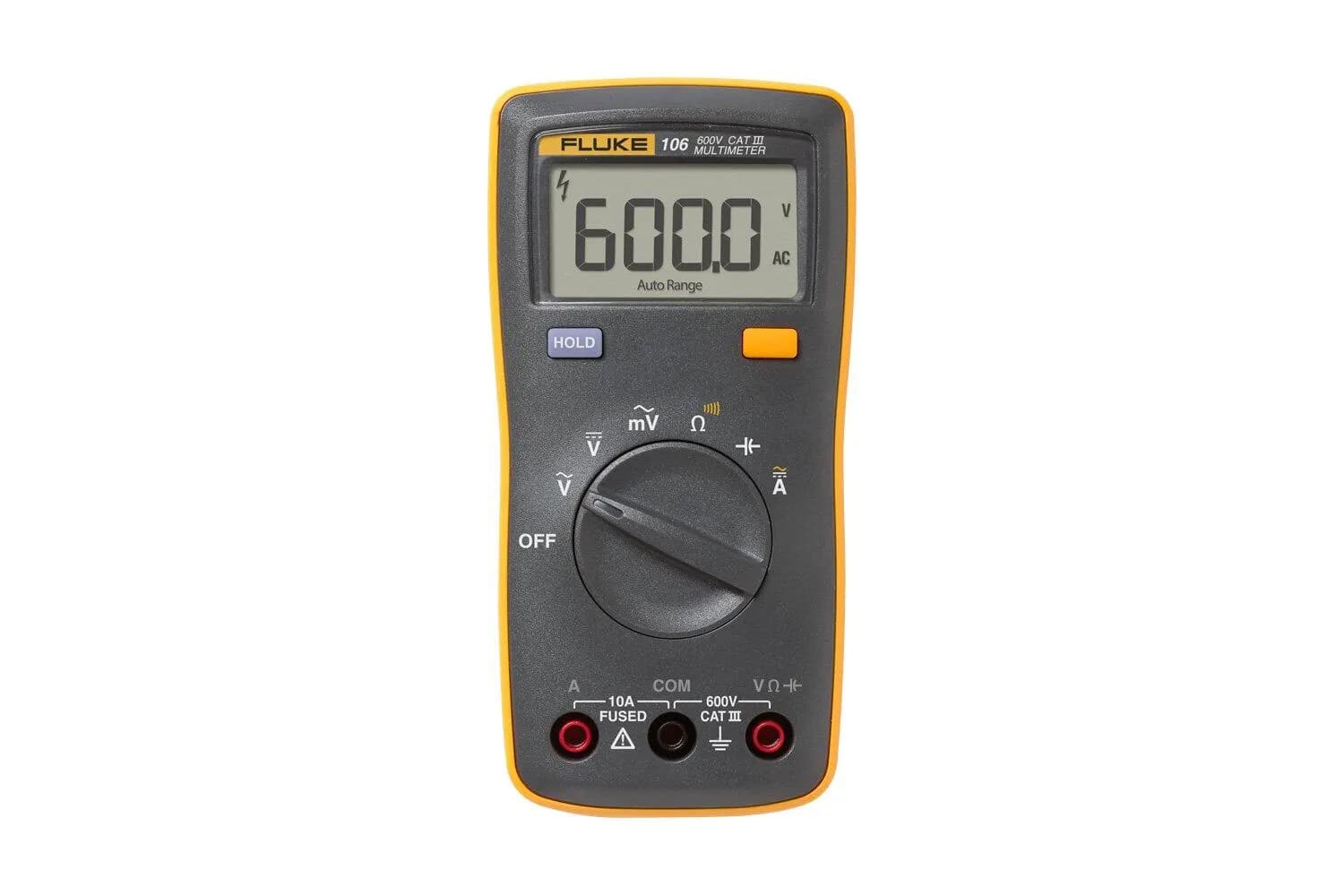
Fluke 106
4.2★★★★☆The 107's palm-sized body for less, without diode test, frequency or duty cycle.
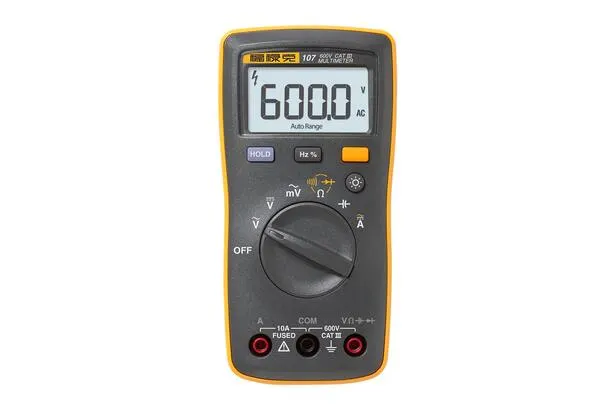
Fluke 107
4.3★★★★☆A palm-sized Fluke with CAT III 600V and a 6,000-count display, but not True RMS.
Specs side by side
| Fluke 106 | Fluke 107 | |
|---|---|---|
| Rating | 4.2★★★★☆ | 4.3★★★★☆ |
| Accuracy | Average-responding (not True RMS) | Average-responding (not True RMS) |
| Safety rating | CAT III 600V | CAT III 600V |
| Auto-ranging | Yes | Yes (per display) |
| Best for | A small, cheap backup meter | A compact second meter, home and auto checks |
| Display | 6,000 counts, 3 updates/s | 6,000 counts, 3 updates/s, backlit |
| Max voltage | 600V AC/DC | 600V AC/DC |
| Current | 4A and 10A ranges, AC/DC (no mA/µA) | 4A and 10A ranges, AC/DC (no mA/µA) |
| Resistance | 400.0 Ω to 40.00 MΩ | 400.0 Ω to 40.00 MΩ |
| Capacitance | 50 nF to 1,000 µF | 50 nF to 1,000 µF |
| Diode test | No | Yes, 2.000 V range |
| Frequency / duty cycle | No | 10 Hz to 100 kHz; 1% to 99% |
| Size / weight | 142 × 69 × 28 mm, 200 g | 142 × 69 × 28 mm, 200 g |
| Battery | 2 × AAA, 200 hours minimum | 2 × AAA, 200 hours minimum |
| Data hold | Not listed by Fluke | Yes |
| In the box | TL75 leads, 2 × AAA | TL75 leads, SmartStrap magnetic lanyard, 2 × AAA |
Specs checked against manufacturer documentation and official Amazon listings. Desk research, not bench testing. How we research.
Key differences
- →Fluke's 106/107 manual marks diode test, frequency and duty cycle as 107-only functions.
- →The 107's backlight is listed by Fluke; the 106 pages don't list one and its photo shows no backlight button.
- →Both have only 4A and 10A current ranges, with no milliamp or microamp ranges.
- →Neither meter is True RMS; Fluke positions the 106 for work where True RMS accuracy isn't needed.
- →Size, weight, CAT III 600V rating, the 6,000-count display and every shared accuracy figure are identical.
At a glance
Same body
142 × 69 × 28 mm, 200 g, two AAA cells, IP40 and CAT III 600V on both.
Same accuracy
Identical volts, amps, ohms and capacitance specs in Fluke's tables.
107 extra: diode
A 2.000 V diode range for LEDs, rectifiers and junctions.
107 extra: Hz and %
Frequency from 10 Hz to 100 kHz plus duty cycle from 1% to 99%.
107 extra: backlight
Listed for the 107; the 106 page and photo show none.
Verdict
Electronics or automotive signals: 107. Wiring checks only: 106.
Every difference between the Fluke 106 and 107
We went through both of Fluke's US product pages, spec tabs and the shared users manual line by line. These are all the differences we found, including the small ones that never make it into a feature list. Anything not in this table is the same on both meters.
| Difference | Fluke 106 | Fluke 107 | Who notices |
|---|---|---|---|
| Diode test | None | 2.000 V range, 1 mV steps, about 2.0 V open-circuit, under 0.6 mA | Anyone checking LEDs, rectifiers, flyback diodes |
| Frequency | None | 10 Hz to 100 kHz in five ranges, ±(0.1% + 3) | Generator, motor, oscillator and sensor checks |
| Hz while on AC volts or AC amps | No | Yes, per the manual | Checking line frequency without re-wiring |
| Duty cycle | None | 1% to 99%, 0.1% resolution, 1% typical | PWM fans, dimmers, injectors |
| Backlight | Not listed by Fluke | Listed; turns itself off after 2 minutes | Attics, crawl spaces, footwells |
| Data hold | Not listed on the 106 page | Listed on the 107 page | Readings taken where you can't see the screen |
| Lanyard in the box | Not listed (TL75 leads and batteries only) | SmartStrap magnetic lanyard plus TL75 leads | Hands-free work on steel panels |
| Warranty shown on the US page | Not stated on the page (2 years per Fluke's 106/107 documentation) | 2 years | Paperwork only, same term |
That is the whole list: three measuring functions, two display conveniences and an accessory. The body, the CAT III 600V rating, the 11 A fuse, the 6,000-count display, battery life, every accuracy figure and even the input impedance (over 10 MΩ on volts, over 1 MΩ on AC millivolts) are shared. So is a limit Fluke footnotes on the 106 page: AC readings are specified only from 1% to 100% of range, so anything under 0.06 V on the 6.000 V AC range is outside the published accuracy on either meter.
Fluke 106 vs 107 spec by spec
Fluke prints one accuracy table for the pair and marks the 107-only rows. Read down the last column: every measurement the 106 makes, the 107 makes to exactly the same tolerance. The gap is functions, not quality.
| Spec | Fluke 106 | Fluke 107 | Same? |
|---|---|---|---|
| DC volts | 6.000 to 600.0 V, ±(0.5% + 3) | 6.000 to 600.0 V, ±(0.5% + 3) | Same |
| AC volts, 40 to 500 Hz | 6.000 to 600.0 V, ±(1.0% + 3) | 6.000 to 600.0 V, ±(1.0% + 3) | Same |
| AC millivolts | 600.0 mV, ±(3.0% + 3) | 600.0 mV, ±(3.0% + 3) | Same |
| AC/DC amps | 4.000 A and 10.00 A, ±(1.5% + 3) | 4.000 A and 10.00 A, ±(1.5% + 3) | Same |
| Resistance | 400.0 Ω to 40.00 MΩ, ±(0.5% + 2) mid-ranges | 400.0 Ω to 40.00 MΩ, ±(0.5% + 2) mid-ranges | Same |
| Capacitance | 50 nF to 1,000 µF, ±(2% + 5) to ±(5% + 5) | 50 nF to 1,000 µF, ±(2% + 5) to ±(5% + 5) | Same |
| Continuity | Beeps below 70 Ω | Beeps below 70 Ω | Same |
| Diode test | Not available | 2.000 V range, 10% accuracy | 107 only |
| Frequency | Not available | 10 Hz to 100 kHz, ±(0.1% + 3) | 107 only |
| Duty cycle | Not available | 1% to 99%, 0.1% resolution | 107 only |
| Backlight | Not listed by Fluke | Yes, auto-off after 2 min | 107 only |
| Auto power off | After 20 min idle | After 20 min idle | Same |
| Battery and life | 2 × AAA, 200 h minimum | 2 × AAA, 200 h minimum | Same |
| Fuse | 11 A, 1000 V fast | 11 A, 1000 V fast | Same |
The capacitance row hides a practical detail from the manual: let the reading settle for up to 18 seconds on large electrolytics, and expect up to 1.5 nF of floor on the 50 nF range from the leads themselves. Both meters share that behavior, so it doesn't tip the choice either way.
What frequency and duty cycle actually show you
Many modern loads are switched on and off thousands of times a second rather than fed a steady voltage: PC and HVAC fans, LED dimmers, small motor controllers and fuel injectors. Put a DC-volts probe on one of those signals and you get an average that tells you little. The 107's Hz and % modes read the switching rate and the share of each cycle spent on, which is what the controller is actually changing.
Worked example, not a measurement: a 4-wire PC fan's PWM input typically runs at about 25 kHz, well inside the 107's 100 kHz limit. If the 107 reads 40.0% duty and the fan still won't spin up, the controller is doing its job and the fan or its tach wiring is the suspect. On a 106 you would only see a fixed-looking DC figure and could not tell a 40% command from a stuck output. The manual also lets the 107 read frequency on its current input, handy for checking line frequency through a load. For a full fan procedure, see how to test a 4-wire fan motor with a multimeter.
Where each meter earns its place
The 106 is a capable wiring meter. Receptacle voltage, a blown cartridge fuse, a heater element's resistance, or the running current of a 5 A appliance on the 10 A range are all inside its reach, with the same tolerance the 107 would give. Where it runs out is semiconductors and switched signals. Without a diode range you can't confirm an LED, a rectifier or a flyback diode, and a resistance reading across a junction depends on a test voltage Fluke doesn't publish for the ohms ranges, so it proves little.
That matters most in three places: hobby electronics, car electrical work and appliance control boards. A car's alternator diodes, LED tail lights and PWM-driven fuel pumps all need either the diode range or the duty-cycle mode. If any of that is on your list, the 107 is the only one of the pair that helps; if your work stays on the mains side of the panel, the 106 loses nothing.
01
Test LEDs or diodes?
Yes: 107
02
Read PWM or fan speed?
Yes: 107
03
Work in dim spaces?
Yes: 107 (backlight)
04
None of these
106 does the job
What the diode test is for
Fluke 106 or 107: which should you buy?
| You are… | Better fit | Why |
|---|---|---|
| Homeowner checking outlets, fuses and batteries | Fluke 106 | Same volts, ohms and amps accuracy; the extras would sit unused |
| Electronics hobbyist | Fluke 107 | Diode test for LEDs and rectifiers; frequency for oscillators and PWM |
| DIY car owner | Fluke 107 | Duty cycle on injectors and fuel pumps; diode test on alternator diodes |
| HVAC helper reading fan signals | Fluke 107 | Hz and % modes read EC fan PWM commands |
| Electrician wanting a pocket backup | Fluke 106 | Volts, continuity and 10A cover a backup role; both lack True RMS |
| Anyone working in attics or crawl spaces | Fluke 107 | Fluke lists a backlight for the 107 only |
If you need True RMS readings on drives or LED drivers, step up instead: see Fluke 117 vs Fluke 107 or the best budget True RMS multimeters.
Value: what each step up actually buys
We don't quote prices, because they move weekly, but value can still be judged by what each tier adds and what it takes away. Count the measuring functions and the 106 has eight: AC volts, DC volts, AC millivolts, AC amps, DC amps, resistance, continuity and capacitance. The 107 has eleven, adding diode, frequency and duty cycle, and it gives up nothing to get them: the same 200 g body, the same tolerances, the same battery life.
That makes 106 to 107 the cleanest upgrade in Fluke's entry range, a pure addition. The next steps are trades rather than additions, which is why the ladder below says what you lose as well as what you gain.
| Tier | What it adds | What it gives up | Worth it if… |
|---|---|---|---|
| Fluke 106 | Volts, 4 A and 10 A current, ohms, continuity, capacitance in a 200 g body | Diode, Hz, duty cycle, listed backlight | Your work is outlets, fuses, batteries and heaters |
| Fluke 107 | Diode, frequency, duty cycle, backlight, data hold, magnetic lanyard | Nothing versus the 106 | You touch electronics, cars or PWM-driven loads even occasionally |
| Fluke 15B+ | 400.0 µA to 400 mA ranges, readings to 1000 V (CAT II), backlight and diode test | Frequency and duty cycle; adds 255 g | You need standby current or flame-sensor microamps |
| Fluke 117 | True RMS and non-contact voltage detection | Leaves the palm-sized format | You work on drives, dimmers or electronic loads for a living |
The value case for the 106 is narrow but real. A second meter for a van or kitchen drawer, a meter for someone who will only ever check receptacles and batteries, or a shared tool where fewer modes means fewer mistakes: in those roles the three missing functions have no worth to you. Everywhere else, the cost of missing them is a second instrument, because there is no reliable workaround for a diode test or a frequency reading on a meter that lacks them. For the next step past the pair, see Fluke 15B+ vs Fluke 106.
What neither pocket Fluke does
- No milliamp or microamp ranges. The smallest current range is 4.000 A with 1 mA resolution, too coarse for standby draw or sensor loops. Our milliamp measuring guide explains what to use instead.
- Not True RMS. Fluke says so outright for the 107, and the 106 is positioned for jobs where True RMS isn't needed. Distorted waveforms can read high or low.
- No temperature, NCV or low-impedance mode. For those, look at the Fluke 17B+ (temperature) or the Fluke 117 (VoltAlert and LoZ).
Safety: a small meter is still a CAT III tool, not a CAT IV one
Choose the Fluke 106 if…
- ✓You mainly check outlets, batteries and fuses and never test diodes
- ✓You want the simpler of the two, with fewer modes behind the yellow button
- ✓You never look at signal frequency, fan PWM or injector pulses
Choose the Fluke 107 if…
- ✓You repair electronics and need a diode test
- ✓You check fan, motor or PWM signals and want frequency and duty cycle
- ✓You want a backlit display, which Fluke lists for the 107 but not for the 106
The bottom line
Buy the Fluke 107 if you touch electronics at all: diode test, frequency, duty cycle and a backlight cost little extra in the same 200 g body, with identical accuracy on everything else. The Fluke 106 is the right pick only as a pure electrical backup meter for voltage, current, resistance and continuity, where those extras would go unused.
Frequently asked questions
Are the Fluke 106 and 107 the same size?+
Yes. Fluke lists both at 142 × 69 × 28 mm and 200 g, both run on two AAA cells for at least 200 hours, and they share one users manual and one accuracy table. Only the function set differs: the 107 adds diode test, frequency, duty cycle and a listed backlight.
Does the Fluke 106 have a diode test?+
No. Fluke's 106/107 manual marks the diode test as a 107-only function, along with frequency and duty cycle. You can sometimes spot a dead short across a diode on the 106's resistance range, but you can't read a forward voltage or confirm an LED lights, so electronics work really calls for the 107.
Is either the Fluke 106 or 107 True RMS?+
No. Fluke states the 107 is not a True RMS meter and positions the 106 for work where True RMS accuracy isn't needed. On clean sine-wave mains that's fine. For variable-speed drives, dimmers and electronic loads, look at a Fluke 115 or 117, which read the true heating value of distorted waveforms.
Can the Fluke 106 or 107 measure milliamps?+
Not usefully. Fluke lists only 4.000 A and 10.00 A current ranges on both, with 1 mA as the finest resolution on the 4 A range and no dedicated mA or µA input. That rules out parasitic-drain checks, 4-20 mA loops and microcontroller sleep current. The Fluke 15B+ and 17B+ add µA and mA ranges.
Which pocket Fluke is better for a car toolbox?+
The 107. Both cover battery voltage, fuse continuity and 10 A current, but the 107's duty-cycle mode reads fuel-injector and PWM fuel-pump signals, its frequency mode checks some sensor outputs, and its diode range tests alternator diodes. Its backlight also helps under a dash or in a dark engine bay.
What frequency can the Fluke 107 measure?+
Fluke specifies 10 Hz to 100 kHz across five ranges with ±(0.1% + 3) accuracy, and duty cycle from 1% to 99% at 0.1% resolution. The manual lets you switch to frequency while reading AC volts or AC current, so you can check a 60 Hz line or a switching signal without moving the leads.
Does the Fluke 106 have a backlight or data hold?+
Fluke's US page for the 106 lists neither, and its product photo shows no backlight button, while the 107 page lists both a backlit display and data hold. If you take readings in a dark panel or somewhere you can't watch the screen, that alone can justify the 107, since every shared measurement is otherwise identical.
Related



