COMPARISON · MULTIMETERS
Fluke 15B+ vs Fluke 107
Fluke 15B+ vs Fluke 107 is an unusual trade: the smaller meter has the extra functions. The pocket 107 reads frequency and duty cycle, which the 15B+ can't, while the full-size 15B+ counters with microamp and milliamp current ranges and a reading up to 1000V. Neither is True RMS, and both carry CAT III 600V. Buy the 15B+ if small currents matter to you, and the 107 if signals and pocketability do.
By the OhmSavvy Research Team ·
Disclosure: OhmSavvy earns a commission from qualifying Amazon purchases made through these links, at no extra cost to you. How we're funded.
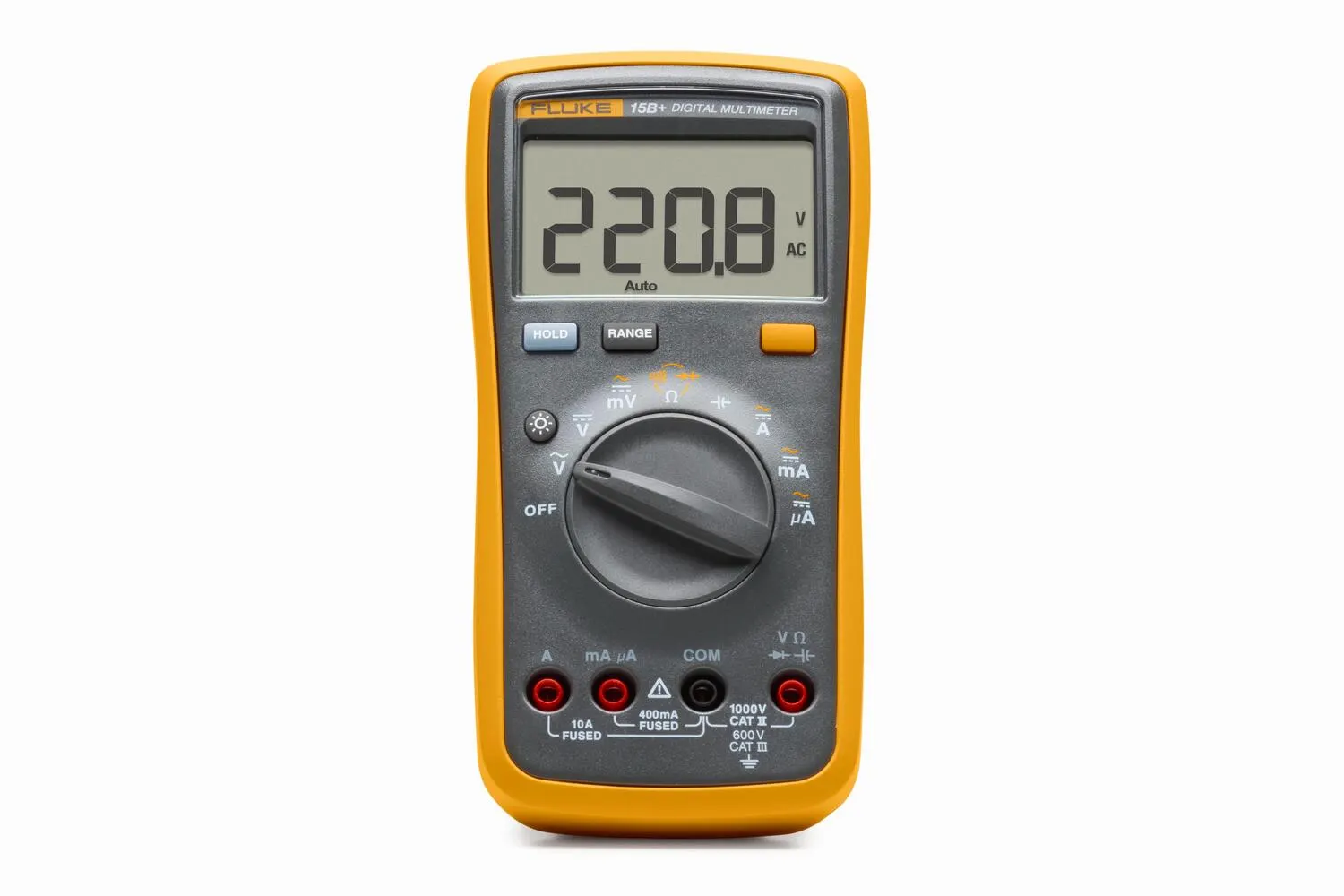
Fluke 15B+
4.3★★★★☆The 17B+ body and safety rating without frequency, temperature or MIN MAX: a plain, tough Fluke for volts, amps and ohms.
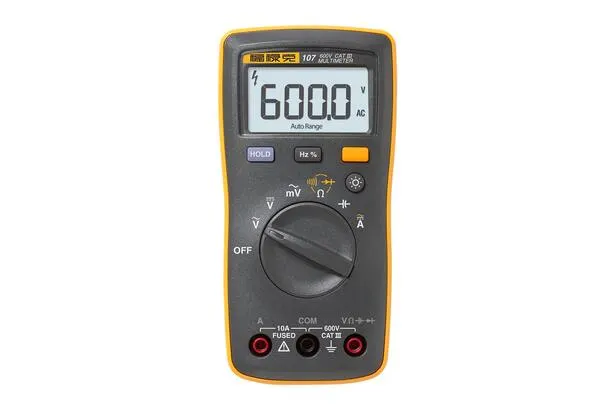
Fluke 107
4.3★★★★☆A palm-sized Fluke with CAT III 600V and a 6,000-count display, but not True RMS.
Specs side by side
| Fluke 15B+ | Fluke 107 | |
|---|---|---|
| Rating | 4.3★★★★☆ | 4.3★★★★☆ |
| Accuracy | Not stated as True RMS by Fluke | Average-responding (not True RMS) |
| Safety rating | CAT III 600V / CAT II 1000V | CAT III 600V |
| Auto-ranging | Yes (manual override) | Yes (per display) |
| Best for | Basic electrical and electronics checks | A compact second meter, home and auto checks |
| Display | 4,000 counts, backlit | 6,000 counts, backlit |
| Max voltage | 1000V AC/DC | 600V AC/DC |
| Current | 400.0 µA to 10.00 A in six ranges | 4.000 A and 10.00 A |
| Best current resolution | 0.1 µA | 1 mA |
| Frequency / duty cycle | No / No | Yes / Yes |
| Capacitance | 40.00 nF to 1,000 µF | 50.00 nF to 1,000 µF |
| Diode / continuity | Yes / Yes | Yes / Yes |
| Current fuses | 440 mA and 11 A, 1000V | 11 A, 1000V |
| Drop rating | Not stated | 1 m |
| Size / weight | 183 × 91 × 49.5 mm, 455 g | 142 × 69 × 28 mm, 200 g |
| Battery | 2 × AA, 500 h minimum | 2 × AAA, 200 h minimum |
Specs checked against manufacturer documentation and official Amazon listings. Desk research, not bench testing. How we research.
Key differences
- →The 107 measures frequency and duty cycle; Fluke's datasheet lists both as unavailable on the 15B+.
- →The 15B+ includes µA and mA current ranges; the 107 starts at a 4 A range with 1 mA steps.
- →The 15B+ reads up to 1000V and is also rated CAT II 1000V; the 107 is a 600V meter.
- →The 107's display reaches 6,000 counts, the 15B+'s 4,000.
- →The 107 is less than half the weight (200 g against 455 g) and is rated for a 1 m drop.
What each one has that the other doesn't
Only on the 15B+
µA / mA
Small-current ranges on a fused input.
1000V
Reads to 1000V; CAT II 1000V.
Only on the 107
Frequency
For signals, motors and supplies.
Duty cycle
For PWM and switching outputs.
OhmSavvy hasn't bought either meter; the figures on this page come from Fluke's product pages and its 15B+/17B+ datasheet. Both share the same voltage and resistance accuracy class, so the choice comes down to which extra functions you'll use.
Fluke 15B+ vs 107 spec by spec
| Spec | Fluke 15B+ | Fluke 107 |
|---|---|---|
| DC volts ranges | 4.000 / 40.00 / 400.0 / 1000 V | 6.000 / 60.00 / 600.0 V |
| DC volts accuracy | ±(0.5% + 3) | ±(0.5% + 3) |
| AC volts accuracy | ±(1.0% + 3), 40–500 Hz | ±(1.0% + 3), 40–500 Hz |
| Current ranges | 400.0 µA, 4000 µA, 40.00 mA, 400.0 mA, 4.000 A, 10.00 A | 4.000 A, 10.00 A |
| Current accuracy | ±(1.5% + 3) | ±(1.5% + 3) |
| AC current bandwidth | 40–400 Hz | 40–200 Hz |
| Resistance | 400.0 Ω to 40.00 MΩ | 400.0 Ω to 40.00 MΩ |
| Frequency | No | 10 Hz to 100 kHz, ±(0.1% + 3) |
| Duty cycle | No | 1% to 99% |
| Display | 4,000 counts, 3 updates/s | 6,000 counts, 3 updates/s |
| Safety rating | CAT III 600V, CAT II 1000V | CAT III 600V |
| Warranty | 1 year (users manual) | 2 years |
Bars use a logarithmic scale: each step is ten times the last.
Where small-current ranges make the difference
Both meters quote the same ±(1.5% + 3) current accuracy, but the "+ 3" is counted in the last digit of whichever range you're on, so resolution decides what you can see. A device drawing 50 µA in standby reads 50.0 µA on the 15B+'s 400 µA range, with a tolerance of 1.5% × 50 + 3 × 0.1 = ±1.05 µA. On the 107's 4 A range, the same current is a twentieth of one 1 mA step, so the display shows 0.000 A.
That gap covers battery-powered sensors, remote controls in standby, a car module that should be asleep, and 4–20 mA instrument loops, which read 4.00 to 20.00 mA on the 15B+'s 40 mA range but only 0.004 to 0.020 A on the 107. Our guide to measuring standby current walks through the hookup.
Where frequency and duty cycle make the difference
Going the other way, the 107 turns PWM questions into numbers. A 12 V PWM output switching at 25 kHz and 40% duty shows as about 4.8 V average on a voltmeter, which tells you little on its own. The 107 adds the frequency, read to ±(0.1% + 3), and the duty cycle, so you can confirm a controller is actually commanding 40%. The 15B+ shows only the average voltage. These figures are an illustrative example, not a measurement.
Frequency also helps confirm 60 Hz from a generator or an inverter's output. For waveform shape, though, neither meter replaces a scope; our guide to measuring PWM duty cycle with an oscilloscope shows what a meter can't.
Fluke 15B+ vs 107: which should you buy?
| You are | Better fit | Reason |
|---|---|---|
| An electronics hobbyist debugging PWM | 107 | Frequency and duty cycle |
| Checking device standby current | 15B+ | mA and µA ranges |
| Keeping a meter in a car or bag | 107 | 200 g, 1 m drop rating |
| Testing CAT II equipment above 600V | 15B+ | Reads to 1000V |
| Servicing 4–20 mA sensors | 15B+ | 40.00 mA range with 0.01 mA steps |
| Student on a lab bench | 15B+ | Full current ranges and AA battery life |
| Electrician on mains wiring | Neither ideal | Not True RMS; see the Fluke 117 |
If you want both sets of features
Safety: current ranges are fused for a reason
Choose the Fluke 15B+ if…
- ✓Small currents in µA or mA are part of your work
- ✓You sometimes measure above 600V on CAT II equipment
- ✓You want long battery life from AA cells: 500 hours minimum
Choose the Fluke 107 if…
- ✓You need frequency or duty cycle, for example on PWM or motor signals
- ✓You want a 6,000-count display
- ✓You want a meter that fits in a pocket and survives a 1 m drop
The bottom line
The 107 is the better pick for most electronics hobbyists: frequency, duty cycle and a 6,000-count display in a pocketable, drop-rated body. The 15B+ wins if you need small-current ranges or readings above 600V, and you're happy with a full-size meter.
Frequently asked questions
Does the Fluke 15B+ measure frequency?+
No. Fluke's 15B+/17B+ datasheet lists frequency and duty cycle as not available on the 15B+, and its product page specifies only volts, current, resistance, capacitance, diode and continuity. The 107 reads frequency from 10 Hz to 100 kHz and duty cycle from 1 to 99%, and the full-size 17B+ has both as well.
Can the Fluke 107 measure milliamps?+
Only coarsely. Fluke lists 4.000 A and 10.00 A ranges for the 107, so the smallest step is 1 mA and a 25 mA load reads 0.025 A. There are no dedicated mA or µA ranges. The 15B+ has 400.0 µA, 4000 µA, 40.00 mA and 400.0 mA ranges for small currents.
Which is more rugged, the 15B+ or the 107?+
Fluke states a 1 m drop rating for the 107 and gives both meters an IP 40 rating. The 15B+ product page doesn't state a drop height, though it is a larger meter in a full-size case. Neither is sealed against water, so keep both out of rain and wet work.
Are the Fluke 15B+ and 107 True RMS?+
No. Fluke's 107 page says plainly that it is not a true-RMS meter, and Fluke makes no True RMS claim for the 15B+. Both read clean sine waves well, but on variable-speed drives, LED drivers and switch-mode supplies their AC readings can be wrong. The Fluke 115 or 117 are the True RMS step up.
Why does the 15B+ read 1000V but carry a 600V CAT III rating?+
The measurement range and the safety category are different things. The 15B+ can display up to 1000V and is rated CAT II 1000V for equipment plugged into outlets, but only CAT III 600V for building wiring such as panels and feeders. Never use it above 600V on fixed installation circuits.
Related



