COMPARISON · MULTIMETERS
Fluke 101 vs Fluke T5-600
Fluke 101 vs Fluke T5-600 is the simplest current question in the Fluke range: only one of them measures current at all. The 101 is Fluke's smallest meter, with voltage, resistance, capacitance, frequency and diode test but no current jack. The T5-600 reads AC current up to 100A through its open jaw, and gives up the 101's signal and component functions, plus fine voltage resolution, to do it. Electricians checking loads want the T5-600; anyone measuring batteries, sensors or components wants the 101.
By the OhmSavvy Research Team ·
Disclosure: OhmSavvy earns a commission from qualifying Amazon purchases made through these links, at no extra cost to you. How we're funded.
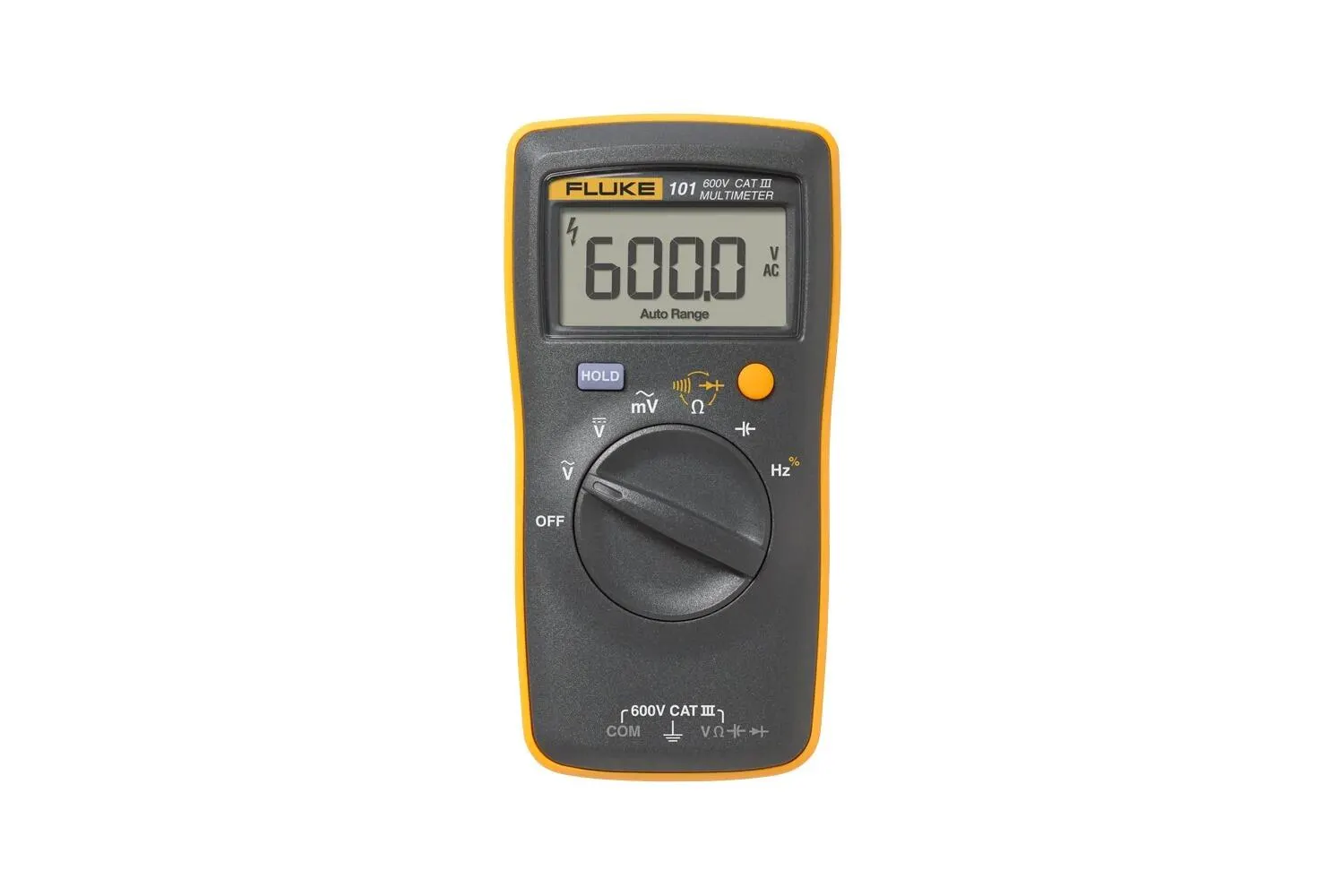
Fluke 101
4.1★★★★☆Fluke's smallest, simplest meter: volts, ohms, capacitance and frequency in 160 g, but no current measurement at all.
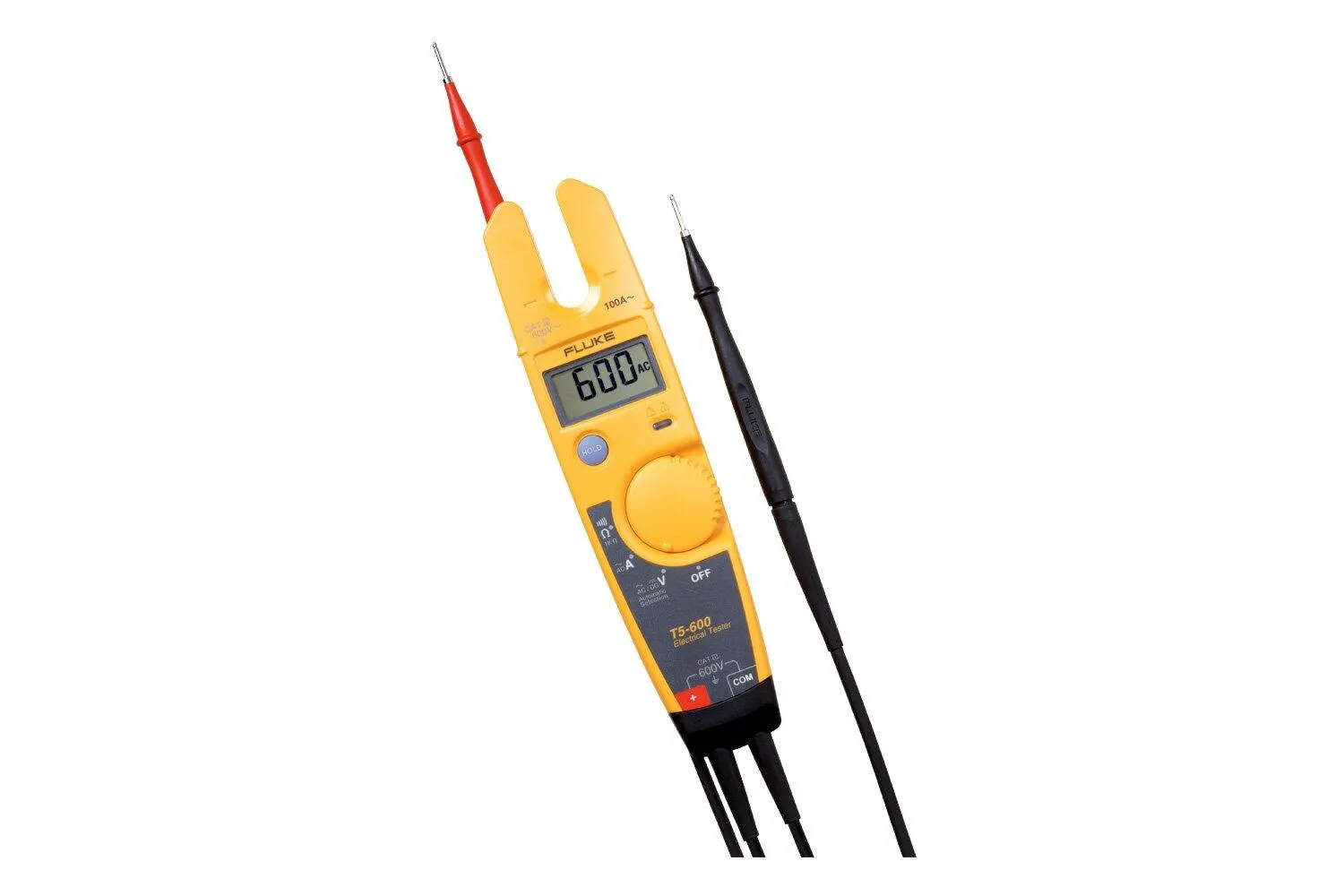
Fluke T5-600
4.4★★★★☆Not a multimeter but an electrician's tester: volts, continuity and up to 100A AC through an open jaw, no leads in the circuit.
Specs side by side
| Fluke 101 | Fluke T5-600 | |
|---|---|---|
| Rating | 4.1★★★★☆ | 4.4★★★★☆ |
| Accuracy | Not stated as True RMS by Fluke | Average-responding (not True RMS) |
| Safety rating | CAT III 600V | CAT III 600V |
| Auto-ranging | Yes | Automatic AC/DC voltage selection |
| Best for | Voltage and continuity checks only | Electricians' quick voltage and current checks |
| Instrument type | Basic digital multimeter | Electrical tester |
| Current | None | To 100.0A AC via open jaw, ±(3% + 3) |
| Voltage | To 600V AC/DC, 0.001 V best resolution | To 600V AC/DC, 1 V resolution, automatic AC/DC |
| Resistance | To 40 MΩ | To 1,000 Ω |
| Capacitance | Yes (Fluke lists 100 µF and 1,000 µF in different documents) | No |
| Frequency / duty cycle | To 100 kHz; 1–99% | No |
| Diode test | Yes | Not listed |
| AC response | Not stated as True RMS | Averaging |
| Battery | 2 × AAA | 2 × AA, 400 h alkaline |
| Weight | 160 g | 300 g |
| Drop rating | 1 m | 3 m (10 ft) |
| Warranty | 1 year | 2 years |
| US availability | Import listings only | Sold on fluke.com US |
Specs checked against manufacturer documentation and official Amazon listings. Desk research, not bench testing. How we research.
Key differences
- →The T5-600 measures AC current up to 100A; the 101 has no current function.
- →The 101 adds frequency to 100 kHz, duty cycle, capacitance and diode test, which the T5-600 lacks.
- →Resistance runs to 40 MΩ on the 101 but only 1,000 Ω on the T5-600.
- →The T5-600 shows voltage in whole volts; the 101 resolves down to a millivolt on its 6 V range.
- →The 101 weighs 160 g, 140 g less than the T5-600, and is much shorter at 130 mm against 203 mm.
- →Fluke warrants the T5-600 for two years and the 101 for one; the 101 isn't sold on Fluke's US site.
What each one measures
Fluke 101
Voltage, resistance to 40 MΩ, capacitance, frequency, duty cycle, diode, continuity.
Fluke T5-600
Voltage with auto AC/DC, resistance to 1,000 Ω, continuity, AC current to 100A.
Neither
DC current or temperature; and Fluke describes neither as True RMS.
These two are often cross-shopped because both are small, yellow and CAT III 600V, but they are built for different jobs. The 101 is a pocket multimeter for components and low-voltage circuits. The T5-600 is an electrician's tester that answers three questions fast: is it live, is it continuous, and how much current is it pulling. We haven't bought either for testing; everything here comes from Fluke's published specifications.
Fluke 101 vs T5-600 spec by spec
| Spec | Fluke 101 | Fluke T5-600 |
|---|---|---|
| DC volts | 6.000 / 60.00 / 600.0 V, ±(0.5% + 3) | To 600 V, 1 V resolution, ±(1% + 1) |
| AC volts | 600.0 mV to 600.0 V, ±(1.0% + 3) | To 600 V, 1 V resolution, ±(1.5% + 2) |
| AC/DC selection | Separate dial positions | Automatic |
| AC current | None | 100.0 A, 0.1 A resolution, ±(3% + 3) |
| DC current | None | None |
| Resistance | 400.0 Ω to 40.00 MΩ | To 1,000 Ω, 1 Ω resolution, ±(1% + 2) |
| Continuity | Yes, with buzzer | Beeps below 25 Ω, silent above 400 Ω |
| Capacitance | 50.00 nF to 1,000 µF ranges | No |
| Frequency | 10 Hz to 100 kHz | No |
| Size | 130 × 65 × 27 mm | 203 × 51 × 30.5 mm |
| Safety rating | CAT III 600V | CAT III 600V |
Bars use a logarithmic scale: each step is ten times the last.
Bars use a logarithmic scale: each step is ten times the last.
Why one reads amps and the other can't
A conventional multimeter measures current by putting itself in series: you break the circuit and route the current through a fused shunt behind a dedicated amps jack. The 101 has only two jacks, COM and V/Ω, so that path doesn't exist. The T5-600 takes the other route. Its OpenJaw fork slips around a single conductor and senses the magnetic field that alternating current creates, so the circuit never opens.
Two limits follow from that design. The fork only senses changing fields, so it can't read DC current from a battery or solar string. And it must go around one conductor: around a whole cord, the hot and neutral currents cancel and the display reads near zero. Fluke rates the gap at 12.9 mm, enough for wire up to 1/0 THHN. For the wider topic, see measuring current without breaking the circuit.
What the resolution gap means on a car battery
Whole-volt resolution is fine for confirming 120 V at a receptacle, but it hides the detail that low-voltage work depends on. Take a 12 V battery. On the 101's 60 V range, a reading of 12.60 V carries a tolerance of 0.5% × 12.60 + 3 × 0.01 = ±0.09 V. The T5-600 would show 13, with a tolerance of 1% × 13 + 1 = ±1.1 V, so a healthy battery and a half-flat one can show the same number.
The same arithmetic runs the other way for current. A 1.5 A load on the T5-600 reads to ±(3% × 1.5 + 0.3) = ±0.35 A, rough but useful for spotting an overloaded circuit. On a 15 A load the error is about ±0.75 A, which is plenty to compare against a breaker rating. Our guide to testing a car battery with a multimeter explains which voltages matter.
Fluke 101 vs T5-600: which should you buy?
| You are… | Better fit | Why |
|---|---|---|
| Electrician checking loads on branch circuits | Fluke T5-600 | AC current to 100 A without opening the circuit |
| Electronics hobbyist | Fluke 101 | Millivolt resolution, diode test, capacitance and frequency |
| Car or battery owner | Fluke 101 | Resolves 12.60 V; the T5-600 shows whole volts only |
| HVAC tech checking a compressor's draw | Fluke T5-600 | Reads running amps on one conductor |
| Appliance repair, element and switch checks | Either | Both read low resistance and continuity |
| Tester that lives on a ladder or in a van | Fluke T5-600 | 3 m drop rating and stored probes |
| Needs DC current | Neither | Look at the Fluke 107 or 15B+ |
If you need both current and signals
Use cases in practice
On a service call the T5-600 earns its place by speed. The meter picks AC or DC on its own, the probes stow in the back, and a quick slip of the fork over a motor lead tells you whether it pulls its nameplate current. It is a go/no-go tool, which is why Fluke designed its protection circuit to tolerate a longer connection to a voltage source than a solenoid tester.
The 101 suits the bench, the glovebox and the hobby drawer. Reading a sensor's 0.45 V output, checking a PWM fan signal's frequency, or confirming a resistor is 47 kΩ rather than 4.7 kΩ are all jobs the T5-600 simply can't do. When the 101 shows OL on resistance, our guide to OL on a multimeter explains what it means.
Safety: CAT III 600V is the ceiling for both
Choose the Fluke 101 if…
- ✓You need frequency, duty cycle, capacitance or a diode test
- ✓You want the lightest possible Fluke, at 160 g
- ✓You need readings finer than 1 V, such as battery state of charge
Choose the Fluke T5-600 if…
- ✓You need to know how much current a circuit draws
- ✓You want a two-year warranty and a model sold on Fluke's US site
- ✓You want a tester rated for a 3 m drop
The bottom line
Choose the T5-600 if you ever need to know how much current something draws; the 101 simply can't tell you. Choose the 101 for light electronics, battery and signal work, where frequency, duty cycle, diode test, millivolt resolution and a 160 g body matter, and current never does.
Frequently asked questions
Does the Fluke 101 measure amps?+
No. The 101 has only two input jacks, COM and V/Ω, and no current function on the dial, so it can't read amps in any form. If you need current from a pocket Fluke, the 107 and 106 add 4 A and 10 A ranges, and the T5-600 reads AC current up to 100 A through its open jaw.
Can the Fluke T5-600 measure DC current?+
No. Fluke specifies the T5-600's current function for AC at 50/60 Hz only, up to 100.0 A, and its own product Q&A confirms it can't measure DC amps. The OpenJaw fork senses a changing magnetic field, so batteries, solar strings and automotive DC circuits need a DC-capable clamp meter or a meter with fused amps inputs.
Can the T5-600 measure frequency or capacitance?+
No. The T5-600 measures voltage, continuity, resistance to 1,000 Ω and AC current, and nothing else. Frequency to 100 kHz, duty cycle, capacitance and diode test are all on the Fluke 101. If you need those plus current in one tool, a pocket meter such as the Fluke 107 covers both sets.
Are the Fluke 101 and T5-600 both CAT III 600V?+
Yes. Fluke rates both at CAT III 600V, so either is suitable for distribution panels, feeders and branch circuits in a building. Neither carries a CAT IV rating, so don't use them at the meter base, service drop or outdoor feeds; for that work, look at the Fluke 87V or Fluke 179.
Why is the Fluke 101 hard to find in the US?+
Fluke sells the 101 in markets such as India and Malaysia but doesn't list it on its US site, so US listings come from third-party importers. It carries a one-year warranty, against two years for the T5-600. Check the seller and the warranty terms on the listing before buying.
Related



