COMPARISON · MULTIMETERS
Fluke 107 vs Fluke 115 for Electronics Beginners
For a beginner learning electronics on the bench, the Fluke 107 is the better fit: it reads small resistors and small ceramic capacitors more precisely than the Fluke 115, adds duty cycle for PWM, and costs and weighs less. The 115 wins if your learning includes mains AC, because it is True RMS, and it has a finer DC millivolt range and a far tighter diode test. Neither has a milliamp range, which is the gap every electronics beginner should know about before buying.
By the OhmSavvy Research Team ·
Disclosure: OhmSavvy earns a commission from qualifying Amazon purchases made through these links, at no extra cost to you. How we're funded.
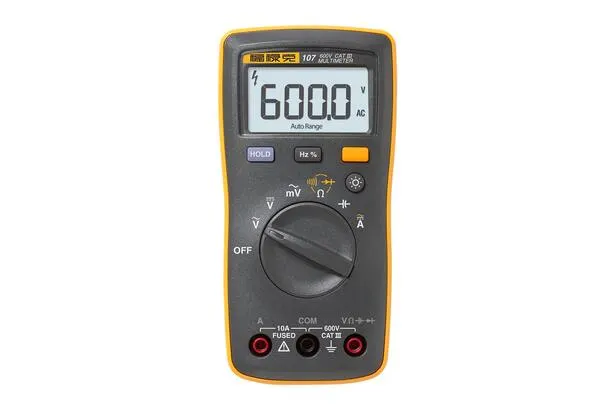
Fluke 107
4.3★★★★☆A palm-sized Fluke with CAT III 600V and a 6,000-count display, but not True RMS.

Fluke 115
4.8★★★★★The same Fluke reliability as the 117, in the same body, without the electrician-specific extras (NCV, AutoVolt, LoZ).
Specs side by side
| Fluke 107 | Fluke 115 | |
|---|---|---|
| Rating | 4.3★★★★☆ | 4.8★★★★★ |
| Accuracy | Average-responding (not True RMS) | True RMS |
| Safety rating | CAT III 600V | CAT III 600V |
| Auto-ranging | Yes (per display) | Yes |
| Best for | A compact second meter, home and auto checks | Field technicians, general electrical and electronics work |
| True RMS | No (Fluke says so) | Yes |
| Display | 6,000 counts, 3 updates/s | 6,000 counts, 4 updates/s + bar graph |
| Lowest DC volts range | 6.000 V (1 mV steps) | 600.0 mV (0.1 mV steps) |
| Resistance, lowest range | 400.0 Ω, ±(0.5% + 3) | 600.0 Ω, ±(0.9% + 1) |
| Capacitance | 50.00 nF to 1,000 µF | 1,000 nF (1 nF steps) to 9,999 µF |
| Diode test | 2.000 V, 10% | 2.00 V, ±(0.9% + 2) |
| Current | 4.000 A and 10.00 A | 6.000 A and 10.00 A |
| Frequency / duty cycle | To 100 kHz / 1–99% | To 50 kHz / not listed |
| Continuity beep | Below 70 Ω | Below 20 Ω |
| Safety rating | CAT III 600V | CAT III 600V |
| Battery | 2 × AAA, at least 200 h | One 9V, 400 h typical |
| Size / weight | 142 × 69 × 28 mm, 200 g | 167 × 84 × 46 mm, 550 g |
| Warranty | 2 years | 3 years |
Specs checked against manufacturer documentation and official Amazon listings. Fluke 115 is hands-on tested by OhmSavvy; the Fluke 107 assessment is desk research. How we research.
Key differences
- →The 115 is True RMS; Fluke states the 107 is not, so the 107's AC readings drift on distorted waveforms such as dimmers and switch-mode supplies.
- →The 107 has tighter resistance accuracy on its lower ranges, ±(0.5% + 2 or 3), against ±(0.9% + 1) on the 115.
- →The 107 has a 50.00 nF capacitance range with 0.01 nF steps; the 115's smallest range is 1,000 nF with 1 nF steps, so small ceramics read far more precisely on the 107.
- →The 115 has a 600.0 mV DC range and a ±(0.9% + 2) diode test; the 107's DC volts start at 6.000 V and its diode test is specified at 10%.
- →The 107 adds duty cycle and reads frequency to 100 kHz; the 115 adds a bar graph, Min/Max/Avg and a 3-year warranty.
What a beginner actually measures
Most first months with a multimeter look the same: checking battery and supply voltages, sorting resistors from a mixed bag, confirming a wire or solder joint is continuous, finding which way round a diode or LED goes, reading a capacitor that lost its markings, and trying to see how much current a project draws. The table below takes those jobs one at a time.
| Beginner task | Fluke 107 | Fluke 115 | Edge |
|---|---|---|---|
| Battery or 5 V / 3.3 V rail | 6.000 V range, ±(0.5% + 3) | 6.000 V range, ±(0.5% + 2) | Tie |
| Sorting resistors | 400.0 Ω range, ±(0.5% + 3) | 600.0 Ω range, ±(0.9% + 1) | 107 |
| Small ceramic capacitors | 50.00 nF range, 0.01 nF steps | 1,000 nF range, 1 nF steps | 107 |
| Electrolytic capacitors | To 1,000 µF, ±(5% + 5) | To 9,999 µF, ±(1.9% + 2) | 115 |
| Diode or LED direction | 2.000 V, 10% | 2.00 V, ±(0.9% + 2) | 115 |
| Continuity on a wire or joint | Beeps below 70 Ω | Beeps below 20 Ω | 115 |
| Arduino PWM pin | Frequency + duty cycle | Frequency only | 107 |
| Project current in mA | 1 mA steps, ±3 counts | 1 mA steps, ±3 counts | Neither |
| Wall-outlet AC | Average-responding | True RMS | 115 |
Four rows go to the 115, three to the 107, one is a tie, and one is a gap in both. The rows the 107 wins are the bench-electronics ones; the 115 wins on diodes, continuity, big capacitors and mains. Our how to use a multimeter guide covers each of these measurements from scratch, and multimeter symbols explained decodes the dial on either meter.
Fluke 107 vs 115 spec by spec, worked out
Accuracy lines like ±(0.5% + 3) only mean something once you apply them to a real part. Here they are on values a beginner meets on day one. One count is the last digit of the range in use.
The arithmetic behind the charts: for 220 Ω, the 107 allows 0.5% (1.1 Ω) plus 3 × 0.1 Ω, while the 115 allows 0.9% (2.0 Ω) plus 0.1 Ω. For 10 nF, the 107 allows 2% (0.2 nF) plus 5 × 0.01 nF; the 115 reads it on a range with 1 nF steps, so its 2-count allowance alone is 2 nF, or 20% of the part. For 47 µF the tables turn: the 107's ±(5% + 5) gives about ±2.4 µF against about ±1.1 µF on the 115. For a 0.6 V diode drop, the 107's 10% means ±60 mV; the 115 allows 0.9% plus 2 mV, about ±7 mV.
Precision isn't the same as being the better beginner meter
The current-range trap for beginners
Beginners almost always want to measure current: how much an LED, a motor or an Arduino sketch draws. Neither Fluke has a milliamp or microamp jack. The 107's smallest current range is 4.000 A and the 115's is 6.000 A, both with 1 mA steps and a 3-count allowance. On an LED driven at a typical 20 mA, the 107 allows 0.3 mA plus 3 mA, about ±3.3 mA; the 115's DC line of ±(1.0% + 3) gives about ±3.2 mA. Either way the reading is uncertain by roughly 16%, and a microcontroller sleeping at a few hundred microamps reads 0.000 A on both.
If measuring project current matters to you, either meter needs a partner, or you should pick a meter with real mA and µA ranges from our Arduino and circuit board multimeter guide. The workaround with either Fluke is to measure the voltage across a known resistor and divide, as our guide to measuring an Arduino's current consumption explains. Here the 115's 600.0 mV DC range helps: 20 mA through a 10 Ω resistor drops 200 mV, which it reads in 0.1 mV steps, while the 107 reads it on its 6.000 V range in 1 mV steps.
True RMS, safety ratings and size
True RMS matters less to a bench beginner than marketing suggests. Breadboard work is DC, and on a clean sine from a wall transformer the average-responding 107 and the True RMS 115 agree within spec. The gap opens on distorted AC: dimmer outputs, switch-mode supply inputs and motor drives, where the 107 can read wrong and the 115 stays honest. The 107's AC current is also specified only from 40 to 200 Hz. If your next step after kits is appliance repair, that is a reason to choose the 115.
On safety, the two are equals: both are rated CAT III 600V, far beyond anything on a hobby bench, and Fluke lists an 11 A, 1000 V fast-acting fuse on the 107's current input. The commonest beginner accident is leaving the red lead in the A jack and then probing a battery or outlet as if measuring volts; that shorts the source through the fuse. Read why a multimeter fuse blows when measuring current before your first current reading.
Size cuts both ways. The 107 weighs 200 g against 550 g and is 28 mm thick against 46 mm, so it sits on a crowded bench or in a backpack without fuss, and its AAA cells are cheap and easy to find. The 115's larger display adds a 33-segment bar graph that updates 32 times a second, which helps when you turn a potentiometer and want to watch the trend, and Min/Max/Avg catches a supply that dips while a motor starts.
Fluke 107 strengths
Small parts precision, duty cycle, 100 kHz, 200 g, AAA cells.
Fluke 115 strengths
True RMS, 600.0 mV DC, tight diode test, bar graph, 3-year warranty.
Shared limits
No mA or µA ranges, no temperature, CAT III 600V on both.
Compact vs professional: what the bigger meter adds
The 107 is Fluke's palm-sized meter; the 115 is a full-size field-service meter of the kind technicians carry all day. Safety is not what separates them, since both carry the same CAT III 600V rating. The professional body buys three things a compact one gives up: True RMS, tools for watching a reading change (the bar graph and Min/Max/Avg), and longer intervals between battery changes, plus an extra warranty year. The compact body buys portability and two published ruggedness figures that Fluke doesn't list for the 115.
| Trait | Fluke 107 (compact) | Fluke 115 (professional) | When it matters |
|---|---|---|---|
| Carry weight | 200 g | 550 g | In a pocket, backpack or glovebox all day |
| AC conversion | Average responding | True RMS | Dimmers, drives, switch-mode supplies |
| Watching a changing value | Digits only, 3 updates/s | 33-segment bar graph at 32/s, 4 digit updates/s | Adjusting a pot, a sensor or a supply |
| Catching a dip or peak | Not listed | Min/Max/Avg | A supply that sags when a motor starts |
| Battery | 2 × AAA, at least 200 h | One 9V, 400 h typical | Long shifts, infrequent maintenance |
| Published ruggedness | IP40, 1 m drop | Not stated in our sources | Dusty benches, drops from a bench top |
| Safety rating | CAT III 600V | CAT III 600V | Equal on both |
| Warranty | 2 years | 3 years | Heavy daily use |
For a learner, the honest summary is that the compact meter is not a toy and the professional one is not a requirement. The 107 measures to Fluke's published specs and is rated for the same circuits. Move up to the 115 when your work starts to include distorted AC, values you have to watch rather than read once, or a meter that stays in a work belt every day. If you want the professional body with LoZ and non-contact detection too, our Fluke 115 vs Fluke 117 comparison covers the next step.
Fluke 107 vs Fluke 115 for beginners: which should you buy?
| You are… | Better fit | Why |
|---|---|---|
| Learning on breadboards and kits | Fluke 107 | Better small-resistor and ceramic-capacitor readings, duty cycle |
| Learning Arduino and PWM | Fluke 107 | Duty cycle and frequency to 100 kHz; pair with a mA-capable meter |
| Student who will move into electrical trades | Fluke 115 | True RMS and a body built for field work |
| Hobbyist repairing appliances or audio gear | Fluke 115 | True RMS on AC, 600.0 mV DC, tight diode test |
| Carrying a meter in a backpack | Fluke 107 | 200 g and 28 mm thick |
| Wanting the longest warranty | Fluke 115 | 3 years against 2 |
| Mainly measuring project current | Neither | No mA or µA ranges on either |
The Fluke 115 is one of the meters the owner has bought and tested; our 107 assessment is desk research against Fluke's published specifications. For more starter options, see our best multimeter for beginners guide. To see the 107 against a True RMS electrician's meter, read Fluke 117 vs Fluke 107; against its cheaper twin, read Fluke 106 vs Fluke 107.
Safety for first-time meter users
Choose the Fluke 107 if…
- ✓You are learning on breadboards, Arduino boards and kits rather than house wiring
- ✓You want the closer resistor and small-capacitor readings and a duty-cycle function
- ✓You want a light meter that lives on the bench or in a backpack
Choose the Fluke 115 if…
- ✓Your learning will move on to mains appliances, motors or HVAC controls
- ✓You want True RMS AC readings and a 600.0 mV DC range
- ✓You want a bar graph and Min/Max/Avg to watch values change
The bottom line
For a beginner learning electronics, buy the Fluke 107: it reads small resistors and ceramic capacitors more precisely, adds duty cycle, and is easy to carry. Choose the Fluke 115 if your learning will reach mains appliances or trade work, where True RMS, a 600.0 mV range and a tight diode test matter. With either, plan for a separate meter with mA and µA ranges if you need to measure project current.
Frequently asked questions
Is the Fluke 107 good for beginners?+
Yes, especially for electronics. It is small and light, rated CAT III 600V, reads resistance with ±(0.5% + 3) accuracy on its lowest range and has a 50.00 nF capacitance range for small ceramics. Its limits are no True RMS, a loose 10% diode test and no milliamp range, so it can't read small project currents precisely.
Is the Fluke 115 overkill for a beginner?+
Not if you'll work on mains equipment. Its True RMS, bar graph and Min/Max/Avg are useful once you move past kits. For purely breadboard learning, though, it is bigger and heavier than needed, and it reads small capacitors and low resistances less precisely than the Fluke 107. It is the more versatile long-term meter of the two.
Can the Fluke 107 or 115 measure milliamps?+
Only coarsely. Neither has a milliamp or microamp jack; their smallest current ranges are 4.000 A and 6.000 A, both with 1 mA steps and a 3-count allowance. A 20 mA LED reads with about ±3 mA of uncertainty. For Arduino sleep currents, use a meter with true mA and µA ranges or measure voltage across a known resistor.
Does a beginner need a True RMS multimeter?+
Not for battery, breadboard and DC work, where True RMS makes no difference. It matters on distorted AC, such as dimmer outputs, switch-mode power supplies and motor drives, where an average-responding meter like the 107 can misread. If you expect to work on mains appliances soon, the True RMS Fluke 115 is worth choosing.
Can the Fluke 107 test LEDs?+
Partly. Its diode test runs to 2.000 V with about 2.0 V available, which covers many red LEDs but not blue or white ones, which typically need around 3 V and show overload. The 115's diode range also stops at 2 V. Accuracy differs: the 107 is specified at 10%, the 115 at ±(0.9% + 2).
Is the compact Fluke 107 a professional multimeter?+
It carries the same CAT III 600V rating as the full-size 115 and Fluke publishes full accuracy specs for it, so it is safe for the same circuits. What it lacks are professional conveniences: True RMS, a bar graph, Min/Max/Avg, the 115's 400-hour battery and a third warranty year. It also suits a professional as a second, pocket meter.
Which is safer for a beginner, the Fluke 107 or 115?+
They share the same CAT III 600V rating, so neither is safer by rating. Safety for a beginner comes from habits: checking the dial and lead jacks before each reading, using lead finger guards, and never measuring current across a voltage source. Replace damaged test leads before using either meter on mains.
Related


