HOW-TO GUIDE
How to Measure Resistance of a Heating Cartridge With a Multimeter
By the OhmSavvy Research Team ·
1Work out the expected resistance
A cartridge is sold by voltage and wattage, not ohms, but the two are linked by R = V² / P. Square the rated voltage and divide by the rated power. Because voltage is squared, cartridges with the same wattage differ by a factor of four between 12V and 24V versions, which is the single most useful thing to know when identifying an unmarked part.
| Rating | Calculation | Expected resistance |
|---|---|---|
| 12 V, 30 W | 144 / 30 | 4.8 Ω |
| 12 V, 40 W | 144 / 40 | 3.6 Ω |
| 24 V, 40 W | 576 / 40 | 14.4 Ω |
| 24 V, 50 W | 576 / 50 | 11.5 Ω |
| 24 V, 60 W | 576 / 60 | 9.6 Ω |
These figures are nominal. Cartridges are made to a tolerance, commonly around ±10%, so a 24V 40W part reading 13.5 or 15.5 Ω is not a fault. Mains cartridges for industrial and soldering use follow the same formula with a much larger V², so they read tens to hundreds of ohms. For the general method on mains elements, see our heating element resistance guide.
2Null the test leads
A handheld meter measures resistance with the same two wires that carry its test current, so it reads the leads, the probe tips and the contact resistance as part of the answer. On a 10 kΩ resistor that is invisible. On a 3.6 Ω cartridge, 0.3 Ω of lead resistance is an error of more than 8%. Set the meter to its lowest resistance range, press the probe tips firmly together, and note the reading. Subtract it from everything you measure, or use the meter's relative or zero mode if it has one.
3Measure the cartridge
Switch the printer off and unplug it, then let the hot end cool fully. Unplug the heater leads from the control board, or unscrew them from the terminal block, so the MOSFET and board traces aren't in the measurement. Measure across the two heater wires and subtract the lead figure. While the probes are on, flex the wires near the cartridge body and at the crimp: a reading that jumps or opens when the cable moves is a broken conductor, a very common failure on moving print heads.
4Check for a short to the sheath
Move to a high resistance range and measure from each heater lead to the cartridge's metal sheath, or to the heater block it sits in. Both should read OL. A finite reading means the element has broken through its insulation to the casing. On a low-voltage printer this can feed heater voltage into the hot end, the nozzle and anything touching it, and on a mains cartridge it is a shock hazard. Either way the cartridge should be replaced. Our washing machine element guide walks through the same terminal-to-sheath check on a mains appliance.
Cold vs hot resistance
12V cartridge on 24V: why it's dangerous
Power is V² / R, so doubling the voltage across the same resistance quadruples the power. A 12V 40W cartridge of about 3.6 Ω fed from a 24V board tries to dissipate around 160W. It heats far faster than the firmware's control loop expects, overshoots, and can overheat the block, melt nearby plastic or wiring, and stress the board's heater MOSFET and connector. The opposite mistake is safe but useless: a 24V cartridge on 12V delivers only a quarter of its rating and may never reach temperature.
Check before you fit
Reading the results
| What you measure | Likely cause |
|---|---|
| Within ~10% of V²/P after subtracting leads, OL to sheath | Cartridge healthy; check thermistor, wiring and firmware |
| About a quarter of the expected value | 12V cartridge fitted to a 24V machine |
| About four times the expected value | 24V cartridge fitted to a 12V machine |
| OL across the leads | Open element or broken lead; flex the cable to find it |
| Reading jumps when the leads are moved | Broken conductor or loose crimp near the hot end |
| Near 0 Ω across the leads | Shorted leads or a shorted element; inspect the cable first |
| Any reading from a lead to the sheath | Insulation breakdown; replace the cartridge |
Meters for low-ohm cartridge checks
Heater cartridges often read only a few ohms, so lead resistance is a real share of the reading. A relative-zero function or a fine resolution helps you trust the number.
Meters for heater resistance
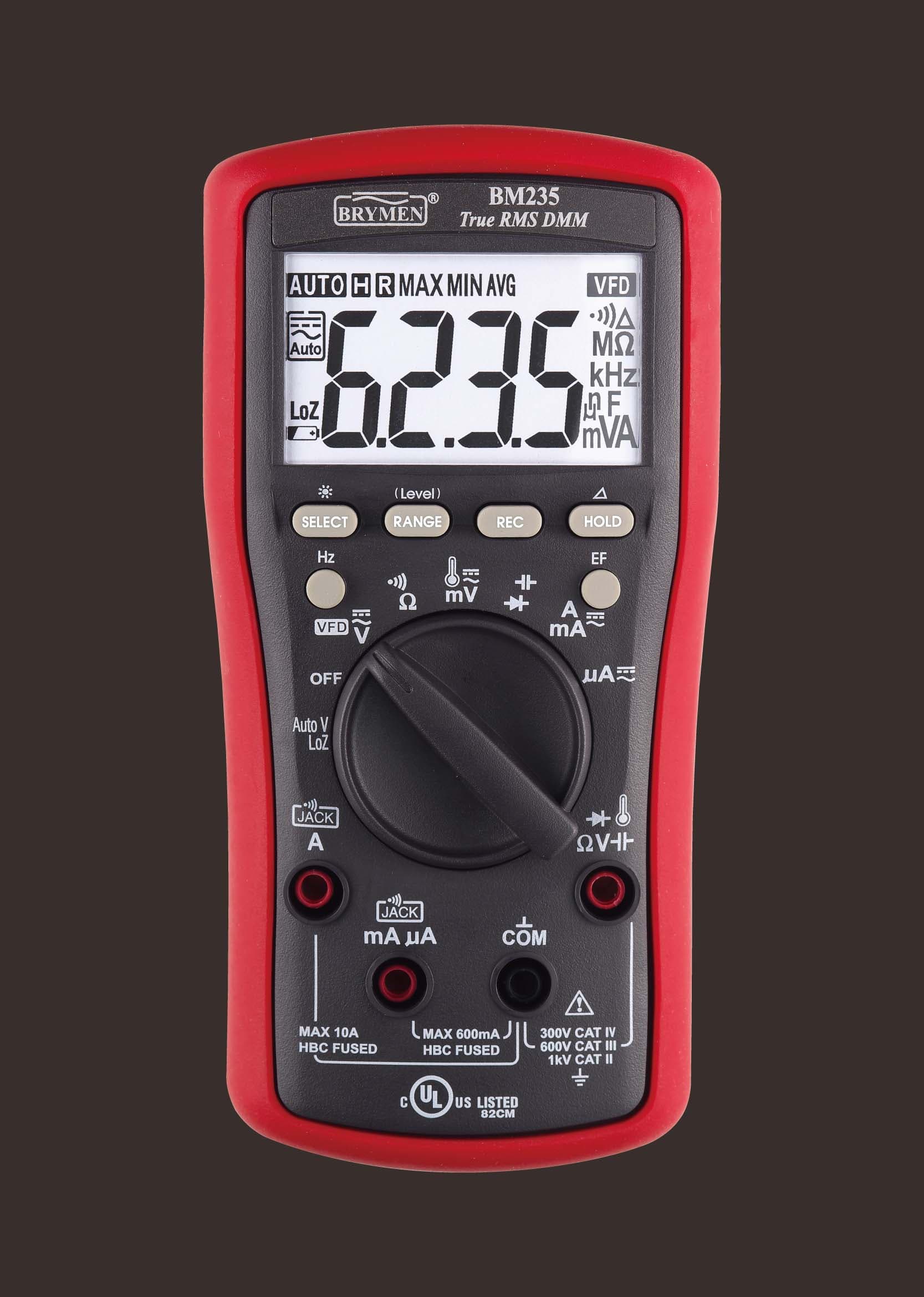
Brymen includes a relative zero mode, so you can null the test leads before reading a low-ohm cartridge.

Its 19,999-count high-resolution mode resolves the small differences between a healthy element and a 12V/24V mix-up.
Compact and auto-ranging, with Type K temperature input for checking the hot end once the heater is back in.
As an Amazon Associate I earn from qualifying purchases. Prices and availability are shown on Amazon.
Frequently asked questions
What resistance should a 24V 40W heater cartridge have?
About 14.4 ohms, from R = V² / P, which is 24 × 24 / 40. Cartridges are made to a tolerance, so a reading within roughly 10% of that, after subtracting your lead resistance, is normally fine. A 12V 40W cartridge works out to 3.6 ohms.
How can I tell if my hot end cartridge is 12V or 24V?
Measure it. A 40W cartridge for 12V reads about 3.6 ohms and one for 24V reads about 14.4 ohms, a four-to-one difference that's easy to see even on a basic meter. Some cartridges have the rating printed on the lead or sleeve, but resistance is the reliable check when the marking is missing.
Why does my meter read 0.4 ohms with the probes touching?
That's the resistance of the test leads, probe tips and the meter's input connections. It's normal, and on high-value resistors it doesn't matter. On a cartridge of a few ohms it's a significant error, so subtract it from every reading, or use your meter's relative or zero function if it has one.
Can a heater cartridge test fine and still cause a thermal runaway error?
Yes. Thermal runaway and heating-failed errors often come from the thermistor or thermocouple, a cartridge that has slipped partly out of the heater block, a loose set screw, a part-cooling fan blowing on the block, or a crimp that goes open when hot. A correct resistance rules out only the heater element itself.
Is a mains-voltage industrial cartridge tested the same way?
The resistance method is the same, but the expected value is far higher because of the higher voltage, and insulation matters more. A cartridge that reads anything other than OL from a lead to its metal sheath must not be powered from mains. An insulation resistance tester is the proper tool for that check.


