HOW-TO GUIDE
How to Measure Resistance of a Heating Element With a Multimeter
By the OhmSavvy Research Team ·

Safety first: these are mains appliances
- Unplug the appliance, or for a hardwired appliance such as a water heater or oven, switch off its breaker. Then prove it is dead: with the meter on AC volts, measure across the element terminals and from each terminal to the metal chassis. On a 240 V circuit a thermostat may only switch one leg, so one terminal can still be live with the element apparently off.
- Use a meter and leads rated for the circuit, CAT III for a household panel or hardwired appliance, and check your meter on a known live source before and after the dead test.
- Let elements cool fully before touching them. Never switch on a water heater with the tank empty or partly drained, because an element that is not covered by water can burn out within moments.
- If you see scorched wiring, melted terminals or water leaking around an element, stop and call a qualified technician.
1Unplug and isolate the element
With power off and confirmed dead, take a photo of the wiring, then disconnect at least one wire from the element terminals. This step is easy to skip and important. While the element is still wired in, the meter can read through other paths: a second element, a thermostat, an indicator lamp, or the appliance's own wiring. The reading then describes the circuit, not the element.
Clean the terminals if they are corroded or coated with scale. At about 10 to 30 Ω, a little contact resistance from oxide or a poor probe grip is a noticeable share of the reading.
2Work out the expected resistance from the rating
Every element, or the appliance it sits in, is stamped with a voltage and a wattage. Power is P = V² ÷ R, so rearranging gives the resistance the element needs to produce its rated power: R = V² ÷ P. Square the rated voltage and divide by the rated wattage.
For a step-by-step appliance example, including the earth check that finds RCD-tripping faults, see how to test a washing machine heating element with a multimeter.
| Rating on the plate | Typical example | Calculation | Expected resistance |
|---|---|---|---|
| 120 V, 1000 W | Small 120 V heater or appliance | 14,400 ÷ 1000 | 14.4 Ω |
| 120 V, 1500 W | 120 V portable space heater | 14,400 ÷ 1500 | 9.6 Ω |
| 230 V, 2000 W | 230 V oven or heater element | 52,900 ÷ 2000 | ≈ 26.5 Ω |
| 240 V, 3000 W | 240 V immersion or kettle element | 57,600 ÷ 3000 | 19.2 Ω |
| 240 V, 3500 W | 240 V water heater element | 57,600 ÷ 3500 | ≈ 16.5 Ω |
| 240 V, 4500 W | 240 V water heater element | 57,600 ÷ 4500 | 12.8 Ω |
Notice that higher wattage at the same voltage means lower resistance: the element has to let more current through. Use the voltage printed on the element, not your supply voltage. An element stamped 240 V, 4500 W is still 12.8 Ω when it runs on a 208 V supply; it simply produces less heat there.
3Measure across the terminals
Set the meter to resistance (Ω). At these low values, the test leads matter, so first touch the probe tips together and note the reading; that is the resistance of the leads and contacts. Some meters have a relative or zero function that subtracts it for you. Then press the probes firmly onto the two element terminals and read the display. If the basics of the ohms range are new to you, start with how to use a multimeter.
Two practical shortcuts help when the rating plate is missing or worn. If the appliance has a second, identical element, such as the upper and lower elements in many dual-element water heaters, measure both: two matching parts should read close to each other, so a large difference points at the odd one out. Check that they really are the same rating first, because the two positions do not always use the same element. And if you can only find the appliance's total wattage, remember it may include fans, lamps or a second element, so the calculation becomes an estimate.
Some elements have more than two terminals, for example dual-coil cooktop or oven elements that switch between power levels. Each coil is effectively its own element: identify the terminals from the wiring diagram, usually printed inside a panel or in the service manual, and measure each coil separately against its own expected value.
Cold vs hot resistance: why the reading may be a little low
The R = V² ÷ P figure is the resistance at operating temperature, but you measure the element cold. The resistance wire in most sheathed and open-coil elements is a nickel-chromium type alloy chosen because its resistance changes relatively little with temperature, so the cold reading is usually only modestly lower than the calculated value. Manufacturing tolerance adds to that, and makers do not all publish the same tolerance, so a reading close to the calculation and slightly below it is normal. Where the appliance's service manual gives a resistance, use that figure instead.
Some heaters do not follow the formula cold
4Check for an open element
The most common element failure is simple: the resistance wire burns through, often at a hot spot, and the circuit opens. The meter then reads OL across the terminals, meaning the resistance is above the range it can measure. An open element cannot heat at all and must be replaced. Before you condemn it, make sure the probes are actually touching clean metal and the meter is on ohms, not volts; our page on what OL means on a multimeter covers the other reasons for that reading.
5Test for a short to ground
An element can have the right resistance end to end and still be faulty if the insulation between the wire and its metal sheath has failed. Current then leaks to the appliance chassis, which can trip an RCD or GFCI and is a shock risk. With the wires still disconnected, put the meter on its highest resistance range. Hold one probe on an element terminal and the other on bare metal: the sheath, the mounting flange, or a clean, unpainted part of the chassis or tank. Repeat for the other terminal.
A multimeter applies only a small test voltage, so it finds hard faults but can miss insulation that only breaks down at full mains voltage or when hot. If an appliance keeps tripping the RCD and the element reads OL to ground on a multimeter, an insulation resistance tester, which tests at a much higher voltage, is the next step, usually in the hands of an electrician or appliance technician.
Reading the results
| Across terminals | Terminal to sheath / chassis | Meaning |
|---|---|---|
| Close to V² ÷ P (often slightly below) | OL | Element is probably good; look elsewhere |
| OL | OL | Open element: burned through, replace it |
| Far below the expected value | OL or a reading | Damaged or wrong element, or still wired in parallel with something |
| Any value | Any finite reading | Ground fault: replace the element |
If the element passes both tests, the fault is somewhere else in its supply path: a thermostat, a thermal cutoff or fuse, a switch, a relay or a loose connection. A blown fuse is a common culprit, and you can often confirm it on a live circuit with our guide to testing a fuse without removing it. For wiring, see how to test electrical wires with a multimeter.
Which meter to use for heating element tests
The resistance tests themselves are low-voltage and any working meter can do them, but proving the circuit dead before you touch it means measuring mains voltage, so use a meter with a CAT rating that matches the circuit. A True RMS meter rated CAT III 600V covers household panels and hardwired appliances. The meters below are from our best multimeters roundup; the best multimeter for home use guide narrows the field further.
Meters in our reviews
True RMS, auto-ranging, CAT III 600V. The meter working electricians actually buy with their own money.
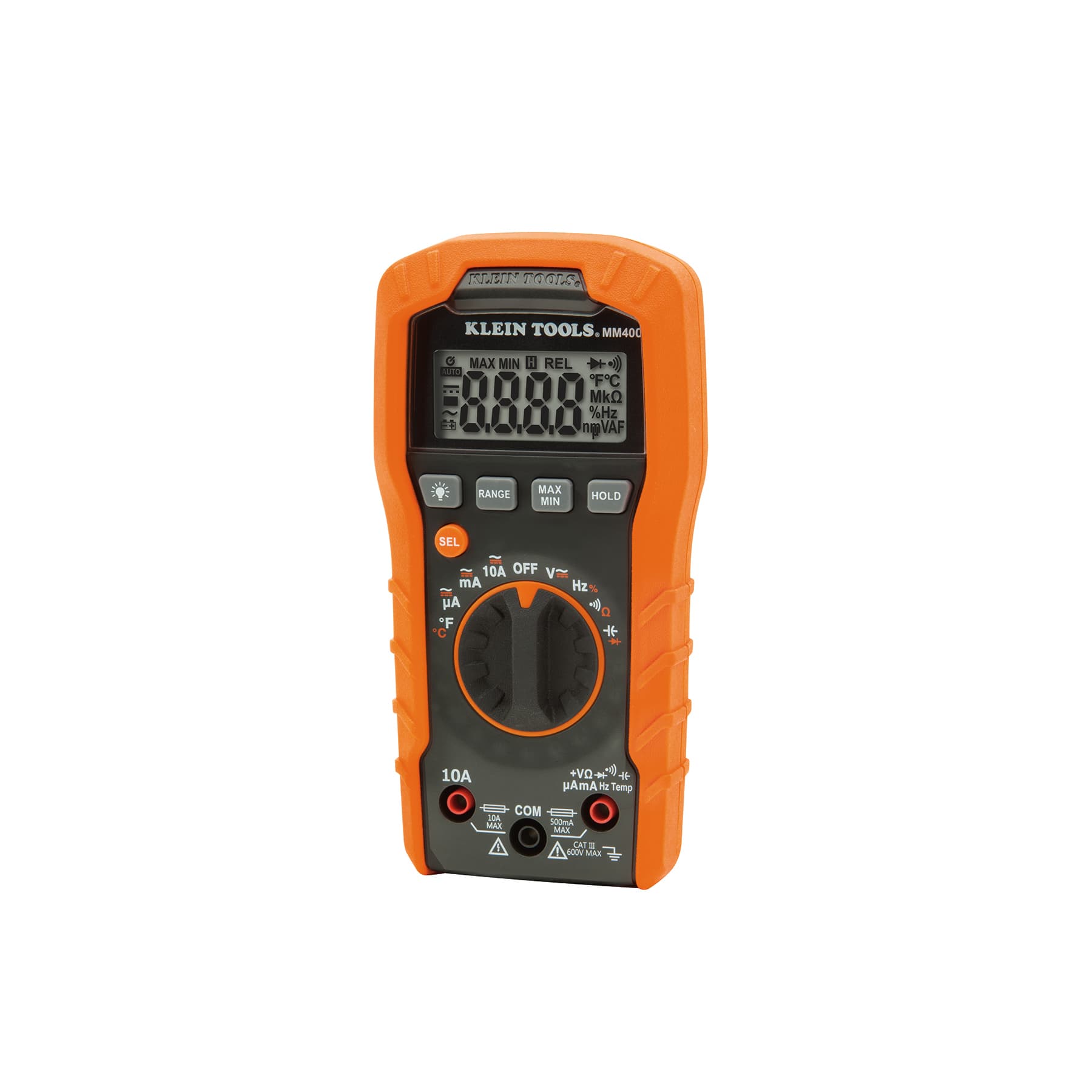
Auto-ranging, CAT III 600V, with temperature and capacitance. Not True RMS; discontinued by Klein.

6,000-count resolution for element ohms, plus temperature with the supplied thermocouple to check the element heats.
As an Amazon Associate I earn from qualifying purchases. Prices and availability are shown on Amazon.
Frequently asked questions
What resistance should a 4500 W water heater element have?
If it is rated 4500 W at 240 V, the expected resistance is 240² ÷ 4500 = 57,600 ÷ 4500 = 12.8 Ω. A cold reading close to that, often slightly lower, is normal. OL means the element is open, and any reading from either terminal to the tank or mounting flange means it has a ground fault. Always calculate from the voltage stamped on the element.
Can a heating element test good but still not heat?
Yes. If the resistance is close to the calculated value and there is no reading to ground, the element is probably fine and the fault is elsewhere in the circuit: a thermostat, a thermal fuse or cutoff, a switch, a relay, a loose terminal or a tripped breaker. Test each part of the path that feeds the element, with the power off.
Does a heating element have polarity?
No. A resistive heating element works the same whichever way current flows, so its two terminals are interchangeable and the probes can go either way round. The wiring to it still matters, though: on a 240 V appliance both supply wires can be live, so label the wires before you disconnect them and reconnect them exactly as they were.
Why does a heating element trip the RCD or GFCI?
Usually because the insulation inside the element has broken down and current is leaking to its metal sheath and the appliance chassis. That leakage is exactly what a residual-current device is designed to detect. A multimeter on its highest resistance range finds hard faults; a slight leak that only appears when hot may need an insulation resistance tester.
Can I use the continuity beeper to test a heating element?
Only as a quick check for a broken element. Many meters beep below a threshold of a few tens of ohms, and that threshold varies by model, so a healthy higher-resistance element may stay silent while a low-resistance one beeps. The beeper also gives no number to compare with the rating. Use the ohms range for a real verdict and keep the beeper for tracing broken leads.

