HOW-TO GUIDE
How to Measure AC Current With a Clamp Meter
By the OhmSavvy Research Team ·
How a clamp meter actually measures current
Current flowing through a conductor generates a magnetic field around it, proportional to the current. A standard AC clamp meter's jaw contains a current transformer that senses this field and converts it into a current reading, without the meter ever making electrical contact with the conductor. This is what makes it faster and safer than breaking the circuit open the way an in-series multimeter current measurement requires.
The single-conductor rule
The jaw must close around exactly one current-carrying conductor to read correctly. Clamp around a cable containing both the hot and neutral wires together, and their equal, opposite currents largely cancel each other's magnetic field out, giving a reading close to zero regardless of how much current is actually flowing to the load.
Safety first: the conductor is live while you clamp it
1Select the AC current function
Turn the dial to the AC current function (usually marked A~ or with a sine-wave symbol). If your meter has manual ranges, start on the highest one and step down. Unplug the test leads if the meter doesn't need them for this mode; they only get in the way near live wiring.
2Find one isolated conductor
Choose the hot conductor of the circuit you want to measure, where it runs on its own: at a breaker lug, a terminal block or through a line splitter on a plug-in load. Don't include the neutral or any other wire inside the jaw.
3Close the jaw around it and center it
Squeeze the trigger to open the jaw, position it around the conductor and release the trigger so the jaw closes fully with no gap at the tips. Move the meter until the wire sits near the center of the opening, away from the hinge.
4Run the load and read the display
Switch the load on, let the reading settle for a second or two and note it. Use the Hold button if you can't see the screen from where you're clamping. As a sanity check, compare the figure with the load's nameplate: a 1,500 W space heater on 120 V should draw roughly 1,500 ÷ 120 = 12.5 A, so a reading near 12 A is plausible while a reading near zero points back to a clamping mistake.
Getting an accurate reading
| Practice | Why it matters |
|---|---|
| Clamp exactly one conductor | Multiple conductors with opposing current cancel the field the jaw reads |
| Center the conductor in the jaw | Sensing is generally most accurate away from the jaw's hinge and edges |
| Ensure the jaw closes fully | A gap at the jaw's closing point can affect the magnetic circuit and accuracy |
| Use a True RMS meter for non-sinusoidal loads | Variable-speed drives, dimmers, and switching supplies distort the waveform |
Jaw size vs. what you're clamping
A clamp meter's jaw opening is a hard physical limit, separate from its current rating — a meter rated for hundreds of amps still can't clamp around a conductor or bundle too thick to fit inside the jaw.
Confirm your meter actually reads AC current
Can it catch a brief inrush spike?
Motors, transformers, and some electronics draw a short current surge well above their normal running current the instant they switch on, lasting only a fraction of a second. A standard clamp meter's display updates too slowly to catch that spike's true peak — it shows a smoothed, averaged reading rather than the instantaneous surge. Meters with a dedicated "inrush" or "peak hold" function are built specifically to capture this; an oscilloscope with a current probe shows the full shape of the spike directly, which our oscilloscope vs multimeter guide covers in more depth.
Clamp meters we recommend
For household and light commercial circuits, a 400 A AC clamp with True RMS covers almost everything: branch circuits rarely exceed 20–50 A, and True RMS keeps readings honest on dimmers, LED drivers and variable-speed motors. If you service HVAC equipment, an inrush mode and a microamp range for flame sensors earn their place. A reading that looks wrong is most often the two-conductor mistake above, a jaw not fully closed, or an averaging meter on a distorted waveform, so rule those out before suspecting the load.
Clamp meters from our verified picks
True RMS, 400 A AC through a 1-inch jaw, CAT III 600V. It reads AC amps only, which is all this job needs.
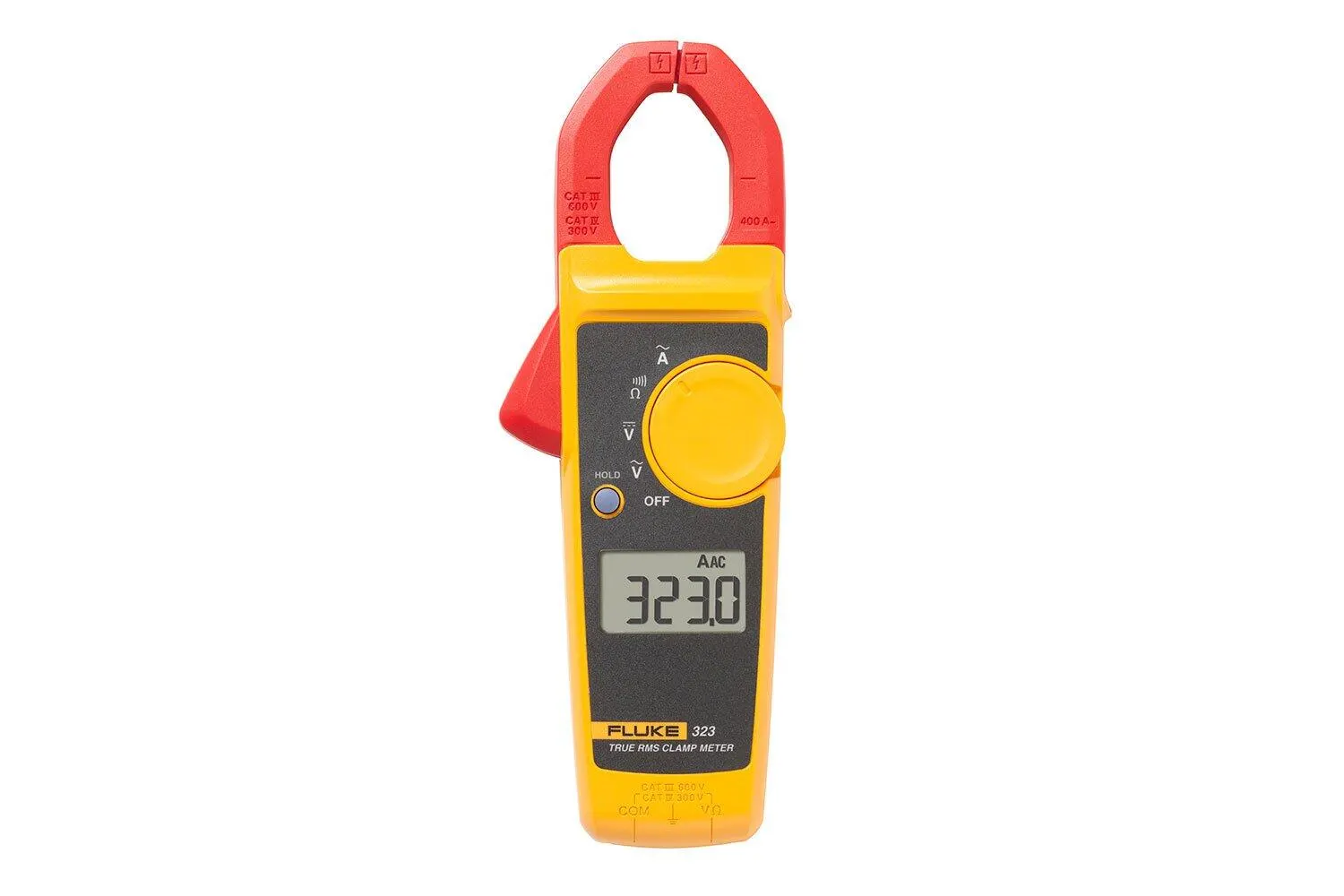
Fluke's compact True RMS clamp: 400 A AC, rated CAT III 600V and CAT IV 300V. No DC amps or backlight.

600 A AC with an inrush mode for motor start-up, plus a 0.1 µA DC range through the leads for flame sensors.
As an Amazon Associate I earn from qualifying purchases. Prices and availability are shown on Amazon.
Frequently asked questions
Why did my reading drop to near zero when I clamped around the whole cable?
That's the single most common clamp meter mistake. A standard power cable carries two conductors (hot and neutral) with equal and opposite current. Clamping around both at once means their magnetic fields largely cancel out, so the meter reads close to zero instead of the actual current flowing through the load.
How do I access a single conductor on a finished cable or cord?
Options include testing at a point where conductors separate (inside a panel, junction box, or appliance terminal block), using a cord separator/splitter accessory designed for clamp meter use, or testing at an outlet where individual conductors are accessible. Never cut into cable insulation to expose a conductor just for testing.
Does jaw position around the conductor affect accuracy?
Yes — center the conductor in the jaw opening rather than letting it sit off to one side or near the jaw's hinge point, where the magnetic field sensing is generally less uniform. Most clamp meters are most accurate with the conductor centred and the jaw fully closed.
Can a clamp meter measure current through a very thick cable or bus bar?
Only if it physically fits inside the jaw opening. Clamp meters come with different jaw sizes for this reason — check the jaw opening dimension against the actual conductor or bus bar size you need to measure, not just the meter's current rating.
How do I measure a small AC current, under 1 amp, with a clamp meter?
Loop the single conductor through the jaw several times, then divide the reading by the number of turns. Five passes of a wire carrying 0.4 A make the meter see about 2 A, which sits higher in its range where resolution is better. For milliamp-level or DC microamp work, a meter with test leads or a dedicated µA range is the better tool.



