COMPARISON · MULTIMETERS
Brymen BM235 vs Fluke 117
Brymen BM235 vs Fluke 117 is the enthusiast's favorite against the electrician's standard. On the core electrician features they match: True RMS, 6,000 counts, a low-impedance voltage mode and non-contact voltage detection. The BM235 piles on a VFD mode, Type-K temperature, relative zero and µA/mA ranges; the 117 answers with a bar graph, a three-year warranty and Fluke's US support network.
By the OhmSavvy Research Team ·
Disclosure: OhmSavvy earns a commission from qualifying Amazon purchases made through these links, at no extra cost to you. How we're funded.
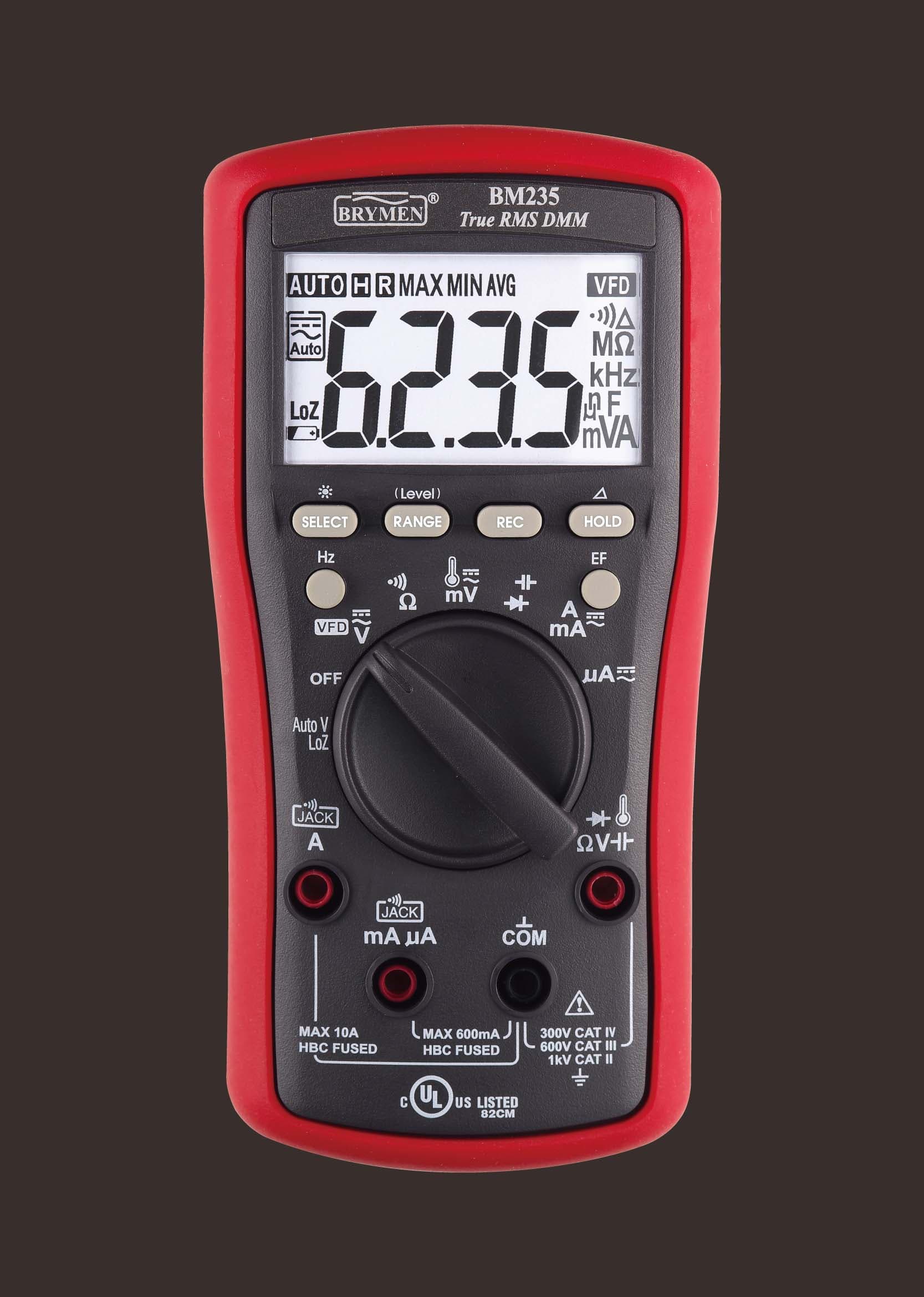
Brymen BM235
4.6★★★★★True RMS with AutoV LoZ, NCV, VFD mode and temperature: more electrician features than most meters at its price.

Fluke 117
4.8★★★★★The meter working electricians actually buy with their own money, not just the one brands push.
Specs side by side
| Brymen BM235 | Fluke 117 | |
|---|---|---|
| Rating | 4.6★★★★★ | 4.8★★★★★ |
| Accuracy | True RMS | True RMS |
| Safety rating | CAT III 600V / CAT IV 300V | CAT III 600V |
| Auto-ranging | Yes (manual override) | Yes |
| Best for | Electricians and enthusiasts who want every feature | Electricians, serious hobbyists |
| Display | 6,000 counts, 5 updates/s, white backlight | 6,000 counts, 4 updates/s + 33-segment bar graph |
| DC volts accuracy | ±(0.2% + 2) to ±(0.4% + 2) by range | ±(0.5% + 2) |
| Low-impedance mode | AutoV LoZ, impedance varies with voltage | AutoVolt position, about 3 kΩ |
| Non-contact voltage | Yes (Hi/Lo EF detection) | Yes (VoltAlert, Lo/Hi) |
| VFD mode | Yes, 600 V, ±(1.0% + 3) at 10–100 Hz | No |
| Temperature | Type-K, -40 to 400 °C, bead probe included | No (Fluke datasheet: 116 only) |
| Current ranges | 600 µA to 10A, six ranges | 6A and 10A AC/DC |
| Capacitance | 20 nF to 10 mF | 1 nF to 9,999 µF |
| Continuity | Beep + backlight flash, 30–480 Ω threshold | Beeps below 20 Ω |
| Recording | Max/Min/Avg, relative zero | Min/Max/Average |
| Max voltage | Brymen sources differ (600V–1000V) | 600V AC/DC |
| Ingress protection | IP40 | Not stated |
| Battery | 2 × AAA | One 9V, 400 h typical |
| Size / weight | 161 × 80 × 50 mm, about 334 g with holster | 167 × 84 × 46 mm, 550 g |
| Warranty | Not stated in our sources | 3 years |
Specs checked against manufacturer documentation and official Amazon listings. Fluke 117 is hands-on tested by OhmSavvy; the Brymen BM235 assessment is desk research. How we research.
Key differences
- →Both are True RMS with a low-impedance mode and non-contact voltage detection, so the core electrician toolkit is shared.
- →The BM235 adds a VFD voltage and frequency mode, Type-K temperature, relative zero and µA/mA current ranges.
- →The Fluke 117 adds a 33-segment bar graph and comes with a stated three-year warranty.
- →Brymen's own documents disagree on the BM235's ratings: its BM230 Series catalog gives CAT III 600V and CAT IV 300V, while the BM235 product sheet and web page list CAT II 1kV and CAT III 600V.
- →The BM235's low-impedance input changes with voltage, from above 8 MΩ to about 2.1 kΩ and back up to 240 kΩ at 600 V; Fluke quotes about 3 kΩ for the 117.
- →The BM235's US Amazon listing is the EEVblog edition, and support runs through Brymen's distributors rather than a large US brand.
Feature-by-feature
| Feature | Brymen BM235 | Fluke 117 |
|---|---|---|
| True RMS | Yes | Yes |
| Low-impedance voltage | Yes | Yes |
| Non-contact voltage | Yes | Yes |
| Automatic AC/DC selection | Yes (AutoV) | Yes (AutoVolt) |
| VFD mode | Yes | No |
| Temperature | Yes | No |
| µA and mA ranges | Yes | No |
| Relative zero | Yes | Not listed |
| Bar graph | Not listed | Yes |
Brymen BM235 vs Fluke 117 spec by spec
Brymen publishes a full accuracy table for the BM230 Series in its catalog, and Fluke publishes one for the 110 Series. Set side by side, the Brymen is the tighter instrument on paper for DC volts and line-frequency AC volts, and it resolves far smaller currents. The Fluke's advantages are elsewhere: the analog-style bar graph, a lower continuity threshold that only beeps on a near-dead short, and the paperwork behind the brand.
Bars use a logarithmic scale: each step is ten times the last.
What those numbers mean on the job: for checking a 120 V receptacle, either meter is far more accurate than the question needs. A 0.5% error on 120 V is 0.6 V. The gap matters on a 0-10 V control signal or a 4-20 mA loop, where the BM235's mA ranges read loop current directly at 0.01 mA resolution and the 117 can only show whole milliamps on its 6 A range. For furnace flame-sensor current in microamps, only the Brymen has a range at all.
Two kinds of low-impedance input
Both meters fight ghost voltage, the phantom reading a disconnected wire picks up from a live neighbor in the same conduit, by loading the circuit with a low input impedance. They do it differently. Fluke gives one figure for the 117's AutoVolt position: about 3 kΩ. Brymen publishes a curve. Below about 8 V the BM235's AutoV input stays above 8 MΩ, so it doesn't load a low-voltage control circuit. Between 9 V and 50 V it falls to about 2.6 kΩ. Push well past 50 V and it starts near 2.1 kΩ, then climbs within a fraction of a second to about 12 kΩ at 100 V and 240 kΩ at 600 V.
Why the rise matters is our arithmetic, not a Brymen statement: at 600 V a 240 kΩ load dissipates about 1.5 W (600² ÷ 240,000), while a fixed 2.1 kΩ would have to absorb more than 170 W. A ghost voltage never gets that far, because the coupled source can't hold its voltage up once the meter loads it, so it collapses while the BM235 is still in its low-impedance region. A real supply holds its voltage and drives the meter up the curve. For a walk-through of the check itself, see why a multimeter shows voltage on a disconnected circuit.
Reading the BM235's safety rating
BM235, BM230 Series catalog
CAT III 600V and CAT IV 300V, 6 kV transient
BM235, product sheet and web page
CAT II 1kV and CAT III 600V
Fluke 117
CAT III 600V, stated consistently
Practical meaning
Who each meter suits
The BM235 is the better instrument for anyone who works across trades. An HVAC technician gets temperature, microamps for flame rectification and capacitance up to 10 mF for run and start capacitors in one meter. A maintenance technician on drives gets a VFD mode with a low-pass filter that reads the fundamental voltage of a PWM motor output, specified at ±(1.0% + 3) from 10 Hz to 100 Hz, a job where an ordinary True RMS input reads the switching noise too.
The 117 is the safer purchase for a working electrician who wants the meter the inspector, the employer and the rental crib already recognize. Its bar graph tracks a drifting reading better than digits alone, its 9V battery lasts about 400 hours, and Fluke's three-year warranty is stated plainly. We have owner-tested the 117; the BM235 assessment here is desk research against Brymen's catalog. Our Fluke 117 review covers the Fluke in depth.
Brymen BM235 vs Fluke 117: which should you buy?
| You are… | Better fit | Why |
|---|---|---|
| Residential or commercial electrician | Fluke 117 | Known brand, stated warranty, LoZ and VoltAlert cover daily wiring checks |
| HVAC technician | Brymen BM235 | Temperature, µA for flame sensors and capacitance in one meter |
| Drive and motor maintenance | Brymen BM235 | VFD mode reads the drive's fundamental voltage and frequency |
| Controls and 4-20 mA loops | Brymen BM235 | Dedicated mA ranges at 0.01 mA resolution |
| Apprentice whose employer specifies Fluke | Fluke 117 | Matches what the crew and the tool list expect |
| Electronics hobbyist who also does house wiring | Brymen BM235 | µA ranges and finer DC accuracy, plus LoZ for mains |
If the Fluke appeals but you don't need VoltAlert or LoZ, see Fluke 115 vs Fluke 117. For a shortlist by trade, read our best multimeter for HVAC technicians and best multimeter for electricians guides.
Safety: a beep is not a voltage test
Choose the Brymen BM235 if…
- ✓You service variable-frequency drives and want a dedicated VFD voltage and frequency mode
- ✓You want temperature, relative zero and µA/mA ranges in the same meter
- ✓You value features per dollar over brand and US support
Choose the Fluke 117 if…
- ✓You want the meter most electricians and employers already know and accept
- ✓You prefer a clear CAT III 600V rating stated consistently by the maker
- ✓You want a 33-segment bar graph and Fluke's three-year warranty
The bottom line
Choose the Brymen BM235 if you want the most features for the money, especially a VFD mode and temperature, and you're comfortable buying the EEVblog edition with distributor support. Choose the Fluke 117 if you want a consistently documented rating, a three-year warranty and the meter employers and inspectors already trust.
Frequently asked questions
Do both the Brymen BM235 and Fluke 117 have LoZ and NCV?+
Yes. Brymen lists AutoV LoZ and Hi/Lo EF non-contact detection for the BM235, and Fluke lists AutoVolt with a low-impedance input of about 3 kΩ plus VoltAlert for the 117. The Brymen's input impedance changes with the applied voltage, while Fluke quotes a single figure, but both are built to collapse ghost voltage on disconnected wires.
What is the Brymen BM235's CAT rating?+
Brymen's BM230 Series catalog and the meter's own markings give CAT III 600V and CAT IV 300V. Its BM235 product sheet and web page list CAT II 1kV and CAT III 600V instead. Either way it covers CAT III 600V household and panel work, the same as the Fluke 117, and neither is rated CAT IV 600V for service entrances.
Why is the BM235 sold as an EEVblog meter?+
The US Amazon listing we link is titled EEVblog Brymen BM235. It is the Brymen meter sold through that channel, which is how most US buyers get one. Support and warranty run through Brymen's distributors rather than a US service network, so check the seller, the contents and the return terms on the listing before you buy.
Can the Fluke 117 measure a VFD output?+
It can read the True RMS voltage, but Fluke doesn't list a VFD mode or low-pass filter for the 117, so the switching noise on a PWM drive output can inflate the reading. The BM235's VFD mode filters that out and reads the fundamental voltage and frequency, specified at ±(1.0% + 3) from 10 Hz to 100 Hz.
Which meter is better for HVAC work?+
The BM235, for most technicians. It reads Type-K temperature from -40 °C to 400 °C with an included bead probe, has a 600.0 µA range for flame-sensor current and measures capacitance up to 10 mF. Fluke's datasheet puts temperature and microamps on the Fluke 116, not the 117, so the 117 would need extra tools for those checks.
Related


