HOW-TO GUIDE
Why Does My Car Fuse Have Power on One Side Only? How to Test It
By the OhmSavvy Research Team ·

Before you probe the fuse box
Causes at a glance
| Symptom | Likely cause | How to check | Fix or who to call |
|---|---|---|---|
| Supply tab 12 V, load tab 0 V, load switched on | Blown fuse (open element) | Pull it and test continuity: OL means open | Find the short, then fit the same rating |
| Supply tab 12 V, load tab a few volts that wander | Blown fuse with the load switched off | Switch the load on or add a test light, then re-read | As above once confirmed |
| Both tabs 0 V with the key off | Ignition-switched or relay-fed feed | Turn the key to run and repeat | Normal; test again with the circuit active |
| Both tabs 0 V with the key on | Relay not closing, upstream fuse or fusible link open | Check the relay and the main fuse feeding the bus | Relay test; a mechanic for main links |
| Both tabs 12 V, circuit still dead | Fault downstream: wire, switch, connector or ground | Back-probe feed and ground at the component | Voltage drop test along the circuit |
| Meter shows 12 V but a test light stays dim | High-resistance connection in the feed | Measure voltage drop on the supply side under load | Clean or repair the terminal or busbar |
| New fuse blows at once | Short to ground downstream | Isolate sections of the circuit one at a time | Repair the chafed wire or failed component |
What each side of a fuse is
Every fuse sits in series between a supply and a load. One tab connects to the feed, usually a busbar inside the fuse box; the other tab connects to the wire running out to the circuit it protects. Current enters on the supply side, passes through the thin metal element and leaves on the load side. Most modern blade fuses have small test points exposed on top, one per tab, so you can probe both without pulling the fuse.
When the element is intact, both tabs sit at the same potential, so you read essentially the same voltage to ground on each. When it has melted open, the supply tab still reads battery voltage, but the load tab is cut off. It reads close to 0 V, because the load connects it to ground.
Why does the dead tab read zero rather than something in between? Because the meter and the load form a voltage divider. Suppose the load is a lamp of about 2 Ω and the meter's input is 10 MΩ. With the fuse open, whatever tiny voltage leaks onto the load tab is shared between them, and the lamp's 2 Ω is five million times smaller than the meter, so the tab is held within a few microvolts of ground. Switch the lamp off and that 2 Ω path disappears; the tab now floats, and the meter can show a few volts of leakage that means nothing.
1Verify your ground first
A one-sided reading is only meaningful if your reference is solid. Clip the black lead to the battery negative post or a known-good chassis ground stud, not a painted bracket. Then touch the red probe to the battery positive post: you should see full battery voltage, typically about 12.6 V on a charged battery with the engine off. With a test light, clip it to ground and touch the battery positive; it should light brightly. If it doesn't, your ground point is the problem, and every reading after this would mislead you. Our guide to testing a car ground wire covers finding a good reference.
2Probe each side of the fuse to ground
Turn the key to the position the circuit needs (many circuits only work in run) and switch on the component the fuse protects. Touch the red probe to one test point on the fuse, note the reading, then the other. You are looking for one of three patterns: both sides at battery voltage, one side at battery voltage and the other near zero, or both sides at zero.
That pair of readings, full voltage in and nothing out with the load on, is the signature of an open fuse. A pair that reads within a few hundredths of a volt of each other, such as 12.48 V and 12.46 V, means current is passing through the element normally.
3Confirm the fuse is open
If one side is live and the other is dead, pull the fuse with the circuit off and look at the element, then confirm with a continuity check across its two blades. An intact fuse beeps and reads close to 0 Ω (most of what you see is your test leads); a reading of OL confirms the element is open. See what OL means on a multimeter and our general guide to testing a fuse with a multimeter. If you prefer to keep the fuse in place, the across-the-fuse voltage method gives the same answer by reading the difference between the two tabs directly.
4Check whether the fuse is ignition-switched or relay-fed
Not every fuse is hot all the time. If both sides read zero, the fuse may simply be on a supply that is not active yet. Typical feeds fall into a few groups:
Always hot (battery)
Live with the key out. Hazard lights, horn and memory circuits often sit here.
Ignition-switched
Live only in accessory or run. Dead on both sides with the key off is normal.
Relay-fed
Live only when a relay closes, often commanded by a module. Dead until the relay pulls in.
With a relay-fed fuse, power on neither side may point upstream to the relay or its control circuit rather than to the fuse. Our guide to testing an automotive relay walks through the coil and contact checks. The fuse box lid label or the wiring diagram in your service manual tells you which group each fuse belongs to. If a whole row of fuses is dead with the key on, suspect the main fuse or fusible link that feeds that busbar.
01
Ground OK?
Battery + reads ~12.6 V to your ground
02
Circuit on
Key in run, component switched on
03
Read A and B
Each tab to ground, DC volts
04
Interpret
12/12 good, 12/0 open, 0/0 no feed
What the readings mean
| Supply side | Load side | Most likely meaning |
|---|---|---|
| Battery voltage | Battery voltage | Fuse is intact; look downstream if the circuit is dead |
| Battery voltage | About 0 V | Fuse is open (blown); find the cause before replacing |
| About 0 V | About 0 V | Feed not active: key position, relay or upstream fuse/fusible link |
| Battery voltage | Floating, a few volts | Fuse open with the load switched off, or a poor connection |
The last row catches people out. With the component switched off, nothing pulls the load side to ground firmly, so a blown fuse can show a stray, unstable reading on its dead side. Switch the load on and repeat; the dead side should then fall to zero. The chart shows what tab B typically reads in each case, using illustrative figures for a 12 V system.
Fuse ratings and the numbers behind them
Blade fuses use a standard color code, so you can check that the fuse in the slot matches the rating on the lid. The rating is the current the fuse carries continuously; circuits are designed to run well below it, so a fuse that blows is usually reacting to a fault rather than a normal load. Multiplying by system voltage gives a rough feel for what each rating protects (P = V × I):
| Color | Rating | Power at 12 V (V × I) | Typical circuits (varies by car) |
|---|---|---|---|
| Tan | 5 A | 12 × 5 = 60 W | Sensors, module feeds, small relays |
| Brown | 7.5 A | 12 × 7.5 = 90 W | Lighting and control circuits |
| Red | 10 A | 12 × 10 = 120 W | Lamps, radio memory, ignition feeds |
| Blue | 15 A | 12 × 15 = 180 W | Horn, fuel pump, power outlets |
| Yellow | 20 A | 12 × 20 = 240 W | Power seats, sunroof, outlets |
| Clear / natural | 25 A | 12 × 25 = 300 W | Blower motors, window circuits |
| Green | 30 A | 12 × 30 = 360 W | Fans, larger motors, defrosters |
An intact fuse is a very small resistance, not a perfect conductor. Fuse makers publish a maximum voltage drop at rated current, and for blade fuses it is typically in the tens of millivolts to around 0.1 V or so, depending on rating and size. As a worked example, a fuse with about 10 mΩ of element resistance carrying 5 A drops 5 × 0.010 = 0.05 V, which is why the two tabs of a healthy fuse read within a few hundredths of a volt of each other. Some meters, such as the Power Probe DM300AUTO below, use exactly this drop to estimate the current through a fuse without pulling it.
Both sides live, but the circuit still doesn't work
Meters for this job
Every check on this page needs only DC volts and continuity, so any working digital meter will do. These picks from our verified automotive list add features that speed up fuse-box work.
Meters for fuse and circuit checks
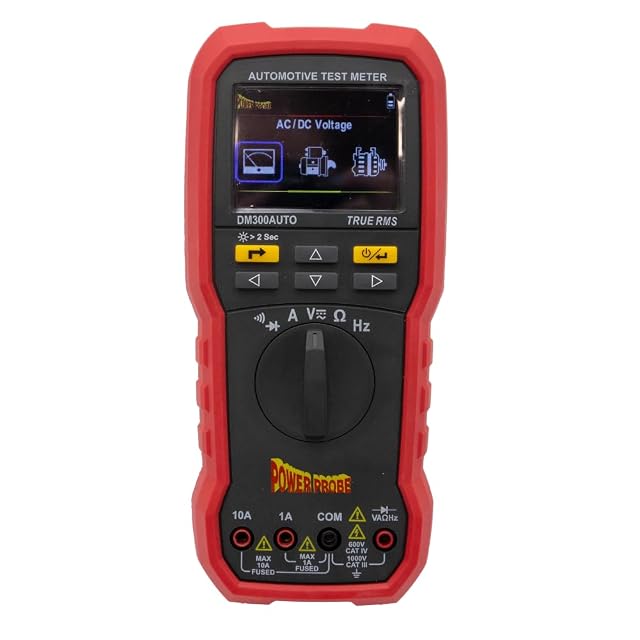
Fuse-current mode estimates current through MINI, ATC and MAXI fuses up to 80 A from the voltage drop. Voltage accuracy ±(2% + 3).

Budget True RMS, 6,000-count, with current from a 600 µA range to 10 A and Min/Max. Maker's page and manual disagree on max voltage.

True RMS, CAT III 600V, with RPM, dwell, duty cycle, frequency and temperature for wider car diagnosis.
As an Amazon Associate I earn from qualifying purchases. Prices and availability are shown on Amazon.
Frequently asked questions
If only one side of the fuse has power, is the fuse definitely blown?
Only if the side with power is the supply side and the circuit is switched on. If power appears on the input tab and nothing on the output tab, the element is open and the fuse needs replacing. Confirm by pulling it and checking continuity before you buy parts, and look for the short that blew it.
Why do some fuses have no power on either side with the key off?
Many fuses are fed through the ignition switch or a relay, so their supply bus is dead until the key is in run or accessory, or until the module energizes the relay. Check the fuse box lid or the wiring diagram to see which fuses are always hot and which are switched before assuming anything has failed.
Can a test light give a different answer than a multimeter on a fuse?
Yes. A meter has very high input impedance, so it can show voltage through a corroded or nearly open connection that cannot carry real current. A test light draws a small current, so a weak feed may make it glow dimly or not at all. If the two disagree, suspect a high-resistance connection upstream of the fuse.
Why did the new fuse blow as soon as I put it in?
A replacement fuse that opens immediately, or as soon as a switch is turned on, points to a short to ground somewhere downstream, such as a chafed wire, a failed motor or a water-damaged connector. Never fit a higher-rated fuse to stop it blowing; that moves the weak point to the wiring. Find the short instead.
Why does the dead side of a blown fuse show a few volts on my meter?
With the load switched off, nothing holds the load side firmly at ground, so the meter's 10 MΩ input picks up leakage through modules, indicator bulbs or moisture and shows a few volts that wander. It is not usable power. Switch the load on, or load the tab with a test light, and the reading should drop to zero.
Can a fuse look fine but still be blown?
Yes. Blade fuses sometimes crack at the leg where it joins the element, or open inside a cloudy housing you cannot see through, so a visual check is not proof. Mini and low-profile fuses are especially hard to read by eye. Use the test points or a continuity check: an intact fuse beeps and reads close to 0 Ω, a blown one reads OL.
Where to go next
How to Test a Fuse Without Removing It →
Measure across the fuse itself instead of to ground, with the load running.
How to Test an Automotive Relay →
When the fuse is dead on both sides because the relay feeding it never closes.
Why Does My Car Keep Blowing Fuses? →
Tracking down the short once you know the fuse is open.



