COMPARISON · MULTIMETERS
Fluke 117 vs Fluke 107
Fluke 117 vs Fluke 107 (or Fluke 107 vs Fluke 117, as many people search it) compares Fluke's electrician's meter with its palm-sized one. Both are CAT III 600V with 6,000-count backlit displays and 10A current. The 117 is True RMS and adds VoltAlert non-contact detection, AutoVolt and a low-impedance mode; the 107 weighs 200 g, fits in a pocket, and Fluke states plainly that it is not True RMS.
By the OhmSavvy Research Team ·
Disclosure: OhmSavvy earns a commission from qualifying Amazon purchases made through these links, at no extra cost to you. How we're funded.

Fluke 117
4.8★★★★★The meter working electricians actually buy with their own money, not just the one brands push.
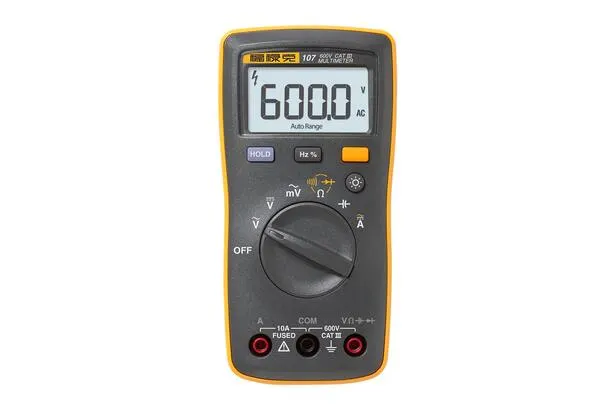
Fluke 107
4.3★★★★☆A palm-sized Fluke with CAT III 600V and a 6,000-count display, but not True RMS.
Specs side by side
| Fluke 117 | Fluke 107 | |
|---|---|---|
| Rating | 4.8★★★★★ | 4.3★★★★☆ |
| Accuracy | True RMS | Average-responding (not True RMS) |
| Safety rating | CAT III 600V | CAT III 600V |
| Auto-ranging | Yes | Yes (per display) |
| Best for | Electricians, serious hobbyists | A compact second meter, home and auto checks |
| Display | 6,000 counts + 33-segment bar graph | 6,000 counts, backlit |
| AC response | True RMS | Average-responding (Fluke: not True RMS) |
| DC volts accuracy | ±(0.5% + 2) | ±(0.5% + 3) |
| AC volts accuracy | ±(1.0% + 3), 45–500 Hz | ±(1.0% + 3), 40–500 Hz |
| Max voltage | 600V AC/DC | 600V AC/DC |
| Current | 6A and 10A AC/DC | 4A and 10A AC/DC |
| AC current bandwidth | 45–500 Hz | 40–200 Hz |
| Non-contact voltage | VoltAlert built in | No |
| AutoVolt / LoZ | Yes, about 3 kΩ | No; input >10 MΩ |
| Capacitance | 1 nF to 9,999 µF | 50 nF to 1,000 µF |
| Frequency / duty cycle | To 50 kHz / not listed | 10 Hz–100 kHz / 1–99% |
| Size | 167 × 84 × 46 mm | 142 × 69 × 28 mm |
| Weight | 550 g | 200 g |
| Battery | One 9V, 400 h typical | 2 × AAA, 200 h minimum |
| Drop rating | Not stated by Fluke | 1 m |
| Warranty | 3 years | 2 years |
Specs checked against manufacturer documentation and official Amazon listings. Fluke 117 is hands-on tested by OhmSavvy; the Fluke 107 assessment is desk research. How we research.
Key differences
- →The Fluke 117 is True RMS; Fluke says the 107 is not, so the 107's AC readings on distorted waveforms are less dependable.
- →Only the 117 has VoltAlert non-contact detection, AutoVolt and a low-impedance mode for ghost voltages.
- →The 107 weighs 200 g and measures 142 × 69 × 28 mm; the 117 is 550 g and 167 × 84 × 46 mm.
- →The 117 adds a 33-segment bar graph for watching changing readings.
- →The 107 reads frequency to 100 kHz and duty cycle, and lists a 1 m drop rating; the 117 stops at 50 kHz and Fluke lists neither duty cycle nor a drop height for it.
- →Fluke gives the 117 a 3-year warranty and the 107 a 2-year warranty.
How much smaller is the Fluke 107?
Size is the 107's whole argument. It is roughly a third of the 117's weight and noticeably thinner, which is the difference between a meter that lives in your pocket and one that lives in the van.
By volume the gap is bigger than either chart suggests. Multiply out Fluke's dimensions and the 117's case is about 646 cm³ against roughly 274 cm³ for the 107, so the small meter takes up about 42% of the space. The 107 also runs on two AAA cells you can buy anywhere, while the 117 takes a 9V battery.
Fluke 117 vs 107 spec by spec
On the numbers Fluke publishes, the two are closer than the price gap suggests. Basic DC volts accuracy is ±0.5% on both, with one extra count of uncertainty on the 107. AC volts are ±(1.0% + 3) on both. The real differences are what the meter does with a distorted AC signal, how far its AC current reading stays accurate up the frequency scale, and how long it keeps going between battery changes.
Bars use a logarithmic scale: each step is ten times the last.
What True RMS changes in practice
An average-responding meter such as the 107 rectifies the AC signal, measures its average and multiplies by 1.11, the ratio between RMS and rectified average for a pure sine wave. On a clean sine that trick works, so on a healthy 120 V receptacle the 107 and the 117 should agree within their stated accuracy. A True RMS meter like the 117 computes the heating value of the waveform directly, so it doesn't care what shape the wave is.
Shape is where the methods split. A square wave of 10 V peak has a rectified average of 10 V, so the 1.11 multiplier makes an average-responding meter show about 11.1 V against the true 10.0 V, an 11% error. The error runs the other way on the narrow, peaky current drawn by computer power supplies and LED drivers, where an averaging meter tends to read low. Variable-speed drives, dimmers and switch-mode loads all produce these shapes, which is why True RMS matters most for drive and lighting work. Our budget True RMS multimeters guide lists other options.
What you give up with the 107
| Feature | Fluke 117 | Fluke 107 |
|---|---|---|
| True RMS | Yes | No (Fluke states this) |
| Non-contact voltage | Yes | No |
| AutoVolt AC/DC selection | Yes | No |
| Low-impedance mode | Yes | No |
| Bar graph | 33 segments | No |
| Duty cycle | Not listed | Yes |
| Diode test | Yes | Yes, 2.000 V |
A second meter, not a replacement
The missing low-impedance mode is the gap electricians feel most. With an input above 10 MΩ, the 107 can show a believable voltage on a disconnected conductor that shares a conduit with a live one. The 117's AutoVolt position drops to about 3 kΩ and drains that phantom away. If you carry the 107 for wiring work, learn the load-check method in our guide to measuring voltage on a floating circuit.
Home electrical testing with the 117 or the 107
Around a house, most readings are the easy kind: is the receptacle getting its 120 V, is the battery flat, is the fuse or the lamp cord open. On those the two meters are equals, because Fluke gives them the same AC volts line and nearly the same DC line. The 117 pulls ahead on the three jobs that involve uncertainty about what is live: finding which box or cable is energized, telling a dead circuit from one showing phantom voltage, and reading circuits fed by dimmers or LED drivers.
| Home task | Fluke 117 | Fluke 107 | Edge |
|---|---|---|---|
| Receptacle voltage, 120 V | ±1.5 V from ±(1.0% + 3) | ±1.5 V from ±(1.0% + 3) | Tie |
| AA cell, 1.500 V | ±9.5 mV from ±(0.5% + 2) | ±10.5 mV from ±(0.5% + 3) | Tie |
| Doorbell or thermostat transformer | V AC | V AC | Tie |
| Fuse, bulb or lamp-cord continuity | Beeps below 20 Ω | Beeps below 70 Ω | Tie |
| Bath fan current in series | 6.000 A range | 4.000 A range | Tie |
| Which box or cable is live? | VoltAlert, no contact | Leads only | 117 |
| Switched-off circuit still reads volts | AutoVolt LoZ, about 3 kΩ | Input above 10 MΩ shows phantom | 117 |
| Dimmed or LED lighting circuit | True RMS | Average responding | 117 |
So which suits a homeowner? If you mostly check batteries, outlets, fuses and appliance cords, the 107 covers every one of them, and its 200 g body fits a kitchen drawer. If you replace receptacles, switches or fixtures yourself, the 117's three extra wins all happen at the moment you decide a circuit is safe to touch, which is where they are worth the most. Neither replaces the live-dead-live routine with the leads. If a GFCI receptacle is the problem, see how to test a GFCI outlet that won't reset.
Fluke 117 vs Fluke 107: which should you buy?
| You are… | Better fit | Why |
|---|---|---|
| Electrician on daily panel and branch-circuit work | Fluke 117 | True RMS, LoZ and VoltAlert for live wiring |
| Technician on drives, dimmers or LED lighting | Fluke 117 | Distorted waveforms need True RMS |
| Homeowner checking outlets and batteries | Fluke 107 | Covers the basics in a pocket-sized body |
| Car owner who wants a glovebox meter | Fluke 107 | 200 g, 1 m drop rating, DC current to 10A |
| Electronics hobbyist on PWM circuits | Fluke 107 | Duty cycle and frequency to 100 kHz |
| Electrician wanting a backup meter | Both | The 117 as the main meter, the 107 in the pocket |
We have owner-tested the 117; our view of the 107 is desk research against Fluke's published specs. For the 107 against its cheaper twin, read Fluke 106 vs Fluke 107, and for the full Fluke write-up see our Fluke 117 review.
Safety: both stop at CAT III 600V
Choose the Fluke 117 if…
- ✓You work on circuits with drives, LED drivers or electronic loads, where True RMS matters
- ✓You want NCV, AutoVolt and LoZ for fast, safe checks on live electrical work
- ✓This will be your main meter, used every day
Choose the Fluke 107 if…
- ✓You want a Fluke small enough for a pocket, glovebox or second toolbag
- ✓You mostly check batteries, outlets, continuity and resistance
- ✓You want frequency, duty cycle and diode test in a compact meter
The bottom line
Electricians should buy the Fluke 117: True RMS, NCV, AutoVolt and LoZ make it the right main meter for live electrical work. The Fluke 107 makes sense as a compact second meter, or for anyone who mainly checks batteries, outlets and continuity and values pocket size over True RMS.
Frequently asked questions
Is the Fluke 107 True RMS?+
No. Fluke's own answer is that the 107 is not a True RMS meter; it is average-responding. It reads clean sine waves correctly, but on the distorted waveforms from drives, dimmers and LED drivers it can read high or low. The 117 is True RMS, so its AC readings hold up on those loads.
Does the Fluke 107 have non-contact voltage detection?+
No. Fluke lists no NCV sensor for the 107, and it has no low-impedance mode either. The 117's VoltAlert lights an LED and beeps near a live AC conductor without contact. If you carry the 107 for wiring work, pair it with a separate pen-style voltage tester and always confirm with the test leads.
Are the Fluke 117 and 107 rated for the same work?+
Both are rated CAT III 600V, so both are suitable for panels, feeders and branch circuits at that voltage. Neither is rated CAT IV, so neither belongs at the meter base or service drop. The difference between them is in measurement features such as True RMS and LoZ, not in the safety category printed on the case.
Can the Fluke 107 measure current?+
Yes, AC and DC current on 4A and 10A ranges, with ±(1.5% + 3) accuracy. Fluke specifies AC current only from 40 Hz to 200 Hz on the 107, against 45 Hz to 500 Hz on the 117. Neither has a milliamp or microamp range, so both are too coarse for small electronics currents.
Is the Fluke 107 enough for home electrical testing?+
For outlets, batteries, fuses, cords and doorbell transformers, yes; its AC volts accuracy matches the 117's at ±(1.0% + 3). It lacks the 117's non-contact VoltAlert and LoZ mode, so on switched-off circuits it can show phantom voltage and can't flag a live cable without contact. If you replace outlets or fixtures yourself, the 117 is the safer pick.
Which Fluke is better for automotive work, the 117 or the 107?+
For most car work the 107 is enough. Automotive circuits are 12 V DC, where True RMS, VoltAlert and LoZ add little, and the 107 reads DC volts, DC current to 10A, resistance, diode and duty cycle for injector or PWM fan checks. Its 200 g body and 1 m drop rating also suit a glovebox.
Related


