COMPARISON · MULTIMETERS
Fluke 15B+ vs Fluke T5-600
Fluke 15B+ vs Fluke T5-600 comes down to which end of the current scale you work at. The 15B+ is a basic multimeter whose current ranges start at microamps and stop at 10A, with capacitance and resistance to 40 MΩ. The T5-600 is an electrical tester that starts where the 15B+ stops, reading AC current to 100A through an open jaw, but it can't see small currents or test capacitors.
By the OhmSavvy Research Team ·
Disclosure: OhmSavvy earns a commission from qualifying Amazon purchases made through these links, at no extra cost to you. How we're funded.
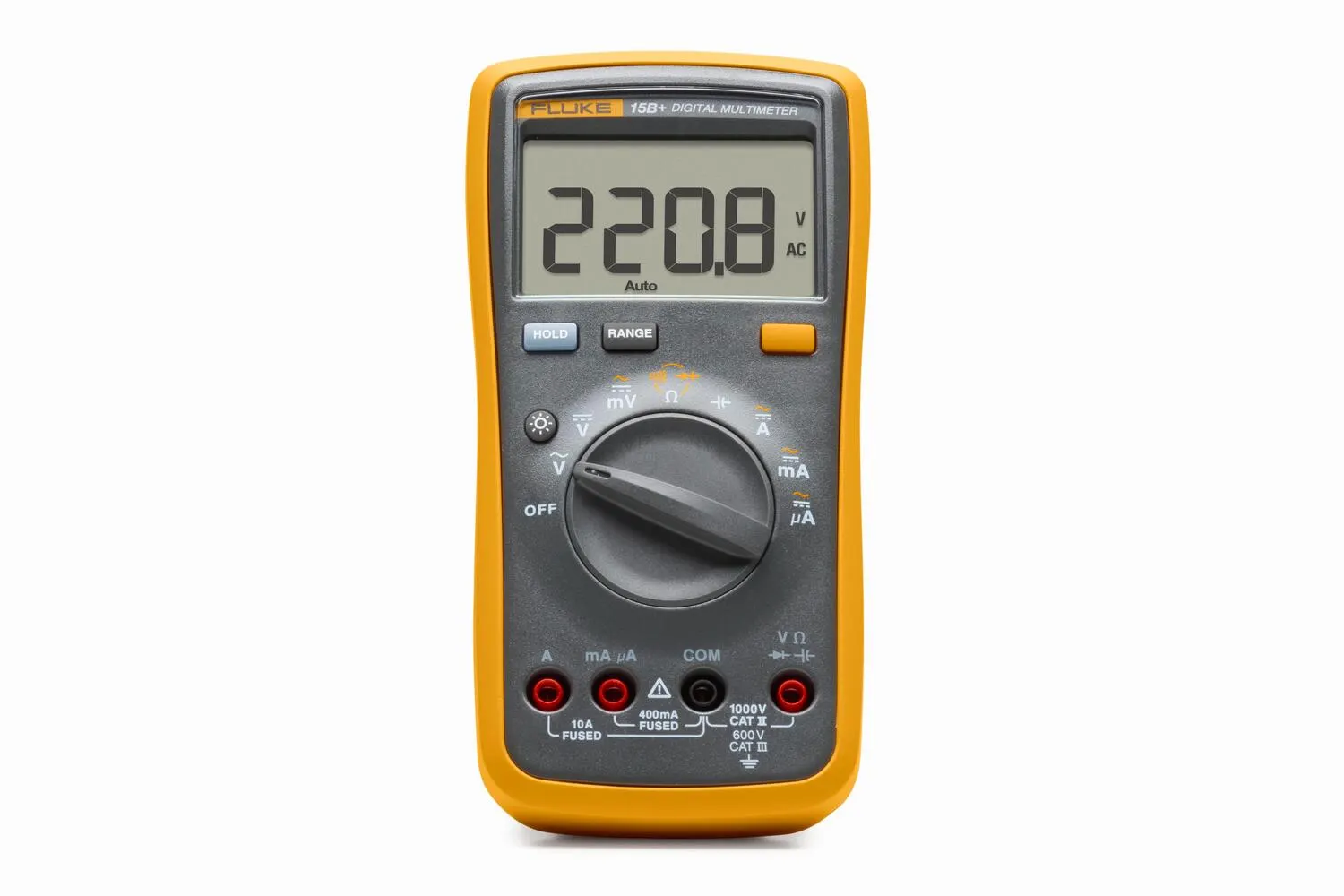
Fluke 15B+
4.3★★★★☆The 17B+ body and safety rating without frequency, temperature or MIN MAX: a plain, tough Fluke for volts, amps and ohms.
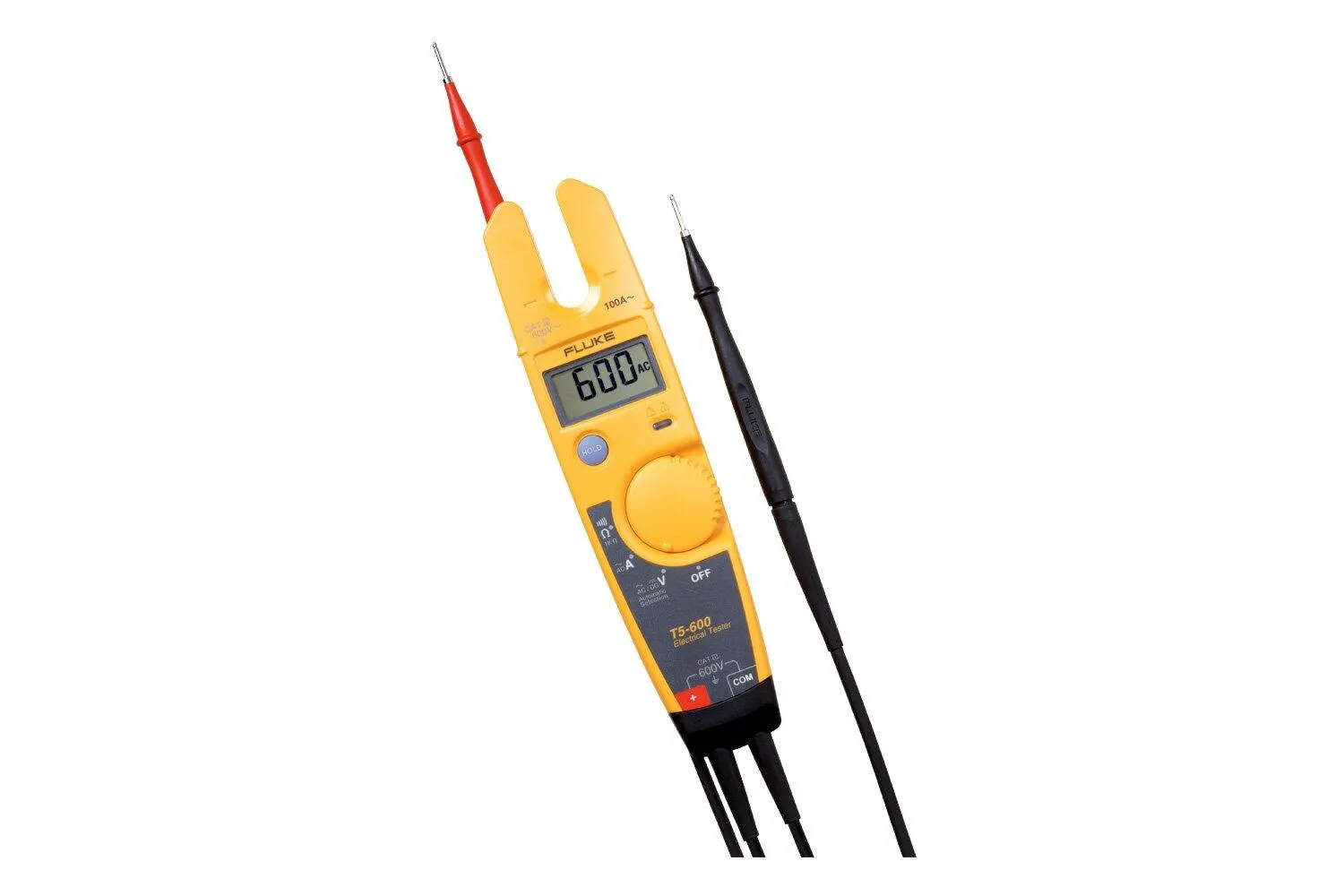
Fluke T5-600
4.4★★★★☆Not a multimeter but an electrician's tester: volts, continuity and up to 100A AC through an open jaw, no leads in the circuit.
Specs side by side
| Fluke 15B+ | Fluke T5-600 | |
|---|---|---|
| Rating | 4.3★★★★☆ | 4.4★★★★☆ |
| Accuracy | Not stated as True RMS by Fluke | Average-responding (not True RMS) |
| Safety rating | CAT III 600V / CAT II 1000V | CAT III 600V |
| Auto-ranging | Yes (manual override) | Automatic AC/DC voltage selection |
| Best for | Basic electrical and electronics checks | Electricians' quick voltage and current checks |
| Instrument type | Digital multimeter | Electrical tester |
| Display | 4,000 counts, backlit | Digital LCD (count not stated) |
| Voltage | To 1000V AC/DC | To 600V AC/DC |
| Current | µA, mA and A ranges to 10A, AC/DC | To 100A AC only |
| Current resolution | 0.1 µA on the 400.0 µA range | 0.1 A |
| Current accuracy | ±(1.5% + 3), AC 40–400 Hz | ±(3% + 3), 50/60 Hz |
| Resistance | To 40 MΩ | To 1,000 Ω |
| Capacitance | 40 nF to 1,000 µF | No |
| Continuity | Beeper below 70 Ω | Beeper below 25 Ω |
| Current fuses | 440 mA and 11 A, 1000 V | None needed for the jaw |
| Weight | 455 g | 300 g |
| Battery | 2 × AA, 500 hours minimum | 2 × AA, about 400 hours alkaline |
| Warranty | 1 year (Fluke manual) | 2 years |
Specs checked against manufacturer documentation and official Amazon listings. Desk research, not bench testing. How we research.
Key differences
- →The 15B+ covers small currents from the microamp range up to 10A, AC and DC; the T5-600 reads only AC current, up to 100A.
- →The T5-600 doesn't need the circuit opened to read current; the 15B+ does.
- →Only the 15B+ measures capacitance, and its resistance range runs to 40 MΩ against 1,000 Ω.
- →The 15B+ carries a CAT II 1000V rating in addition to CAT III 600V; the T5-600 is CAT III 600V.
- →The T5-600 weighs 300 g, 155 g less than the 15B+, and is rated for a 3 m drop.
- →Fluke's manual gives the 15B+ a 1-year warranty; the T5-600 has 2 years.
Fluke 15B+ vs T5-600 spec by spec
On a log scale the two current ranges barely overlap. The 15B+ resolves the tiny currents of electronics and standby loads; the T5-600 handles the heavy currents of motors and heating elements.
Bars use a logarithmic scale: each step is ten times the last.
Bars use a logarithmic scale: each step is ten times the last.
Accuracy follows the same split. The 15B+ is specified at ±(1.5% + 3) on every current range, so a 25.00 mA reading is good to about ±0.4 mA (0.375 mA plus three 0.01 mA counts). The T5-600 is ±(3% + 3) with 0.1 A counts, so even a 5 A reading carries about ±0.45 A (0.15 A plus 0.3 A), and anything below a few tenths of an amp is lost in the last digit.
Why the open jaw needs a single wire
The T5-600's OpenJaw senses the magnetic field that AC current creates around a conductor. Fluke warns that it won't read a multi-conductor cord, and the reason is simple: the current going out on the hot wire comes back on the neutral, so inside a cord the two fields are equal and opposite and cancel. Slip the jaw around the hot conductor alone, up to 1/0 THHN in its 12.9 mm opening, and it reads the full load.
In a panel that is easy, because each branch circuit's hot conductor runs separately to its breaker. On a plug-in appliance it isn't, so you would need a line splitter. The 15B+ has no such limit but pays for it another way: the circuit must be opened and the meter wired in series. Our guide to measuring current without breaking the circuit compares both methods.
What each can and can't do
15B+ only
Capacitance, µA and mA current, DC current, resistance to 40 MΩ.
T5-600 only
AC current to 100A without breaking the circuit, automatic AC/DC voltage.
Both
AC/DC voltage, continuity, hold, CAT III 600V.
| Example | Use |
|---|---|
| A phone charger's standby draw | 15B+ (needs mA or µA) |
| An air-conditioner compressor | T5-600 (above 10A) |
| A motor-run capacitor | 15B+ (capacitance) |
| A quick live/dead check at a panel | T5-600 |
| A car's parasitic battery drain | 15B+ (DC mA) |
Small currents need small ranges
Which jack the 15B+ uses, and why it has two fuses
The 15B+ splits current across two inputs. Microamps and milliamps up to 400 mA go through the µA/mA jack, protected by a 440 mA, 1000 V fast fuse. The 4 A and 10 A ranges use the A jack and an 11 A, 1000 V fuse. Start a measurement of unknown size on the A jack, then move down once you know it is small; putting several amps through the mA jack is the classic way to blow its fuse. Our guide on why a multimeter fuse blows when measuring current covers the other causes.
The T5-600 needs no current fuse for its jaw because no load current flows through the tester. That is one reason electricians like it for motor and heater checks: there is no series connection to make and nothing to blow.
Fluke 15B+ vs T5-600: which should you buy?
| You are… | Better fit | Why |
|---|---|---|
| Homeowner building a first toolbox | Fluke 15B+ | Batteries, fuses, capacitors and small currents |
| Electronics hobbyist | Fluke 15B+ | µA ranges, 40 MΩ resistance and capacitance |
| Car owner chasing a battery drain | Fluke 15B+ | DC milliamps; the T5-600 reads AC only |
| Electrician checking motors and heaters | Fluke T5-600 | 100A AC without opening the circuit |
| HVAC tech reading compressor amps | Fluke T5-600 | Clamp the compressor feed at the disconnect |
| Anyone who works off ladders | Fluke T5-600 | 300 g and rated for a 3 m drop |
Our assessment of both is desk research against Fluke's published specs. If you want the 15B+ body with frequency, temperature and MIN MAX added, compare it in Fluke 17B+ vs Fluke 15B+.
Safety: opening a circuit to measure current
Choose the Fluke 15B+ if…
- ✓You measure small currents, from microamps upward, on electronics or batteries
- ✓You need capacitance up to 1,000 µF
- ✓You want a CAT II 1000V rating as well as CAT III 600V
Choose the Fluke T5-600 if…
- ✓Your current checks are on motors, heaters and circuits above 10A
- ✓You don't want to open a circuit to read its current
- ✓You want automatic AC/DC voltage without turning a dial
The bottom line
Choose the Fluke 15B+ if your work involves electronics, batteries or capacitors: it reads currents the T5-600 can't see and has the wider resistance range. Choose the T5-600 for electrical service work, where currents run past 10A and opening a circuit to measure is a nuisance.
Frequently asked questions
Can the Fluke T5-600 measure milliamps?+
Not usefully. It reads AC current through its open jaw with 0.1 A resolution up to 100A, and its ±(3% + 3) spec adds 0.3 A of uncertainty on every reading. Anything under a few tenths of an amp, and any DC current, needs a multimeter with mA or µA ranges such as the 15B+.
Does the Fluke 15B+ measure capacitance?+
Yes, from 40.00 nF to 1,000 µF per Fluke's specifications, at ±(2% + 5) on the nanofarad ranges and ±(5% + 5) above. That covers motor-run and filter capacitors. Discharge the capacitor first, and expect large values to take several seconds to settle. The T5-600 has no capacitance function at all.
Is the 15B+ True RMS?+
Fluke makes no True RMS claim for the 15B+, and it lists the T5-600 as averaging, so neither suits distorted waveforms from variable-speed drives, dimmers or LED drivers. On ordinary 60 Hz sine-wave circuits both read correctly. If you need True RMS from Fluke, look at the Fluke 115 or 117 instead.
Which has the higher voltage rating?+
The 15B+ measures to 1000V and Fluke's datasheet gives it CAT II 1000V alongside CAT III 600V. The T5-600 measures to 600V and is CAT III 600V. For household panels and branch circuits the two share the same CAT III 600V rating, and neither is rated for CAT IV service-entrance work.
Which is better for a home toolbox?+
The 15B+, because typical household jobs such as testing AA and car batteries, checking fuses and continuity, and measuring a capacitor need its multimeter functions. The T5-600 suits electricians who mainly check panels and motors. If you want both kinds of tool, a basic multimeter plus a separate clamp meter covers most home work.
Related



