HOW-TO GUIDE
How to Measure Standby Current in an Electronic Device
By the OhmSavvy Research Team ·
Before you start
- Never touch the probes across a battery with the meter in a current range. The meter is close to a short circuit, and lithium cells in particular can deliver a very large current, blowing the meter's fuse, damaging the cell or causing heat and fire.
- This method is for battery-powered and low-voltage DC devices. Do not open mains-powered equipment to insert a meter; see the FAQ below for measuring standby power on a mains appliance.
- Work with clips rather than hand-held probes, and keep the exposed ends of battery leads apart.
1Break the supply and connect the meter in series
Current has to flow through the meter to be measured, so the meter replaces a piece of the device's supply wire. Power the device down, then open its positive supply lead: unplug the battery connector and bridge it with clip leads, slip a thin insulating tab between a battery and one contact, or remove a jumper on the board's power input. Red lead in the meter's µA or mA jack goes to the battery side of the break; black lead in COM goes to the device side. The full procedure, with the fuse precautions, is in our guide to measuring milliamps with a multimeter.
Disconnect everything else first: a USB cable, a programmer or debugger, or a serial adapter can all power the device through a back door, and the meter then reads only part of the current.
2Choose the µA or mA range
A sleeping device may draw a few microamps, but at power-up it can draw tens or hundreds of milliamps. The range that resolves the first will overload on the second. If you have no idea of the current, start on the mA range, or even the 10 A jack, and only move down once you know the steady value is well inside the smaller range's maximum. Always move leads with the device powered off.
| Range | Good for | Watch out for |
|---|---|---|
| µA (where fitted) | Deep-sleep current of microcontrollers and sensors | Overloads when the device wakes; highest burden voltage |
| mA | Idle current with LEDs or radios on, start-up current | Too coarse to show a few microamps clearly |
| 10 A (or A) | Unknown or large currents, first check only | Reads tiny currents as zero |
Not every meter has a µA range; many have only mA and A, which limits how small a current you can read. Your manual lists the ranges and resolution. For very small currents and the special care they need, see how to measure microamps with a multimeter.
Burden voltage: why the device may reset
Inside the meter, the current flows through a shunt resistor, and the meter reads the voltage across it. That voltage, the burden voltage, is subtracted from what reaches the device. Lower current ranges use larger shunts to get resolution, so they have more burden per unit of current; manuals often list it per range.
An illustrative example: suppose a µA range used a 100 Ω shunt. At a 10 µA sleep current it drops 100 Ω × 10 µA = 1 mV, which is harmless. But when the device wakes and tries to draw 15 mA, the same shunt would need to drop 100 Ω × 15 mA = 1.5 V. A 3.3 V microcontroller cannot run with 1.5 V missing, so it browns out and resets, and you may never see it reach sleep at all.
The bypass trick
3Let the device fall asleep, then read
Standby is a state, not a moment. Many devices stay awake for seconds or longer after power-up or a button press, connecting to a network, blinking an LED or waiting for input, before they drop to their lowest-power mode. Watch the reading fall and wait until it stops falling. Then remove the bypass jumper if you used one, and note the steady value.
If the floor is higher than the datasheets suggest, the usual suspects are a power LED, a linear regulator's own quiescent current, pull-up resistors held low, a sensor left powered, or the back-power paths mentioned in step 1. Pull parts out of the circuit one at a time, the same elimination approach used for parasitic battery drain in cars.
Wake-up spikes and why a meter can't average them
Most battery devices do not sleep continuously. They wake briefly to take a reading or check a radio, then sleep again. Those bursts are short, but they are often thousands of times the sleep current, so they can dominate the battery drain. Take a device that sleeps at 10 µA and wakes for 20 ms every 10 seconds, drawing 15 mA while awake:
| Part of each 10 s cycle | Current × time | Charge |
|---|---|---|
| Asleep (9.98 s) | 10 µA × 9.98 s | 99.8 µA·s |
| Awake (0.02 s) | 15,000 µA × 0.02 s | 300 µA·s |
| Whole cycle (10 s) | 99.8 + 300 | 399.8 µA·s |
| Average current | 399.8 µA·s ÷ 10 s | ≈ 40 µA |
The 20 ms bursts use three times as much charge as nearly ten seconds of sleep. A multimeter updates its display only a few times a second, and how it responds to a 20 ms pulse depends on its design; it may show a jump, show nothing, or overload on the µA range. The digits that jump about are a sign of bursts, not a usable average. Use the meter for the sleep floor, and find the bursts' height and length another way. Our page on unstable multimeter readings covers other reasons a display wanders.
Estimate battery life from the average current
Battery life in hours is the capacity in milliamp-hours divided by the average current in milliamps. Convert microamps first: 40 µA is 0.04 mA.
| Battery capacity | Average current | Calculation | Estimated life |
|---|---|---|---|
| 220 mAh | 10 µA (sleep only) | 220 ÷ 0.01 | 22,000 h ≈ 2.5 years |
| 220 mAh | 40 µA (with wake-ups) | 220 ÷ 0.04 | 5,500 h ≈ 229 days |
| 220 mAh | 200 µA | 220 ÷ 0.2 | 1,100 h ≈ 46 days |
| 2,000 mAh | 40 µA | 2,000 ÷ 0.04 | 50,000 h ≈ 5.7 years |
| 2,000 mAh | 1 mA | 2,000 ÷ 1 | 2,000 h ≈ 83 days |
Bars use a logarithmic scale: each step is ten times the last.
Treat the result as an upper limit. Real batteries deliver less than their rated capacity when cold, at high pulse currents or when the device stops working above the battery's fully discharged voltage, and they lose some charge to self-discharge over the years. The battery datasheet gives the conditions behind its rated capacity.
Use a shunt resistor and a scope for pulsed loads
To see the bursts, do what the meter does internally, but with a display fast enough to follow them. Put a small resistor, the shunt, in series with the device's ground lead, between the device and the battery's negative terminal. Clip the scope's ground lead to the battery negative and the probe tip to the device side of the shunt. The scope now shows the current as a voltage: I = V ÷ R.
From the scope you get the burst current and duration, and from the meter the sleep floor; the table in the previous section combines them. Choosing the shunt is the same burden trade-off: a larger resistor gives a bigger, easier signal but drops more of the supply. Here 15 mA × 10 Ω = 150 mV, which a 3.3 V device usually tolerates; check yours against its minimum supply voltage.
The ground side matters. A bench scope's ground clip is connected to mains earth, so it must go to the battery negative, never to a point that is earthed some other way. If the device is also plugged into a computer by USB, its ground is earthed through the computer and the earth path bypasses the shunt, so disconnect it. If scopes are new to you, start with how to use an oscilloscope and how to measure voltage with an oscilloscope.
Which meter to use for standby current
For sleep currents, the deciding features are a µA range, its resolution and its burden voltage, so check the manual's current-range specifications rather than the headline features. A higher display count also helps you read small currents with more digits. The meters below are from our best multimeters roundup, and the multimeter accuracy guide for electronics repair explains how accuracy specifications apply at the bottom of a range.
Meters in our reviews
True RMS, 6,000-count, auto-ranging. Our pick for low-voltage microcontroller and electronics projects.
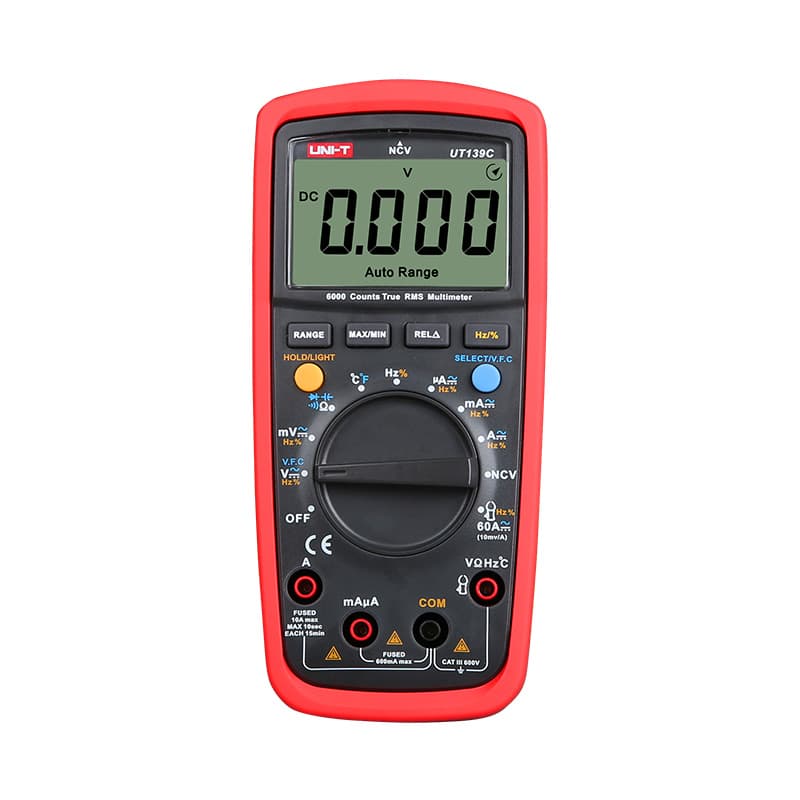
True RMS and auto-ranging with a 6,000-count display and a CAT III 600V rating, at a budget price.

True RMS, auto-ranging, CAT III 600V. The 117's reliability without NCV or LoZ, for field and electronics work.
As an Amazon Associate I earn from qualifying purchases. Prices and availability are shown on Amazon.
Frequently asked questions
What is a normal standby current for a battery-powered device?
There is no single normal figure; it depends on the design and the battery. Many microcontroller boards built for battery life sleep in the low microamps to tens of microamps, while boards with power LEDs, regulators or USB chips can draw milliamps. The component datasheets give the sleep currents each part should reach, which is the best yardstick for your own device.
Why does my device reset when I connect the multimeter?
Usually burden voltage. On a microamp range the meter drops more voltage per unit of current, so when the device wakes and draws milliamps the drop can pull its supply below the brown-out level. Start the device with the meter shorted out by a jumper, remove the jumper once it sleeps, or use the mA range and accept less resolution.
Can a clamp meter measure standby current?
Not usually. A clamp meter is built for amps, not microamps, and many clamp meters only measure AC current. Standby current in battery electronics is DC and often in the microamp range, far below what a clamp can resolve. A multimeter connected in series, or a shunt resistor with a scope or meter across it, is the right method.
How do I measure the standby power of a mains appliance?
Do not open the appliance or break its mains wiring to insert a multimeter. Use a plug-in power meter that sits between the wall socket and the appliance and reports watts, which is safe and gives standby power directly. The series-meter method on this page is for battery and low-voltage DC devices.
Why does the current reading keep jumping around?
The device is probably waking up periodically, for a sensor reading, a radio check or a timer, and the meter catches some of those bursts and misses others. The lowest steady figure between jumps is the sleep current. To find the true average including the bursts, measure the pulses with a shunt and a scope and calculate it.


