HOW-TO GUIDE
How to Test a Fan Motor Capacitor With a Multimeter
By the OhmSavvy Research Team ·

Mains voltage and stored charge
- Ceiling and extractor fans run on mains: 230 V in the UK and 120 V in North America. HVAC outdoor units in North America are usually fed at 208–240 V. Switch off at the breaker or disconnect, and confirm the circuit is dead with your meter before opening anything.
- A run capacitor can hold a charge close to the peak mains voltage (about 325 V on a 230 V supply) after power is removed. Always discharge it through a resistor first.
- Never short the terminals with a screwdriver. The arc can pit the terminals, weld metal, damage the capacitor and throw molten fragments toward your face.
What a fan motor run capacitor does
Most small fan motors are permanent split capacitor (PSC) motors. The run capacitor sits in series with an auxiliary winding and shifts its current out of phase with the main winding, which creates the rotating field that starts the motor and keeps it turning efficiently. These are non-polarised metal film capacitors, so either lead can go to either terminal.
Ceiling fans
Small multi-section capacitors, often a few µF each, with colored wires. Each section sets a speed.
HVAC condenser fans
A single fan capacitor, or the FAN section of a dual capacitor shared with the compressor.
Extractor fans
Kitchen hood, bathroom and inline fans with PSC motors use a small run capacitor.
This page is specific to motor run capacitors. For electrolytic and general-purpose capacitors, see how to test a capacitor with a multimeter, and for small board-level parts, the guide to checking a ceramic capacitor.
1Isolate the power and discharge the capacitor safely
Turn off and lock out the supply, then check for voltage between each capacitor terminal and between the terminals and ground. Connect a bleed resistor across the terminals using insulated clip leads; a 20 kΩ, 5 W resistor is a common choice. Hold it on for at least five seconds (longer for large HVAC sections), then switch the meter to DC volts and confirm the reading across the terminals is near zero. On a dual capacitor, discharge C to HERM and C to FAN separately.
2Read the µF rating and tolerance
The label shows the capacitance in µF (sometimes MFD), a tolerance such as ±5% or ±6%, and a voltage rating, typically 250 VAC or 450 VAC for fans and 370 VAC or 440 VAC for HVAC units. Ceiling fan capacitors with several sections list each value, for example 4 µF + 5 µF, and a wiring key for the colored leads. Photograph the label and wiring first.
3Measure the fan capacitor in capacitance mode
Remove the wires from the capacitor so the motor winding is not connected across it. Set the meter to capacitance (the symbol looks like two parallel lines, sometimes shared with ohms or diode on the dial) and connect the leads across the section. Larger values take a few seconds to settle, so wait for the reading to stop changing before you note it.
4Test both sections of a dual capacitor
Many HVAC outdoor units use one round dual run capacitor for both the compressor and the condenser fan. It has three terminals: C (common), HERM (the compressor or hermetic section) and FAN. Measure C to HERM and C to FAN separately and compare each with its own rating. One section can fail while the other is still fine, which is why a condenser fan may stop while the compressor keeps running. Measuring HERM to FAN gives the two sections in series and tells you nothing useful.
Is the fan motor capacitor good or does it need replacing?
Work out the tolerance window from the label and compare. The examples below use the printed tolerance; your meter's own capacitance accuracy, often a few percent, adds some uncertainty right at the edges, so a reading just outside the window is worth measuring again.
| Rating | Acceptable range | Typical use |
|---|---|---|
| 2.5 µF ±5% | 2.38–2.63 µF | Extractor fan, small ceiling fan section |
| 5 µF ±6% | 4.70–5.30 µF | Condenser fan, FAN section of a dual cap |
| 7.5 µF ±6% | 7.05–7.95 µF | Larger condenser fan motor |
| 45 µF ±6% | 42.3–47.7 µF | HERM section of a dual run capacitor |
Replace the capacitor if any section reads below its range, reads OL, or reads near zero. Replace it regardless of the reading if the case is bulging, the top is domed, the casing is cracked, or there is oil or residue around the terminals.
01
Isolate
Breaker off, confirm dead
02
Discharge
Resistor, then 0 V check
03
Inspect
Bulge, leaks, cracks
04
Measure
µF on each section
05
Compare
Inside tolerance = good
No capacitance mode? A rough resistance check
Without a capacitance range, resistance mode can still show whether the capacitor is shorted or completely open. After discharging it, set the meter to a high ohms range and connect the leads. The meter's small test current charges the capacitor, so the reading starts low and climbs steadily toward OL. Discharge it again, reverse the leads and you should see the same climb.
A rough check only
Which multimeter to use for fan capacitors
Look for a capacitance range that comfortably covers the largest value you work on, and a CAT III rating for mains-connected equipment. Check the manufacturer's specification sheet, because not every meter includes capacitance. Among our picks, the Fluke 115 and Klein Tools MM400 listings include it. For a wider comparison of meters suited to condensers and air handlers, see our best multimeter for HVAC technicians guide, or how to use a multimeter for the basics of each mode.
Meters in our reviews
True RMS, CAT III 600V, 6,000-count backlit display. Includes capacitance and frequency measurement.
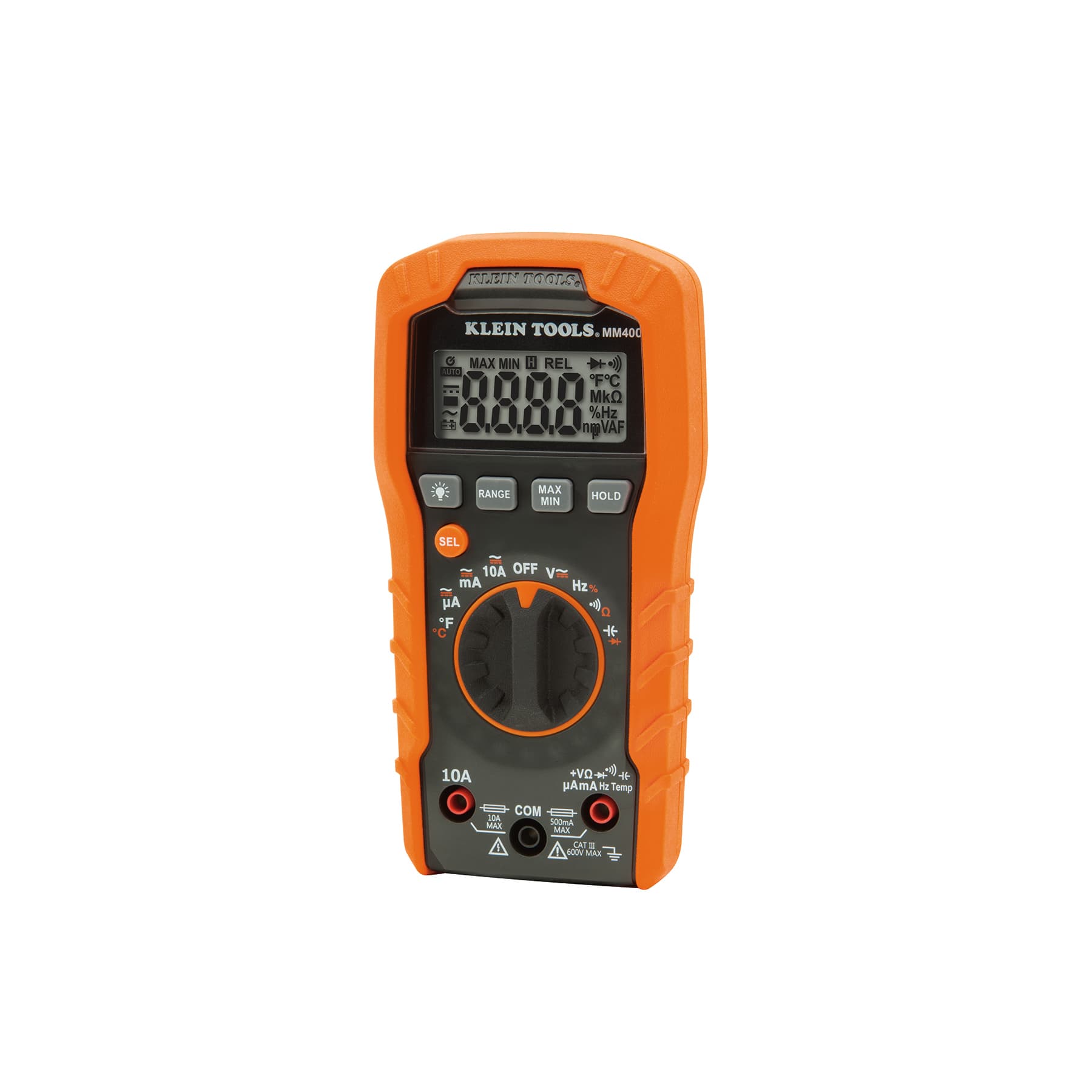
Auto-ranging, CAT III 600V, and measures capacitance and temperature. Not True RMS; discontinued by Klein.

Capacitance to 10,000 µF, True RMS and CAT IV 600V. Covers run capacitors and condenser fan motors.
As an Amazon Associate I earn from qualifying purchases. Prices and availability are shown on Amazon.
Frequently asked questions
What are the symptoms of a bad fan capacitor?
A fan that hums but will not start, starts only when you spin the blades by hand, runs slower than it should, or loses speed settings on a ceiling fan. In an HVAC outdoor unit, the condenser fan may sit still while the compressor runs, which can lead to high-pressure trips. A capacitor reading below its tolerance is the usual cause.
Can I replace a fan capacitor with a different µF value?
Match the µF value to the original. A lower value weakens starting torque and speed, and a higher value can push too much current through the motor winding, making it run hot. The voltage rating can be the same or higher, never lower, so a 440 VAC capacitor can replace a 370 VAC one of the same capacitance.
How long does a fan motor capacitor last?
There is no fixed life. Heat is the main enemy, so capacitors in outdoor condenser units exposed to summer sun, or in fans that run constantly, tend to fail sooner. Capacitance usually falls gradually before obvious symptoms appear, so measuring it during routine maintenance catches a weak part early.
Is it safe to test a fan capacitor in place?
Only after power is isolated and the capacitor has been discharged and confirmed at 0 V. Even then, disconnect at least one wire from each section before measuring, because the motor winding connected across the terminals can distort the capacitance reading. Never measure capacitance on a capacitor that is still connected to a live supply.
Why does my meter show OL in capacitance mode?
Either the capacitor is open internally, or its value is above the meter's capacitance range. Check the range in the meter's specification: a large HVAC section around 45 µF or more can exceed the limit of some basic meters. If the meter's range covers the rated value and it still shows OL, the capacitor has failed open.

