HOW-TO GUIDE
How to Diagnose a Car Window That Won't Roll Up or Down With a Multimeter
By the OhmSavvy Research Team ·
Keep clear of the window mechanism while powered
- Keep fingers and tools clear of the regulator track and mechanism any time power is connected, including with the door panel removed.
- Disconnect the battery before doing any wiring repairs, not just testing.
- Check for a window lockout switch being engaged before assuming a fault.
How a power window circuit works
A window motor is a small permanent-magnet DC motor, and it changes direction when the polarity across it is reversed. The switch does that job. At rest, both motor wires are connected to ground through the switch. Press "up" and one wire is lifted from ground and connected to 12V; press "down" and the other wire gets the 12V while the first returns to ground. That's why the switch is the first place to measure: in one direction a single wire should carry battery voltage while its partner stays at ground. Many newer cars replace the direct switch with a door control module and a one-touch relay, but the motor still sees the same reversing polarity at its connector.
1Listen first: does the motor try to move?
Press the switch and listen closely. A motor that hums, clicks, or strains without the glass moving suggests the electrical side is at least partly working and the problem may be mechanical. Total silence suggests no power is reaching the motor at all — start the electrical tests from the switch.
2Test voltage at the switch output
With the ignition on, back-probe the switch's output wires while pressing it in each direction and measure voltage. You should see voltage present on one output wire for "up" and the other for "down" — a switch with no output voltage in either direction (but power present at its input) points to a failed switch.
3Test voltage at the motor
If the switch shows good output voltage, move to the motor connector (door panel removal may be needed) and test for voltage there while operating the switch. Voltage present at the switch but not at the motor points to a break in the wiring between them.
| Symptom | Likely cause | How to check | Fix |
|---|---|---|---|
| Silent, no voltage at the switch's output | Blown fuse, lockout engaged, or a failed switch | Power at the switch input but none at its outputs | Replace the fuse or switch; release the lockout |
| Voltage at the switch, none at the motor | Broken wire or connector between switch and motor | Probe both ends of the wire while pressing the switch | Repair the wire, often in the door-jamb boot |
| Voltage at the motor, motor doesn't move | Bad motor, bad ground, or a mechanical jam | Full voltage across the motor connector, no movement | Tap the motor; replace it if it stays dead |
| Motor strains or clicks but glass doesn't move | Mechanical fault: regulator, cable, or track | Motor runs with the regulator unbolted | Replace the regulator or free the track |
| Works in one direction only | Worn switch contact for that direction | Output wire stays at 0V for one direction only | Replace the switch |
Readings to expect
These are general guidelines for a 12V car with the ignition on and the engine off, not values from a specific model. Start by measuring the battery so you have a reference; most will sit around 12.4–12.6V.
| Measurement point | Healthy (guideline) | Points to a fault |
|---|---|---|
| Switch input to ground | Within a few tenths of battery voltage | 0V: fuse, relay or feed wire |
| Switch output, button pressed | Close to battery voltage | 0V or several volts low: switch contacts |
| Across the motor connector, button pressed | Within about 0.5V of battery | Much lower: wiring or connector resistance |
| Motor ground side to chassis, button pressed | Under about 0.2V | Higher: poor ground path |
An illustrative example: the battery reads 12.5V, the switch output reads 12.4V while pressed, but the motor connector shows only 6V. Half the voltage is being lost in the wiring between them, so look at the rubber boot between the door and the body, where the harness flexes every time the door opens and copper strands break inside intact insulation.
4Test the motor's ground
If voltage reaches the motor but it still doesn't run, check the motor's ground connection — resistance or voltage-drop testing the same way as testing a car ground wire. A poor ground can starve the motor of the current it needs even with normal-looking supply voltage.
Mechanical vs. electrical failure
Good voltage and ground at a motor that still won't move the glass means the fault is mechanical — a broken regulator cable, worn gear, or a track obstruction — and electrical testing has done its job of ruling out the wiring. At that point the repair shifts from a multimeter to disassembling the regulator mechanism itself.
One electronic quirk is worth ruling out before you buy parts. On many cars with one-touch auto-up, the window module forgets the glass's end positions after the battery is disconnected or goes flat, and the auto function, sometimes the anti-pinch reverse as well, stops working properly until it's re-learned. The usual procedure is to run the window fully down, then fully up and keep holding the switch for a few seconds, but the exact steps vary, so check the owner's manual. If that restores normal operation, no part has failed.
A strained-sounding motor is a mechanical clue, not just noise
Which meter to use
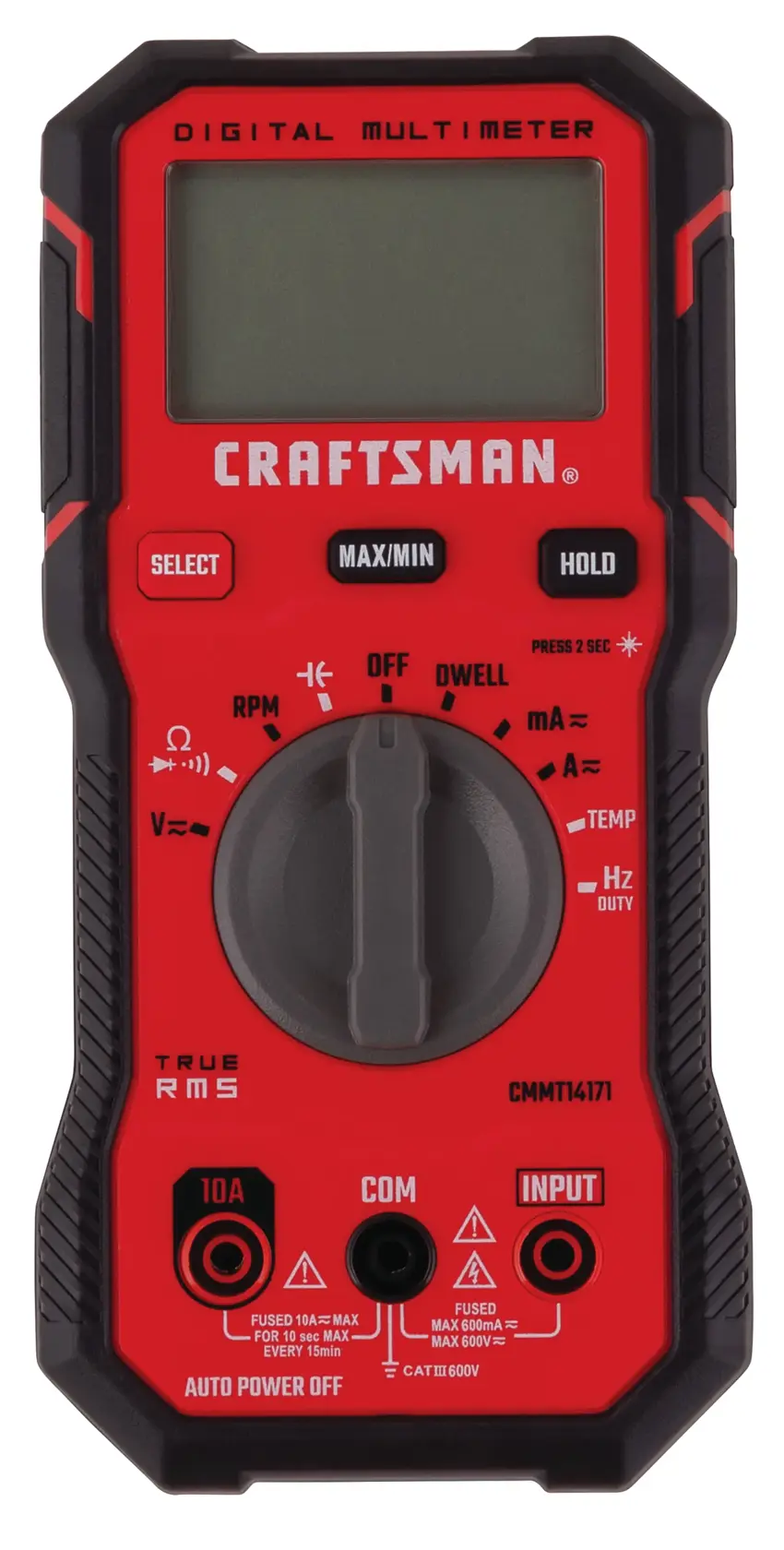
A meter with DC volts and continuity covers this whole test sequence. See the full best multimeter for automotive picks.
Meters in our reviews
Built for this kind of automotive circuit tracing.

Hands-on tested. Auto-ranging DC volts and continuity, CAT III 600V.
As an Amazon Associate I earn from qualifying purchases. Prices and availability are shown on Amazon.
Frequently asked questions
The motor hums or strains but the window doesn't move — is that electrical?
A motor that's getting power and trying to turn but can't move the window usually points to a mechanical problem — a broken regulator cable, a jammed track, or a stripped gear — rather than an electrical fault. Confirming the motor is receiving proper voltage first rules the electrical side in or out before you move to mechanical inspection.
Could a master lockout switch cause one window to stop working?
Yes — many vehicles have a window lockout switch, usually at the driver's door, that disables the rear or passenger windows entirely. Check that it isn't engaged before troubleshooting further; it's an easy thing to overlook.
Why would a window work from one switch but not the other?
If the master switch panel can operate the window but the individual door's own switch can't (or vice versa), that points to a fault isolated to one specific switch or its wiring, rather than the motor or the circuit shared by both.
Can a blown fuse affect just one window and not others?
It depends on the vehicle's wiring — some share one fuse across multiple windows, others fuse each window separately. Check your owner's manual's fuse diagram to see whether the affected window has its own dedicated fuse or shares one with windows that are still working.
Is it safe to test the window motor with the door panel off?
Yes, as long as you keep clear of the regulator mechanism and track while testing with power connected — a power window mechanism can move unexpectedly and has enough force to pinch fingers.


