COMPARISON · MULTIMETERS
Fluke 106 vs Fluke 114: Which Compact Multimeter Should You Buy?
The Fluke 106 vs 114 differences run in opposite directions. The 106 is the genuinely compact one, a 200 g palm-sized meter that reads amps and capacitance but isn't True RMS. The 114 is a full-size 110-series body that does less, measuring only volts, ohms and continuity, yet does those with True RMS, an AutoVolt low-impedance input, a bar graph and Min/Max/Average. Pick by the measurement you can't do without, not by size.
By the OhmSavvy Research Team ·
Disclosure: OhmSavvy earns a commission from qualifying Amazon purchases made through these links, at no extra cost to you. How we're funded.
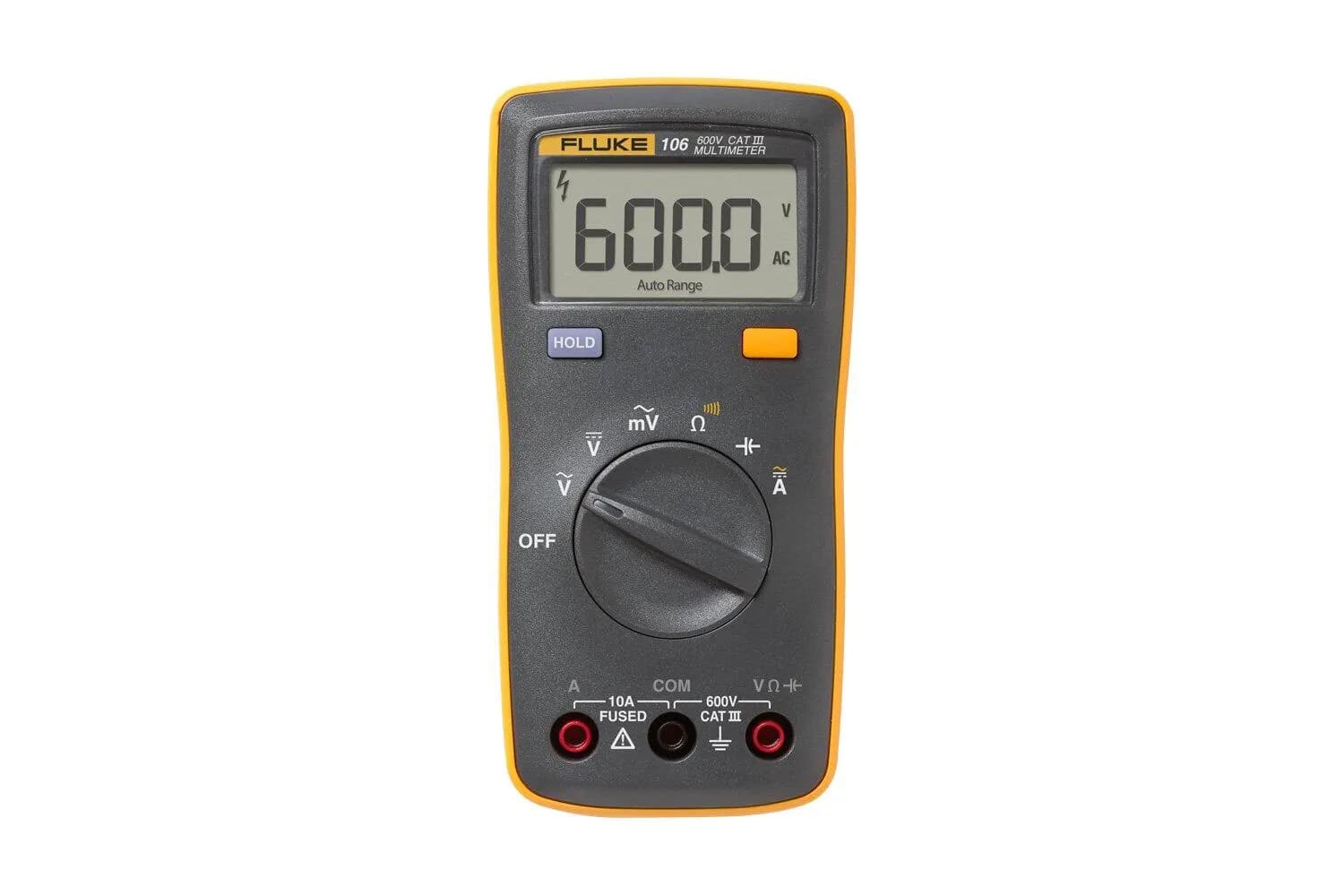
Fluke 106
4.2★★★★☆The 107's palm-sized body for less, without diode test, frequency or duty cycle.

Fluke 114
4.5★★★★★A True RMS voltage-and-continuity meter with AutoVolt LoZ, made for quick go/no-go checks on 600 V circuits.
Specs side by side
| Fluke 106 | Fluke 114 | |
|---|---|---|
| Rating | 4.2★★★★☆ | 4.5★★★★★ |
| Accuracy | Average-responding (not True RMS) | True RMS, ±(0.5% + 2) DC V |
| Safety rating | CAT III 600V | CAT III 600V |
| Auto-ranging | Yes | Yes (manual override) |
| Best for | A small, cheap backup meter | Electrician go/no-go voltage checks |
| True RMS | No (average-responding) | Yes, AC volts and AC mV |
| Low-impedance volts | No | AutoVolt LoZ, 600.0 V, auto AC/DC |
| DC volts accuracy | ±(0.5% + 3) | ±(0.5% + 2) |
| AC volts accuracy | ±(1.0% + 3), 40–500 Hz | ±(1.0% + 3), 45–500 Hz; ±(2.0% + 3) to 1 kHz |
| Millivolts | AC 600.0 mV only | AC and DC mV |
| Current | 4 A and 10 A, AC/DC (no mA/µA) | None (two jacks only) |
| Capacitance | 50 nF to 1,000 µF | Not listed |
| Resistance | 400 Ω to 40 MΩ | 600 Ω to 40 MΩ |
| Continuity beep | Below 70 Ω | Below 20 Ω (off above 250 Ω) |
| Display extras | 6,000 counts; backlight not listed | 6,000 counts, 33-segment bar graph, backlight |
| Recording | Hold: see note | Min/Max/Average with elapsed time |
| Size / weight | 142 × 69 × 28 mm, 200 g | 167 × 84 × 46 mm, 550 g (Amazon: 0.51 kg) |
| Battery | 2 × AAA, 200 h minimum | One 9 V, 400 h without backlight |
| Warranty | 2 years per Fluke docs (106 page: not stated) | 3 years |
Specs checked against manufacturer documentation and official Amazon listings. Desk research, not bench testing. How we research.
Key differences
- →The 106 measures current on 4 A and 10 A ranges and capacitance to 1,000 µF; the 114 has only COM and V/Ω jacks and lists neither function.
- →The 114 is True RMS and has AutoVolt, a low-impedance 600 V position that picks AC or DC for you; the 106 is average-responding with a conventional high-impedance input only.
- →The 114 adds a 33-segment bar graph, a listed backlight and Min/Max/Average with elapsed time; Fluke's 106 page lists none of these.
- →The 106 weighs 200 g against 550 g and is 28 mm thick against 46 mm.
- →Both are CAT III 600V with 6,000-count displays, and their shared DC and AC voltage accuracy is close: ±(0.5% + 3) versus ±(0.5% + 2) on DC.
- →Warranty is 3 years on the 114; Fluke's 106/107 documentation gives the 106 two years, though the 106 product page itself doesn't state one.
Only one of these is really compact
Searchers often lump the 114 in with Fluke's small meters because it does so few things, but physically it shares the same 167 × 84 × 46 mm housing as the 115 and 117. The 106 belongs to a different family: the 101/106/107 pocket line, built around two AAA cells. Drawn to the same scale, the gap is obvious.
The bulk buys the 114 a 9 V battery rated for twice the hours, a bar graph that refreshes 32 times a second and a backlight. The 106 trades all three for something you can drop in a shirt pocket. If "compact" is your top requirement, the honest answer is the 106, and the real question becomes whether you can live without True RMS and LoZ.
Function coverage: a crossed trade
Most Fluke pairings are a ladder, where the pricier meter does everything the cheaper one does and more. This pair isn't. Each meter has functions the other lacks entirely, so the table below matters more than the spec sheets' headline numbers.
| Function | Fluke 106 | Fluke 114 |
|---|---|---|
| DC and AC volts to 600 V | Yes | Yes |
| True RMS AC | No | Yes |
| Low-impedance (LoZ) volts | No | Yes, AutoVolt |
| DC millivolts | Not listed | Yes |
| Current, 4 A / 10 A | Yes | No |
| Milliamps or microamps | No | No |
| Capacitance | 50 nF to 1,000 µF | Not listed |
| Resistance and continuity | Yes | Yes |
| Diode test, frequency | No (107 only) | No |
| Min/Max/Average | Not listed | Yes, with elapsed time |
| Bar graph | No | 33 segments |
Notice that neither meter tests diodes or reads frequency. If you need those on a pocket body, the step up is the 107, covered in Fluke 106 vs Fluke 107. If you want the 114's voltage tools plus current and capacitance, that combination is the 117, compared in Fluke 114 vs Fluke 117.
Two ways to be wrong about a dead wire
The biggest practical gap is how each meter behaves on an open conductor that runs beside a live one. The 106's volts input is over 10 MΩ, which is what you want on electronics, but it also means a disconnected wire picking up voltage capacitively from its neighbor can show a sizable AC reading with almost no current behind it. You then have to decide whether that number is real.
The 114's AutoVolt position puts a low resistance across the leads. A stiff source such as a real 120 V feed barely notices; a weak, coupled voltage collapses toward zero. As a hedged illustration, a coupled wire might read tens of volts on a high-impedance meter and close to nothing on LoZ, while a genuinely energized circuit reads about the same on both. That contrast is the diagnostic. Fluke doesn't publish the LoZ input resistance on the 114 page we checked; the same feature on the 113 and 117 is specified at roughly 3 kΩ.
The 106 workaround, and its limits
Where the 106's current and capacitance ranges win
Current is the job the 114 simply can't start. The 106 reads up to 10 A in series, AC or DC, at ±(1.5% + 3), with AC current specified from 40 to 200 Hz. That covers a 12 V accessory in a car, a bench supply feeding a project or a low-voltage lighting run, as long as the load stays within 10 A. It has no milliamp range, so best resolution on the 4 A range is 1 mA and small standby currents are out of reach; see Fluke 17B+ vs Fluke 106 if you need finer current.
Capacitance follows the same pattern. The 106 reads from its 50 nF range up to 1,000 µF, though Fluke notes readings can take up to 18 seconds to settle. That handles a furnace blower's run capacitor or a power-supply filter cap. The 114 lists no capacitance function at all, so an HVAC or appliance user who needs that test should not start with it; our Fluke 114 vs Fluke 116 page covers the 110-series model that adds it.
Which should you buy?
| Situation | Better fit | Reason |
|---|---|---|
| Glovebox or junk-drawer meter | Fluke 106 | 200 g and 28 mm thick |
| Is this outlet wire live or just induced? | Fluke 114 | AutoVolt LoZ settles it in one step |
| Current draw of a 12 V car accessory | Fluke 106 | 4 A and 10 A ranges; the 114 has none |
| Dimmer, LED driver or VFD output | Fluke 114 | True RMS AC volts |
| Run or filter capacitor check | Fluke 106 | 50 nF to 1,000 µF listed |
| Watching a sagging supply over time | Fluke 114 | Min/Max/Average and a 32/s bar graph |
| Dim attic or crawl space | Fluke 114 | Backlight listed; not for the 106 |
| Low-voltage control signals in mV DC | Fluke 114 | DC mV range; the 106 lists AC mV only |
Buy the Fluke 106 if you're a homeowner, car owner or hobbyist who wants a tough, small meter that covers volts, amps, ohms and capacitance, and you mostly measure clean utility power or DC. Skip it if you work on building wiring for a living, because it has no LoZ, no True RMS and no backlight listed. Buy the Fluke 114 if your day is spent proving circuits live or dead in panels and boxes. Skip it if you'll ever need amps or capacitance, since the more complete 115 and 117 share its body; compare it with the Fluke 115 first.
Both stop at CAT III 600V
Where the published specs disagree
Fluke's 114 overview mentions "voltage and current", but its own spec table lists no current range and the meter has only two jacks, so we treat it as voltage and resistance only. The same page carries a temperature footnote without any temperature function. Amazon gives the 114's weight as 0.51 kg against Fluke's 550 g. On the 106, our product summary mentions data hold, yet Fluke's 106 page doesn't list hold or a backlight, so treat both as unconfirmed. Fluke's 106/107 documentation gives a two-year warranty that the 106 product page itself doesn't repeat. A 1 m drop rating is published for the 107; for the 106 and 114 it is not stated in the sources we cite.
Choose the Fluke 106 if…
- ✓You need to read current, up to 10 A, as well as volts
- ✓You want to check capacitors from 50 nF to 1,000 µF
- ✓The meter has to live in a glovebox, kitchen drawer or small pouch
Choose the Fluke 114 if…
- ✓You check building wiring and want a low-impedance input to rule out ghost voltage
- ✓You need True RMS readings on dimmers, drives or electronic loads
- ✓You log a fluctuating voltage with Min/Max/Average and want a fast bar graph
Neither if…
You need current/capacitance and AutoVolt/True RMS/bar graph together — neither meter covers both sets, and the Fluke 117 does.
The bottom line
Choose the Fluke 106 if you want a truly pocketable meter that reads current and capacitance and you mostly measure clean mains or DC. Choose the Fluke 114 if you test building wiring and value True RMS, AutoVolt LoZ, a bar graph and Min/Max/Average over amps. If you need both sets of features, look at the Fluke 117 instead of compromising.
Frequently asked questions
Is the Fluke 114 a compact multimeter?+
Not physically. It uses the same 167 × 84 × 46 mm, 550 g housing as the Fluke 115 and 117. It is compact only in its feature list: volts, resistance and continuity. The Fluke 106 is the small one here at 142 × 69 × 28 mm and 200 g.
Can the Fluke 106 detect ghost voltage?+
Not directly. It has a high-impedance volts input of over 10 MΩ and no low-impedance mode, so an induced voltage on an open wire can show up as a real-looking reading. You can confirm with a second method, such as a plug-in tester or a known load. The Fluke 114's AutoVolt position is built for exactly that check.
Does the Fluke 114 measure amps or capacitance?+
No. Fluke's spec table lists neither, and the meter has only two input jacks, COM and V/Ω. Fluke's overview text mentions current, which conflicts with its own table, but there is no current input on the meter. For amps on this body you need the Fluke 115 or 117; for capacitance and temperature, the 116.
Which is more accurate, the Fluke 106 or 114?+
On clean sine-wave AC and on DC they are close: both list AC volts at ±(1.0% + 3), and DC volts at ±(0.5% + 3) on the 106 versus ±(0.5% + 2) on the 114. The real difference is waveform. The 114 is True RMS, so it stays correct on distorted AC from dimmers and drives, where the average-responding 106 can read off.
Which battery lasts longer, the Fluke 106 or 114?+
Fluke rates the 114 at 400 hours on one 9 V battery without the backlight, and the 106 at a minimum of 200 hours on two AAA cells. The 106 also switches itself off after 20 minutes of inactivity, which helps if it lives in a toolbox and sometimes gets left on.
Do the Fluke 106 and 114 have the same continuity beeper?+
Not quite. Per Fluke's documents, the 106 beeps below 70 Ω, while the 114 beeps below 20 Ω and stays silent above 250 Ω. So a corroded joint measuring 50 Ω beeps on the 106 but not on the 114, which matters when you are confirming a clean connection rather than just checking that a fuse isn't blown.
Related



