COMPARISON · MULTIMETERS
Fluke 117 vs Fluke 106
Fluke 117 vs Fluke 106 pits Fluke's electrician's meter against its entry-level pocket model. Both are CAT III 600V with 6,000-count displays and similar 10A current ranges, but the 117 adds True RMS, VoltAlert non-contact detection, AutoVolt and a low-impedance mode, while the 106 trades all of that for a 200 g body. Electricians and anyone working on household wiring should buy the 117; the 106 suits a cheap second meter for batteries, fuses and continuity.
By the OhmSavvy Research Team ·
Disclosure: OhmSavvy earns a commission from qualifying Amazon purchases made through these links, at no extra cost to you. How we're funded.

Fluke 117
4.8★★★★★The meter working electricians actually buy with their own money, not just the one brands push.
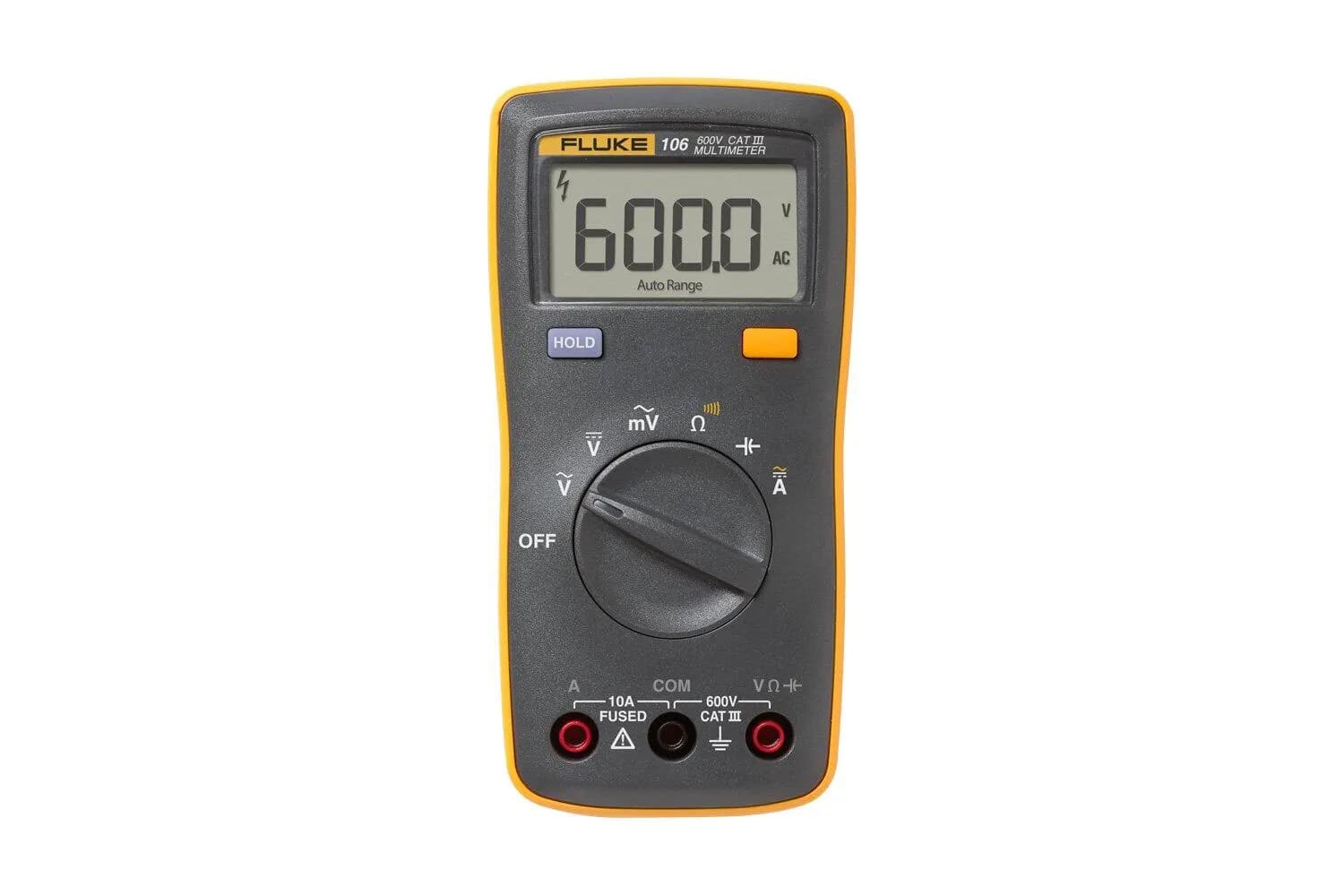
Fluke 106
4.2★★★★☆The 107's palm-sized body for less, without diode test, frequency or duty cycle.
Specs side by side
| Fluke 117 | Fluke 106 | |
|---|---|---|
| Rating | 4.8★★★★★ | 4.2★★★★☆ |
| Accuracy | True RMS | Average-responding (not True RMS) |
| Safety rating | CAT III 600V | CAT III 600V |
| Auto-ranging | Yes | Yes |
| Best for | Electricians, serious hobbyists | A small, cheap backup meter |
| True RMS | Yes | No |
| VoltAlert NCV / AutoVolt / LoZ | Yes / Yes / Yes | No / No / No |
| Display | 6,000 counts + 33-segment bar graph | 6,000 counts |
| DC volts accuracy | ±(0.5% + 2) | ±(0.5% + 3) |
| Current ranges | 6A and 10A AC/DC | 4A and 10A AC/DC |
| Capacitance | Up to 9,999 µF | Up to 1,000 µF |
| Frequency | Up to 50 kHz | No |
| Diode test | Yes | No |
| Min/Max | Min/Max/Average | Not listed |
| Size / weight | 167 × 84 × 46 mm, 550 g | 142 × 69 × 28 mm, 200 g |
| Battery | One 9V, about 400 h typical | 2 × AAA, 200 h minimum |
| Warranty | 3 years | Not stated on Fluke's current US page |
Specs checked against manufacturer documentation and official Amazon listings. Fluke 117 is hands-on tested by OhmSavvy; the Fluke 106 assessment is desk research. How we research.
Key differences
- →The 117 is True RMS; Fluke positions the 106 for work where True RMS accuracy isn't needed.
- →Only the 117 has VoltAlert non-contact voltage detection, AutoVolt AC/DC selection and a low-impedance mode for ghost voltages.
- →The 117 reads frequency to 50 kHz, tests diodes and reaches 9,999 µF; the 106 has no frequency or diode test and stops at 1,000 µF.
- →Neither has milliamp or microamp ranges: the 117 has 6A and 10A, the 106 4A and 10A.
- →The 106 weighs 200 g against the 117's 550 g, and is 28 mm thick rather than 46 mm.
Electrician features: what the extra money buys
| Feature | What it does | 117 | 106 |
|---|---|---|---|
| True RMS | Correct AC readings on distorted waveforms | Yes | No |
| VoltAlert | Senses a live conductor without contact | Yes | No |
| AutoVolt | Picks AC or DC voltage automatically | Yes | No |
| LoZ mode | Loads the circuit to collapse ghost voltage | Yes | No |
| Bar graph | Shows trends and fluctuations | 33 segments | No |
| Min/Max/Avg | Catches sags and peaks while you watch elsewhere | Yes | Not listed |
The owner has bought and used the 117, which is why it carries our Hands-on Tested badge. The 106 hasn't been tested by OhmSavvy, so its column is drawn from Fluke's product page and users manual only.
Why LoZ matters on building wiring
Fluke 117 vs 106 spec by spec
| Spec | Fluke 117 | Fluke 106 |
|---|---|---|
| DC volts | 600.0 mV to 600.0 V, ±(0.5% + 2) | 6.000 to 600.0 V, ±(0.5% + 3) |
| AC volts | ±(1.0% + 3), 45–500 Hz, True RMS | ±(1.0% + 3), 40–500 Hz, average-responding |
| AC/DC current | 6.000 A and 10.00 A, ±(1.5% + 3) | 4.000 A and 10.00 A, ±(1.5% + 3) |
| Resistance | 600.0 Ω to 40.00 MΩ, ±(0.9% + 1) | 400.0 Ω to 40.00 MΩ, ±(0.5% + 2) mid ranges |
| Capacitance | 1 nF to 9,999 µF, ±(1.9% + 2) | 50.00 nF to 1,000 µF, ±(2% + 5) to ±(5% + 5) |
| Continuity | Beeps below 20 Ω | Yes |
| Display updates | 4 per second, bar graph 32 per second | 3 per second |
| Battery | One 9V, 400 h typical | 2 × AAA, 200 h minimum |
| Ingress rating | Not stated | IP 40 |
Bars use a logarithmic scale: each step is ten times the last.
On a clean 120 V receptacle the two agree closely: on the 600.0 V range, both tolerances work out to 1.0% × 120 + 3 × 0.1 = ±1.5 V. The 106 is even slightly tighter on resistance. The 117's advantages are not about raw accuracy on easy signals; they are about getting the right answer on difficult ones.
How much bigger is the 117?
The 117's extra 18 mm of thickness and 350 g come with the full-size 110 Series case and its 9V battery. That size carries the bar graph, the VoltAlert sensor and the extra dial positions, and it is meant to ride on a belt or in a tool bag. The 106 is built to vanish into a pocket or a glovebox until it's needed.
When True RMS changes the reading
The 106 rectifies AC, averages it and scales the result for a sine wave. That is exact for a clean sine and drifts for anything else. On a triangle wave with a 10 V peak, for example, the true RMS is 10 ÷ √3 ≈ 5.77 V, while an average-responding meter shows 5.0 × 1.11 ≈ 5.55 V, about 4% low. Narrow, peaky waveforms, like the current drawn by LED drivers and switch-mode supplies, push the error much further.
On household receptacles, heater circuits and incandescent lighting the waveform is close to a sine, and the 106 is fine. On variable-speed drives, dimmers and electronic ballasts, trust the 117. Our Fluke 117 vs Fluke 107 comparison draws the sine and square-wave case.
Fluke 117 vs 106: which should you buy?
| You are… | Better fit | Why |
|---|---|---|
| Electrician on branch circuits and panels | Fluke 117 | NCV, LoZ and True RMS for real-world wiring |
| Homeowner replacing switches and outlets | Fluke 117 | VoltAlert and LoZ help confirm a circuit is dead |
| Homeowner checking batteries and fuses | Fluke 106 | Light, simple and accurate on DC |
| HVAC tech on drives and ECM motors | Fluke 117 | True RMS on distorted waveforms |
| Glovebox or kitchen-drawer backup | Fluke 106 | 200 g and 28 mm thick |
| Electronics hobbyist | Neither ideal | No mA or µA ranges; the 106 lacks diode test |
If you want the 117's accuracy without the electrician features, the Fluke 115 vs Fluke 117 comparison covers the cheaper sibling. For a pocket meter with diode test and frequency, see Fluke 106 vs Fluke 107.
Safety: a pocket meter is not a voltage detector
Choose the Fluke 117 if…
- ✓You work on building wiring and want NCV and LoZ to rule out live and ghost voltages
- ✓You measure on drives, LED drivers or other electronic loads where True RMS matters
- ✓You want frequency, a bar graph and Min/Max/Average
Choose the Fluke 106 if…
- ✓You want a light, inexpensive Fluke for a drawer, van or glovebox
- ✓Your checks are batteries, outlets, fuses and continuity
- ✓You don't need True RMS or electrician-specific safety features
The bottom line
If you do electrical work in buildings, the Fluke 117 is worth the step up: True RMS, NCV, AutoVolt and LoZ are safety and accuracy features the 106 simply doesn't have. The 106 is a sensible cheap second meter for batteries, outlets and continuity, not a replacement for the 117.
Frequently asked questions
Is the Fluke 106 True RMS?+
No. Fluke's US page positions the 106 for everyday work where True RMS accuracy isn't needed, and it reads AC by averaging. That's accurate on clean sine waves such as a healthy receptacle, but readings drift on drives, dimmers and LED drivers. The 117 is True RMS on both AC volts and AC amps.
Does the Fluke 106 have non-contact voltage detection?+
No. VoltAlert non-contact detection, AutoVolt and the low-impedance mode are 117 features, and none is listed for the 106. If you buy the 106 for household wiring, pair it with a separate non-contact voltage tester, and remember that a high-impedance meter can show ghost voltage on disconnected wires.
Can either meter measure milliamps?+
Only coarsely. The 117 has 6A and 10A ranges with 1 mA best resolution, and the 106 has 4A and 10A ranges, also with 1 mA steps. Neither has a dedicated mA or µA input, so small currents like standby draw or flame-sensor signals need a meter such as the Fluke 17B+ or 87V.
Which battery lasts longer, the Fluke 117 or 106?+
Fluke quotes about 400 hours typical for the 117's single 9V cell without backlight, and a 200-hour minimum for the 106's two AAA cells. The figures are measured on different bases, typical against minimum, so treat them as a rough guide rather than a direct comparison.
Which is better for a homeowner?+
For occasional battery, outlet and fuse checks, the 106 is enough and costs less. If you plan to replace switches, receptacles or light fixtures yourself, the 117's VoltAlert and LoZ make it the safer choice, because they help you confirm a circuit is really dead before you touch it.
Related


