COMPARISON · MULTIMETERS
Fluke 106 vs Fluke T5-600
Fluke 106 vs Fluke T5-600 is unusual among Fluke match-ups because both tools read current, just in completely different ways. The palm-sized 106 measures up to 10A, AC or DC, with its leads wired into the circuit. The T5-600 measures up to 100A AC by sliding its open jaw around a conductor. Which approach suits you matters more than any other spec here.
By the OhmSavvy Research Team ·
Disclosure: OhmSavvy earns a commission from qualifying Amazon purchases made through these links, at no extra cost to you. How we're funded.
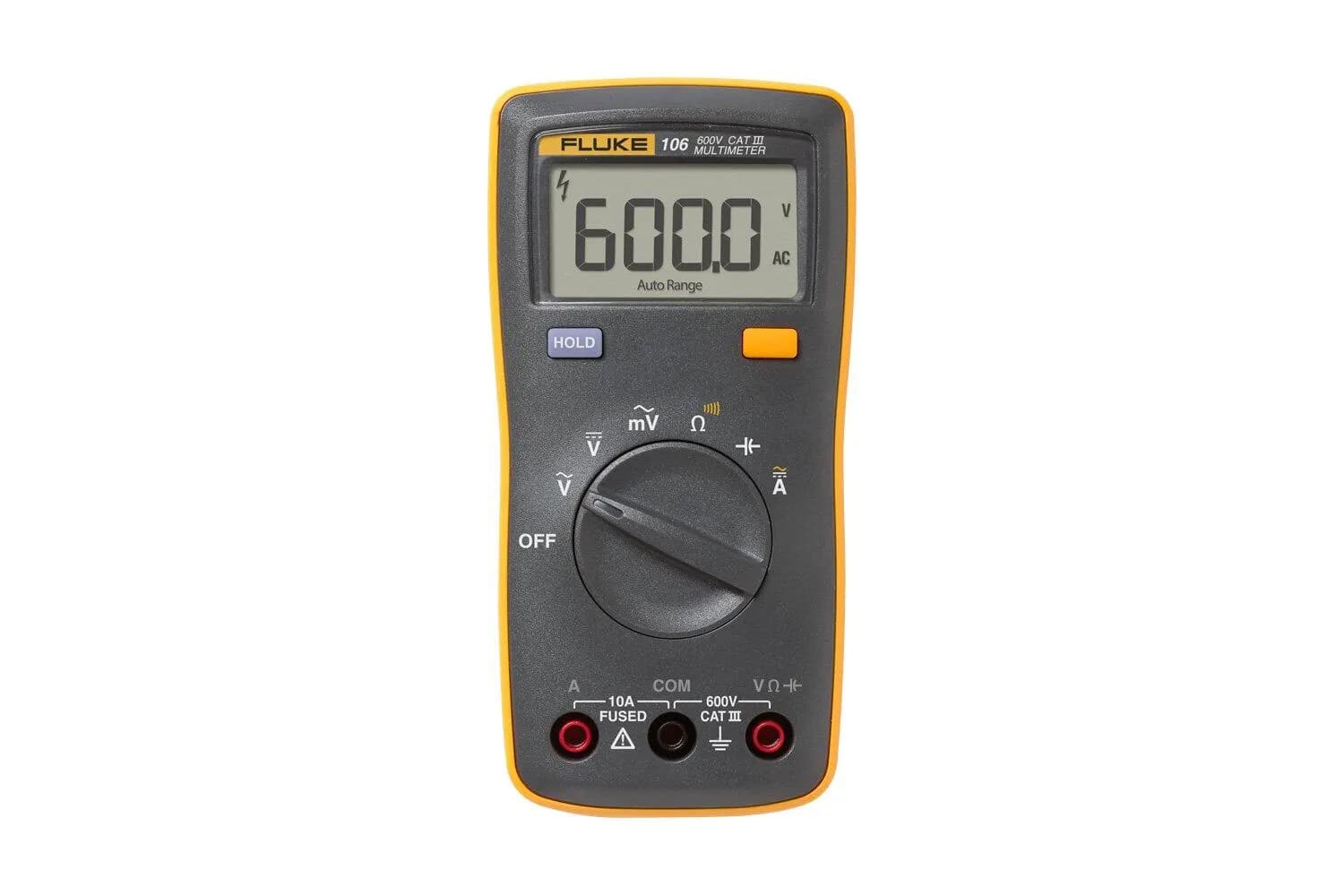
Fluke 106
4.2★★★★☆The 107's palm-sized body for less, without diode test, frequency or duty cycle.
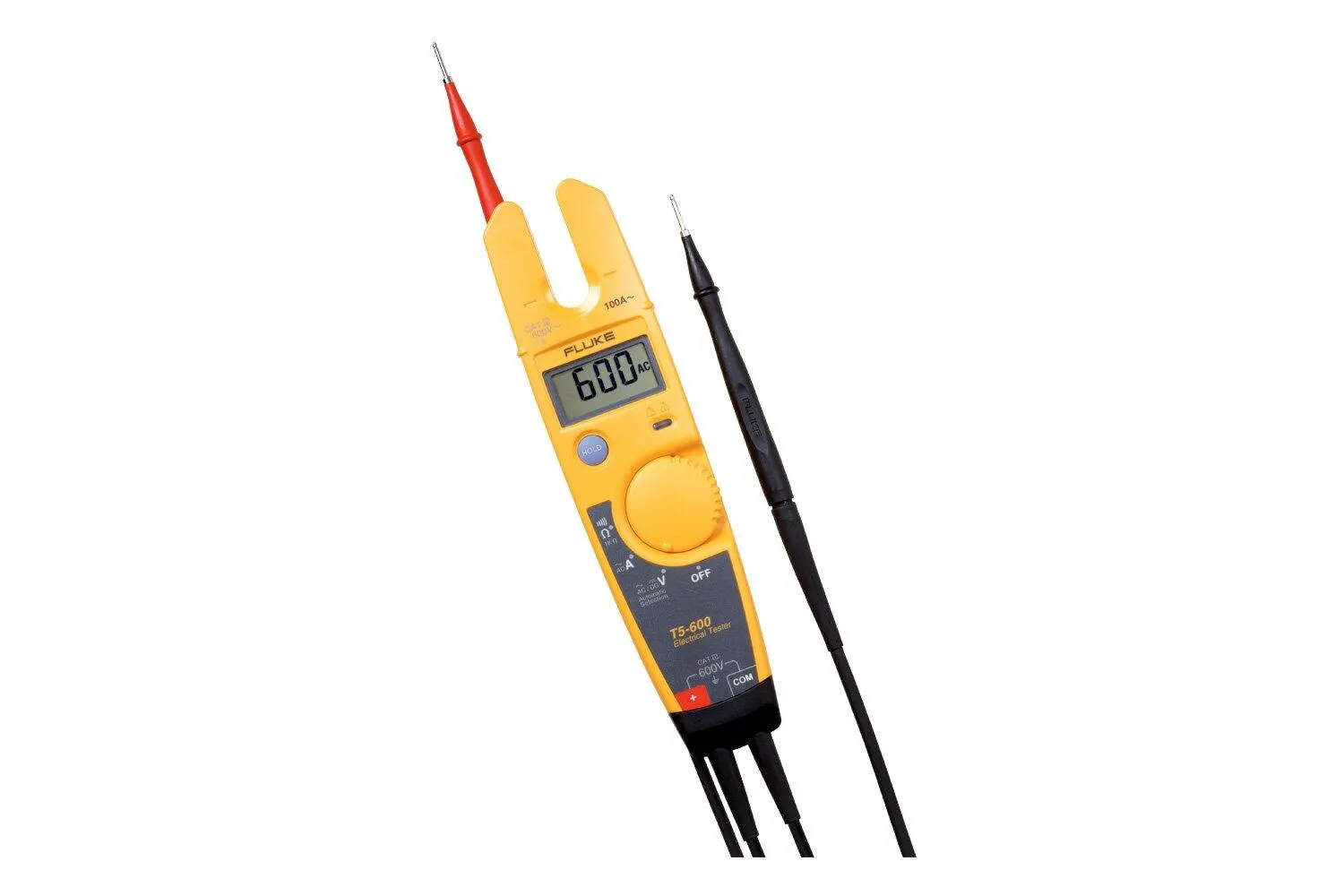
Fluke T5-600
4.4★★★★☆Not a multimeter but an electrician's tester: volts, continuity and up to 100A AC through an open jaw, no leads in the circuit.
Specs side by side
| Fluke 106 | Fluke T5-600 | |
|---|---|---|
| Rating | 4.2★★★★☆ | 4.4★★★★☆ |
| Accuracy | Average-responding (not True RMS) | Average-responding (not True RMS) |
| Safety rating | CAT III 600V | CAT III 600V |
| Auto-ranging | Yes | Automatic AC/DC voltage selection |
| Best for | A small, cheap backup meter | Electricians' quick voltage and current checks |
| Instrument type | Digital multimeter | Electrical tester |
| Current method | Leads in series with the load | Open jaw around one conductor |
| Current range | 4A and 10A ranges, AC and DC | To 100A, AC only |
| Voltage | To 600V AC/DC | To 600V AC/DC, auto AC/DC |
| Voltage resolution | 0.001 V on the 6 V range | 1 V |
| Resistance | To 40 MΩ | To 1,000 Ω |
| Capacitance | 50 nF to 1,000 µF | No |
| Display | 6,000 counts | Digital LCD (count not stated) |
| Weight | 200 g | 300 g |
| Battery | 2 × AAA, 200 hours minimum | 2 × AA, about 400 hours alkaline |
| Warranty | 2 years | 2 years |
Specs checked against manufacturer documentation and official Amazon listings. Desk research, not bench testing. How we research.
Key differences
- →The 106 reads current through its leads, so the circuit must be opened; the T5-600 reads through its jaw with the circuit intact.
- →The 106 measures DC current as well as AC; the T5-600 reads AC current only.
- →The T5-600's current range reaches 100A against the 106's 10A.
- →Only the 106 measures capacitance, and its resistance range runs to 40 MΩ instead of 1,000 Ω.
- →The 106 resolves voltage to the millivolt on its 6 V range; the T5-600 shows whole volts.
- →The 106 is the lighter tool at 200 g; the T5-600 weighs 300 g but is rated for a 3 m drop.
Two ways to measure current
A multimeter's current range works by making the meter part of the circuit: you open the circuit, and the full load current flows in through the 10 A jack, across an internal shunt and fuse, and back out through COM. The T5-600 instead senses the magnetic field that AC current creates around a single conductor, so nothing is disconnected. That one design choice explains most of the spec differences below, including why the T5-600 can't read DC.
The jaw has to go around one conductor, not a whole cord: in a two-wire cord the out-and-back currents cancel and the reading falls toward zero. Fluke gives the jaw a 12.9 mm opening, which fits wire up to 1/0 THHN. The 106's series method has the opposite limits. It reads DC as easily as AC, but the current must stay within the 10 A range and its 11 A fuse.
Measuring the same load, step by step
Suppose you want the current drawn by a heater. Here is what each tool asks of you.
01
Switch off
Isolate the circuit
02
Open it
Disconnect one wire
03
Wire in leads
10A jack and COM
04
Power up, read
Up to 10A
01
Set to current
Select amps
02
Slide the jaw
Round one conductor
03
Read
Up to 100A AC
Fluke 106 vs T5-600 spec by spec
The T5-600 trades precision for speed and toughness. Its voltage display shows whole volts, and its accuracy figures are looser than the 106's on every function both share.
Bars use a logarithmic scale: each step is ten times the last.
Bars use a logarithmic scale: each step is ten times the last.
Resolution matters most on batteries. A 12 V lead-acid battery at about 12.6 V is roughly full and at about 12.0 V is largely discharged, a 0.6 V spread that is a typical guide rather than a hard rule. The 106 shows that battery to 0.01 V on its 60 V range; the T5-600 displays it as 12 or 13 V and can't separate the two states. Our guide to testing a car battery with a multimeter covers the readings in detail.
Which should you buy?
| Current to check | Fluke 106 | Fluke T5-600 |
|---|---|---|
| Car or RV battery drain (DC) | Coarsely: lowest range is 4A | No (AC only) |
| Solar panel output (DC) | Yes, to 10A | No |
| Space heater on a 15A or 20A circuit | Only to 10A | Yes |
| Air-conditioner or pump motor | Only if it draws 10A or less | Yes, to 100A |
| Checking a 12 V battery's charge | Yes, 0.01 V steps | Too coarse: whole volts |
| Measuring a run capacitor | Yes, to 1,000 µF | No capacitance function |
The two tools suit different trades. The 106 fits a vehicle, boat or off-grid toolbox, where most circuits are DC and the loads you'll measure stay under 10 A. The T5-600 fits an electrician's belt: it reads receptacle voltage without choosing AC or DC, beeps continuity, and checks a motor or heater feed in seconds without touching a terminal screw. If you want clamp-on current and a full meter in one, see Fluke 117 vs Fluke T5-600 or the clamp meter buying guide; for the 106's step-up with diode test and frequency, read Fluke 106 vs Fluke 107.
Open-jaw safety
Safety: opening a live circuit
Choose the Fluke 106 if…
- ✓You need DC current, for batteries, solar or automotive circuits
- ✓You want capacitance and resistance to 40 MΩ in a 200 g meter
- ✓Your currents stay at or below 10A
Choose the Fluke T5-600 if…
- ✓You need AC current readings above 10A
- ✓You can't or don't want to break the circuit to measure
- ✓You want voltage that switches between AC and DC by itself
The bottom line
Pick the Fluke 106 if you need DC current or capacitance, or want the smallest tool that reads amps. Pick the T5-600 if your current checks are AC, often above 10A, and you'd rather not open circuits to make them. The 106 suits batteries and vehicles; the T5-600 suits panels and motors.
Frequently asked questions
Can the Fluke T5-600 measure DC current?+
No. Its open jaw reads AC current only, up to 100A at 50 or 60 Hz, and Fluke's own Q&A confirms it can't measure DC amps. For battery, solar or automotive current you need a meter with a DC current range, such as the Fluke 106, which reads AC and DC current up to 10A through its leads.
Do I need to break the circuit to measure current with the Fluke 106?+
Yes. Like any multimeter current range, its leads go in series with the load, so you switch off, disconnect one wire, connect the 10 A jack and COM across the gap and power up again. The T5-600 avoids this by reading through its open jaw while the circuit stays intact.
What is the largest wire the T5-600's jaw takes?+
Fluke gives a 12.9 mm (0.5 in) jaw opening, enough for wire up to 1/0 THHN. Put the jaw around a single conductor only. Around a two-wire cord the currents in each wire flow in opposite directions and cancel, so the reading drops toward zero even when the appliance is running.
Is the Fluke T5-600 good for checking a car battery?+
Not really. It reads DC voltage to 600 V but in 1 V steps, so a healthy 12.6 V battery and a nearly flat 12.0 V one can look the same. It also can't measure DC current for a parasitic drain test. The Fluke 106 shows 0.01 V steps and has a DC current range.
Are either of these True RMS?+
No. Fluke lists the T5-600's AC response as averaging, and its page for the 106 positions it for jobs where True RMS isn't needed. Both read clean sine-wave mains and resistive loads correctly, but on variable-speed drives or LED lighting their AC readings can drift from the true value.
Related



