COMPARISON · MULTIMETERS
Fluke 17B+ vs Fluke 106
Fluke 17B+ vs Fluke 106 sets a full-size, feature-heavy meter against Fluke's cheapest pocket model. The 17B+ brings temperature, frequency, duty cycle and microamp ranges; the 106 strips those away to fit a 6,000-count display into a 200 g body that slips into a shirt pocket. Neither is True RMS.
By the OhmSavvy Research Team ·
Disclosure: OhmSavvy earns a commission from qualifying Amazon purchases made through these links, at no extra cost to you. How we're funded.
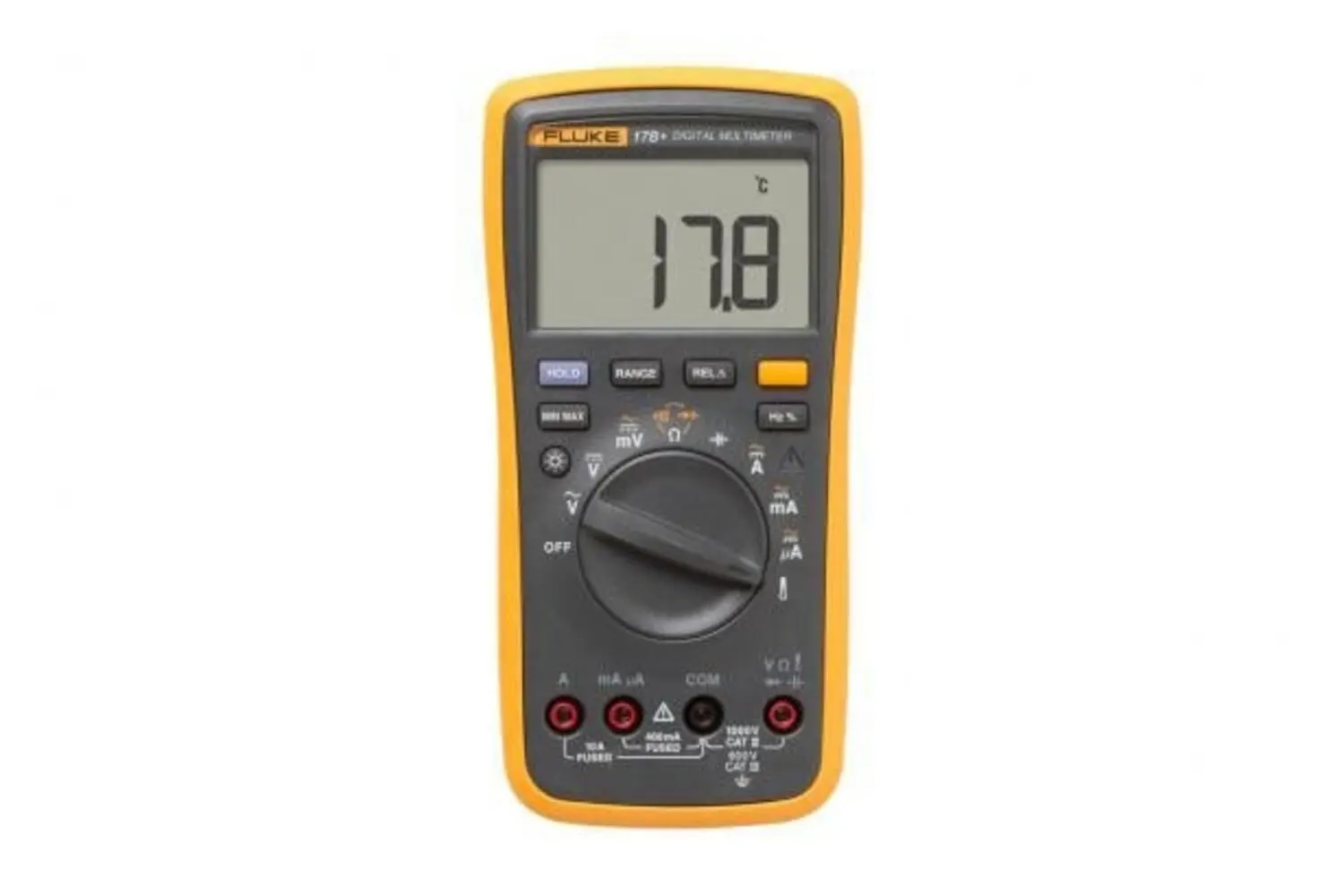
Fluke 17B+
4.5★★★★★A full-size Fluke with temperature, frequency, MIN MAX and relative mode, but not True RMS.
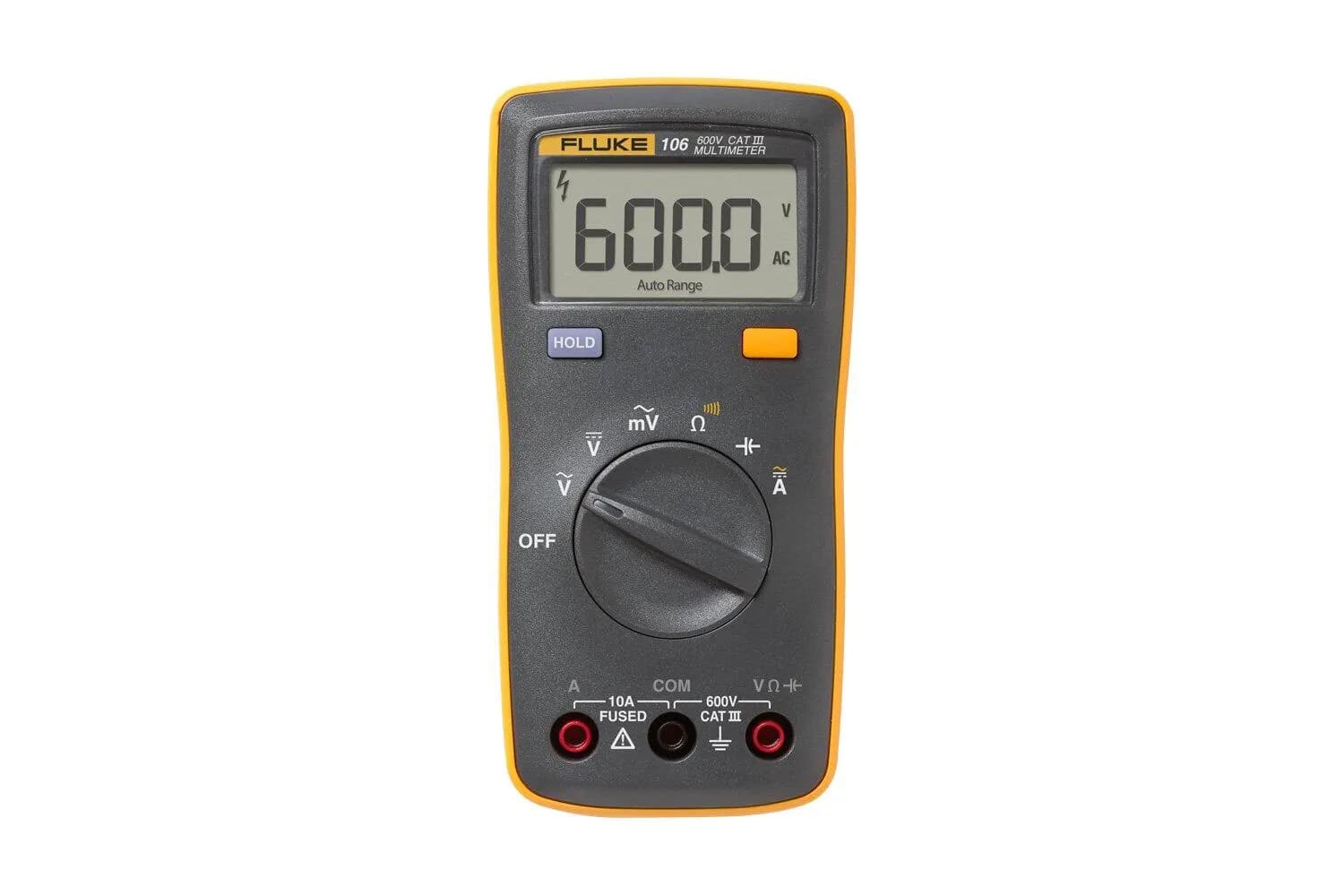
Fluke 106
4.2★★★★☆The 107's palm-sized body for less, without diode test, frequency or duty cycle.
Specs side by side
| Fluke 17B+ | Fluke 106 | |
|---|---|---|
| Rating | 4.5★★★★★ | 4.2★★★★☆ |
| Accuracy | Not stated as True RMS by Fluke | Average-responding (not True RMS) |
| Safety rating | CAT III 600V / CAT II 1000V | CAT III 600V |
| Auto-ranging | Yes (manual override) | Yes |
| Best for | Electronics hobbyists, students, appliance repair | A small, cheap backup meter |
| Display | 4,000 counts, 3 updates/s | 6,000 counts, 3 updates/s |
| Voltage ranges | 400.0 mV, 4.000, 40.00, 400.0, 1000 V | 600.0 mV, 6.000, 60.00, 600.0 V |
| DC / AC volts accuracy | ±(0.5% + 3) / ±(1.0% + 3) | ±(0.5% + 3) / ±(1.0% + 3) |
| Max voltage | 1000V AC/DC | 600V AC/DC |
| Current ranges | 400 µA to 10A AC/DC | 4A and 10A AC/DC only (no mA/µA) |
| Current fuses | 440 mA (µA/mA) and 11 A, 1000 V | Not stated on Fluke's 106 page |
| Resistance | Up to 40 MΩ | Up to 40 MΩ |
| Capacitance | Up to 1,000 µF | Up to 1,000 µF |
| Frequency / duty cycle | To 100 kHz; 1% to 99% | No (107 only) |
| Diode test | Yes | No (107 only) |
| Temperature | −55 °C to 400 °C, probe included | No |
| Size / weight | 183 × 91 × 49.5 mm, 455 g | 142 × 69 × 28 mm, 200 g |
| Battery | 2 × AA, 500 h minimum | 2 × AAA, 200 h minimum |
Specs checked against manufacturer documentation and official Amazon listings. Desk research, not bench testing. How we research.
Key differences
- →The 106 weighs 200 g against the 17B+'s 455 g, and is 28 mm thick rather than 49.5 mm.
- →The 106 has a 6,000-count display; the 17B+ has 4,000 counts, so the 106 holds finer resolution before changing range.
- →The 17B+ covers µA, mA and A current; the 106 has only 4A and 10A ranges, which rules it out for small currents.
- →Temperature, frequency, duty cycle, diode test and MIN MAX are on the 17B+ but not the 106.
- →The 17B+ carries a CAT II 1000V rating alongside CAT III 600V; the 106 is CAT III 600V only.
Fluke 17B+ vs 106 spec by spec
The most visible gap is physical. The 106 shares the 107's compact case, while the 17B+ is a conventional full-size handheld with room for its extra jacks and buttons. Less obvious is that Fluke quotes the same basic voltage accuracy for both: ±(0.5% + 3 digits) on DC and ±(1.0% + 3) on AC. What changes is the size of a digit, which depends on the range each meter is on.
Where 6,000 counts beats 4,000, and where it doesn't
A 4,000-count meter tops each range at 3.999, 39.99 or 399.9; a 6,000-count meter carries on to 5.999, 59.99 or 599.9. So the 106 only shows an extra digit when your reading falls in the band between those two limits. Below 4 V, 40 V or 400 V both meters sit on equivalent ranges and display the same thing.
| Reading | 17B+ range and display | 106 range and display | Who resolves more |
|---|---|---|---|
| 1.5 V AA cell | 4.000 V: 1.500 | 6.000 V: 1.500 | Same |
| 5 V USB supply | 40.00 V: 5.00 | 6.000 V: 5.000 | 106, by one digit |
| 12.6 V car battery | 40.00 V: 12.60 | 60.00 V: 12.60 | Same |
| 48 V battery bank | 400.0 V: 48.0 | 60.00 V: 48.00 | 106, by one digit |
| 120 V outlet | 400.0 V: 120.0 | 600.0 V: 120.0 | Same |
| 480 V three-phase | 1000 V: 480 | 600.0 V: 480.0 | 106, but see the safety note |
The 5 V case shows why it matters. Using Fluke's DC spec, the 17B+ on its 40.00 V range is good to ±(0.5% × 5 V + 3 × 0.01 V) = ±0.055 V, while the 106 on 6.000 V is good to ±(0.025 V + 0.003 V) = ±0.028 V. That is the arithmetic of the published spec, not a measurement. For a USB rail that must sit between 4.75 V and 5.25 V, either is adequate; for a 5.0 V reference you'd prefer the 106's tighter window. At 480 V the 106 resolves more, but that is industrial three-phase territory and the 17B+'s 1000 V reach and CAT II 1000V rating are the more relevant numbers there.
Current measurement is the deciding gap
| Current you want to read | Fluke 17B+ | Fluke 106 |
|---|---|---|
| Microamps (sensor bias, flame rod) | Yes | No |
| Milliamps (LED strip, device standby) | Yes | No |
| A few amps (small motor, heater) | Yes | Yes, 4A range |
| Up to 10A | Yes | Yes, 10A range for under 7 minutes |
Fluke fits the 17B+ with a separate 440 mA fuse for its µA and mA input, so small currents go through their own input, and the meter can resolve 0.1 µA on the 400.0 µA range. The 106's smallest range is 4.000 A with 1 mA resolution, which means a device drawing 25 mA reads 0.025 A at best and the ±(1.5% + 3 digits) spec allows ±3 mA of error on top. Fluke also limits the 106's AC current specification to 40 to 200 Hz, against 40 to 400 Hz on the 17B+.
What the 106's limit means in practice
Which should you buy?
| Your situation | Better fit | Reason |
|---|---|---|
| Glovebox or kitchen-drawer backup meter | Fluke 106 | 200 g and 28 mm thick |
| Car parasitic-drain or LED current checks | Fluke 17B+ | mA and µA ranges with their own fuse |
| HVAC duct and pipe temperatures | Fluke 17B+ | Type K probe from −55 °C to 400 °C |
| Checking 5 V and 48 V DC rails closely | Fluke 106 | 6,000 counts keep an extra digit there |
| Diode and frequency checks on electronics | Fluke 17B+ | The 106 has neither function |
| Long jobs away from spare batteries | Fluke 17B+ | 500 h minimum vs 200 h |
The honest split is this. If you mainly confirm that outlets are live, batteries are charged and fuses are intact, the 106 does that in a meter you'll actually carry, and its display is the sharper of the two in several common bands. Once your work involves small currents, temperatures or signal checks, the 17B+ is the only one of the pair that can do the job at all. If you want the pocket size plus diode test and frequency, compare the Fluke 106 vs 107; if you want the 17B+ body without the extras, see the 17B+ vs 15B+.
Choose the Fluke 17B+ if…
- ✓You need µA or mA ranges for sensors, standby current or flame rods
- ✓You want temperature and frequency in the same meter
- ✓Your bench or toolbox has room for a full-size meter
Choose the Fluke 106 if…
- ✓You want a meter that lives in a pocket, glovebox or drawer
- ✓You mostly check voltage, continuity and resistance, with the odd amp reading
- ✓You prefer a 6,000-count display for finer voltage steps
The bottom line
Choose the 17B+ for electronics, appliance and HVAC work where microamps, temperature and frequency come up. Choose the 106 as a light, inexpensive pocket meter for voltage and continuity, with a finer 6,000-count display but no small-current ranges.
Frequently asked questions
Can the Fluke 106 measure milliamps?+
No. Fluke lists only 4A and 10A current ranges for the 106, so it can't read milliamp or microamp currents with any useful resolution: its finest step is 1 mA. The 17B+ covers 400 µA up to 10A, with a separate fused input for the small ranges.
Which has the better display, the 17B+ or the 106?+
The 106 has 6,000 counts against the 17B+'s 4,000, so it shows a reading such as 5.000 V on one range where the 17B+ has already stepped up to 40.00 V. Below 4 V, 40 V or 400 V they show the same digits. The 17B+ is backlit; Fluke's 106 page doesn't mention a backlight.
Is the Fluke 106 rated for 1000V?+
No. The 106 is rated CAT III 600V and Fluke lists 600V as the maximum between any terminal and earth. The 17B+ reads up to 1000V and adds a CAT II 1000V rating alongside CAT III 600V, though for most household work the two ratings are equivalent.
Does either meter read temperature?+
Only the 17B+, using the supplied Type K probe from −55 °C to 400 °C with 0.1 °C resolution. Fluke specifies ±2 °C between 0 and 50 °C. The 106 has no temperature function and no thermocouple input, so it can't be added later.
Which is better as a car glovebox meter?+
The 106, for size: 142 × 69 × 28 mm and 200 g, on two AAA cells. It handles battery voltage and fuse continuity well. For parasitic-drain checks in milliamps you'd need the 17B+, which is too bulky for many gloveboxes but fine in a trunk toolbag.
Related



