HOW-TO GUIDE
How to Check a Car Alternator Diode With a Multimeter
By the OhmSavvy Research Team ·
Symptoms of a bad alternator diode
A shorted or open rectifier diode produces a recognizable set of complaints. None proves a diode fault on its own, but two or three together make the ripple test worth doing before anything else.
- Headlights or dash lights that flicker or pulse with engine speed.
- A whine through the audio system that rises and falls with RPM.
- A battery that slowly discharges while parked, with no obvious drain in the fuse box.
- Charging voltage on the low side, especially with lights and blower running.
- A dimly glowing battery warning light while driving.
1AC ripple test at the battery
Start the engine, hold it at a fast idle (around 1,500 to 2,000 RPM), and switch on the headlights and blower so the alternator is working. Set the meter to AC volts, not DC, and place the red probe on the battery positive post and the black on the negative post. The meter now ignores the 14-ish volts of DC and shows only the AC left over from rectification. Read it, then compare against the figures below.
Typical ripple readings
These bands are widely used rules of thumb, not a manufacturer specification. Meter type and engine speed both shift the number, so treat a borderline reading as a prompt to retest under heavier load.
2Check for diode leakage drain
If the complaint is a dead battery after sitting, a leaking positive diode is a candidate. With the engine off and the car asleep, disconnect the battery negative, remove the alternator's output (B+) cable at the alternator, reconnect the battery, and put the meter in series between the cable and the stud on its milliamp range. Any meaningful current flowing into the alternator with the engine off indicates leakage. Never start the engine with the meter in this position. Our parasitic drain guide covers series current measurement and sleep timing in full.
3Bench test the rectifier in diode mode
Disconnect the battery before removing the alternator
With the alternator removed and opened, unsolder or unbolt the stator leads from the rectifier so the windings don't form paths between diodes. Set the meter to diode mode. Each stator terminal sits between a positive diode (to the B+ heat sink) and a negative diode (to the grounded heat sink). Test each one in both directions: a good diode reads a forward drop one way and OL the other. The full method for a single diode is in our diode testing guide, and the same probe pattern on a standalone four-diode part is covered in our bridge rectifier guide.
| Probe red on | Probe black on | Good diode reads |
|---|---|---|
| Stator terminal | B+ heat sink | Forward drop, typically ~0.4–0.7V |
| B+ heat sink | Stator terminal | OL |
| Ground heat sink | Stator terminal | Forward drop, typically ~0.4–0.7V |
| Stator terminal | Ground heat sink | OL |
Testing a diode trio
Reading the results
| Finding | Likely cause |
|---|---|
| Ripple under ~0.3VAC, charging voltage normal | Rectifier healthy; look at cables, grounds or the battery |
| Ripple above ~0.5VAC | Open or shorted rectifier diode, or an open stator phase |
| Current into the B+ stud with engine off | Leaking positive diode draining the battery |
| Diode reads low or beeps in both directions | Shorted diode; replace the rectifier |
| Diode reads OL in both directions | Open diode; replace the rectifier |
| Normal ripple, but low charging voltage | Regulator, brushes, belt slip or a voltage drop in the cabling |
Meters for charging-system checks
The ripple test needs a meter that reads small AC voltages riding on DC, and the bench test needs a diode mode. A Min/Max function is a bonus for catching charging voltage swings while someone blips the throttle. These three come from our automotive meter picks.
Meters for alternator and battery diagnosis
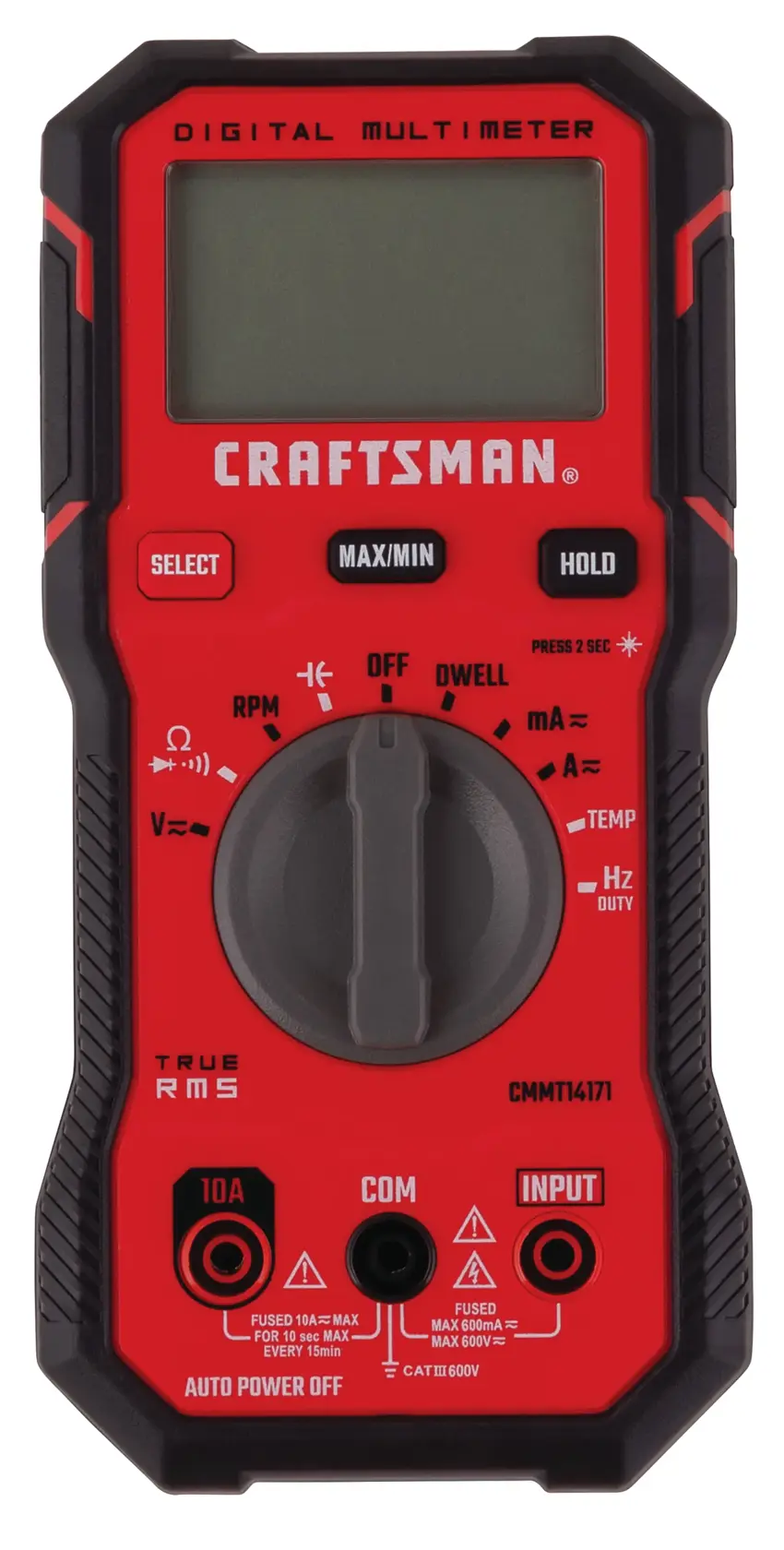
True RMS at CAT III 600V, adding RPM, dwell angle and duty cycle for the rest of the engine bay.
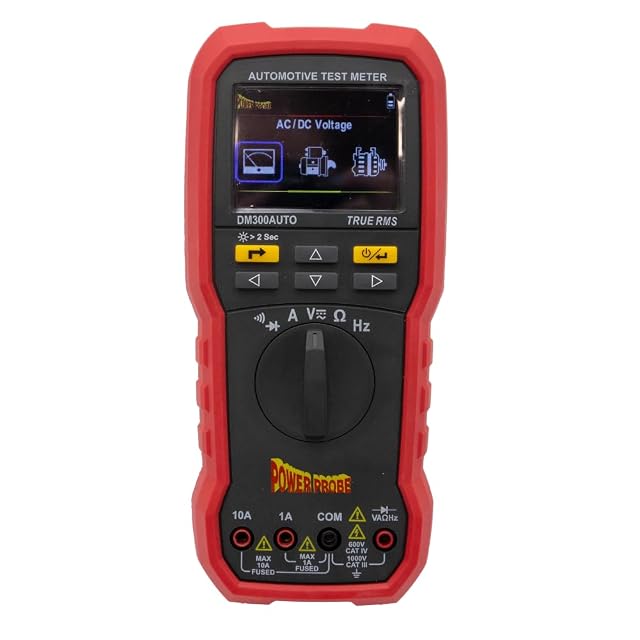
Guided cranking and alternator charging tests for 12V and 24V systems with on-screen pass/fail. Voltage accuracy ±(2% + 3).

Budget 6,000-count True RMS with Min/Max and a 600 µA range for parasitic-drain checks.
As an Amazon Associate I earn from qualifying purchases. Prices and availability are shown on Amazon.
Frequently asked questions
How much AC ripple is acceptable from an alternator?
A commonly used rule of thumb is that a healthy alternator shows well under 0.5VAC across the battery with the engine running and some load on, often only around 0.1 to 0.3VAC. Readings above about 0.5VAC suggest a failed diode or stator winding. Your vehicle's service information may give a tighter figure, so treat these as typical guides.
Can a bad alternator diode drain the battery overnight?
Yes. A positive-side rectifier diode that leaks in reverse lets battery current flow back through the stator to ground with the engine off. Because the alternator output cable usually connects to the battery through a high-current fuse link rather than a fuse in the interior fuse box, pulling fuses during a drain test won't reveal it. Measuring current in the alternator output lead will.
Does a True RMS meter matter for the ripple test?
It helps. The ripple is not a clean sine wave, and its frequency rises with engine speed into the hundreds of hertz or more. An averaging meter can misread that waveform, and any meter's AC range has a limited frequency response. A True RMS meter gives a more representative number; an oscilloscope shows the actual waveform, including the regular dips a single dead diode creates.
Will a bad diode always turn on the battery warning light?
Not always. With one diode of six open, the alternator often still charges, just with lower output and more ripple, so the light may stay off. A failed diode trio on older alternators commonly makes the warning light glow dimly while driving. The ripple test catches problems the warning light misses.
Can I replace just the rectifier instead of the whole alternator?
On many alternators the rectifier is a separate, replaceable assembly, and rebuilders do exactly that. Whether it's worth it depends on the unit's age, the condition of the bearings and brushes, and parts availability. For most owners a remanufactured alternator is the simpler fix, but the bench test still tells you whether the fault was the diodes or the stator.



