REVIEW · MULTIMETERS
Craftsman CMMT14171 Review
The one pick here built specifically for diagnosing cars, not just household wiring.
By the OhmSavvy Research Team ·
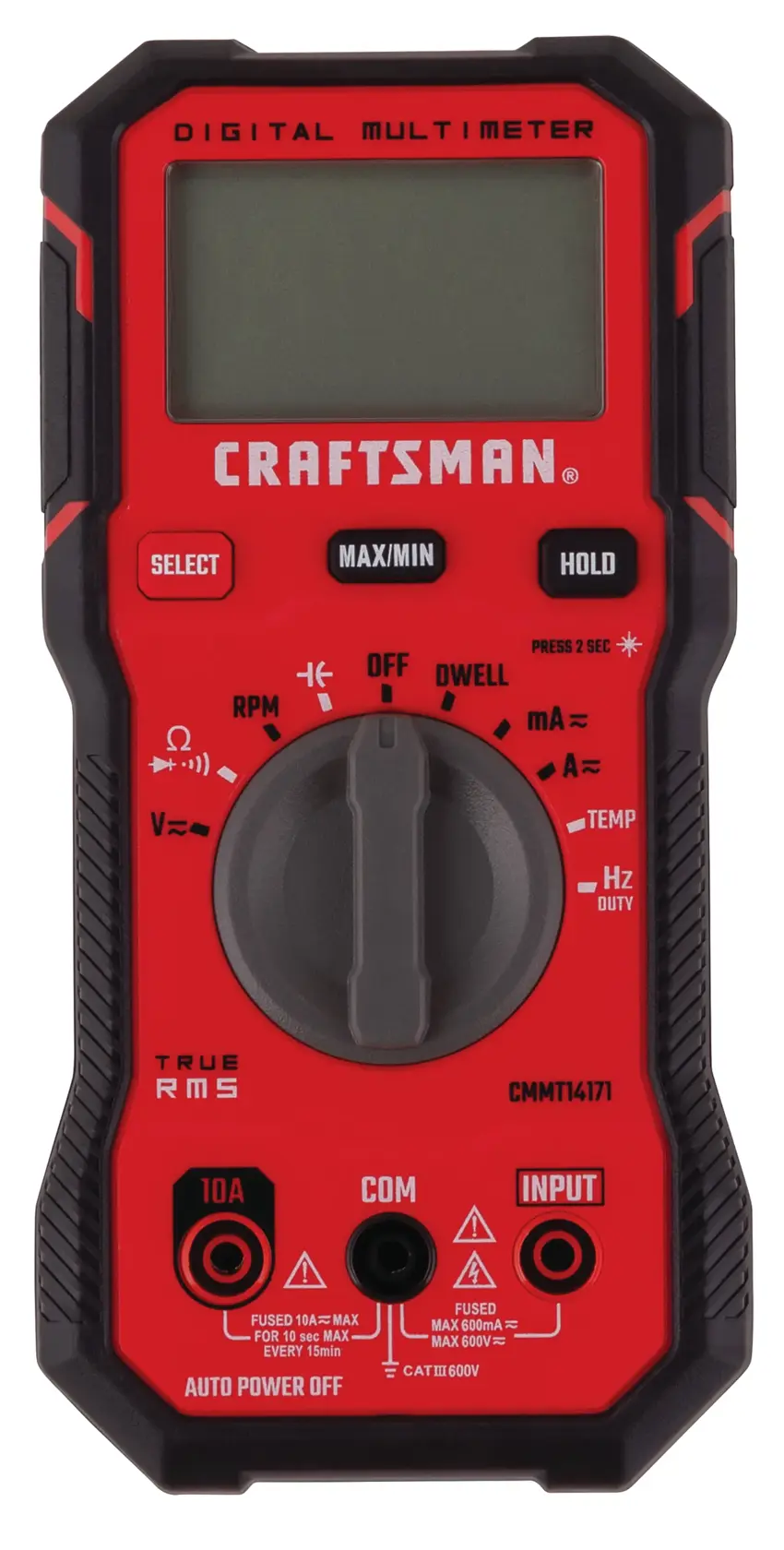
| Model | Craftsman CMMT14171 |
|---|---|
| Accuracy | True RMS |
| Safety rating | CAT III 600V |
| Auto-ranging | Yes |
| Best for | DIY mechanics diagnosing vehicle electrical systems |
| Review status | Desk research, not bench-tested |
Disclosure: OhmSavvy earns a commission from qualifying Amazon purchases made through these links, at no extra cost to you. How we're funded.
The verdict
Craftsman's CMMT14171 adds RPM, dwell angle, and duty-cycle measurement on top of standard True RMS multimeter functions — the specific toolkit automotive diagnostics actually needs, at a CAT III 600V rating.
Consider it if
- ✓You diagnose engines and need RPM, dwell angle, or duty-cycle readings
- ✓You want one garage meter that also handles household checks
- ✓You prefer a familiar tool brand
- ✓You check sensors and coolant or A/C vent temperatures and want temperature on the same meter
- ✓You'd rather own one meter that covers both the garage and the breaker panel than two specialized tools
Skip it if
- ✕You never work on vehicles — you'd be paying for functions you won't use
- ✕You need CAT IV protection for service-entrance work
- ✕You want published accuracy and range figures before you buy; Craftsman's spec page wasn't available when we checked
- ✕You need to watch a sensor waveform rather than a single number — that's oscilloscope territory
The trade-off: Its value is in the automotive functions. Without them, it's a capable CAT III 600V True RMS meter, but not one that stands out from cheaper general-purpose picks — so buy this specifically because you need the vehicle diagnostics, not as a generic first meter.
Key specifications
- Accuracy
- True RMS
- Safety rating
- CAT III 600V
- Auto-ranging
- Yes
- Best for
- Automotive diagnostics
Checked against the manufacturer's official product page or datasheet and the official Amazon listing when this model was added to our guide.
Strengths and limitations
Reasons to buy
- +RPM, dwell, and duty-cycle functions built in
- +Familiar, trusted Craftsman brand
- +Also measures temperature and frequency
Reasons to avoid
- −Automotive functions are wasted if you don't work on cars
- −Not rated for CAT IV panel work
Performance assessment
We haven't bench-tested this unit. This assessment is based on its published specifications and on what those specifications mean in practice. How we research.
Automotive functions
RPM, dwell angle, and duty cycle are the measurements general-purpose meters usually skip. Duty cycle helps when checking pulse-width-modulated components such as fuel injectors and solenoids, while RPM and dwell apply to ignition systems.
Duty cycle in practice
Most modern actuators are switched on and off rapidly by the engine computer, and the percentage of on-time sets how hard they work. As a typical, hedged example, a port fuel injector at warm idle often sits in the low single digits of duty cycle and climbs as load rises; a purge or idle-air solenoid behaves the same way. Reading that percentage tells you whether the computer is commanding the part at all, and whether the command changes when you raise the revs. If the command looks right but the part doesn't respond, the fault is in the part or its wiring, not the computer.
RPM and dwell: where they still help
An RPM function lets you confirm engine speed while you test something that depends on it, such as charging voltage at idle versus about 2,000 rpm, without relying on a dash tachometer that may not exist on older vehicles. Dwell angle comes from the points-ignition era: it's how many degrees of rotation the coil spends charging. It's essential for tuning classic cars, motorcycles and small engines with contact points, and much less relevant to modern coil-on-plug ignition, where the computer controls dwell itself.
General measurement
Underneath, it's a True RMS, auto-ranging meter rated CAT III 600V, with temperature and frequency functions for sensor and signal checks. Craftsman's listing says True RMS applies to both voltage and current, which matters on vehicles too: alternator ripple, inverter outputs on hybrids and the AC side of a shop charger are not clean sine waves.
What we couldn't verify
Craftsman's product page returned an error when we checked, and the Amazon listing doesn't publish display counts, voltage or current ranges, accuracy figures or how the RPM function picks up engine speed. We list those as not stated rather than guess. If exact accuracy matters for your work, such as voltage-drop testing across a ground strap where tenths of a volt count, compare against a meter whose maker publishes the figures.
One meter, two toolboxes
The practical appeal here is consolidation: rather than owning a separate ignition analyzer plus a household multimeter, the CMMT14171 covers both jobs from one case. For a DIYer who splits time between the garage and the breaker panel, that's a real convenience even though it means neither role gets a dedicated, specialized instrument the way a Fluke 117 would for building wiring.
Alternatives to consider
Where to buy the Craftsman CMMT14171
We link to the official Amazon listing. Prices change often, so check the current price at the retailer before you buy.
Frequently asked questions
What makes the Craftsman CMMT14171 an automotive multimeter?+
It adds RPM, dwell angle and duty-cycle measurement on top of standard True RMS functions, plus temperature and frequency. Those are the readings ignition and fuel-system diagnosis rely on, and general-purpose meters usually skip RPM and dwell entirely. The rest of the meter covers the voltage, resistance and continuity checks any car electrical job needs.
Can I use the CMMT14171 for household electrical work?+
Yes, within its CAT III 600V rating, which covers household panels, branch circuits and building wiring. It isn't rated CAT IV, so it's not the right tool at the meter base, service drop or an outdoor feed between buildings. For outlets, switches and appliance circuits around the house, the rating is appropriate.
What does duty cycle actually tell you about a car part?+
Duty cycle is the percentage of time a pulse-width-modulated signal spends on versus off. On a fuel injector or an idle-air solenoid, that percentage is how the engine computer controls flow. A higher figure generally means the part is being told to work harder, so you can check whether the command matches conditions, which a meter without this function can't do.
Can the Craftsman CMMT14171 test an alternator?+
Yes, for the standard voltage checks. Measure battery voltage with the engine off, then again at idle and at about 2,000 rpm, using the RPM function to confirm engine speed. As a typical guide, a charging system usually holds roughly 13.8 to 14.7 V running, but check your vehicle's service data for its exact range before condemning anything.
Is dwell angle still useful on modern cars?+
Mostly not. Dwell measurement matters on breaker-point ignitions, where you set the points gap to get the right number of degrees. Modern electronic and coil-on-plug systems let the computer control coil charge time, so there's nothing to adjust. If you work on classic cars, older motorcycles or small engines with points, it remains a genuinely useful function.
Related
Craftsman CMMT14171
4.4★★★★☆


