COMPARISON · MULTIMETERS
Fluke 17B+ vs Fluke 15B+
Fluke 17B+ vs Fluke 15B+ is a comparison of two meters built on one platform. They share the case, the CAT III 600V / CAT II 1000V rating, the 4,000-count backlit display and the µA-to-10A current ranges, so the decision rests entirely on the functions the 17B+ adds and the 15B+ leaves out: temperature, frequency, duty cycle, MIN MAX, relative mode and a hazardous-voltage LED.
By the OhmSavvy Research Team ·
Disclosure: OhmSavvy earns a commission from qualifying Amazon purchases made through these links, at no extra cost to you. How we're funded.
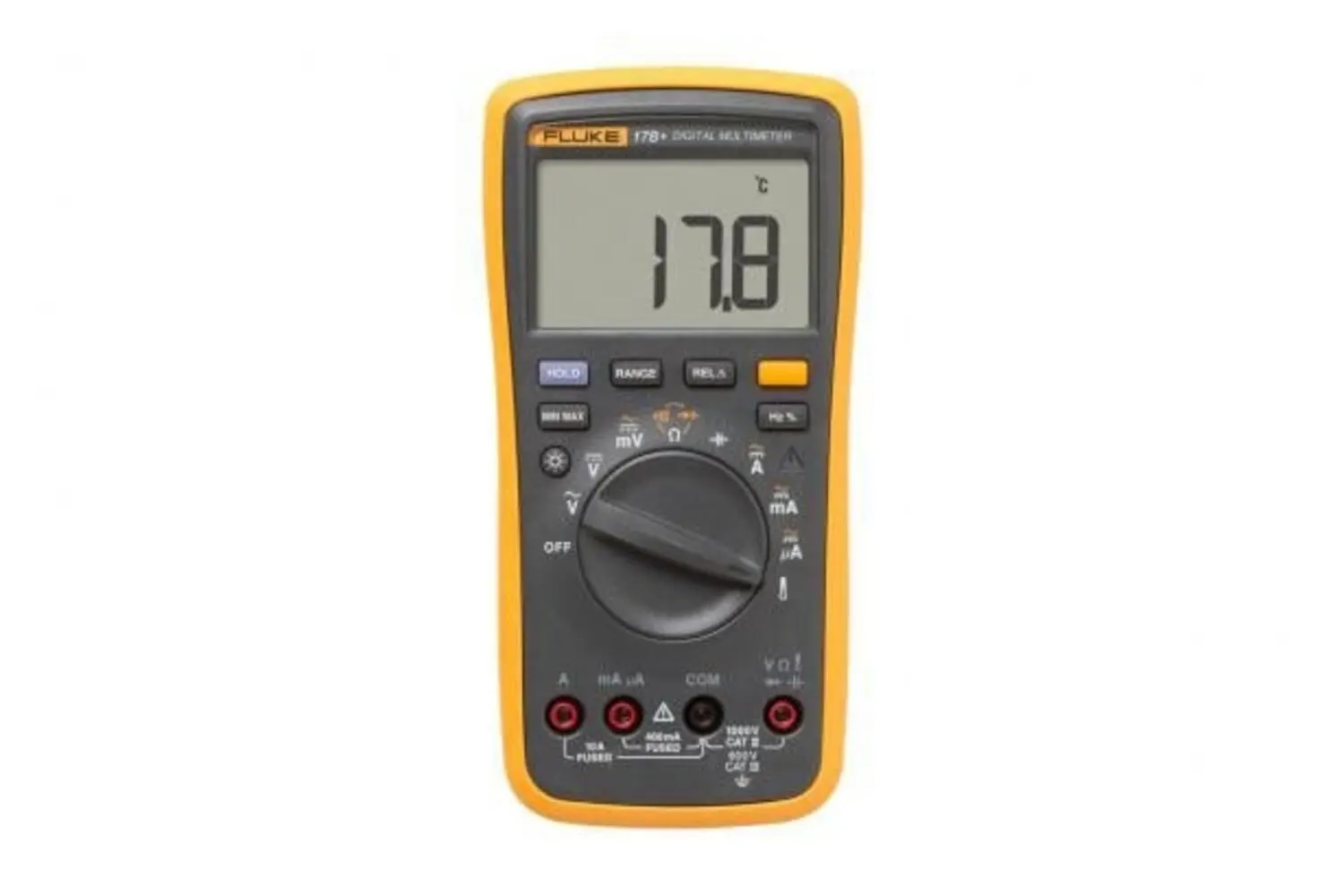
Fluke 17B+
4.5★★★★★A full-size Fluke with temperature, frequency, MIN MAX and relative mode, but not True RMS.
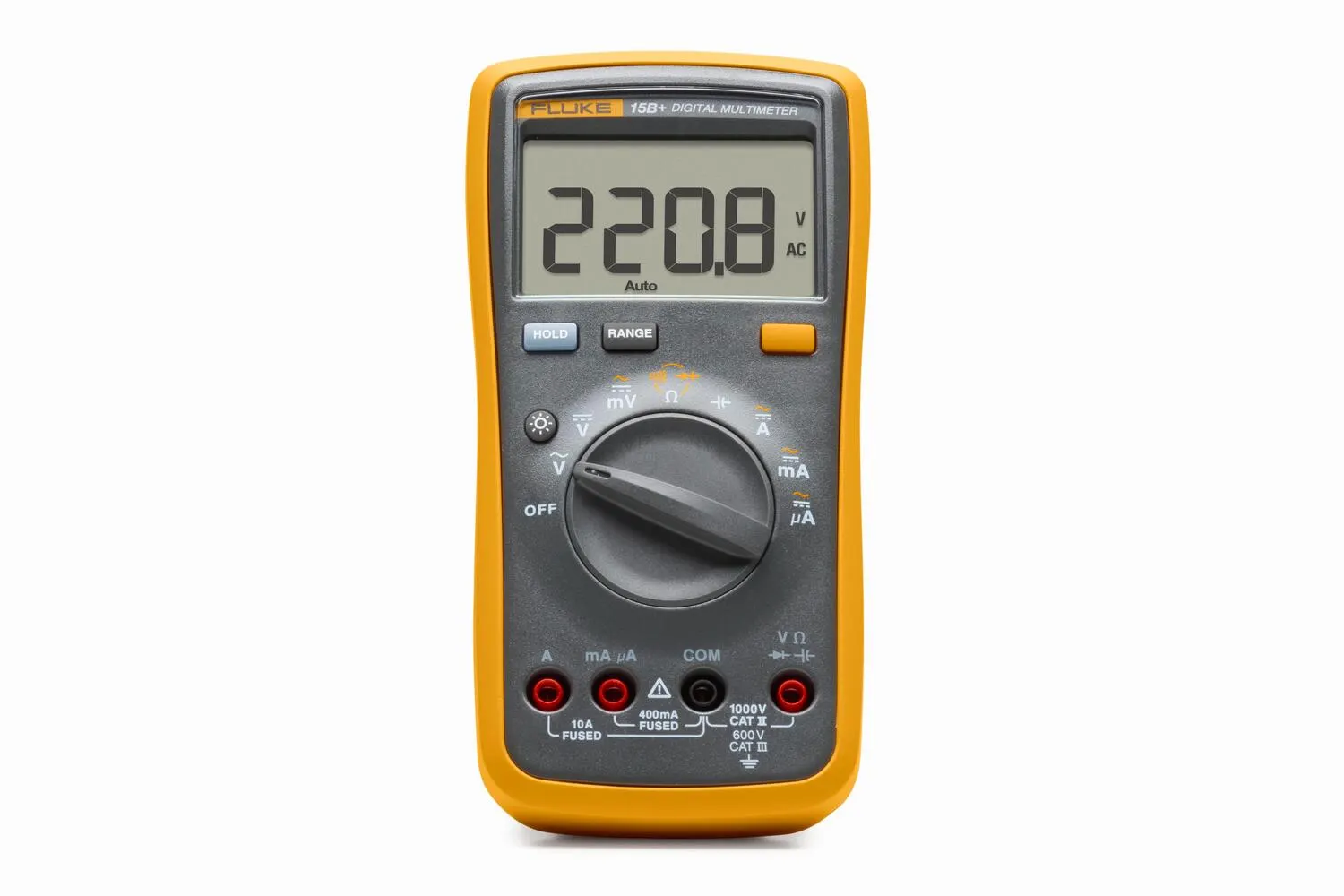
Fluke 15B+
4.3★★★★☆The 17B+ body and safety rating without frequency, temperature or MIN MAX: a plain, tough Fluke for volts, amps and ohms.
Specs side by side
| Fluke 17B+ | Fluke 15B+ | |
|---|---|---|
| Rating | 4.5★★★★★ | 4.3★★★★☆ |
| Accuracy | Not stated as True RMS by Fluke | Not stated as True RMS by Fluke |
| Safety rating | CAT III 600V / CAT II 1000V | CAT III 600V / CAT II 1000V |
| Auto-ranging | Yes (manual override) | Yes (manual override) |
| Best for | Electronics hobbyists, students, appliance repair | Basic electrical and electronics checks |
| Display | 4,000 counts, backlit, 3 updates/s | 4,000 counts, backlit, 3 updates/s |
| Max voltage | 1000V AC/DC | 1000V AC/DC |
| Current ranges | 400.0 µA to 10.00 A AC/DC, ±(1.5% + 3) | 400.0 µA to 10.00 A AC/DC, ±(1.5% + 3) |
| Capacitance | 40 nF to 1,000 µF | 40 nF to 1,000 µF |
| Frequency / duty cycle | 10 Hz to 100 kHz; 1% to 99% | No |
| Temperature | −55 °C to 400 °C, Type K probe included | No |
| MIN MAX / relative | Yes / Yes | No / No |
| Hazardous-voltage LED | Lights at 30V or more | No |
| Size / weight | 183 × 91 × 49.5 mm, 455 g | 183 × 91 × 49.5 mm, 455 g |
| Battery / warranty | 2 × AA, 500 h minimum; 1 year | 2 × AA, 500 h minimum; 1 year |
| AC bandwidth (volts / amps) | 40–500 Hz / 40–400 Hz | 40–500 Hz / 40–400 Hz |
| In the box | TL75 leads, Type K probe, 2 × AA | TL75 leads, 2 × AA |
Specs checked against manufacturer documentation and official Amazon listings. Desk research, not bench testing. How we research.
Key differences
- →Only the 17B+ measures temperature; Fluke includes a Type K probe and specifies −55 °C to 400 °C.
- →Only the 17B+ reads frequency (10 Hz to 100 kHz) and duty cycle; Fluke's manual marks both as 17B+ functions.
- →MIN MAX recording and relative mode are 17B+ only, per Fluke's users manual.
- →The 17B+ has a warning LED that lights at 30V or more, or on an overload; the 15B+ has no such indicator.
- →Everything else matches: same 183 × 91 × 49.5 mm, 455 g case, same safety rating, same 4,000-count display, same current ranges and 1,000 µF capacitance range.
- →Neither is described by Fluke as True RMS, so both are best kept to ordinary sine-wave mains and electronics work.
The functions only the 17B+ has
Put the two side by side and the dials tell the story: the 17B+ has extra positions and buttons, the 15B+ stops at the basics. These are the additions, each confirmed in Fluke's 15B+/17B+/18B+ manual.
Temperature
Type K probe included; −55 °C to 400 °C, °C or °F.
Frequency
10 Hz to 100 kHz in five ranges, ±(0.1% + 3).
Duty cycle
1% to 99%, for PWM and switching signals.
MIN MAX
Holds the lowest and highest reading on volts, amps and temperature.
Relative
Zeroes a reference on volts, amps, capacitance or temperature.
30V warning LED
Lights when the input reaches 30 V or overloads.
Fluke 17B+ vs 15B+ spec by spec
Fluke publishes identical accuracy figures for every function the two meters share. That means the 15B+ is not a lower-grade meter; it is the same instrument with a shorter function list. The table puts the shared specs first and the 17B+ additions last.
| Spec | Fluke 17B+ | Fluke 15B+ | Same? |
|---|---|---|---|
| DC volts | 4.000 to 1000 V, ±(0.5% + 3) | 4.000 to 1000 V, ±(0.5% + 3) | Same |
| AC volts, 40 to 500 Hz | 4.000 to 1000 V, ±(1.0% + 3) | 4.000 to 1000 V, ±(1.0% + 3) | Same |
| DC millivolts | 400.0 mV, ±(1.0% + 10) | 400.0 mV, ±(1.0% + 10) | Same |
| Current | µA, mA and A ranges to 10 A, ±(1.5% + 3) | µA, mA and A ranges to 10 A, ±(1.5% + 3) | Same |
| Resistance | 400.0 Ω to 40.00 MΩ | 400.0 Ω to 40.00 MΩ | Same |
| Capacitance | 40 nF to 1,000 µF, ±(2% + 5) to ±(5% + 5) | 40 nF to 1,000 µF, ±(2% + 5) to ±(5% + 5) | Same |
| Diode test | 2.000 V, 10% | 2.000 V, 10% | Same |
| Continuity | Beeps below 70 Ω | Beeps below 70 Ω | Same |
| Volts input impedance | >10 MΩ | >10 MΩ | Same |
| Fuses | 440 mA and 11 A, both 1000 V | 440 mA and 11 A, both 1000 V | Same |
| Frequency | 10 Hz to 100 kHz, ±(0.1% + 3) | Not available | 17B+ only |
| Duty cycle | 1% to 99%, 1% typical | Not available | 17B+ only |
| Temperature | −55 °C to 400 °C, Type K | Not available | 17B+ only |
| MIN MAX, relative | Yes | Not available | 17B+ only |
| Hazardous-voltage LED | At 30 V or OL | Not available | 17B+ only |
Bars use a logarithmic scale: each step is ten times the last.
The temperature arithmetic: at 200 °C, 2% of the reading is 4 °C, plus 1 °C gives ±5 °C. At −20 °C, 9% of 20 is 1.8 °C, plus 2 °C gives ±3.8 °C. That is plenty for checking an oven element, a heat-sink or a duct, but it is not lab-grade, and the supplied bead probe adds its own tolerance on top.
What MIN MAX catches that a live display misses
A display that updates three times a second can miss a dip that lasts a fraction of a second, and even if it shows, you have to be looking at that moment. MIN MAX on the 17B+ keeps the lowest and highest values it sees while you watch the machine instead of the meter. Fluke allows it on voltage, current and temperature, not on resistance, capacitance, frequency, duty cycle or diode.
That is the classic intermittent fault: a control board that resets when a compressor kicks in, or a car accessory that drops out on crank. The 15B+ can only tell you the supply looks fine now. For more on chasing that kind of problem, see how to find an intermittent electrical fault with a multimeter.
Relative mode: what it can and can't zero
Use cases: where the extras pay off
Appliance and HVAC repair is where the 17B+ earns its keep. A thermocouple on an oven cavity, a dryer exhaust or a supply-air register answers whether the heat source works before you start pulling panels, and the duty-cycle mode reads the PWM command to an EC blower motor. In hobby electronics, frequency and duty cycle cover 555 timers, fan headers and motor drivers.
The 15B+ is the better buy when the job is plainly electrical: checking a breaker's output, a battery, a fuse or a motor's running current. It keeps the same µA range as the 17B+, so flame-rectification checks and standby-current tests still work. Fewer buttons also means fewer chances to leave the meter in an unexpected mode, which some trainers and shared-tool shops value.
Buyer decision flow: 15B+ or 17B+ in four questions
Because the shared functions are identical, the choice reduces to whether any one of the 17B+'s extras would get used. Work down the chart. A single yes is enough, since there is no way to add temperature or a frequency counter to a 15B+ later; four noes mean the extras would sit idle.
The top box matters more than it looks. Fluke makes no True RMS claim for either meter, and their AC current is specified from 40 to 400 Hz and AC volts from 40 to 500 Hz. If a variable-speed drive or electronic dimmer is involved, both will misread its distorted output, and choosing between them misses the point.
Temperature use cases, with the tolerance at each
Fluke splits the 17B+'s temperature accuracy into three bands: ±(9% + 2 °C) from −55 to 0 °C, a flat ±2 °C from 0 to 50 °C, and ±(2% + 1 °C) from 50 to 400 °C, all at 0.1 °C resolution and for the meter alone. Applied to everyday targets, it looks like this. The targets are common reference values, not OhmSavvy measurements; check the appliance maker's own figure before acting on a reading.
| Job | Typical target | 17B+ band | Meter tolerance |
|---|---|---|---|
| Freezer check | −18 °C (0 °F) | −55 to 0 °C | ±3.6 °C |
| Refrigerator check | 4 °C (40 °F) or below | 0 to 50 °C | ±2.0 °C |
| Water heater outlet | about 49 °C (120 °F) | 0 to 50 °C | ±2.0 °C |
| Oven calibration | 177 °C (350 °F) | 50 to 400 °C | ±4.5 °C |
| 3D-printer hot end (PLA) | around 210 °C | 50 to 400 °C | ±5.2 °C |
Two practical notes. On air-conditioning work, relative mode is allowed on temperature: rest the probe in the return air, press REL, then move it to a supply register and the display shows the drop directly, though each reading still carries its own tolerance. And the 400 °C ceiling belongs to the meter, not necessarily the probe. Fluke's page includes a Type K bead probe without naming its model or its maximum, so don't assume it is good to 400 °C; for a soldering tip or a kiln, use a probe whose own rating you have checked. Our guide on checking a thermocouple with a multimeter covers the furnace-side version of this job, and the 15B+ can do that one too, since it measures the thermocouple's millivolts rather than its temperature.
Frequency and duty cycle use cases
The 17B+ counts from 10 Hz to 100 kHz across five ranges, and the range sets the step: 0.01 Hz on the 50.00 Hz range up to 0.1 kHz on the top one. A US portable generator should hold close to 60 Hz; that lands on the 500.0 Hz range, where the tolerance is 0.1% × 60 + 3 × 0.1 = ±0.36 Hz, fine enough to spot a governor running fast or slow under load. If your generator cuts out when an appliance starts, read the frequency and voltage with the load applied, alongside our guide to a generator that shuts off under load.
Duty cycle carries a catch that Fluke states in small print: the 1% typical accuracy applies at 50 or 60 Hz with a duty between 10% and 90%. A PC or EC-motor fan PWM line usually runs far faster, often around 25 kHz, so a 17B+ reading there is a useful indication (is the controller commanding 30% or 90%?) rather than a specified measurement. The frequency figure itself remains specified at those speeds. The 15B+ has neither mode; on a PWM line its DC volts range shows only the average.
For the budget buyer: value by features
On a tight budget, the useful question is not which meter is better but what the cheaper one costs you in capability. With this pair the answer is precise, because the spec table above splits cleanly: ten shared rows with identical figures and five rows that exist only on the 17B+. Saving money on the 15B+ never means a less accurate volts, amps or ohms reading, a lower safety rating, a weaker fuse or a shorter warranty. It means doing without specific functions, and for each one the question is whether you have a workaround.
| 17B+ function you give up | Workaround on a 15B+ | How good is the workaround? |
|---|---|---|
| Temperature with Type K probe | A separate thermometer | Fine, but one more tool to buy and carry |
| Frequency, 10 Hz to 100 kHz | None on the meter | No substitute; DC volts shows only an average |
| Duty cycle, 1% to 99% | None on the meter | No substitute for reading a PWM command |
| MIN MAX on volts, amps, temperature | Watch the display | Misses short dips at 3 updates/s |
| Relative mode | Subtract by hand | Workable for lead capacitance |
| 30 V hazardous-voltage LED | Read the display before touching | Workable with good habits |
Three of the six have reasonable workarounds and three don't. If frequency, duty cycle or catching a brief sag is part of your work, a 15B+ can't do it at all, and the 17B+ is the better value even on a budget. If all you need are volts, amps, ohms, continuity and capacitance, the 15B+ delivers the same measurements and the extra spend would buy dial positions you never turn to. Neither meter is described by Fluke as True RMS, so a budget buyer who works near drives or LED drivers should stretch to a True RMS model instead; the Fluke 117 vs Fluke 15B+ comparison shows what that step adds.
Fluke 17B+ or 15B+: which should you buy?
| You are… | Better fit | Why |
|---|---|---|
| Appliance or HVAC repair tech | Fluke 17B+ | Type K temperature, duty cycle for EC motors, MIN MAX for sags |
| Electronics student or hobbyist | Fluke 17B+ | Frequency and duty cycle for timers, PWM and fan circuits |
| 3D-printer or reflow tinkerer | Fluke 17B+ | Checks hot-end and bed temperatures against the firmware |
| Homeowner with a basic toolkit | Fluke 15B+ | Volts, amps, ohms and continuity, with the same accuracy |
| Maintenance shop buying shared meters | Fluke 15B+ | Fewer modes to misuse; identical safety rating and fuses |
| Anyone working near variable-speed drives | Neither | No True RMS claim; look at the Fluke 115 or 117 |
Comparing either one with a True RMS electrician's meter? Read Fluke 17B+ vs Fluke 117 and Fluke 117 vs Fluke 15B+.
Safety: the 1000 V figure is CAT II, not CAT III
Choose the Fluke 17B+ if…
- ✓You check appliance, HVAC or 3D-printer temperatures and want the Type K probe in the box
- ✓You work on PWM, motor speed or supply circuits where frequency and duty cycle matter
- ✓You want MIN MAX to catch a dipping supply and relative mode to null lead capacitance or an offset
Choose the Fluke 15B+ if…
- ✓You only measure volts, amps, ohms, continuity, diodes and capacitance
- ✓You want the fewest buttons possible: just HOLD and RANGE
- ✓You'd rather not pay for functions you won't use
The bottom line
Buy the 17B+ unless you are sure you will never need temperature, frequency or MIN MAX; the extra functions make it the more useful meter for electronics and appliance work. The 15B+ suits anyone who wants a simple, tough Fluke for volts, amps and ohms, with the same accuracy. Either way, check the 17B+ listing, as its Amazon photo shows the newer 17B MAX.
Frequently asked questions
What is the difference between the Fluke 17B+ and 15B+?+
The 17B+ adds temperature with a Type K probe, frequency to 100 kHz, duty cycle, MIN MAX recording, relative mode and a 30V hazardous-voltage LED. The case, safety rating, 4,000-count display, current ranges from 400 µA to 10 A, capacitance range, fuses, battery life and one-year warranty are the same, and so is every shared accuracy figure.
Are the Fluke 17B+ and 15B+ True RMS?+
Fluke doesn't describe either as True RMS in its datasheet, manual or product pages, so treat them as average-responding. On clean mains and batteries that is fine. For variable-speed drives, LED drivers and other distorted waveforms, a True RMS meter such as the Fluke 115 or 117 is the better tool.
Do the 17B+ and 15B+ measure microamps?+
Yes. Both have 400.0 µA and 4000 µA ranges with 0.1 µA resolution on the lowest, plus mA and A ranges up to 10A AC and DC, all at ±(1.5% + 3). The current inputs are protected by 440 mA and 11 A fuses rated at 1000V, which suits flame-sensor and standby-current checks.
Can the Fluke 15B+ measure temperature?+
No. Fluke's manual lists temperature as a 17B+-only function, and the 15B+ has no thermocouple position on its dial. If you need temperature from a 15B+, you'd carry a separate thermometer. The 17B+ ships with a Type K bead probe and reads from −55 °C to 400 °C in °C or °F.
Is the Fluke 15B+ the better value for a budget buyer?+
Yes, if your work is volts, amps, ohms, continuity and capacitance. Fluke gives it the same accuracy, current ranges, fuses, safety rating and one-year warranty as the 17B+. It is poorer value if you will ever need frequency, duty cycle or MIN MAX, because the 15B+ has no way to take those readings, while temperature can at least come from a separate thermometer.
What warranty do the Fluke 15B+ and 17B+ have?+
One year for both. Fluke's 15B+/17B+/18B+ users manual gives a one-year warranty, and the US product pages don't state a different term; they show only a 30-day return window in the purchase box. That's a shorter term than Fluke gives the pocket 106/107 or the 115/117, so keep your proof of purchase.
Can the Fluke 17B+ check a generator's frequency?+
Yes. Its frequency mode covers 10 Hz to 100 kHz, and a 60 Hz output reads on the 500.0 Hz range to about ±0.36 Hz, enough to see whether a governor holds speed under load. The 15B+ can read the generator's voltage but has no frequency function, so checking speed regulation would need a second tool.
Why does the Amazon 17B+ listing show a 17B MAX?+
The listing's main photo shows a meter printed 17B MAX, the newer model, so the listing may now ship the successor rather than the 17B+. Check the product details and the seller's notes before you order if you specifically want the 17B+, and compare the specs you receive against Fluke's own page.
Related



