COMPARISON · MULTIMETERS
Fluke 17B+ vs Fluke 117
Fluke 17B+ vs Fluke 117 splits Fluke's line into the electronics meter and the electrician's meter. The 17B+ carries more measurement functions: temperature with an included probe, frequency to 100 kHz, duty cycle, relative mode and a 1000V range. The 117 carries the safety-and-speed features: True RMS, VoltAlert non-contact detection, AutoVolt and a low-impedance mode, on a finer 6,000-count display.
By the OhmSavvy Research Team ·
Disclosure: OhmSavvy earns a commission from qualifying Amazon purchases made through these links, at no extra cost to you. How we're funded.
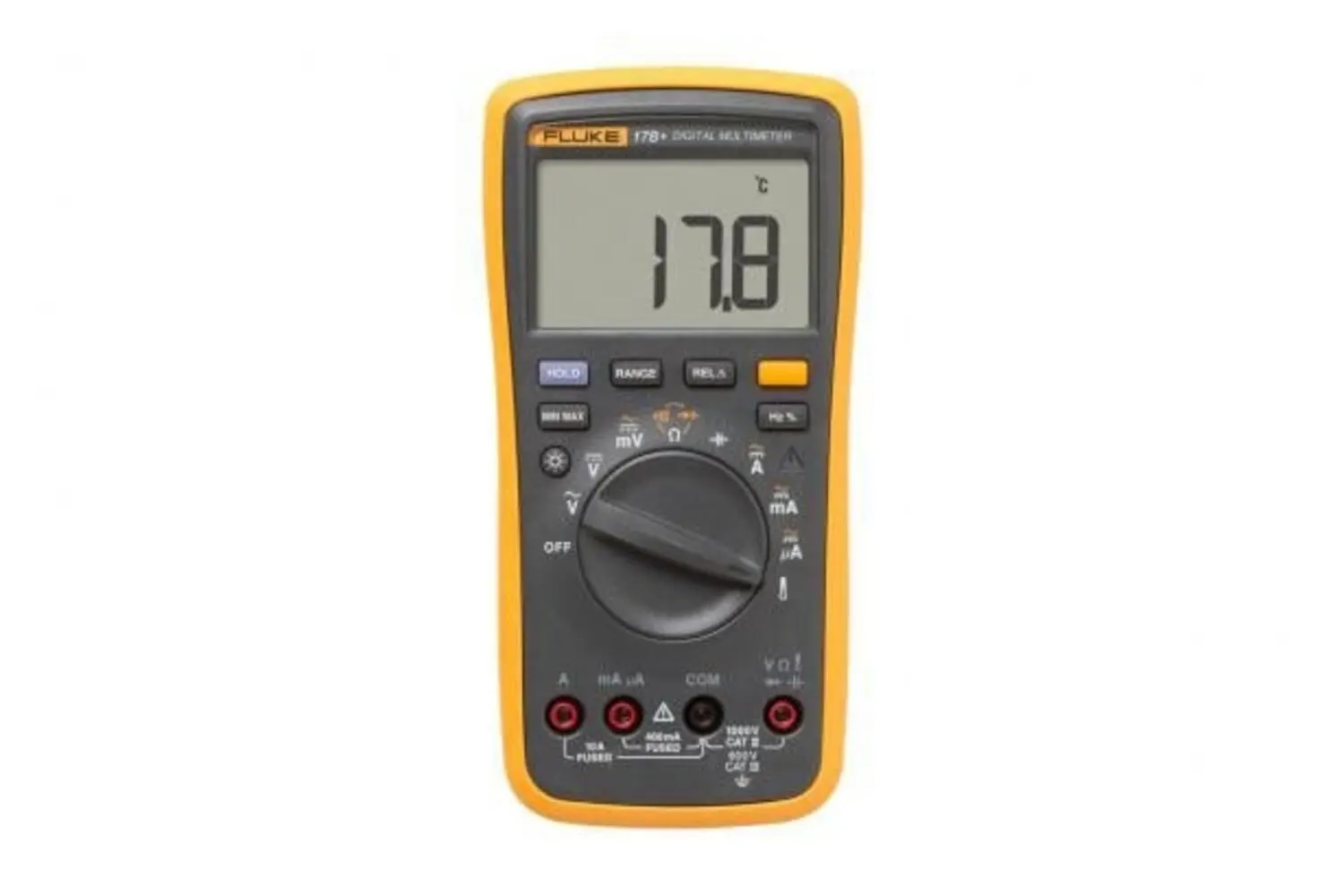
Fluke 17B+
4.5★★★★★A full-size Fluke with temperature, frequency, MIN MAX and relative mode, but not True RMS.

Fluke 117
4.8★★★★★The meter working electricians actually buy with their own money, not just the one brands push.
Specs side by side
| Fluke 17B+ | Fluke 117 | |
|---|---|---|
| Rating | 4.5★★★★★ | 4.8★★★★★ |
| Accuracy | Not stated as True RMS by Fluke | True RMS |
| Safety rating | CAT III 600V / CAT II 1000V | CAT III 600V |
| Auto-ranging | Yes (manual override) | Yes |
| Best for | Electronics hobbyists, students, appliance repair | Electricians, serious hobbyists |
| Display | 4,000 counts, 3 updates/s, backlit | 6,000 counts + 33-segment bar graph |
| AC response | No True RMS claim by Fluke | True RMS |
| Max voltage | 1000V AC/DC | 600V AC/DC |
| DC volts accuracy | ±(0.5% + 3) | ±(0.5% + 2) |
| Current ranges | 400 µA to 10A AC/DC, six ranges | 6A and 10A AC/DC |
| Capacitance | 40 nF to 1,000 µF | 1 nF to 9,999 µF |
| Frequency | 10 Hz to 100 kHz, plus duty cycle | Up to 50 kHz |
| Temperature | −55 °C to 400 °C, Type K probe included | No (Fluke datasheet: 116 only) |
| NCV / AutoVolt / LoZ | None listed | Yes / Yes / Yes |
| Continuity | Beeps below 70 Ω | Beeps below 20 Ω |
| Hazard warning | LED at 30 V or more | Not listed |
| Size | 183 × 91 × 49.5 mm | 167 × 84 × 46 mm |
| Weight | 455 g | 550 g |
| Battery | 2 × AA, 500 hours minimum | One 9V, about 400 hours |
| Warranty | 1 year (Fluke manual) | 3 years |
Specs checked against manufacturer documentation and official Amazon listings. Fluke 117 is hands-on tested by OhmSavvy; the Fluke 17B+ assessment is desk research. How we research.
Key differences
- →The 117 is True RMS; Fluke makes no True RMS claim for the 17B+.
- →Only the 117 has VoltAlert non-contact detection, AutoVolt and a low-impedance mode.
- →The 17B+ adds temperature with an included Type K probe, duty cycle, relative mode and µA and mA current ranges.
- →The 17B+ reads up to 1000V and 100 kHz; the 117 stops at 600V and 50 kHz.
- →The 117's 6,000-count display and bar graph are finer than the 17B+'s 4,000 counts.
- →Fluke's manual gives the 17B+ a 1-year warranty against 3 years for the 117.
- →The 17B+ Amazon listing's photo shows the newer 17B MAX, so check which model ships.
Fluke 17B+ vs 117 spec by spec
The 17B+ reaches further on frequency and voltage, while the 117 shows readings with finer resolution. Which matters depends on whether you chase signals or confirm mains. Basic DC accuracy is nearly identical: ±0.5% of reading on both, with one extra count on the 17B+. On the 400 V range that count is 0.1 V; on the 117's 600 V range a count is also 0.1 V, so in practice you will not see a difference on a battery or a receptacle.
The 6,000-count display matters more on the 117 than the number suggests. A 4,000-count meter switches from its 40 V range to its 400 V range at 40 V, so a 48 V telecom or solar battery reads to 0.1 V on the 17B+, while the 117 keeps it on its 60 V range with 0.01 V steps. The 17B+'s 4,000 counts are fine for 12 V and 24 V systems, which stay on the 40 V range.
Fluke 17B+ vs 117 for electrical work
For electrical work the Fluke 117 is the better meter, and accuracy has little to do with it. An electrician opening receptacles, switch boxes and panels repeats three questions all day: is this conductor energized, is the number on the screen real, and is it AC or DC? The 117 has a dedicated feature for each. The 17B+ answers them with the test leads and the user's judgment, which works, but more slowly and with more room for a wrong call.
| What the electrician checks | Fluke 17B+ | Fluke 117 |
|---|---|---|
| Is the box live before I touch it? | No NCV; probe with the leads | VoltAlert sensor in the top edge |
| Is 40 V on a dead leg real? | Input above 10 MΩ shows coupled voltage | AutoVolt LoZ input, about 3 kΩ |
| AC or DC at an unknown terminal? | Choose V AC or V DC on the dial | AutoVolt selects it, ±(2.0% + 3) |
| Receptacle on a dimmer or LED driver | Accuracy stated for sine waves only | True RMS |
| Panel and branch-circuit rating | CAT III 600V | CAT III 600V |
| Current in series with a load | 10.00 A range, 11 A fuse | 10.00 A range; 20 A for 30 s |
| OhmSavvy testing | Desk research only | Hands-on Tested |
Bars use a logarithmic scale: each step is ten times the last.
Ghost voltage is where the gap shows most. A disconnected conductor pulled alongside live ones picks up voltage by capacitive coupling, and a meter with an input above 10 MΩ, like the 17B+, barely loads it, so a dead wire can read a convincing few dozen volts. The 117's AutoVolt position puts roughly 3 kΩ across the leads, more than 3,000 times less, and that induced reading sags toward zero while a genuinely energized conductor holds its value. The 17B+ has no LoZ mode for making that distinction; its hazard LED is specified only as lighting at 30 V or more.
At an outlet, the sensible routine on the 117 is VoltAlert first to find the hot box, then the leads on AutoVolt, then live-dead-live on a known source before declaring a circuit off. On the 17B+ the same job skips the first step and needs a dial change between AC and DC. In the panel, the two carry the identical CAT III 600V rating; the 17B+'s extra CAT II 1000V line covers plug-in equipment, not the bus or the breakers, and neither meter is rated CAT IV for the service entrance.
Current is close to a tie. Both read up to 10 A with the leads in series, both state AC current at ±(1.5% + 3), and Fluke lets the 117 carry 20 A for 30 seconds; the 17B+'s overload allowance beyond its 11 A fuse is not stated. A loaded 15 A or 20 A branch circuit is a job for a clamp, not the A jack of either meter (see how to measure AC current with a clamp meter). The one electrical task where the 17B+ wins is a furnace flame-sensor or control-loop reading in microamps or milliamps, covered below. For everyday wiring, the 117 and its peers in our best multimeter for electricians guide are the meters to carry.
Fluke 17B+ vs 117: accuracy compared
Fluke writes every accuracy figure as ±(percent of reading + counts). The percentage scales with the number on the display; the counts are a fixed number of steps in the last digit of whatever range the meter is on. That second term is why the same spec can be tight on one reading and loose on another, and why display counts and accuracy have to be read together. Here is every published line the two meters share, from Fluke's spec pages and manuals as cited above; where Fluke publishes no figure, we say so.
| Function | Fluke 17B+ | Fluke 117 |
|---|---|---|
| DC volts | ±(0.5% + 3) | ±(0.5% + 2) |
| DC millivolts | 400.0 mV, ±(1.0% + 10) | 600.0 mV, ±(0.5% + 2) |
| AC volts, sine | ±(1.0% + 3), 40–500 Hz | ±(1.0% + 3), 45–500 Hz |
| AC volts, 0.5–1 kHz | Not stated | ±(2.0% + 3) |
| AC on distorted waves | Not stated (no True RMS) | True RMS, same spec |
| Volts ranges | 400.0 mV to 1000 V | 600.0 mV to 600.0 V |
| Display | 4,000 counts, 3/s | 6,000 counts, 4/s |
| Resistance | ±(0.5% + 2) to ±(1.5% + 3) | ±(0.9% + 1) |
| AC current | ±(1.5% + 3) | ±(1.5% + 3) |
| Capacitance | ±(2% + 5) to ±(5% + 5) | ±(1.9% + 2) |
| Frequency | ±(0.1% + 3) | ±(0.1% + 2) |
Worked example one, a car battery at 12.6 V DC. Both meters sit on a range with 0.01 V steps (the 17B+'s 40.00 V range, the 117's 60.00 V range). The percentage term is identical: 0.5% of 12.6 V is 0.063 V. The 117 adds 2 counts (0.02 V) for a band of ±0.083 V, so the true voltage lies between about 12.52 V and 12.68 V. The 17B+ adds 3 counts (0.03 V) for ±0.093 V, or about 12.51 V to 12.69 V. A hundredth of a volt apart: irrelevant for telling a charged battery from a flat one.
Worked example two, a 120 V receptacle. The 17B+ reads it on its 400.0 V range and the 117 on its 600.0 V range, both in 0.1 V steps, and both specify AC volts at ±(1.0% + 3). That gives 1.2 V plus 0.3 V, so ±1.5 V and a band of 118.5 V to 121.5 V on either meter. The catch is the waveform: that figure holds for a clean sine on both, but only the 117 is True RMS, so on a dimmer, drive or LED-driver circuit Fluke gives the 17B+ no accuracy figure at all.
Worked example three shows where the count term bites. A 48 V battery bank pushes the 17B+ onto its 400.0 V range, where 3 counts are 0.3 V: 0.5% of 48 V (0.24 V) plus 0.3 V is ±0.54 V. The 117 stays on its 60.00 V range, where 2 counts are 0.02 V, so ±0.26 V, about half the band. On a 48 V solar or telecom system that gap is the difference between seeing a 0.3 V string imbalance and losing it in the error band.
Outside volts, the picture splits. The 17B+'s best resistance line, ±(0.5% + 2), is tighter than the 117's ±(0.9% + 1), though its higher ranges loosen to ±(1.5% + 3); the 117 is tighter on capacitance and by one count on frequency. Neither difference decides a purchase. If accuracy on a bench is the real question, our guide to multimeter accuracy for electronics repair explains when a tighter spec actually changes a diagnosis.
Small currents: where the 17B+ pulls ahead
The biggest functional gap isn't temperature, it's current. The 17B+ has six current ranges from 400.0 µA to 10 A, all at ±(1.5% + 3), through a separate µA/mA jack protected by a 440 mA, 1000 V fuse. The 117 has only its 6 A and 10 A ranges. Its best resolution is 1 mA, so a 4-20 mA control loop reads as a handful of whole milliamps, and a furnace flame-sensor signal of a few microamps doesn't register.
On the 17B+, a 12.00 mA loop reading sits on the 40.00 mA range at 0.01 mA resolution. That is the kind of job the 117 was never designed for. For the method, see how to measure microamps with a multimeter or our best multimeters for 4-20 mA loop testing.
Function checklist
| Function | Fluke 17B+ | Fluke 117 |
|---|---|---|
| True RMS | Not claimed | Yes |
| Non-contact voltage | No | Yes |
| Low-impedance mode | No | Yes |
| Temperature | Yes | No |
| Duty cycle | Yes | Not listed |
| Relative mode | Yes | Not listed |
| MIN MAX | Yes | Yes (Min/Max/Average) |
| Hazardous-voltage LED | Yes, at 30 V or more | Not listed |
Two different jobs
Temperature on the 17B+: how accurate is it?
Fluke specifies the 17B+'s thermocouple input in three bands. From 50 °C to 400 °C it is ±(2% + 1 °C), so a 200 °C heatsink or oven reading carries about ±5 °C (2% of 200 is 4 °C, plus 1 °C). From 0 °C to 50 °C it is ±2 °C, good enough for supply and return air. Below freezing the spec loosens to ±(9% + 2 °C), so a -20 °C freezer reads within about ±3.8 °C. Those figures cover the meter only; any thermocouple probe adds its own tolerance on top.
| Temperature band | 17B+ accuracy | Worked example |
|---|---|---|
| -55 °C to 0 °C | ±(9% + 2 °C) | -20 °C reads within about ±3.8 °C |
| 0 °C to 50 °C | ±2 °C | 22 °C room air reads 20 to 24 °C |
| 50 °C to 400 °C | ±(2% + 1 °C) | 200 °C heatsink reads within about ±5 °C |
The 117 has no temperature function at all. Fluke's datasheet puts the thermocouple input on the Fluke 116, the HVAC model of the 110 Series. For thermocouple checks themselves, see how to check a thermocouple with a multimeter.
Fluke 17B+ vs Fluke 117: which should you buy?
| You are… | Better fit | Why |
|---|---|---|
| Electrician on live building wiring | Fluke 117 | True RMS, VoltAlert and LoZ for daily panel work |
| Electronics hobbyist or student | Fluke 17B+ | µA ranges, frequency to 100 kHz, duty cycle and relative mode |
| Appliance repair technician | Fluke 17B+ | Temperature probe plus mA ranges for controls |
| Controls technician on 4-20 mA loops | Fluke 17B+ | 40.00 mA range reads loop current to 0.01 mA |
| Technician on VFDs and LED drivers | Fluke 117 | Distorted waveforms need True RMS |
| Buyer who wants the longest warranty | Fluke 117 | Three years against one |
We have owner-tested the 117; the 17B+ assessment is desk research against Fluke's specifications. For the 17B+ against its simpler twin, read Fluke 17B+ vs Fluke 15B+; for the full Fluke write-up, see our Fluke 117 review.
Safety: a 1000V range is not a 1000V rating for mains
Choose the Fluke 17B+ if…
- ✓You work on electronics, appliances or HVAC and want temperature in the same meter
- ✓You need µA ranges, frequency, duty cycle and relative mode
- ✓You want MIN MAX recording and a hazardous-voltage warning LED
Choose the Fluke 117 if…
- ✓You do live electrical work where NCV and LoZ speed up safe checks
- ✓You measure drives, LED drivers or other loads that need True RMS
- ✓You want a 6,000-count display and a three-year warranty
The bottom line
Buy the Fluke 117 if you do electrical work: True RMS, NCV, AutoVolt and LoZ are what matter on live circuits. Buy the Fluke 17B+ for electronics, appliance and HVAC diagnostics, where temperature, frequency, duty cycle and µA ranges earn their place, and accept that it isn't True RMS.
Frequently asked questions
Is the Fluke 17B+ True RMS?+
Fluke makes no True RMS claim for the 17B+ in its datasheet, manual or product page, so don't count on it. It reads clean sine waves correctly, but on drives, dimmers and LED drivers its AC readings can drift. The Fluke 117 is True RMS, which is why electricians working on those loads usually choose it.
Does the Fluke 17B+ measure temperature?+
Yes. Fluke lists -55 °C to 400 °C with an included Type K bead probe, at ±(2% + 1 °C) above 50 °C and ±2 °C between 0 and 50 °C. Fluke's datasheet doesn't give the 117 a temperature function; in the 110 Series only the Fluke 116 reads a thermocouple.
Which has the higher voltage range, the 17B+ or the 117?+
The 17B+ measures up to 1000V AC/DC and Fluke's datasheet rates it CAT III 600V and CAT II 1000V. The 117 measures up to 600V and is rated CAT III 600V. For panels and branch circuits the two carry the same CAT III 600V rating, so the higher range doesn't make the 17B+ safer on mains.
Why does the 17B+ Amazon listing show a 17B MAX?+
Fluke has introduced the 17B MAX, and the listing's main photo shows it, so the listing may ship the newer model. Check the listing details and the seller's description before buying if you specifically want the 17B+. The specs on this page are for the 17B+ as Fluke publishes them.
Can the Fluke 117 measure milliamps like the 17B+?+
Not usefully. The 117's smallest current range is 6.000 A with 1 mA resolution, so a 4-20 mA loop shows only whole milliamps and microamp signals don't register. The 17B+ has 400.0 µA, 4000 µA, 40.00 mA and 400.0 mA ranges through a separate fused jack, which is why it suits controls and electronics work.
Which is more accurate, the Fluke 17B+ or the Fluke 117?+
On DC volts they are almost tied: both are ±0.5% of reading, plus 3 counts on the 17B+ and 2 on the 117. On a 12.6 V battery that is ±0.093 V against ±0.083 V. The 117 pulls ahead around 48 V, where its 6,000 counts keep a finer range, and on distorted AC, where only the 117 is True RMS.
What does ±(0.5% + 2 counts) mean on a multimeter?+
Take 0.5% of the reading, then add two steps of the last displayed digit on the range in use. On the Fluke 117 reading 12.60 V on its 60.00 V range, that is 0.063 V plus 0.02 V, so ±0.083 V. The same spec on a range with 0.1 V steps adds 0.2 V instead, which is why the range matters.
Is the Fluke 17B+ good enough for an electrician?+
It is safe enough for panels and branch circuits, since it carries the same CAT III 600V rating as the 117, but it slows routine work. It has no VoltAlert non-contact sensor, no low-impedance input to expose ghost voltage, no AutoVolt AC/DC selection and no True RMS claim. Electricians who test live wiring daily are better served by the 117.
Can the Fluke 17B+ tell ghost voltage from real voltage?+
Not directly. Its voltage input is above 10 MΩ, so an unconnected conductor running beside live wires can show a coupled reading of tens of volts. The 117's AutoVolt position drops the input to about 3 kΩ, which pulls that phantom reading toward zero. On a 17B+, you would need a separate low-impedance tester or a known load to check.
Related


