COMPARISON · MULTIMETERS
Fluke 101 vs KAIWEETS KM200s: Which Is Better for Basic Testing?
In the Fluke 101 vs KAIWEETS KM200s choice, the deciding question is whether your probes will ever go inside a breaker panel. The Fluke 101 is rated CAT III 600V and the KM200s only CAT II 600V, and that rating is most of what the Fluke's price buys: it cost roughly five times as much on Amazon when we checked. For outlets, extension cords, batteries and car fuses, the KM200s is the better basic tester, with True RMS, non-contact voltage, a backlight, data hold and a 3-year warranty. Neither one measures amps by any published spec.
By the OhmSavvy Research Team ·
Disclosure: OhmSavvy earns a commission from qualifying Amazon purchases made through these links, at no extra cost to you. How we're funded.
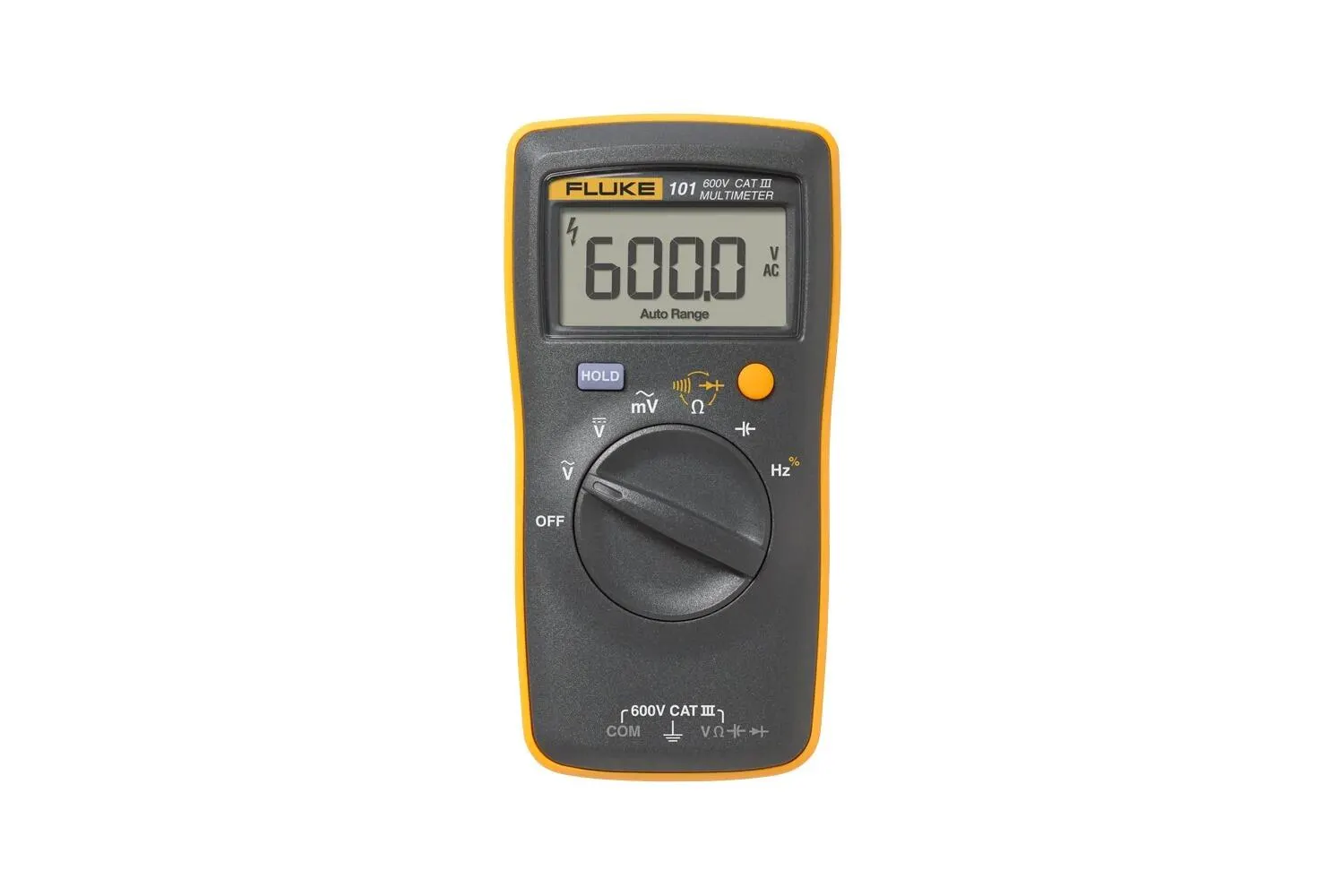
Fluke 101
4.1★★★★☆Fluke's smallest, simplest meter: volts, ohms, capacitance and frequency in 160 g, but no current measurement at all.

KAIWEETS KM200s
4.5★★★★★Covers the fundamentals of the Fluke at under half the price — the sensible first meter.
Specs side by side
| Fluke 101 | KAIWEETS KM200s | |
|---|---|---|
| Rating | 4.1★★★★☆ | 4.5★★★★★ |
| Accuracy | Not stated as True RMS by Fluke | True RMS |
| Safety rating | CAT III 600V | CAT II 600V |
| Auto-ranging | Yes | Yes |
| Best for | Voltage and continuity checks only | Home use, beginners |
| Display | 6,000 counts | 4,000 counts |
| AC response | Not called True RMS by Fluke | True RMS (per listing) |
| DC volts accuracy | ±(0.5% + 3) | Not stated |
| AC volts accuracy | ±(1.0% + 3), 40 to 500 Hz | Not stated |
| Current | None (two input jacks) | Not stated on the listing |
| Capacitance | From 50 nF; top 100 µF or 1,000 µF (Fluke documents differ) | Yes; range not stated |
| Frequency / duty cycle | 10 Hz to 100 kHz; duty cycle | Not stated |
| Non-contact voltage | No | Yes, visual and audible alert |
| Backlight / flashlight | None listed | Backlit LCD and flashlight |
| Data hold | No (per Fluke's India page) | Yes |
| Size | 130 × 65 × 27 mm, 160 g | 4.33 × 2.36 × 1.06 in (about 110 × 60 × 27 mm); weight not stated |
| Drop rating | 1 m | Not stated |
| Batteries | 2 × AAA | 2 × AAA |
| Warranty | 1 year; US Amazon stock is a third-party import | 3 years |
Specs checked against manufacturer documentation and official Amazon listings. Desk research, not bench testing. How we research.
Key differences
- →Safety rating: the Fluke 101 is CAT III 600V, so it is rated for distribution panels and hardwired circuits; the KM200s is CAT II 600V, which covers plug-in outlets and appliances only.
- →AC measurement: KAIWEETS's listing calls the KM200s True RMS, while Fluke makes no True RMS claim for the 101, which matters on dimmers, LED drivers and other electronic loads.
- →Convenience: the KM200s adds non-contact voltage, a backlit screen, a flashlight and data hold; the 101 has none of the four.
- →Published accuracy: Fluke prints ±(0.5% + 3) on DC volts and ±(1.0% + 3) on AC volts for the 101; the KM200s listing gives no accuracy figures at all.
- →Warranty: three years from KAIWEETS against one year for the 101, whose US Amazon stock comes from a third-party importer.
- →Size is almost a wash: both are about 27 mm thick, and the KM200s is slightly smaller in footprint than the 160 g Fluke.
Breaker panel or wall outlet: what the 101's CAT III rating pays for
Strip away the brand and most of the Fluke premium in this pair is one line on the spec sheet. CAT ratings describe how large a transient spike a meter is built to survive at a given point in the wiring, and the spikes get bigger the closer you are to the utility transformer. A CAT II meter is designed for loads plugged into outlets. A CAT III meter is designed for the panel and the fixed wiring that leaves it. The KM200s stops at the first boundary; the 101 is rated across both.
If you're a homeowner who only ever plugs probes into receptacles, that boundary never comes up, and the extra money buys you nothing you'll use. If you're a handyman who swaps breakers, wires a water-heater disconnect or checks a furnace's hardwired feed, the CAT II meter is the wrong tool however good its other features are. Our KM200s vs UNI-T UT139C comparison walks through the CAT II and CAT III boundary room by room, so we won't repeat it here.
Worked example: a 240 V dryer outlet, then the breaker that feeds it
Say a dryer won't heat and you want to know whether it is getting both legs of its 240 V supply. Measured across the two hot slots of the receptacle, both meters are inside their rating. On the Fluke 101's 600.0 V range, a reading of 240.0 V carries a published tolerance of ±(1.0% × 240.0 + 3 × 0.1) = ±2.7 V, so the true voltage lies between 237.3 V and 242.7 V. KAIWEETS publishes no accuracy figure for the KM200s, so the same reading on its display can't be bounded from the spec sheet at all.
| Step | Fluke 101 | KAIWEETS KM200s |
|---|---|---|
| Find a live receptacle without probing it | No NCV; you must probe | NCV alert from outside the faceplate |
| Read 240 V across the two hot slots | 240.0 V, ±2.7 V by Fluke's spec | Reading shown; tolerance not stated |
| Read each hot slot to the neutral | About 120 V each, ±1.5 V | Reading shown; tolerance not stated |
| Probe the double-pole breaker's screws in the panel | Within its CAT III 600V rating | Outside its CAT II rating; don't |
| Freeze the number while you read it in a tight spot | No hold function | Data hold |
The fourth row is where the purchase is decided. If the outlet reads 120 V on one leg and nothing on the other, the next step is the breaker, and only the 101 is rated to follow you there. If you'd call an electrician at that point anyway, the KM200s did every step you're going to do, and it did the first and last rows better.
What the cheaper KM200s does better on everyday jobs
Being fair to the KAIWEETS means listing what the Fluke leaves out. The 101 has no backlight, no data hold and no non-contact detector, and Fluke doesn't call it True RMS, so on a dimmer or LED driver circuit its AC reading rests on a sine-wave assumption. Its warranty runs one year against the KM200s's three, and US buyers get it through an importer because Fluke doesn't sell it on its US website.
The KM200s's smart mode also suits a first meter: KAIWEETS says it recognizes AC volts, DC volts, resistance and continuity on its own, so you don't pick a dial position before touching a wire. The catch with a meter that guesses is that you should glance at the AC or DC indicator before trusting the number. The 101's 6,000-count display is the more precise readout. On a 1.5 V AA cell it shows three decimals on its 6.000 V range with a tolerance of ±(0.5% × 1.500 + 0.003) = ±0.011 V; the KM200s can also show three decimals below 4 V, but without an accuracy spec the last digit is unverified.
When the cheaper meter is the right call
Which should you buy for basic testing?
| Your basic job | Better fit | Why |
|---|---|---|
| Checking outlets and extension cords | KAIWEETS KM200s | Both are rated for it; the KM200s adds NCV and a light |
| Car battery, fuses and 12 V circuits | Either | Both read DC volts and continuity; the 101 publishes its tolerance |
| Swapping a breaker or tracing a panel circuit | Fluke 101 | CAT III 600V; the KM200s is CAT II only |
| Dimmers, LED drivers, variable-speed fans | KAIWEETS KM200s | True RMS per its listing; Fluke makes no such claim for the 101 |
| PWM signals, frequency checks | Fluke 101 | 10 Hz to 100 kHz and duty cycle; the KM200s lists neither |
| Measuring how many amps a load draws | Neither | The 101 has no current jack; the KM200s lists no amp ranges |
For more on the Fluke side, read the Fluke 101 review or see how it stacks up against a tester that does read current in Fluke 101 vs Fluke T5-600. The KAIWEETS KM200s review covers its smart mode in more depth.
Stay inside the lower rating
Choose the Fluke 101 if…
- ✓You'll check breakers, panel lugs or hardwired equipment, where a CAT III rating is the minimum
- ✓You want published accuracy figures you can work out a reading's tolerance from
- ✓You need frequency or duty cycle as well as volts, ohms and continuity
Choose the KAIWEETS KM200s if…
- ✓Your testing stops at plug-in outlets, cords, batteries and automotive circuits
- ✓You want non-contact voltage, a flashlight and a backlit screen for dark cabinets and engine bays
- ✓You'd rather have a 3-year warranty than a 1-year one, at a fraction of the price
Neither if…
You need to measure current. The Fluke 101 has only two input jacks and no amp function, and the KM200s listing names no current ranges. The Fluke 107 adds 4 A and 10 A ranges in a similarly small body, and the Fluke 115 adds True RMS with 6 A and 10 A ranges.
The bottom line
For basic testing that never goes past a wall outlet, the KAIWEETS KM200s is the better buy: True RMS, non-contact voltage, a backlight, data hold and a 3-year warranty at a fraction of the price. Pay for the Fluke 101 only if you'll probe breakers or hardwired circuits, where its CAT III 600V rating is required, or if you want published accuracy and frequency readings.
Frequently asked questions
Is the Fluke 101 worth the extra money over the KAIWEETS KM200s?+
Only if you work in breaker panels or on hardwired equipment. The 101's CAT III 600V rating covers that work and the KM200s's CAT II 600V rating doesn't. For outlet, battery and car checks, the KM200s offers more features for the money, including True RMS, a non-contact detector, a backlight and a longer warranty.
Can the Fluke 101 or KAIWEETS KM200s measure amps?+
The Fluke 101 can't: it has two input jacks and no current function at all. The KM200s listing on Amazon names AC and DC voltage, resistance, continuity, capacitance and non-contact voltage, but no current ranges, so we treat amps as not stated. If you need current, look at the Fluke 107 or Fluke 115 instead.
Which is better for testing a car battery?+
Both read DC volts. The Fluke 101's published accuracy lets you work out a tolerance: on its 60.00 V range, 12.60 V is good to ±(0.5% × 12.60 + 0.03) = ±0.09 V. KAIWEETS doesn't publish an accuracy figure for the KM200s, though its flashlight and backlight help under a hood. Neither one can measure parasitic drain current.
Does True RMS make the KM200s more accurate than the Fluke 101?+
On distorted waveforms, such as LED drivers, dimmers or variable-speed motors, a True RMS meter reads closer to the real value than one that assumes a sine wave. On ordinary outlet voltage the difference is small. KAIWEETS doesn't publish an accuracy figure for the KM200s, so on clean sine waves we can't say which meter reads closer.
Has OhmSavvy tested the Fluke 101 or the KAIWEETS KM200s?+
No. Both assessments are desk research, built from Fluke's published specifications and documents for the 101 and KAIWEETS's official Amazon listing for the KM200s. The worked tolerances on this page are arithmetic on Fluke's published figures, not readings from our bench. The Fluke meters we own and have tested are the 115, 117 and 87V.
Can the KAIWEETS KM200s find a live wire without touching it?+
Yes. Its listing describes non-contact voltage detection with visual and audible alerts, so you can hold the meter near an outlet, switch or cord and see whether it's energized. The Fluke 101 has no such function. Treat a non-contact alert as a first check only, and confirm with the probes before touching any conductor.
Related



