REVIEW · MULTIMETERS
Fluke 17B+ Review
A full-size Fluke with temperature, frequency, MIN MAX and relative mode, but not True RMS.
By the OhmSavvy Research Team ·
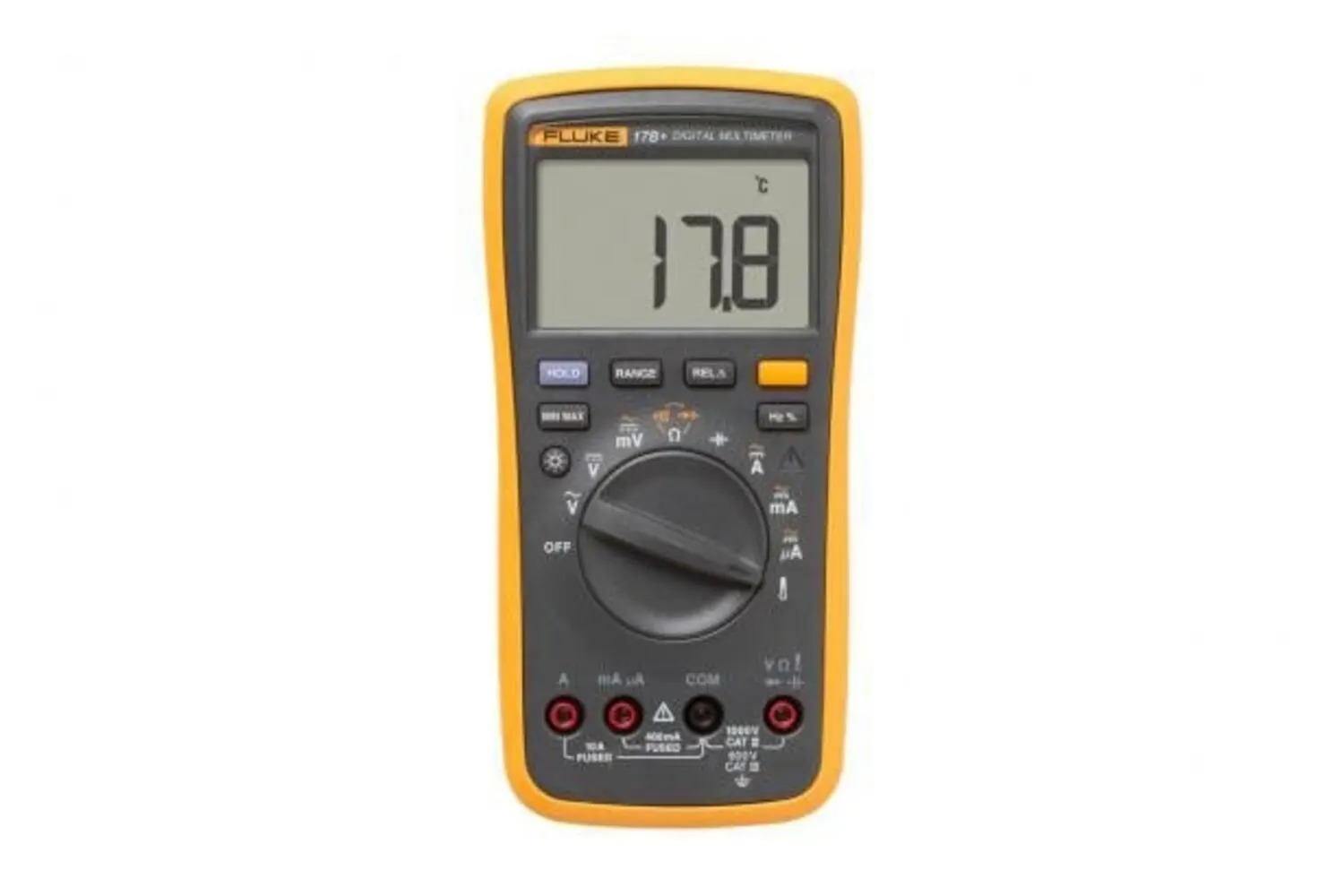
| Model | Fluke 17B+ |
|---|---|
| Accuracy | Not stated as True RMS by Fluke |
| Safety rating | CAT III 600V / CAT II 1000V |
| Auto-ranging | Yes (manual override) |
| Best for | Electronics hobbyists, students and appliance repair |
| Review status | Desk research, not bench-tested |
Disclosure: OhmSavvy earns a commission from qualifying Amazon purchases made through these links, at no extra cost to you. How we're funded.
The verdict
The 17B+ is Fluke's feature-rich entry meter: CAT III 600V (CAT II 1000V), a 4,000-count backlit display, auto and manual ranging, and functions the 117 lacks, including temperature with the supplied Type K probe, frequency to 100 kHz, duty cycle, capacitance to 1,000 µF, MIN MAX and relative mode. Fluke doesn't call it True RMS, so on drives and electronic loads its AC readings are less dependable than a 115 or 117. Note that the Amazon listing's photo shows the newer 17B MAX, so check which model it ships.
Consider it if
- ✓You want a Fluke-branded meter in the budget-to-entry tier that still reads temperature with the supplied Type K probe
- ✓You check small currents: the lowest current range is 400.0 µA with 0.1 µA resolution
- ✓You need frequency to 100 kHz and duty cycle for PWM, fans or simple control signals
- ✓You like MIN MAX recording and a relative (zero-offset) mode on volts and current
- ✓You want a warning LED that lights at 30 V or more as a second cue that the probes are on something dangerous
Skip it if
- ✕You measure VFD outputs, LED drivers or other non-sinusoidal AC, where Fluke makes no True RMS claim for this meter
- ✕Your work includes the service entrance or meter base, which calls for a CAT IV rating it doesn't carry
- ✕You want a built-in non-contact voltage detector or a LoZ ghost-voltage mode
- ✕A long warranty is part of why you buy Fluke: the users manual gives one year, not three or lifetime
- ✕You only ever check outlets and batteries, where the simpler Fluke 15B+ covers the same volts, amps and ohms
The trade-off: The 17B+ trades True RMS and Fluke's longer warranties for breadth. Against the Fluke 115 and 117 you gain a microamp range, temperature, duty cycle and a 100 kHz frequency limit, but lose True RMS, the 6,000-count display, a three-year warranty and (on the 117) VoltAlert and LoZ. Against a True RMS budget meter such as the UNI-T UT139C you're mostly paying for Fluke's documented safety design and fusing rather than for better accuracy on paper.
Key specifications
- Accuracy
- Not stated as True RMS by Fluke
- Safety rating
- CAT III 600V / CAT II 1000V
- Auto-ranging
- Yes (manual override)
- Best for
- Electronics hobbyists, students, appliance repair
Checked against the manufacturer's official product page or datasheet and the official Amazon listing when this model was added to our guide.
Strengths and limitations
Reasons to buy
- +Temperature, frequency and duty cycle built in
- +MIN MAX and relative mode
- +Hazardous-voltage LED lights at 30V or more
Reasons to avoid
- −Not True RMS
- −4,000-count display
- −Amazon listing photo shows the newer 17B MAX
Performance assessment
We haven't bench-tested this unit. This assessment is based on its published specifications and on what those specifications mean in practice. How we research.
Measurement range: wider than its price tier suggests
Few meters in the entry tier cover this much ground. Voltage runs from a 400.0 mV range up to 1000 V. Current is split across six ranges, from 400.0 µA to 10.00 A, protected by a 440 mA fuse on the µA/mA jack and an 11 A fuse on the amps jack, both rated 1000 V. Resistance reaches 40.00 MΩ, capacitance 1,000 µF, frequency 100 kHz and duty cycle 1 to 99%. Add diode test, continuity and temperature from -55 to 400 °C, and the 17B+ handles nearly every routine check on a workbench or in an appliance, without a second meter.
What 4,000 counts and ±(0.5% + 3) mean on real readings
Fluke lists DC volts at ±(0.5% + 3 counts). A 12.00 V battery reading on the 40.00 V range can be off by 0.06 V plus 0.03 V, so about ±0.09 V: fine for judging state of charge, too coarse for millivolt drift work. AC volts are ±(1.0% + 3) from 40 to 500 Hz; a 120.0 V outlet on the 400.0 V range carries about ±1.5 V. The 4,000-count limit shows up at the top end: anything above 399.9 V moves to the 1000 V range with 1 V steps, so a 480 V reading has no decimal place. A 6,000-count Fluke 115 or 117 keeps 0.1 V resolution up to 600.0 V.
Not True RMS: where that costs you
Fluke's product page and datasheet make no True RMS claim for the 17B+. On a clean utility sine wave that rarely matters, because the meter is calibrated for that shape. It matters on waveforms that aren't sinusoidal: the output of a variable-speed drive, current drawn by switch-mode power supplies, dimmers and LED drivers, or a chopped signal from a controller. On those, a non-True-RMS meter can read noticeably high or low, and nothing on the display warns you. If you diagnose modern HVAC, drives or electronic loads, the 115, 117 or 179 are the safer choice.
Temperature, frequency and microamps in practice
The bundled Type K probe makes the 17B+ useful for supply-air and return-air checks, heat sinks and soldering-adjacent work. Fluke specifies ±2 °C between 0 and 50 °C, and ±(2% + 1 °C) from 50 to 400 °C, so a 200.0 °C reading carries about ±5 °C. Frequency is ±(0.1% + 3); 60.0 Hz on the 500.0 Hz range works out to about ±0.4 Hz. On the 400.0 µA range, a 4.0 µA reading carries 0.06 µA plus three 0.1 µA counts, about ±0.36 µA. That's adequate for a flame-sensor or sleep-current check, which is something the Fluke 115 and 117 can't do at all.
MIN MAX, relative mode and the 30 V warning LED
MIN MAX and relative are the two features that separate the 17B+ from the otherwise identical 15B+, and both have limits the users manual spells out. MIN MAX doesn't work on resistance, capacitance, frequency, duty cycle or diode. Relative mode is excluded on frequency, resistance, continuity, duty cycle and diode, so it can't null test-lead resistance for low-ohm work; use it to watch a voltage or current change against a baseline instead. The hazardous-voltage LED lights at 30 V or more, or on an overload, which is a useful extra cue when the display is in an unexpected range.
Safety rating, build, battery and warranty
Fluke's product page lists CAT III 600V with a 1000 V maximum from any terminal to earth, while the 15B+/17B+ datasheet adds a CAT II 1000V rating; both appear on our spec table, and neither is CAT IV. The case measures 183 × 91 × 49.5 mm, weighs 455 g and is rated IP40, so it isn't sealed against water. Two AA cells give at least 500 hours, helped by a 20-minute auto power off and a backlight that times out after two minutes. Fluke's US page states no warranty term; the users manual gives one year. A drop rating isn't stated in our sources. One buying note: the Amazon listing's photo shows the newer 17B MAX, so check which model the listing actually ships.
Alternatives to consider
Fluke 15B+
The same case, ratings and µA-to-10 A ranges without temperature, frequency, duty cycle, MIN MAX, relative or the 30 V LED.
Fluke 115
True RMS and 6,000 counts with Min/Max/Avg and a three-year warranty, but no microamp range and no temperature.
Fluke 117
True RMS plus VoltAlert non-contact detection and LoZ for electricians; current starts at 6 A with 1 mA resolution.
Fluke 179
True RMS, temperature and a CAT IV 600V / CAT III 1000V rating with a lifetime warranty, for industrial and HVAC work.
UNI-T UT139C
A cheaper True RMS, 6,000-count, CAT III 600V meter if brand matters less than the AC measurement method.
Where to buy the Fluke 17B+
We link to the official Amazon listing. Prices change often, so check the current price at the retailer before you buy.
Frequently asked questions
Is the Fluke 17B+ True RMS?+
Fluke doesn't describe it as True RMS on its product page or datasheet, so treat it as a meter calibrated for sine waves. Utility voltage at an outlet reads normally. Distorted waveforms from drives, LED drivers or switch-mode supplies can read high or low, so pick the Fluke 115, 117 or 179 if that work is routine.
What does the 17B+ add over the Fluke 15B+?+
Per the shared users manual, the 17B+ adds temperature with an included Type K probe, frequency to 100 kHz, duty cycle, MIN MAX recording, relative mode and a hazardous-voltage LED that lights at 30 V or more. Everything else, including the case, CAT ratings, 4,000-count display, current ranges and one-year warranty, is shared between the two meters.
Can the Fluke 17B+ measure microamps for a furnace flame sensor?+
Yes, on paper. Its lowest current range is 400.0 µA with 0.1 µA resolution, at ±(1.5% + 3 counts). A 4.0 µA reading works out to roughly ±0.36 µA. Put the meter in series with the sensor lead through the µA/mA jack, and check the furnace maker's specified current rather than a generic number.
Can I use the Fluke 17B+ on a breaker panel?+
Inside a building's distribution system, yes: it carries CAT III 600V, the category for panels, feeders and fixed wiring. It isn't rated CAT IV, so don't use it at the meter base, service drop or utility side. Wear suitable protective gear, confirm the meter on a known live source first, and call an electrician for work you aren't qualified to do.
What warranty does the Fluke 17B+ have?+
One year, according to the Fluke 15B+/17B+/18B+ users manual. Fluke's US product page doesn't state a warranty term. That's shorter than the three-year coverage on the Fluke 115 and 117 and the lifetime warranty on the 87V and 179, so factor it in if you expect heavy daily use.
Has OhmSavvy hands-on tested the Fluke 17B+?+
No. This review is desk research: every figure comes from Fluke's product page, datasheet or users manual, and the worked accuracy numbers are arithmetic on those published specs, not bench measurements. The rating is our editorial score from that research, and we'll update the page if the meter is bought and tested.
Related
Fluke 17B+
4.5★★★★★


