COMPARISON · MULTIMETERS
Fluke 117 vs Fluke 101
Fluke 117 vs Fluke 101 comes down to two questions: do you need to measure current, and do you need True RMS? The 117 answers yes to both and adds NCV, AutoVolt and LoZ for building wiring. The 101 is Fluke's most basic meter, with no current function at all, but it reads frequency to 100 kHz and adds duty cycle and a diode test in a 160 g body.
By the OhmSavvy Research Team ·
Disclosure: OhmSavvy earns a commission from qualifying Amazon purchases made through these links, at no extra cost to you. How we're funded.

Fluke 117
4.8★★★★★The meter working electricians actually buy with their own money, not just the one brands push.
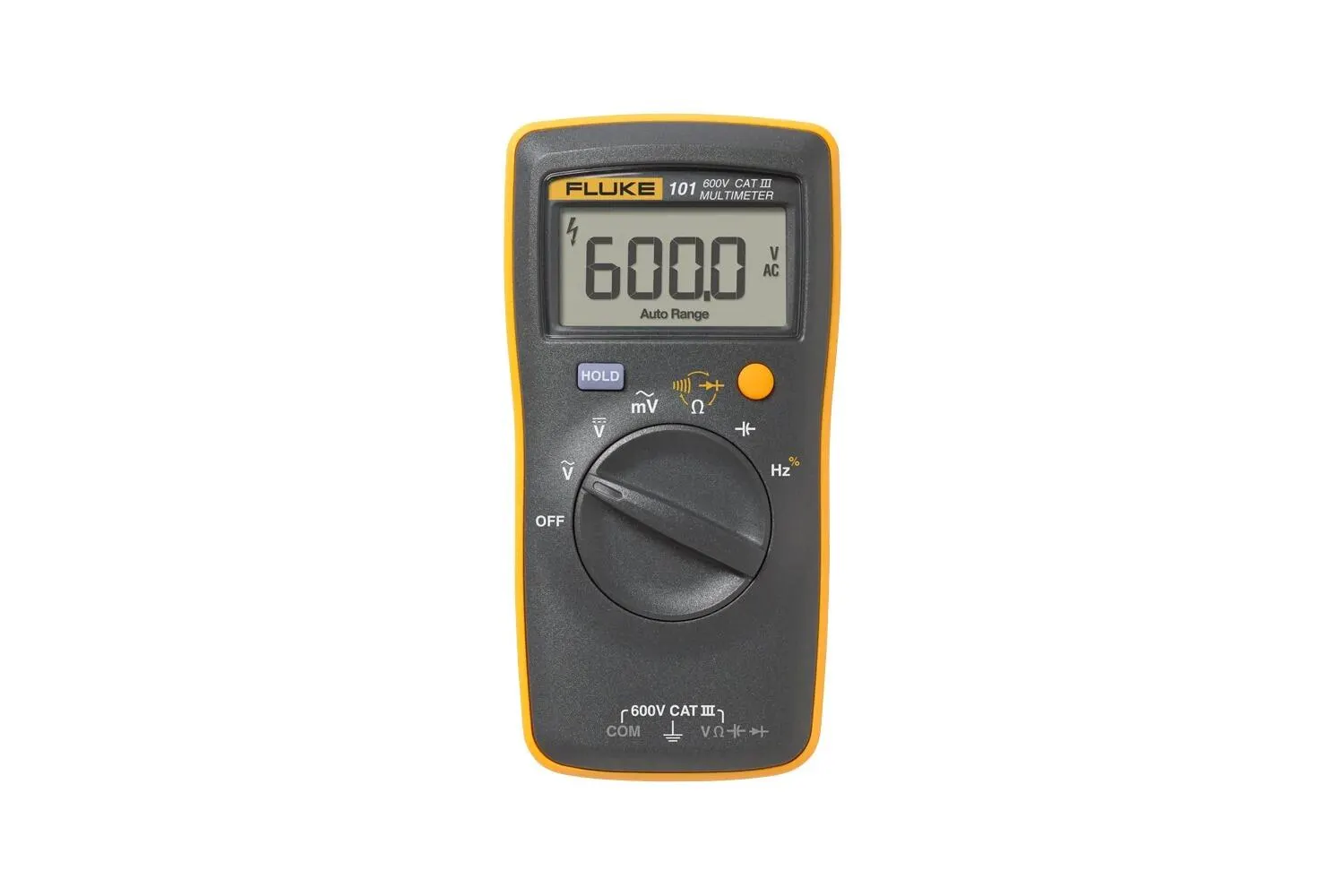
Fluke 101
4.1★★★★☆Fluke's smallest, simplest meter: volts, ohms, capacitance and frequency in 160 g, but no current measurement at all.
Specs side by side
| Fluke 117 | Fluke 101 | |
|---|---|---|
| Rating | 4.8★★★★★ | 4.1★★★★☆ |
| Accuracy | True RMS | Not stated as True RMS by Fluke |
| Safety rating | CAT III 600V | CAT III 600V |
| Auto-ranging | Yes | Yes |
| Best for | Electricians, serious hobbyists | Voltage and continuity checks only |
| Current | 6A and 10A AC/DC | None (two input jacks only) |
| True RMS | Yes | Not stated by Fluke |
| VoltAlert NCV / AutoVolt / LoZ | Yes / Yes / Yes | No / No / No |
| Display | 6,000 counts + 33-segment bar graph | 6,000 counts |
| Max voltage | 600V AC/DC | 600V AC/DC |
| DC volts accuracy | ±(0.5% + 2) | ±(0.5% + 3) |
| Frequency | To 50 kHz (2020 manual: 99.99 kHz) | 10 Hz to 100 kHz, plus duty cycle |
| Diode test | Yes, 2.000 V | Yes |
| Capacitance | 1 nF to 9,999 µF | Fluke sources conflict: 100 µF or 1,000 µF |
| Size / weight | 167 × 84 × 46 mm, 550 g | 130 × 65 × 27 mm, 160 g |
| Battery | One 9V, 400 h typical | Two AAA (life not stated) |
| Drop rating | Not stated | 1 m |
| Warranty / availability | 3 years; sold by Fluke US | 1 year; US listing is a third-party import |
Specs checked against manufacturer documentation and official Amazon listings. Fluke 117 is hands-on tested by OhmSavvy; the Fluke 101 assessment is desk research. How we research.
Key differences
- →The 117 measures AC and DC current to 10A; the 101 has no current function and only two input jacks.
- →The 117 is True RMS; Fluke makes no True RMS claim for the 101.
- →VoltAlert non-contact detection, AutoVolt and the low-impedance mode are on the 117 only.
- →The 101 reads frequency to 100 kHz on Fluke's spec, twice the 117's datasheet figure of 50 kHz, and adds duty cycle.
- →At 160 g the 101 weighs less than a third of the 117's 550 g.
- →The 117 has a 3-year warranty and is sold by Fluke US; the 101 has 1 year and is imported.
Start with one question: do you measure current?
Most people comparing these two are really asking whether a cheap, tiny Fluke can stand in for a full electrician's meter. For voltage and continuity it can. The moment a job needs amps, or a trustworthy AC reading on an electronic load, the answer flips, and no setting on the 101's dial changes that.
01
Measure amps?
Yes: you need the 117
02
Drives or LED loads?
Yes: True RMS, the 117
03
Building wiring?
NCV + LoZ: the 117
04
None of these
The 101 covers you
Fluke 117 vs 101 spec by spec
On the measurements both meters share, Fluke's figures sit close together: basic DC accuracy is 0.5% on each, and both read 600 V on a 6,000-count display. The real gaps are the functions one has and the other lacks, plus size, warranty and where you can buy them.
| Spec | Fluke 117 | Fluke 101 | Edge |
|---|---|---|---|
| DC volts | 600.0 mV to 600.0 V, ±(0.5% + 2) | 6.000 to 600.0 V, ±(0.5% + 3) | Near equal |
| AC volts | To 600.0 V, ±(1.0% + 3), True RMS | To 600.0 V, 1.0% + 3, no True RMS claim | 117 |
| AC/DC current | 6.000 A and 10.00 A, 20 A for 30 s | None | 117 |
| Resistance | To 40.00 MΩ, ±(0.9% + 1) | To 40.00 MΩ, 0.5% + 2 on middle ranges | 101 on paper |
| Capacitance | 1 nF to 9,999 µF | To 100 µF or 1,000 µF (sources conflict) | 117 |
| Frequency | To 50 kHz (manual: 99.99 kHz) | 10 Hz to 100 kHz | 101 |
| Duty cycle | No | 0.1% to 99.9% | 101 |
| Non-contact voltage | VoltAlert, Lo/Hi sensitivity | No | 117 |
| Ghost-voltage check | AutoVolt LoZ, about 3 kΩ | No | 117 |
| Size | 167 × 84 × 46 mm | 130 × 65 × 27 mm | 101 |
| Weight | 550 g | 160 g | 101 |
| Warranty | 3 years | 1 year | 117 |
Why True RMS changes the AC reading
An average-responding meter rectifies the AC signal, takes the average and multiplies by 1.11, the ratio that converts average to RMS for a perfect sine. Feed it anything else and that factor is wrong. A True RMS meter like the 117 computes the heating value directly, so the shape of the wave doesn't matter within its rated crest factor. Fluke doesn't claim True RMS for the 101, so treat its AC readings on non-sine loads with caution.
Real loads are messier than a square wave. The current drawn by a switch-mode power supply or an LED driver comes in short, tall pulses, and an averaging meter tends to read those low rather than high. Either way, the error grows with distortion, which is why electricians who work around variable-speed drives and modern lighting insist on True RMS. On a plain incandescent or resistive heater circuit the two approaches agree.
Who each meter really suits
The 117 is a working electrician's tool. VoltAlert gives a quick no-contact hint that a cord or outlet is energized, AutoVolt picks AC or DC on its own, and the low-impedance input collapses the phantom voltages that capacitive coupling leaves on dead conductors in shared conduit. Add True RMS and 10 A current and it covers panel, branch-circuit and appliance work without a second meter.
The 101 makes sense in a narrower spot: a glovebox or drawer meter for someone who checks batteries, fuses, outlets and the odd signal. Its 100 kHz frequency range, duty cycle and diode test give it surprising reach on small electronics, and at 130 × 65 × 27 mm it fits a shirt pocket. What it won't do is tell you how much current a heater, motor or parasitic drain is pulling.
| Everyday check | 117 | 101 |
|---|---|---|
| Is this outlet live? | Yes, with VoltAlert or leads | Yes, with leads |
| How many amps is this heater drawing? | Yes, up to 10 A | No |
| Is this fuse blown? | Yes | Yes |
| Is that 40 V on a dead wire real? | Yes, AutoVolt LoZ | No way to tell |
| What frequency is this signal? | Yes (see range note) | To 100 kHz |
| What is this PWM duty cycle? | No | Yes |
Fluke 117 vs 101: which is better for beginners?
It depends on what the beginner will measure first. Someone learning on batteries, fuses, cords and small electronics will find the 101 the simpler, more forgiving start. Someone whose first real job is house wiring, such as swapping receptacles or switches, should start on the 117, because its extras exist to catch the mistakes new users make on live circuits.
Ease of use. Both are auto-ranging per our Pick data, so neither asks a newcomer to pick a range, and both show 6,000 counts. The 101 adds a quieter advantage: it has only two input jacks. The classic first-meter accident is leaving the red lead in the amps jack after a current test and then probing an outlet, which puts a near-short across the supply through the meter. A two-jack meter can't be set up that way. The 117 has a separate A jack, so its owner has to learn to check lead placement before every voltage test, a habit worth building anyway.
Safety ratings. Here the two are equal: both are rated CAT III 600V, enough for receptacles, branch circuits and the inside of a panel, and neither is rated CAT IV for the service entrance. The 117 adds VoltAlert and a LoZ input, which help a beginner confirm a circuit is dead and avoid being fooled by phantom voltage; the lesson to learn alongside them is that a silent VoltAlert is not proof. The 101 has a published 1 m drop rating, which suits a meter likely to be knocked off a bench.
| Beginner job | Typical value | Fluke 117 | Fluke 101 |
|---|---|---|---|
| AA or AAA cell | About 1.5 V DC | Yes | Yes |
| 9 V battery | About 9 V DC | Yes | Yes |
| Car battery | About 12.6 V DC | Yes | Yes |
| Wall outlet | About 120 V AC | Yes, + VoltAlert | Yes, leads only |
| Blown fuse, broken cord | Continuity | Yes | Yes |
| LED or diode | Diode test | Yes | Yes |
| Device current draw | mA to A | Yes, 1 mA steps | No |
| Is the wire really dead? | LoZ check | Yes, AutoVolt | No |
The numbers beginners read are forgiving. A fresh AA cell on the 101's 6.000 V range, where one count is 0.001 V, carries ±(0.5% + 3): 0.5% of 1.5 V is 0.0075 V, plus 0.003 V, so about ±0.011 V. The 117's DC spec is one count tighter. Either way, the error is roughly a hundredth of a volt, far finer than the gap between a fresh cell and a spent one. Accuracy is not what separates these meters for a beginner; the jobs they can and can't do are.
| Beginner | Start with | Why |
|---|---|---|
| Curious hobbyist, small kit | Fluke 101 | Entry price tier, pocket size, no A jack |
| New homeowner, batteries and fuses | Fluke 101 | Volts, continuity and diode cover it |
| DIYer about to change outlets | Fluke 117 | VoltAlert and LoZ for prove-dead checks |
| First-year electrical apprentice | Fluke 117 | Learn on a trade meter with amps |
| Electronics student needing mA | Neither: Fluke 17B+ | µA and mA ranges the 117 lacks |
On cost, the 101 sits in the entry price tier and the 117 in the professional tier, so a beginner who may never touch building wiring pays for features they won't use with the 117. For the student row, compare Fluke 17B+ vs Fluke 101, and for a wider shortlist of first meters see our best multimeter for beginners guide.
Fluke 117 vs 101 for electrical troubleshooting
Troubleshooting building wiring is less about taking one reading than about ruling causes out in order: is power reaching the box, is the voltage real, does it hold under load, and what is the load drawing? The 101 can answer the first question with its leads. The 117 was designed around all four, and the table walks through common faults to show where each meter runs out of answers.
| Fault you are chasing | What to check | Fluke 117 | Fluke 101 |
|---|---|---|---|
| Dead receptacle | Hot-neutral and hot-ground volts | Leads, plus VoltAlert to trace the feed | Leads only |
| Which cable in the box is live? | Non-contact scan before touching | VoltAlert, Lo or Hi sensitivity | No NCV |
| Reading on a switched-off circuit | Real feed or ghost voltage | AutoVolt LoZ input, about 3 kΩ | No LoZ: can't tell |
| Breaker trips when a load runs | Running current | 6 A and 10 A ranges, True RMS | No current function |
| Lights flicker now and then | Voltage sag over time | Min/Max/Avg, 33-segment bar graph | Live digits only |
| Doorbell or thermostat transformer | AC or DC low voltage | AutoVolt picks AC or DC | Select by hand |
| Open fuse or broken cord | Continuity | Yes | Yes |
| Service entrance or meter base | Category rating | No: CAT III 600V | No: CAT III 600V |
The ghost-voltage row is the one that trips people up. A conductor that is switched off but runs beside a live one in conduit can pick up enough coupled voltage to show tens of volts on a high-impedance meter like the 101. The 117's AutoVolt position puts roughly 3 kΩ across the leads. A genuine 120 V supply can push 120 / 3,000 = 0.04 A through that and keep its voltage; a coupled phantom can't, so its reading collapses toward zero. That single check settles whether a dead-looking circuit is open or still fed.
Current is the other dividing line. A tripping breaker or a warm cord usually means you need to know what the load draws, and only the 117 can tell you. Mind its limits, though: Fluke specifies a 10.00 A range, with an overload allowance of 20 A for no more than 30 seconds. A 1,500 W space heater on 120 V draws 1,500 / 120 = 12.5 A, so a reading like that should be brief, and a clamp meter is the better tool for sustained loads above 10 A. Our guide to why a circuit breaker keeps tripping lays out the full sequence.
Neither meter is rated for the service side of the panel. For meter-base and main-disconnect checks, see the CAT IV meters in our best multimeter for electricians guide.
Fluke 117 or 101: which should you buy?
| You are… | Better fit | Why |
|---|---|---|
| Electrician or apprentice | Fluke 117 | Current, True RMS, NCV and LoZ are daily needs on building wiring |
| Homeowner doing your own wiring | Fluke 117 | LoZ and VoltAlert help confirm a circuit is really dead |
| Car owner checking fuses and battery voltage | Fluke 101 | Volts, continuity and diode test cover it; add a clamp for current |
| Electronics hobbyist on a tight budget | Fluke 101 | Frequency, duty cycle and diode test in a pocket size |
| HVAC or appliance technician | Fluke 117 | Running current and capacitance up to 9,999 µF |
| Buyer who wants US warranty support | Fluke 117 | Sold by Fluke US with 3 years; the 101 is an import with 1 year |
A middle ground if you want current in a small body
Safety: confirm dead with leads, not just a beep
Choose the Fluke 117 if…
- ✓You need to measure current up to 10A
- ✓You work on circuits with drives, LED drivers or other distorted waveforms
- ✓You want VoltAlert, AutoVolt and LoZ for safer checks on building wiring
Choose the Fluke 101 if…
- ✓You never need to measure current
- ✓You want the smallest, lightest Fluke for voltage and continuity
- ✓You're comfortable buying an import with a one-year warranty
The bottom line
The Fluke 117 is the meter to buy for electrical work: current, True RMS and its NCV, AutoVolt and LoZ features matter on real circuits. The Fluke 101 is only worth considering as an ultra-light voltage, continuity and signal checker, and its US availability as an import with a one-year warranty counts against it.
Frequently asked questions
Why can't the Fluke 101 measure current?+
Fluke built it with only two input jacks, COM and one shared input for volts, ohms, capacitance and frequency, and its specifications list no current function. Measuring current in series needs a separate fused input that the meter can route amps through, which the 117 has on its A jack. For current on a 101 owner's bench, a clamp meter is the usual add-on.
Is the Fluke 101 True RMS?+
Fluke makes no True RMS claim for the 101 on its product page, datasheet or manual, so assume it is not. That's fine on clean mains and batteries. On variable-speed drives, dimmers and switch-mode supplies, an averaging reading can be off by several percent or more, while the True RMS Fluke 117 stays accurate.
Which reads higher frequencies, the Fluke 117 or 101?+
On Fluke's spec sheets, the 101: it measures 10 Hz to 100 kHz and adds duty cycle, while the 117's datasheet stops at 50 kHz. Fluke's 2020 users manual for the 117 lists a 99.99 kHz range, so the gap may be smaller than it looks. Neither is a substitute for an oscilloscope on fast digital signals.
Can I buy the Fluke 101 from Fluke in the US?+
Fluke's US site doesn't list it; it appears on Fluke's India and Malaysia sites. On Amazon it is sold by a third-party importer, and Fluke's one-year warranty applies rather than the longer cover on US models. If local warranty support matters, the Fluke 106 or 107 are the palm-sized models Fluke sells in the US.
Is the Fluke 117 overkill for home use?+
Not if you work on your own wiring. VoltAlert gives a fast first check, LoZ exposes phantom voltage on dead conductors, and True RMS keeps readings honest on LED lighting circuits. For battery, fuse and continuity checks alone, a smaller meter such as the 101 or 107 is enough, and our best multimeter for home use guide covers the middle ground.
Is the Fluke 101 a good first multimeter?+
For batteries, fuses, cords and small electronics, yes. It is auto-ranging, rated CAT III 600V and has only two input jacks, so a beginner can't leave a lead in an amps jack and short an outlet. The limits are no current measurement, no True RMS claim and a one-year warranty on an imported unit.
Is the Fluke 117 too advanced for a beginner?+
No. It is auto-ranging like the 101, and its extras are aimed at safety: VoltAlert flags live conductors and the LoZ AutoVolt position exposes phantom voltage. A beginner does need to learn two habits, checking which jack the red lead is in and proving dead with the leads, not the VoltAlert beep alone.
Can the Fluke 101 tell ghost voltage from a real feed?+
No. The 101 has only a high-impedance voltage input, so a switched-off wire picking up coupled voltage from a neighbor can show a convincing reading. The Fluke 117's AutoVolt position loads the circuit with about 3 kΩ, which drags a phantom reading toward zero while a genuine supply holds steady. Without LoZ, you'd need a separate low-impedance tester.
Which is better for finding why a breaker keeps tripping, the Fluke 117 or 101?+
The 117, because the usual first step is measuring what the load draws. It reads True RMS current on 6 A and 10 A ranges, with a 20 A allowance for up to 30 seconds, so you can compare the draw with the breaker rating. The 101 can confirm voltage and continuity but has no current function, so it can't show an overload.
Related


