COMPARISON · MULTIMETERS
Fluke 101 vs Klein MM325: Which Budget Multimeter Should You Buy?
Fluke 101 vs Klein MM325 is a choice between a pocket voltage checker and a basic all-rounder. Buy the Klein MM325 if you will ever chase a car battery drain or check batteries under load: it measures DC current and the Fluke cannot. Buy the Fluke 101, roughly two and a half times the Klein's Amazon price when we checked, if you mainly read mains voltage and want auto-ranging, finer 240 V readings and capacitance in a 160 g body.
By the OhmSavvy Research Team ·
Disclosure: OhmSavvy earns a commission from qualifying Amazon purchases made through these links, at no extra cost to you. How we're funded.
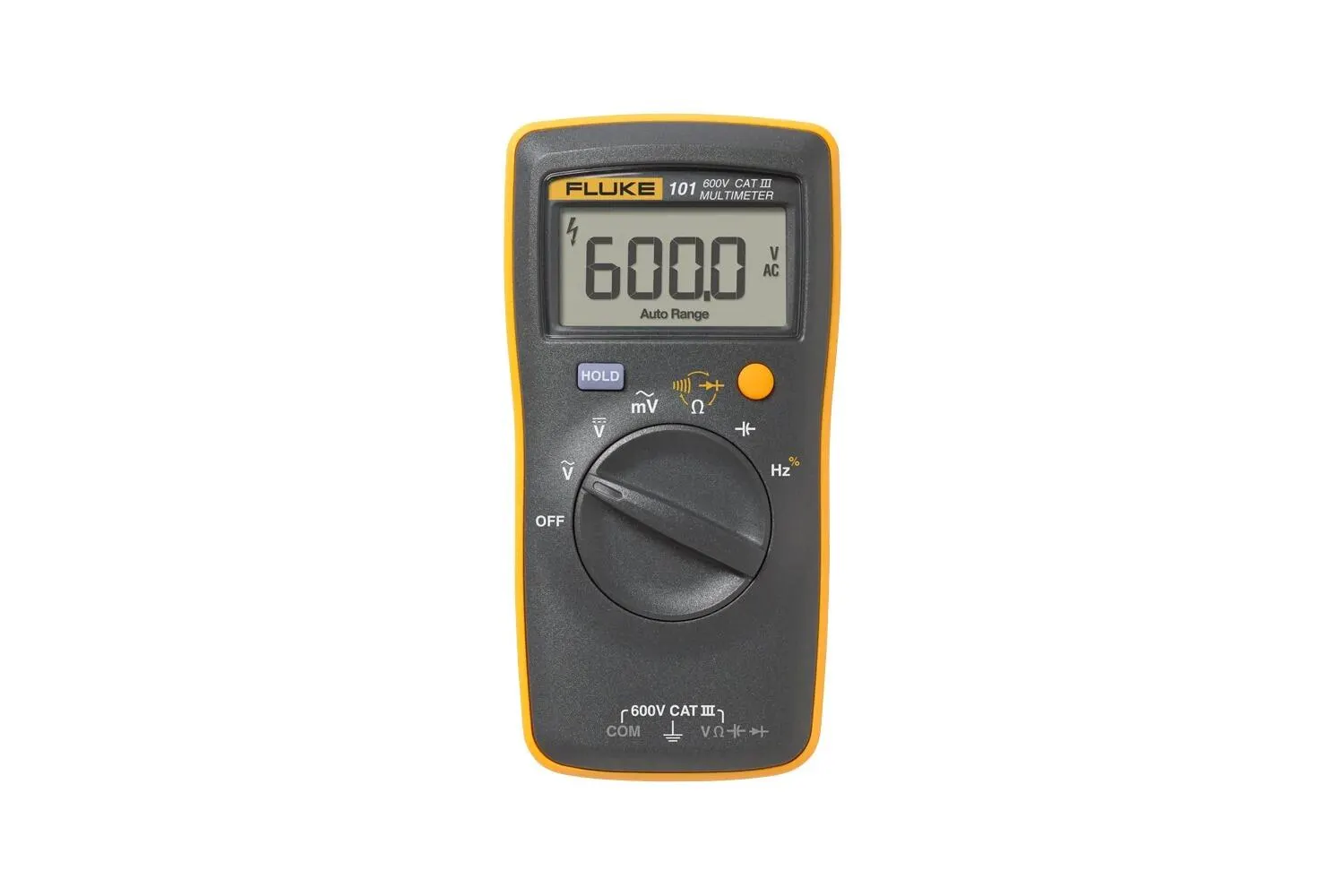
Fluke 101
4.1★★★★☆Fluke's smallest, simplest meter: volts, ohms, capacitance and frequency in 160 g, but no current measurement at all.

Klein Tools MM325
4.1★★★★☆A low-cost Klein for checking outlets, batteries and continuity, as long as you're happy picking ranges yourself.
Specs side by side
| Fluke 101 | Klein Tools MM325 | |
|---|---|---|
| Rating | 4.1★★★★☆ | 4.1★★★★☆ |
| Accuracy | Not stated as True RMS by Fluke | Not True RMS (2,000-count) |
| Safety rating | CAT III 600V | CAT III 600V |
| Auto-ranging | Yes | No (manual ranging) |
| Best for | Voltage and continuity checks only | Basic household and battery checks |
| Ranging / display | Auto, 6,000 counts | Manual, 2,000 counts |
| Current | None (two input jacks) | DC only: 200 µA to 10 A |
| AC volts, 600 V range | 0.1 V steps, ±(1.0% + 3) | 1 V steps, ±(1.2% + 5) |
| Resistance | To 40 MΩ | To 2,000 kΩ |
| Capacitance / frequency | Yes / 10 Hz to 100 kHz | No / No |
| Battery test | No | 1.5 V and 9 V under load |
| Hold / backlight | Hold not listed; no backlight listed | Data hold and backlight |
| Size / weight | 130 × 65 × 27 mm, 160 g | 162.7 × 79.4 × 46.6 mm, 250 g |
| Drop / ingress | 1 m drop, IP40 | 2 m drop, IP not stated |
| Warranty | 1 year (US listing is an import) | Not stated in the manual |
Specs checked against manufacturer documentation and official Amazon listings. Desk research, not bench testing. How we research.
Key differences
- →The MM325 measures DC current on four ranges, 200.0 µA to 10 A; the Fluke 101 has no current function at all.
- →The Fluke auto-ranges on a 6,000-count display; the MM325 is manual-ranging with 2,000 counts, so you pick each range on the dial.
- →At 240 V the Fluke shows 0.1 V steps; the MM325's only range above 200 V shows whole volts.
- →The Fluke adds capacitance, frequency to 100 kHz and duty cycle, none of which the MM325 offers.
- →The MM325 adds a loaded 1.5 V and 9 V battery test, a backlight, data hold and a 2 m drop rating.
- →The 101 is smaller and lighter, 160 g against 250 g, but Fluke doesn't sell it on its US site and gives it a 1-year warranty.
The deal-breaker: the Fluke 101 can't measure amps
Look at the jacks before anything else. The 101 has two, COM and V/Ω, and no current function behind them. The MM325 has three, and its dial includes 200.0 µA, 20.00 mA, 200.0 mA and 10.00 A DC ranges. That one difference decides the purchase for anyone who works on cars, boats, RVs or battery projects.
Worked example: a parked car with an illustrative 35 mA drain. With the MM325 in series on the 200.0 mA range, the display shows 35.0 mA, and Klein's ±(1.0% + 5 digits) spec gives ±(0.35 + 0.5) = ±0.85 mA, easily good enough to see a drain fall when you pull the guilty fuse. Klein's manual caps the mA jack at 200 mA, so start on the 10 A jack until you know the draw is small. The Fluke 101 has no way to take this reading. Our parasitic drain guide walks through the method.
What the MM325 still can't do with current
Reading a 240 V dryer outlet and a 24 V thermostat on each
Where the Fluke pulls ahead is voltage resolution. The MM325 has only two AC ranges, 200.0 V and 600 V. A 120 V receptacle fits the 200.0 V range, but a 240 V dryer or range outlet forces the 600 V range, which shows whole volts at ±(1.2% + 5 digits). The 101 auto-ranges to its 600.0 V range and keeps one decimal place at ±(1.0% + 3 digits).
The arithmetic at 240 V: the Fluke allows 1.0% of 240 (2.4 V) plus 3 digits of 0.1 V, so ±2.7 V. The Klein allows 1.2% of 240 (2.88 V) plus 5 digits of 1 V, so about ±7.9 V. A reading of 232 V on the Klein is therefore within spec for a perfectly normal 240 V supply, which makes it hard to judge a weak leg. At 120 V the gap disappears: on its 200.0 V range the MM325 is ±(1.0% + 3), which is ±1.5 V, exactly the Fluke's figure at 120 V.
A 24 V AC thermostat circuit shows the same pattern at the low end. The MM325's smallest AC range is 200.0 V, so 24 V reads as 24.0 at ±(0.24 + 0.3) = ±0.54 V. The 101 drops to its 60.00 V range and reads 24.00 at ±(0.24 + 0.03) = ±0.27 V. If 240 V circuits are routine for you, the 120 V instead of 240 V troubleshooting guide shows what a low leg looks like.
Manual ranging, battery tests and the small conveniences
Klein's manual describes the MM325 routine: set the dial to the highest voltage range, take the reading, then turn down through the ranges for more resolution. It is slower than the 101, and a beginner who leaves the dial on the 200.0 V AC range and probes a 240 V outlet sees "OL" rather than a number. The compensation is a set of features the Fluke lacks: Lead-Alert LEDs that show which jacks to use for the selected function, a backlight, data hold, and a 2 m drop rating against the 101's 1 m.
The battery test is the most useful of those. It puts a load on the cell, about 15 mA through 100 Ω for 1.5 V cells and about 20 mA through 450 Ω for 9 V, so a tired battery that still shows full voltage when idle sags on the display. The 101 can only read a battery's open-circuit voltage. On the other side, the 101 reads capacitance, frequency and duty cycle, and resistance to 40 MΩ against the MM325's 2,000 kΩ. Fluke's own documents disagree on the 101's top capacitance range (100 µF in one, 1,000 µF in another), so treat the lower figure as safe. The Fluke 101 review covers that conflict in detail.
Fluke 101 or Klein MM325 for your toolbox
| Task | Better fit | Why |
|---|---|---|
| Car or RV parasitic drain | Klein MM325 | DC current to 10 A; the 101 has no current input |
| 240 V dryer, range or A/C circuit | Fluke 101 | 0.1 V steps and ±2.7 V vs ±7.9 V |
| 120 V receptacle check | Either | Both ±1.5 V at 120 V |
| AA, AAA and 9 V cells | Klein MM325 | Loaded battery test |
| Thermostat and doorbell transformers | Fluke 101 | 60.00 V range, ±0.27 V at 24 V |
| Run capacitor or PWM signal | Fluke 101 | Capacitance, frequency and duty cycle |
| Pocket meter for daily carry | Fluke 101 | 160 g and 27 mm thick |
| Dim crawlspaces and panels | Klein MM325 | Backlight and data hold |
Neither maker claims True RMS for these meters, so both should be read with care on dimmers, LED drivers and variable-speed motors. If that is your work, step up to a budget True RMS meter from our True RMS meters under $100 list, or see the wider best multimeter for home use ranking where both of these appear.
Both stop at CAT III 600V
Choose the Fluke 101 if…
- ✓You mostly verify voltage at receptacles, 240 V appliance circuits and low-voltage controls
- ✓You want auto-ranging so you never set a range on the dial
- ✓You need capacitance, frequency or duty cycle in a meter that fits a shirt pocket
Choose the Klein Tools MM325 if…
- ✓You need DC current, from a 200 µA range up to 10 A, for parasitic draw or small circuits
- ✓You want a loaded battery test for 1.5 V and 9 V cells
- ✓You work in dim spaces and want a backlight, data hold and Lead-Alert jack lights
Neither if…
You need AC current or True RMS readings on electronic loads. Neither meter offers either; the KAIWEETS HT118A adds both at a low price, and the Fluke 115 does it with a 3-year warranty.
The bottom line
For most households the Klein MM325 is the better budget buy: it measures DC current and tests batteries under load, which the Fluke 101 cannot do at any price. The Fluke 101 justifies its higher price only for people who mainly read voltage, especially on 240 V and low-voltage controls, and want auto-ranging, capacitance and a true pocket-size meter.
Frequently asked questions
Can the Fluke 101 test a car battery?+
It can read the battery's resting voltage on its 60.00 V range, to ±(0.5% + 3 digits), which is about ±0.09 V at 12.6 V. It can't measure current, so it can't find a parasitic drain, and it has no loaded battery test. The Klein MM325 reads the same 12.6 V in 0.01 V steps and also measures drain current.
Is the Klein MM325 auto-ranging?+
No. The MM325 is manual-ranging: you choose the range on the dial, and Klein's manual tells you to start at the highest range and turn down for resolution. The Fluke 101 is auto-ranging, so it picks the range for you. If you're new to meters and dislike setting ranges, that alone may justify the Fluke's higher price.
Why does the MM325 read 240 V less precisely than 120 V?+
Because 240 V exceeds its 200.0 V range. The meter has to use its 600 V range, which shows whole volts at ±(1.2% + 5 digits), about ±7.9 V. At 120 V it stays on the 200.0 V range with one decimal and ±1.5 V. The Fluke 101 keeps 0.1 V resolution up to 600 V.
Is the Fluke 101 sold in the US?+
Not on Fluke's US website, where it isn't listed. The Amazon listing we link to is a third-party import that was in stock when we checked. Fluke's India page lists a 1-year warranty for the 101, shorter than most Fluke meters. Klein's MM325 manual points to its warranty page but doesn't state a length.
Which meter is safer for beginners?+
Both are CAT III 600V and double insulated. The MM325's Lead-Alert lights show which jacks the selected function needs, which helps avoid a common beginner mistake, but its manual ranging adds a step. The Fluke 101 has only two jacks and no current input, so you can't blow a fuse with leads in the wrong jack.
Related



