COMPARISON · MULTIMETERS
Fluke 117 vs UNI-T UT139C: Which Is Better for Electricians?
For an electrician who works in existing buildings, the Fluke 117 is the better meter, and the reason is one function: LoZ. Both meters are True RMS, rated CAT III 600V and have non-contact voltage detection, but only the 117 can tell a phantom reading on an abandoned conductor from a real feed at the turn of the dial. When we checked Amazon the 117 cost more than the Fluke 115, which itself ran about three times the UT139C's price. An apprentice, a new-construction installer or a homeowner can save that money and buy the UT139C.
By the OhmSavvy Research Team ·
Disclosure: OhmSavvy earns a commission from qualifying Amazon purchases made through these links, at no extra cost to you. How we're funded.

Fluke 117
4.8★★★★★The meter working electricians actually buy with their own money, not just the one brands push.
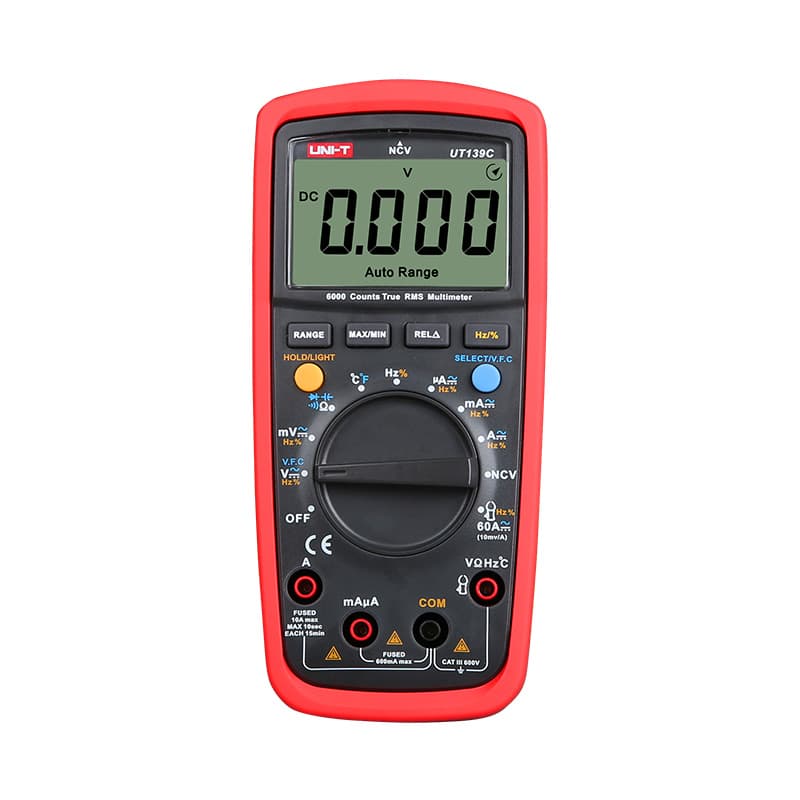
UNI-T UT139C
4.4★★★★☆True RMS and auto-ranging at a price that undercuts most of this list.
Specs side by side
| Fluke 117 | UNI-T UT139C | |
|---|---|---|
| Rating | 4.8★★★★★ | 4.4★★★★☆ |
| Accuracy | True RMS | True RMS, 6,000-count |
| Safety rating | CAT III 600V | CAT III 600V |
| Auto-ranging | Yes | Yes |
| Best for | Electricians, serious hobbyists | Budget-conscious buyers who still want True RMS |
| LoZ (ghost voltage) | Yes, about 3 kΩ on AutoVolt | No (UT139E/S only) |
| Non-contact voltage | VoltAlert | Yes; voltage range not stated |
| Automatic AC/DC selection | AutoVolt, ±(2.0% + 3) | Not stated |
| Volts input impedance | >10 MΩ DC, >5 MΩ AC | Not stated |
| AC volts accuracy | ±(1.0% + 3), 45 to 500 Hz | ±(0.8% + 3), 45 Hz to 1 kHz |
| Current | 6 A and 10 A AC/DC; 20 A for 30 s | 10 A AC/DC |
| Temperature | No | -40 to 1000 °C, probe included |
| Bar graph | 33 segments, 32 updates/s | 31 segments listed for the series |
| Weight | 550 g | 354 g |
| Warranty | 3 years | Not stated in our sources |
Specs checked against manufacturer documentation and official Amazon listings. Fluke 117 is hands-on tested by OhmSavvy; the UNI-T UT139C assessment is desk research. How we research.
Key differences
- →The Fluke 117 has a LoZ input of about 3 kΩ that drains phantom voltage; UNI-T lists LoZ for the UT139E and UT139S, not the UT139C.
- →The 117's AutoVolt position chooses AC or DC automatically; UNI-T doesn't list automatic AC/DC selection for the UT139C.
- →Both are rated CAT III 600V and both detect voltage without contact; neither is rated CAT IV.
- →The UT139C adds a temperature input with a probe and capacitance to 99.99 mF; the 117 has no temperature function.
- →Fluke publishes the 117's input impedance and a 20 A, 30-second current rating; UNI-T's sources state neither for the UT139C.
- →The 117 carries a 3-year warranty; we found no warranty term for the UT139C.
LoZ is the 117's whole case against the UT139C
Strip away the features the two share and one electrician-specific function is left. A conductor that runs alongside a live one, but isn't connected to anything, picks up voltage through stray capacitance. A normal high-impedance volts input barely loads that coupling, so the meter shows a convincing number on a wire that can't deliver any power. The 117's AutoVolt position switches to a low-impedance input of about 3 kΩ, and the phantom collapses while a genuine supply holds up. The UT139C has no equivalent: UNI-T's own page says LoZ belongs to the newer UT139E and UT139S.
Bars use a logarithmic scale: each step is ten times the last.
That impedance drop of more than a thousand times is what does the work. We've already shown the voltage-divider arithmetic in Fluke 115 vs Fluke 117 and Fluke 117 vs Klein MM400, so here the practical question is what a UT139C owner does instead. The answer is to load the conductor yourself, with a low-impedance plug-in tester or a resistor across the leads, as our guide to spotting phantom voltage on a floating circuit describes. It works, but it's a second tool and a second step on every suspect reading.
Worked scenario: de-energizing a 240V dryer circuit in an old house
You're replacing a NEMA 14-30 dryer receptacle in a house with a crowded panel and an old conduit run shared with other circuits. Nominal readings on a live 14-30 are 240V between the two hots, 120V from each hot to neutral and about 0V from neutral to ground. The job is live-dead-live: prove the meter, prove the circuit dead, prove the meter again.
| Step | Fluke 117 | UNI-T UT139C |
|---|---|---|
| Prove the meter on a known live outlet | Yes; AutoVolt reads 120V AC without choosing AC | Yes; select AC volts |
| Quick check that the receptacle is live before work | VoltAlert NCV | NCV |
| Breaker off: read X-Y, X-N, Y-N and X-G, Y-G | Expect about 0V on every pair | Expect about 0V on every pair |
| One pair shows tens of volts with the breaker off | AutoVolt (LoZ): a phantom collapses toward 0V, a real feed holds | Reading alone can't separate phantom from feed; add a load and retest |
| Prove the meter again on the live outlet | Yes | Yes |
| Check the dryer element's resistance, unplugged | Yes | Yes |
The fourth row is the only place the meters differ, and it's exactly the reading that matters. A real voltage there means a mislabeled breaker or a backfeed, and you must not touch the conductors. A phantom means you're safe to proceed. The 117 answers that in one turn of the dial. With the UT139C you treat the reading as live until a loaded test proves otherwise, which is the correct, slower habit. For more on unexpected readings at 240V outlets, see why a meter reads 120V instead of 240V.
CAT III 600V on both, CAT IV on neither
Where the UT139C is enough for electrical work
LoZ earns its keep in remodels, service calls and troubleshooting, where you don't know what every conductor in a box is connected to. In new construction you pulled every wire yourself, phantom readings are rare, and the UT139C covers the job: True RMS for LED drivers and variable-speed equipment, CAT III 600V for panels, NCV for a fast first check and a 10A range. Its AC volts spec, ±(0.8% + 3), is even slightly tighter on paper than the 117's ±(1.0% + 3).
It also does two things the 117 can't. The included temperature probe reads -40 to 1000 °C, handy for checking a motor frame or a condenser line, and its capacitance range reaches 99.99 mF. Electricians who also do light HVAC work may value those more than LoZ. And at roughly a third of a Fluke's price, it's a sensible apprentice meter or a second meter for the van.
Who should pay for the 117
Electrician feature checklist
| Feature | Fluke 117 | UNI-T UT139C | Why electricians care |
|---|---|---|---|
| LoZ | Yes | No | Separates ghost voltage from a real feed |
| NCV | Yes (VoltAlert) | Yes | Fast live check before opening a box |
| Auto AC/DC | Yes (AutoVolt) | Not stated | One dial position for mixed AC and DC controls |
| True RMS | Yes | Yes | Correct readings on LED drivers and drives |
| CAT rating | CAT III 600V | CAT III 600V | Panels and branch circuits; not the service |
| Temperature | No | Yes | Motor and HVAC checks |
| Warranty | 3 years | Not stated | Cost of a failed meter mid-job |
If the 117 is more than you need but you want a Fluke, the 115 drops LoZ, AutoVolt and VoltAlert; we set it against the same UNI-T for general field work in Fluke 115 vs UNI-T UT139C. For more picks, see the best multimeter for electricians and the best multimeters for electricians under $100.
Choose the Fluke 117 if…
- ✓You troubleshoot existing wiring, where ghost voltage on abandoned or open conductors is common
- ✓You want AutoVolt to pick AC or DC for you on one dial position
- ✓You need a published input impedance, a 20 A, 30-second current rating and a 3-year warranty
Choose the UNI-T UT139C if…
- ✓You mostly wire new construction, where every conductor is accounted for
- ✓You want temperature for checking motors or HVAC work alongside electrical
- ✓You're an apprentice or homeowner who needs CAT III 600V and NCV at a budget price
The bottom line
For electricians who troubleshoot existing buildings, the Fluke 117 is worth its higher price because LoZ settles ghost-voltage readings instantly, AutoVolt saves dial changes, and Fluke backs it for three years. The UNI-T UT139C is the right call for new-construction work, apprentices and homeowners: it matches the 117 on True RMS, CAT III 600V and NCV and adds temperature, at a fraction of the cost.
Frequently asked questions
Does the UNI-T UT139C have LoZ?+
No. UNI-T's UT139 series page says LoZ for AC volts is a feature of the newer UT139E and UT139S models, not the UT139C. Without it, a phantom voltage on an open conductor looks like a real reading, so you need a separate low-impedance tester or a deliberate load to check. The Fluke 117 has LoZ through its AutoVolt position.
Are the Fluke 117 and UNI-T UT139C both safe for panel work?+
Both are rated CAT III 600V, which covers panelboards, feeders and branch circuits inside a building, including 277V and 480V equipment. Neither is rated CAT IV, so neither belongs on the service entrance or meter base. Use leads with the same or higher rating, and prove the meter on a known live source before and after testing.
Is the NCV on the UT139C as good as Fluke's VoltAlert?+
We can't compare them directly: neither maker's sources we checked publish a voltage range for the detector, and we haven't bench-tested the UT139C. UNI-T says its NCV works by sensing electric field strength. Treat either as a quick first check only, never as proof that a conductor is dead.
Is the Fluke 117 worth the money for an apprentice?+
Often not at first. An apprentice working under supervision on new installations gets True RMS, CAT III 600V and NCV from the UT139C at a fraction of the price. Once you start troubleshooting existing wiring on your own, the 117's LoZ and 3-year warranty become worth paying for, and the UT139C can stay in the van as a backup.
Can either meter measure a 30A circuit's current?+
Not continuously. Both top out at 10 A through the leads. Fluke rates the 117 for 20 A for up to 30 seconds; UNI-T doesn't state an overload time for the UT139C. For load current on larger circuits, use a clamp meter, which measures without breaking the circuit and keeps you out of the series path.
Which meter reads temperature?+
Only the UNI-T UT139C. UNI-T lists -40 to 1000 °C with a probe included, which helps when checking motor frames, condenser lines or a hot connection after it's de-energized. The Fluke 117 has no temperature function; in Fluke's 110 Series that's the 116, which drops the 117's 6 A and 10 A current ranges.
Related


