COMPARISON · MULTIMETERS
Fluke 115 vs UNI-T UT139C: Which Multimeter Offers Better Value?
On a spec sheet the UNI-T UT139C is the better value by a wide margin. When we checked Amazon, it cost about a third as much as the Fluke 115, matched it on True RMS, 6,000 counts and CAT III 600V, and added temperature, non-contact voltage and a far wider capacitance range. Buy the UT139C for home, hobby and occasional field work. Buy the Fluke 115 only if you use a meter every working day and value a 3-year warranty, fully published specs and a known seller over extra functions.
By the OhmSavvy Research Team ·
Disclosure: OhmSavvy earns a commission from qualifying Amazon purchases made through these links, at no extra cost to you. How we're funded.

Fluke 115
4.8★★★★★The same Fluke reliability as the 117, in the same body, without the electrician-specific extras (NCV, AutoVolt, LoZ).
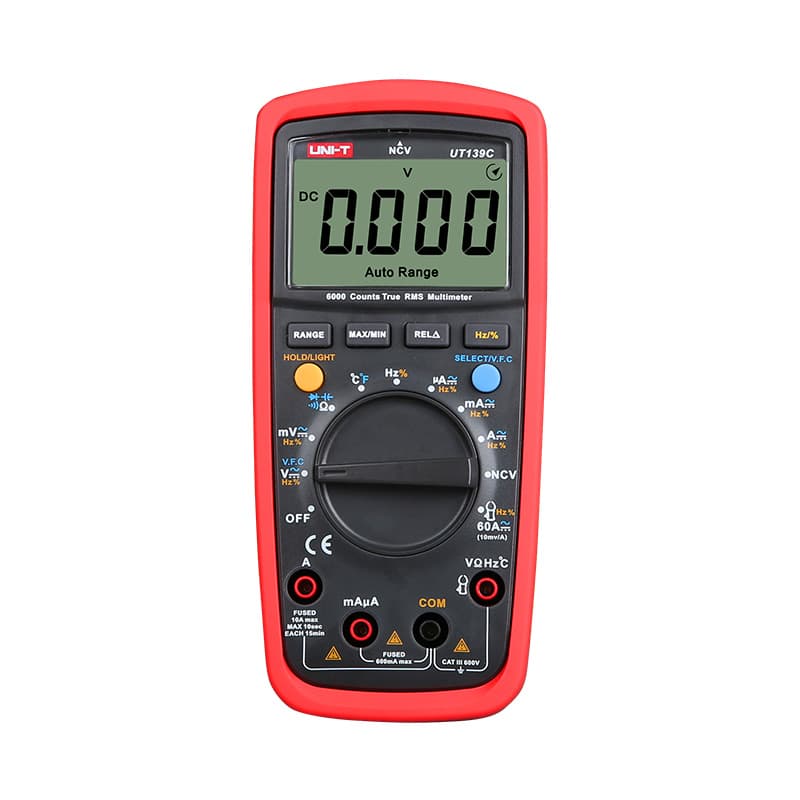
UNI-T UT139C
4.4★★★★☆True RMS and auto-ranging at a price that undercuts most of this list.
Specs side by side
| Fluke 115 | UNI-T UT139C | |
|---|---|---|
| Rating | 4.8★★★★★ | 4.4★★★★☆ |
| Accuracy | True RMS | True RMS, 6,000-count |
| Safety rating | CAT III 600V | CAT III 600V |
| Auto-ranging | Yes | Yes |
| Best for | Field technicians, general electrical and electronics work | Budget-conscious buyers who still want True RMS |
| DC volts accuracy | ±(0.5% + 2) | ±(0.5% + 2) |
| AC volts accuracy | ±(1.0% + 3), True RMS | ±(0.8% + 3), True RMS, 45 Hz to 1 kHz |
| Current | 6 A and 10 A AC/DC; 20 A for 30 s | 10 A AC/DC; overload time not stated |
| Resistance | To 40 MΩ | To 60 MΩ |
| Capacitance | To 9,999 µF | To 99.99 mF (99,990 µF) |
| Frequency | To 50 kHz | 10 Hz to 10 MHz, plus duty cycle |
| Temperature | No | -40 to 1000 °C, probe included |
| Non-contact voltage | No | Yes |
| Manual ranging | Yes | Yes |
| Battery | One 9V, about 400 h | 2 × AA; life not stated |
| Weight | 550 g | 354 g (UNI-T); 370 g (Amazon listing) |
| Warranty | 3 years | Not stated in our sources |
Specs checked against manufacturer documentation and official Amazon listings. Fluke 115 is hands-on tested by OhmSavvy; the UNI-T UT139C assessment is desk research. How we research.
Key differences
- →The UT139C lists temperature (probe included), NCV, duty cycle and capacitance to 99.99 mF; the Fluke 115 has no temperature or NCV and stops at 9,999 µF.
- →Fluke publishes a 3-year warranty, an operating range of -10 to +50 °C and a 20 A, 30-second overload rating; UNI-T's sources we checked state none of these.
- →On paper the UT139C's AC volts spec, ±(0.8% + 3), is slightly tighter than the 115's ±(1.0% + 3); DC volts are identical at ±(0.5% + 2).
- →UNI-T's series table is shared across several UT139 models, so some per-model details are less certain than the 115's dedicated spec sheet.
- →The UT139C weighs 354 g on two AA cells; the 115 weighs 550 g on one 9V battery rated for about 400 hours.
On paper, the UT139C matches the 115 for a third of the price
Most budget-versus-Fluke comparisons end with the budget meter missing something important. This one doesn't. Both are True RMS, both have 6,000-count displays, both are rated CAT III 600V and both offer manual as well as auto ranging. UNI-T's published accuracy is the same as Fluke's on DC volts and a touch tighter on AC volts. Here is what the two AC specs mean on a 120.0V outlet reading:
Bars use a logarithmic scale: each step is ten times the last.
The arithmetic: Fluke's ±(1.0% + 3) is 1.20V plus three counts of 0.1V, so ±1.50V. UNI-T's ±(0.8% + 3) is 0.96V plus 0.3V, so ±1.26V. Both assume a 600.0V range showing 0.1V steps. A quarter of a volt either way won't change any decision you make at an outlet, so treat the two meters as equals on accuracy. The capacitance gap matters more: very large filter and motor-start capacitors that overload the 115 are within the UT139C's range.
What the Fluke 115's premium actually buys
If the functions are a wash, the price difference has to be paid for in other ways. With the 115 you get a 3-year warranty in writing. You get a spec sheet written for one model, with a published operating range of -10 to +50 °C, a 33-segment bar graph that updates 32 times a second and a 20 A rating for up to 30 seconds. UNI-T's page covers the UT139A, B, C and S in one table, and features such as the 31-segment bar graph aren't clearly assigned to the C. The warranty term isn't in the sources we checked, and on Amazon the UT139C was sold by a third-party seller with only a few units left.
We can also speak from experience on one side. We bought a Fluke 115 and have used it on our own bench, which is where its Hands-on Tested badge comes from, though we haven't published measurements from it. The UT139C assessment is desk research from UNI-T's documentation and the Amazon listing; we haven't handled one, so we make no claims about its build beyond what UNI-T states.
When the cheaper meter is the right call
Worked scenario: a 240V water heater that won't heat
A typical field job tests both meters. Take an electric water heater with a 4,500W, 240V element. Its expected resistance is V² ÷ P = 240² ÷ 4,500 ≈ 12.8 Ω, and its running current is P ÷ V = 4,500 ÷ 240 ≈ 18.8 A. Those numbers are arithmetic on a typical nameplate, not readings we took, but they show where each meter fits.
| Check | Fluke 115 | UNI-T UT139C |
|---|---|---|
| 240V at the heater terminals | Yes; CAT III 600V | Yes; CAT III 600V |
| Confirm a conductor is live before opening the cover | No NCV; use the leads | NCV built in |
| Element resistance (about 12.8 Ω), power off | Yes | Yes |
| Thermostat contact continuity, power off | Yes | Yes |
| Tank-surface temperature | No temperature input | Yes, with the included probe |
| Element current (about 18.8 A) | Over the 10 A range; 20 A allowed for 30 s only | Over the 10 A range; overload time not stated |
The last row is the useful lesson. Neither meter is meant to sit in series with an 18.8A load. The 115's 20A, 30-second rating gives you a brief reading, but the right tool for current on a 30A circuit is a clamp meter, which never breaks the circuit; see our clamp meter buying guide. Everything else on this call the UT139C handles at least as well, and its NCV and temperature functions save a step.
Power off before resistance checks
Field-use details: batteries, weight and ranging
Small things decide how a meter feels after a year in a tool bag. The UT139C runs on two AA cells, which any gas station sells, and weighs 354 g by UNI-T's figure (the Amazon listing says 370 g). The 115 takes a single 9V battery that Fluke rates for about 400 hours without the backlight, in a 550 g body. Both let you lock a range manually, which helps when you take a series of readings in one range and don't want auto-ranging to hunt.
If you're an electrician choosing between these two, look first at our Fluke 117 vs UNI-T UT139C comparison, because the 117 adds the LoZ and AutoVolt functions the 115 lacks. For a broader look at budget True RMS meters, see the best True RMS multimeters under $100, and for the 115 against its own siblings, read Fluke 115 vs Fluke 117.
Choose the Fluke 115 if…
- ✓The meter is a daily work tool and a 3-year warranty is worth paying for
- ✓You want every range's accuracy and operating limits published for your exact model
- ✓You sometimes need to measure up to 20 A briefly, which Fluke rates for 30 seconds
Choose the UNI-T UT139C if…
- ✓You want True RMS and CAT III 600V for about a third of the Fluke's price
- ✓You need temperature, NCV or capacitance beyond 9,999 µF
- ✓You prefer AA batteries and a lighter, 354 g meter
The bottom line
The UNI-T UT139C offers better value for most buyers: it matches the Fluke 115 on True RMS, display counts, DC accuracy and CAT III 600V, and adds temperature, NCV and a 10-times-wider capacitance range at roughly a third of the price. The Fluke 115 is worth its premium only as a daily professional tool, where its 3-year warranty, fully documented specs and our own hands-on experience with it count for more than extra functions.
Frequently asked questions
Is the UNI-T UT139C as accurate as the Fluke 115?+
On paper, yes. Both publish ±(0.5% + 2) on DC volts, and UNI-T's True RMS AC spec of ±(0.8% + 3) is slightly tighter than Fluke's ±(1.0% + 3). On a 120.0V reading that is ±1.26V against ±1.50V, a difference no outlet check will notice. Neither spec says how a meter holds its accuracy after years in a tool bag.
What does the Fluke 115 have that the UT139C doesn't?+
Mostly paperwork and backing rather than functions: a 3-year warranty, a dedicated spec sheet with operating temperature limits, a 20 A rating for 30 seconds and a 6 A current range below the 10 A one. Function for function, the UT139C lists more, including temperature and non-contact voltage.
Does the UNI-T UT139C come with a temperature probe?+
Yes. UNI-T lists temperature from -40 to 1000 °C for the UT139C with a probe included. The Fluke 115 has no temperature function; in Fluke's 110 Series that belongs to the 116. If you need duct, pipe or appliance temperatures, the UT139C saves you buying a separate thermometer.
What warranty does the UNI-T UT139C have?+
We couldn't find a warranty term on UNI-T's series page or the Amazon listing we checked, so treat it as Not stated and ask the seller before buying. On Amazon the UT139C was sold by a third-party seller with limited stock. The Fluke 115 carries a 3-year warranty from Fluke.
Can either meter measure microamps?+
Not according to the sources we checked. The Fluke 115's current ranges start at 6 A with 1 mA best resolution, and UNI-T's table shows only a 10 A current range for the UT139C with no separate microamp range. For flame sensors or sleep current, choose a meter with a dedicated µA range.
Is the Fluke 115 worth three times the price of the UT139C?+
For occasional use, no: the UT139C covers the same core measurements and adds more. For a technician who uses a meter all day, the 115's warranty, documented operating limits and single-model spec sheet can be worth it, because a failed meter on a job costs more than the price difference.
Related


