COMPARISON · MULTIMETERS
Fluke 117 vs Fluke T5-600
Fluke 117 vs Fluke T5-600 is the question many electricians ask before buying their first Fluke. The 117 is a True RMS multimeter with VoltAlert non-contact detection, AutoVolt and a low-impedance mode for ghost voltages. The T5-600 is a tester: it can't match the 117's measurements, but it reads AC current up to 100A without opening the circuit and is built to survive a 3 m drop.
By the OhmSavvy Research Team ·
Disclosure: OhmSavvy earns a commission from qualifying Amazon purchases made through these links, at no extra cost to you. How we're funded.

Fluke 117
4.8★★★★★The meter working electricians actually buy with their own money, not just the one brands push.
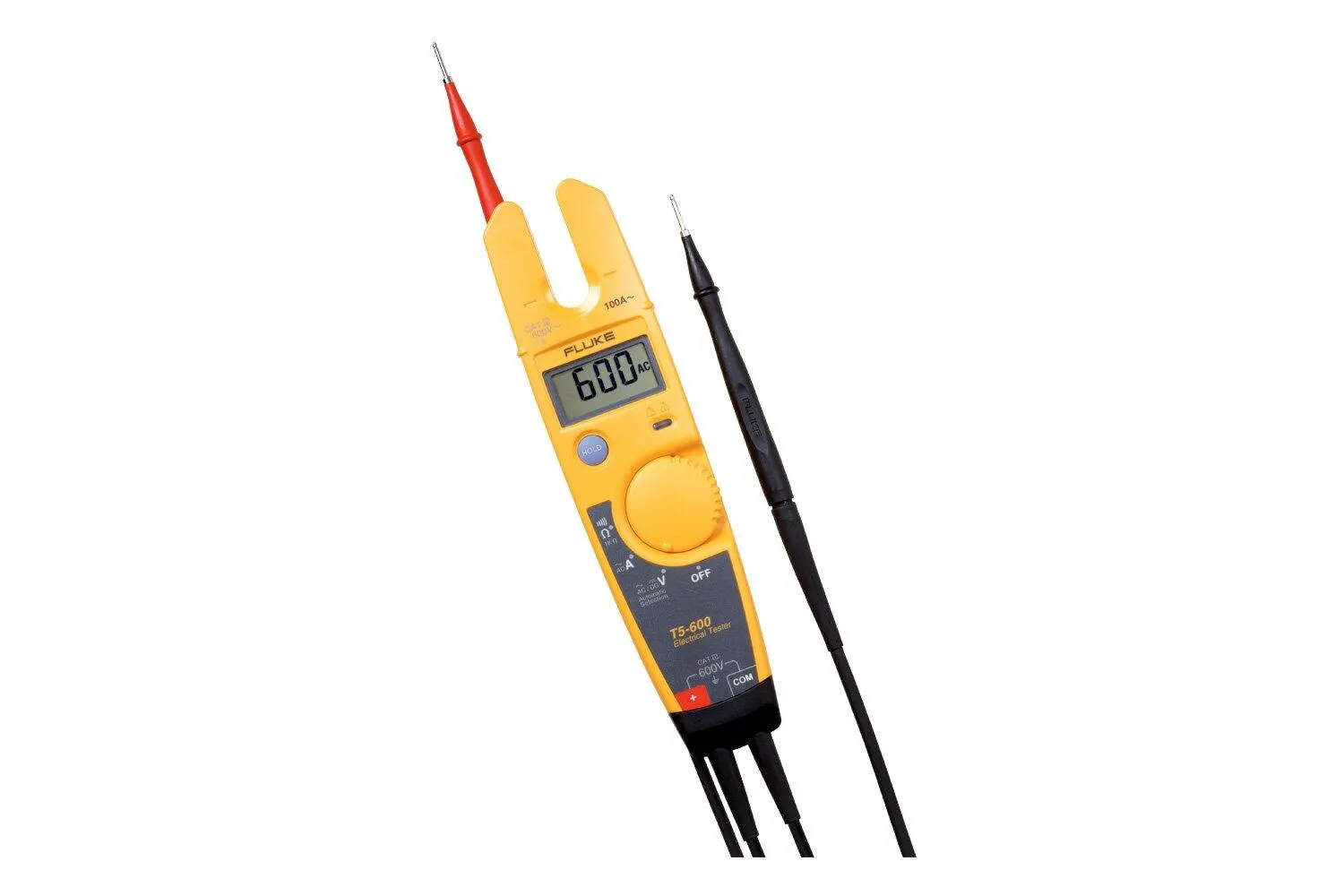
Fluke T5-600
4.4★★★★☆Not a multimeter but an electrician's tester: volts, continuity and up to 100A AC through an open jaw, no leads in the circuit.
Specs side by side
| Fluke 117 | Fluke T5-600 | |
|---|---|---|
| Rating | 4.8★★★★★ | 4.4★★★★☆ |
| Accuracy | True RMS | Average-responding (not True RMS) |
| Safety rating | CAT III 600V | CAT III 600V |
| Auto-ranging | Yes | Automatic AC/DC voltage selection |
| Best for | Electricians, serious hobbyists | Electricians' quick voltage and current checks |
| Instrument type | Digital multimeter | Electrical tester |
| Display | 6,000 counts + 33-segment bar graph | Digital LCD (count not stated) |
| Voltage | To 600V AC/DC, 0.1 V resolution on 600 V | To 600V AC/DC, 1 V resolution, auto AC/DC |
| Voltage accuracy | DC ±(0.5% + 2), AC ±(1.0% + 3) | DC ±(1% + 1), AC ±(1.5% + 2) |
| Current | 6A and 10A ranges, AC/DC, leads in series | To 100.0A AC, open jaw, ±(3% + 3) |
| Resistance | To 40 MΩ | To 1,000 Ω |
| Continuity | Beeps below 20 Ω | On below 25 Ω, off above 400 Ω |
| Capacitance | To 9,999 µF | No |
| Frequency | To 50 kHz | No |
| Ghost-voltage tools | LoZ mode and VoltAlert NCV | Neither listed |
| Battery | One 9V, 400 h typical | 2 × AA, 400 h alkaline |
| Size / weight | 167 × 84 × 46 mm, 550 g | 203 × 51 × 30.5 mm, 300 g |
| Warranty | 3 years | 2 years |
Specs checked against manufacturer documentation and official Amazon listings. Fluke 117 is hands-on tested by OhmSavvy; the Fluke T5-600 assessment is desk research. How we research.
Key differences
- →The 117 is True RMS; Fluke lists the T5-600's AC response as averaging.
- →The 117 has LoZ, AutoVolt and VoltAlert non-contact detection; the T5-600 has automatic AC/DC selection but no LoZ or NCV.
- →The T5-600 reads up to 100A AC through its open jaw without breaking the circuit; the 117 reads up to 10A with its leads in series, but on DC as well.
- →The 117 measures capacitance to 9,999 µF, frequency to 50 kHz and resistance to 40 MΩ; the T5-600 stops at 1,000 Ω and has neither of the others.
- →The 117 resolves 0.1 V on its 600 V range; the T5-600 shows whole volts.
- →The T5-600 is lighter at 300 g against 550 g and is rated for a 3 m drop.
Two ways to read current
This is the biggest practical difference. To read amps the 117 must become part of the circuit, so you switch off, open the circuit and connect the leads in series. The T5-600 slides its fork around a single live conductor and reads the AC current flowing through it.
The open jaw has two catches. It senses the magnetic field of the current, so it must surround one conductor, not a whole cord where the hot and neutral fields cancel. And Fluke caps it at a 12.9 mm opening, enough for conductors up to 1/0 THHN. A split-cord adapter or a single wire at a breaker or motor lead is the usual way in.
Fluke 117 vs T5-600 spec by spec
Range is the T5-600's strength; precision is the 117's. The tester reads ten times more current, but in 0.1 A steps with a ±(3% + 3) tolerance. The multimeter reads less, in 1 mA steps at ±(1.5% + 3), and its voltage display resolves a tenth of a volt where the T5-600 shows whole volts.
Bars use a logarithmic scale: each step is ten times the last.
The arithmetic behind the voltage chart: 1.0% of 120 V is 1.2 V, and 3 counts of 0.1 V add 0.3 V, so the 117 is good to ±1.5 V. On the T5-600, 1.5% of 120 V is 1.8 V and 2 counts of 1 V add 2 V, giving ±3.8 V. Either answers "is it live?" The 117 also answers "is it sagging?" Current works the same way: at a 20.0 A reading the T5-600 is within about ±0.9 A, which is fine for spotting an overloaded motor but not for fine comparisons. Battery life is a tie at 400 hours typical on Fluke's figures.
Which to reach for first on a service call
01
Is it live?
Either; 117 adds VoltAlert
02
Ghost voltage?
117 LoZ mode
03
Load current
T5-600 open jaw
04
Capacitor or frequency
117 only
On a motor that trips its overload, the T5-600 gets you a running-current number in seconds without touching the wiring. Checking the run capacitor, a control transformer's secondary or a DC sensor supply needs the 117. On remodel work, where abandoned runs share boxes with live ones, the 117's LoZ position stops phantom readings from passing as live circuits. The T5-600's strengths are speed and survival: probes stored in the back and a 3 m drop rating suit a tool that rides in a pouch all day.
Why True RMS matters on modern loads
Fluke 117 or T5-600: which should you buy?
| You are… | Better fit | Why |
|---|---|---|
| Electrician buying one tool | Fluke 117 | True RMS, LoZ, NCV, capacitance and DC current cover more jobs |
| Motor and pump service tech | Fluke T5-600 | Running current to 100 A without opening the circuit |
| HVAC technician | Both, or a clamp meter | 117 for capacitors and controls; T5-600 for compressor amps |
| Remodel or service electrician | Fluke 117 | LoZ sorts ghost voltage on shared and abandoned runs |
| Industrial maintenance on drives | Fluke 117 | Averaging AC response misreads distorted waveforms |
| Apprentice wanting a tough first tester | Fluke T5-600 | 3 m drop rating, simple controls, stored probes |
If you want the 117's measurements plus a jaw that reads more than 100 A, a clamp meter is the usual partner; our clamp meter buying guide and Fluke 117 vs Fluke 323 cover that route.
Safety: both stop at CAT III 600V
Choose the Fluke 117 if…
- ✓You work on variable-speed drives, LED lighting or electronic controls where True RMS matters
- ✓You want LoZ to rule out ghost voltages before you touch a conductor
- ✓You need capacitance, frequency, DC current or resistance above 1,000 Ω
Choose the Fluke T5-600 if…
- ✓You check motor and appliance current above 10A
- ✓You want current readings without breaking the circuit
- ✓You want a tester that stores its probes in the back and shrugs off falls
The bottom line
If you can own only one, the Fluke 117 is the more complete electrician's instrument: True RMS, LoZ, NCV and full multimeter functions with finer resolution. The T5-600 wins on current, up to 100A without opening the circuit, and on toughness, which is why it makes an excellent second tool beside a 117 rather than a replacement for it.
Frequently asked questions
Is the Fluke T5-600 True RMS?+
No. Fluke lists its AC response as averaging, calibrated to the RMS value of a sine wave. On resistive loads and clean mains that is accurate enough, but on drives, LED drivers and switch-mode supplies it can read noticeably off. The Fluke 117 is True RMS on both AC volts and AC amps.
Can the Fluke 117 measure 100 amps?+
No. Its current ranges stop at 10A continuous, with 20A allowed for 30 seconds, and the circuit has to be opened so the meter sits in series. For higher currents use a clamp meter or the T5-600's open jaw, which reads up to 100A AC around a single conductor.
Does the T5-600 have a low-impedance mode?+
Fluke doesn't list one, and it has no non-contact voltage sensor either; its automatic AC/DC selection is a convenience, not a LoZ input. The 117's AutoVolt position drops the input to about 3 kΩ, which is the feature to use when you suspect ghost voltage on a disconnected wire.
Can the Fluke T5-600 measure DC current?+
No. Its OpenJaw sensor reads AC current only, from 0.1 A resolution up to 100.0 A, and Fluke's FAQ confirms it can't measure DC amps. For DC current on battery, solar or automotive circuits, the 117 reads up to 10 A DC with its leads in series.
What warranty do the Fluke 117 and T5-600 carry?+
Fluke gives the 117 three years and the T5-600 two years. Both are sold by Fluke in the US. The T5-600 is also built for rough handling: Fluke says it withstands a 3 m (10 ft) drop, a figure Fluke doesn't publish for the 117.
Related


