COMPARISON · MULTIMETERS
Extech EX330 vs UNI-T UT139C
The Extech EX330 vs UNI-T UT139C choice comes down to size against accuracy on modern loads. Both are auto-ranging CAT III 600V meters with built-in non-contact voltage detection, temperature, frequency and duty cycle. The EX330 is smaller and lighter; the UT139C is True RMS, has a 6,000-count display, adds manual ranging and publishes its accuracy, while Extech states no True RMS for the EX330.
By the OhmSavvy Research Team ·
Disclosure: OhmSavvy earns a commission from qualifying Amazon purchases made through these links, at no extra cost to you. How we're funded.
Extech EX330
4.2★★★★☆A genuinely pocket-sized meter with a non-contact voltage detector built in.
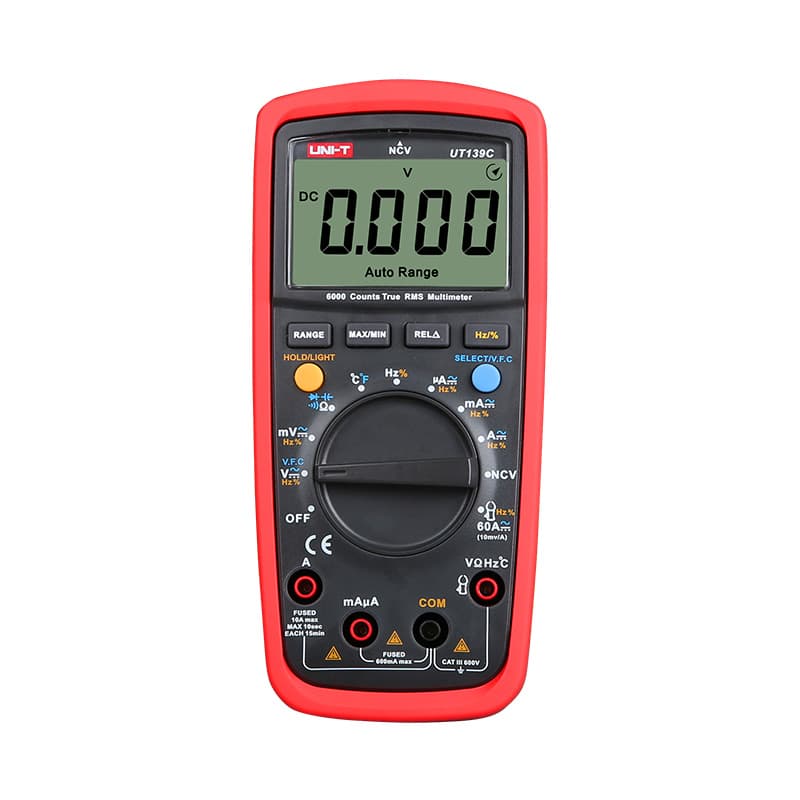
UNI-T UT139C
4.4★★★★☆True RMS and auto-ranging at a price that undercuts most of this list.
Specs side by side
| Extech EX330 | UNI-T UT139C | |
|---|---|---|
| Rating | 4.2★★★★☆ | 4.4★★★★☆ |
| Accuracy | Auto-ranging (True RMS not stated) | True RMS, 6,000-count |
| Safety rating | CAT III 600V | CAT III 600V |
| Auto-ranging | Yes | Yes |
| Best for | Quick checks, pocket carry | Budget-conscious buyers who still want True RMS |
| Display | 4,000 counts | 6,000 counts, backlit |
| Ranging | Auto | Auto and manual |
| DC volts accuracy | Not stated on Extech's page | ±(0.5% + 2) |
| AC volts accuracy | Not stated on Extech's page | ±(0.8% + 3), 45 Hz–1 kHz |
| Current | 0.1 µA to 10 A AC/DC | 10 A range AC/DC |
| Resistance | To 40 MΩ | To 60 MΩ |
| Capacitance | To 200 µF | To 99.99 mF |
| Frequency | To 10 MHz | 10 Hz to 10 MHz |
| Temperature | -20 to 750 °C (Type K) | -40 to 1000 °C (probe included) |
| NCV | 100 to 600 V AC | Yes |
| Other CAT rating | CAT II 1000V | None listed beyond CAT III 600V |
| Size / weight | 147 × 76 × 42 mm, 260 g | 170 × 80 × 48 mm, 354 g |
| Batteries | 2 × AAA | 2 × AA (R6) |
| Warranty | 2 years | Not stated |
Specs checked against manufacturer documentation and official Amazon listings. Desk research, not bench testing. How we research.
Key differences
- →UNI-T lists the UT139C as True RMS; Extech's EX330 page and datasheet make no True RMS claim, so expect it to misread distorted AC.
- →The UT139C has a 6,000-count display against the EX330's 4,000 counts, which keeps finer resolution between 4 and 6 on each range.
- →Only the UT139C offers manual ranging, plus MAX/MIN and relative modes.
- →The EX330 is 94 g lighter and smaller in every dimension, and its current input reaches down to 0.1 µA resolution.
- →UNI-T's capacitance range runs to 99.99 mF against Extech's 200 µF, enough for large motor-run and filter capacitors.
- →Both are CAT III 600V with built-in NCV; Extech adds a CAT II 1000V rating.
EX330 vs UT139C spec by spec
Both makers publish ranges, but only UNI-T publishes accuracy on its product page. The function lists are close: both read volts, amps, ohms, capacitance, frequency, duty cycle, temperature, continuity and diodes, and both have NCV. The differences are display resolution, the True RMS claim, range limits and size.
Bars use a logarithmic scale: each step is ten times the last.
What 2,000 extra counts mean in practice: on common range steps, a 4,000-count meter tops out at 3.999 V on its lowest volts range, so a 5 V USB rail pushes it to the next range with 10 mV steps. A 6,000-count meter keeps 5 V on its 6 V range with 1 mV steps. That is worked arithmetic on typical range steps rather than a published range table, but it is why 6,000 counts help on 5 V logic and 4.2 V lithium cells.
Why True RMS matters on dimmers and drives
A meter without True RMS usually rectifies the AC, takes the average and multiplies by about 1.11, the ratio between RMS and average for a pure sine. On a clean outlet that gives the right number. On a waveform that isn't a sine, the ratio changes and the reading drifts. For a square wave the true ratio is 1.0, so a sine-scaled meter reads roughly 11% high; on chopped or spiky waveforms it typically reads low.
UNI-T lists the UT139C as True RMS over 45 Hz to 1 kHz, so it computes the heating value of the waveform itself. Extech doesn't make that claim for the EX330, so on dimmers, LED drivers, variable-speed drives and the output of many inverters, treat its AC reading as approximate. For more True RMS options at a budget price, see our best budget True RMS multimeters.
What Extech doesn't publish
Extech EX330 vs UNI-T UT139C: which should you buy?
| You are… | Better fit | Why |
|---|---|---|
| Homeowner checking outlets and breakers | Either | Both are CAT III 600V with NCV; mains is a clean sine |
| Installing dimmers or LED lighting | UNI-T UT139C | True RMS reads phase-cut waveforms correctly |
| HVAC tech checking run capacitors | UNI-T UT139C | Capacitance far beyond 200 µF and higher temperature range |
| Electronics hobbyist on 5 V and 3.3 V boards | UNI-T UT139C | 6,000 counts keep 1 mV steps at 5 V |
| Measuring standby current on small gadgets | Extech EX330 | Current input resolves down to 0.1 µA |
| Wants a glovebox or jacket-pocket meter | Extech EX330 | Smaller and 94 g lighter |
| First and only meter | UNI-T UT139C | True RMS, manual ranging and published accuracy |
Both suit household work; our best multimeter for home use guide ranks them against other picks, and the multimeter buying guide explains counts, CAT ratings and True RMS in more depth.
Safety: NCV finds voltage, it doesn't prove a wire is dead
Choose the Extech EX330 if…
- ✓You want a meter small enough for a jacket pocket or glovebox: 147 × 76 × 42 mm, 260 g
- ✓You mostly check outlets, batteries and continuity, where True RMS rarely changes the answer
- ✓You want microamp resolution on the current input for small electronics
Choose the UNI-T UT139C if…
- ✓You measure AC on dimmers, LED drivers, motor drives or switching supplies
- ✓You want a 6,000-count display and the option to lock a range manually
- ✓You want published accuracy figures and MAX/MIN/REL modes in one budget meter
The bottom line
Unless pocket size is the deciding factor, the UNI-T UT139C gives you more measurement capability: True RMS, 6,000 counts, manual ranging and published accuracy, at a budget price. The Extech EX330 makes sense as an everyday-carry meter for quick checks on outlets, batteries and cars, or when you want microamp resolution in a small body.
Frequently asked questions
Is the Extech EX330 True RMS?+
Extech doesn't list it as True RMS. Its product page covers autoranging, NCV, Type K temperature, capacitance, frequency and duty cycle, with no True RMS claim and no accuracy table. Treat its readings on non-sinusoidal AC, such as dimmers and motor drives, with caution. The UNI-T UT139C is listed as True RMS.
Does the UNI-T UT139C have LoZ?+
No. UNI-T lists a low-impedance AC voltage function for the UT139E and UT139S in the same series, not the UT139C. Without LoZ, a disconnected wire running beside a live one can show a phantom voltage, so confirm suspect readings with a known load or a meter that has a LoZ mode.
What batteries do the EX330 and UT139C use?+
Extech lists two AAA batteries for the EX330. UNI-T lists two 1.5 V R6 cells, the IEC name for AA, for the UT139C. AA cells hold more energy than AAA, which partly explains the UT139C's larger body. Neither maker publishes a battery-life figure on the pages we checked.
Can either meter test a motor-run capacitor?+
Both can on small capacitors. Typical motor-run capacitors fall in the single to double-digit microfarad range, inside both meters' limits. The difference shows on large start or filter capacitors: Extech's range stops at 200 µF, while UNI-T's reaches 99.99 mF. Always discharge a capacitor safely before measuring it.
Which is better for automotive work, the EX330 or the UT139C?+
Both read battery voltage, continuity, duty cycle and frequency, which covers most basic car checks. The UT139C's 6,000 counts give finer resolution on a 12.6 V battery reading, and its MAX/MIN mode helps catch cranking voltage dips. The EX330's small size suits a glovebox. Neither has RPM or dwell modes.
Related



