COMPARISON · MULTIMETERS
Fluke 117 vs Klein Tools MM400
Fluke 117 vs Klein Tools MM400 is not a match of equals. Both are CAT III 600V, auto-ranging meters for residential and light commercial electrical work, but the Fluke 117 is True RMS, has a 6,000-count display, a low-impedance AutoVolt mode and built-in VoltAlert NCV. The Klein MM400 is not True RMS, uses a 4,000-count display and answers with temperature and a lighter body. Klein has also discontinued the MM400, and Amazon now sells it only through third-party offers.
By the OhmSavvy Research Team ·
Disclosure: OhmSavvy earns a commission from qualifying Amazon purchases made through these links, at no extra cost to you. How we're funded.

Fluke 117
4.8★★★★★The meter working electricians actually buy with their own money, not just the one brands push.
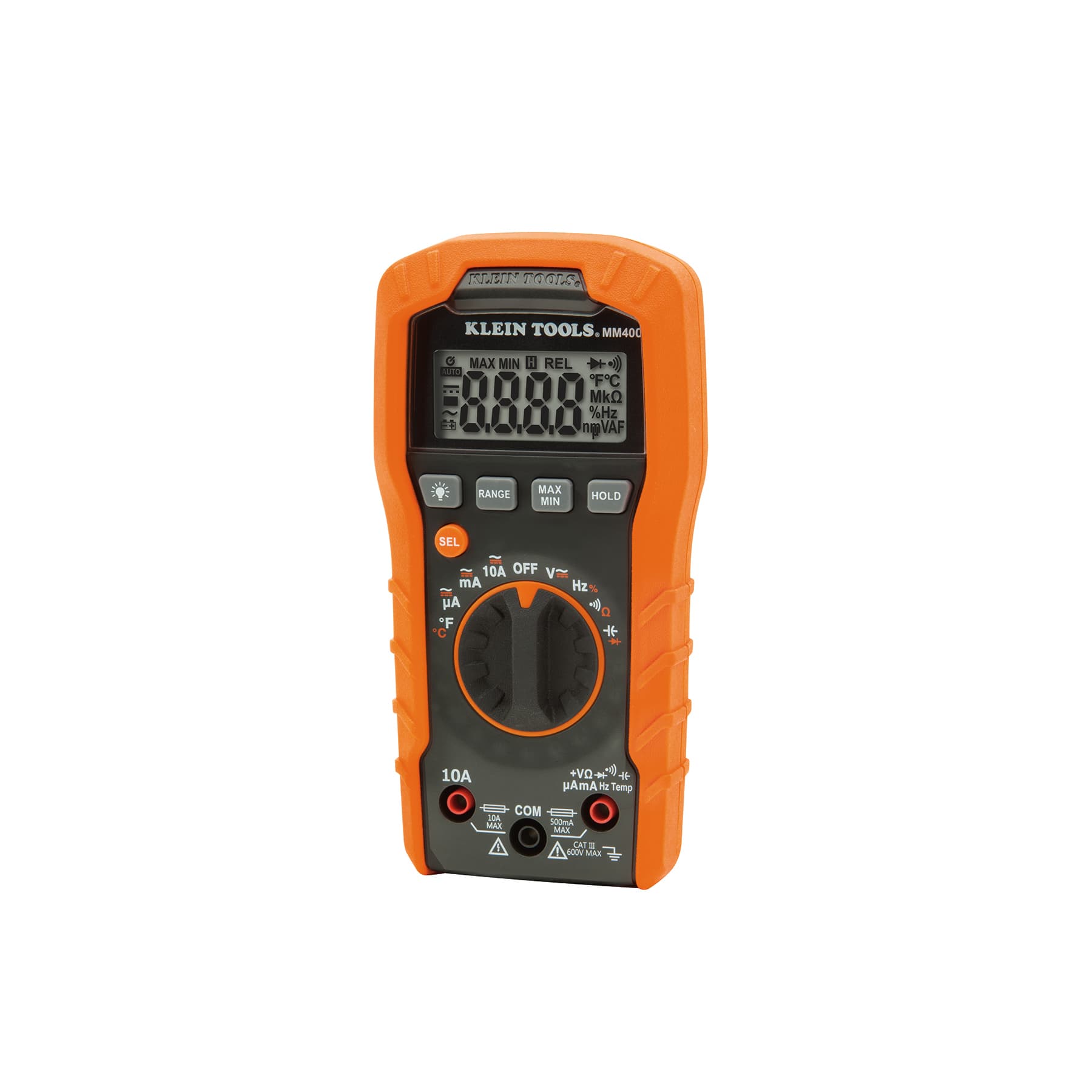
Klein Tools MM400
4.4★★★★☆A solid auto-ranging CAT III meter with temperature and capacitance, but not True RMS, and Klein has now discontinued it.
Specs side by side
| Fluke 117 | Klein Tools MM400 | |
|---|---|---|
| Rating | 4.8★★★★★ | 4.4★★★★☆ |
| Accuracy | True RMS | Auto-ranging (not True RMS) |
| Safety rating | CAT III 600V | CAT III 600V |
| Auto-ranging | Yes | Yes |
| Best for | Electricians, serious hobbyists | Tradespeople, home electrical work |
| Display | 6,000 counts + 33-segment bar graph | 4,000 counts |
| Low-impedance (LoZ) mode | Yes, AutoVolt, about 3 kΩ | No |
| Non-contact voltage | Yes, VoltAlert | No |
| Current | 6A and 10A AC/DC | 10A AC/DC, plus a fused 500 mA input |
| Capacitance | 1 nF to 9,999 µF | Up to 200 µF |
| Frequency | To 50 kHz | 1 Hz to 50 kHz, plus duty cycle |
| Temperature | No (Fluke 116 only, per datasheet) | 0 to 1000°F (-18 to 538°C), thermocouple included |
| Size / weight | 167 × 84 × 46 mm, 550 g | 152 × 80 × 45 mm, 232 g |
| Battery | One 9V, 400 h typical | 2 × AAA |
| Status | Current model; 3-year warranty | Discontinued by Klein (MM420 replaces it) |
Specs checked against manufacturer documentation and official Amazon listings. Fluke 117 is hands-on tested by OhmSavvy; the Klein Tools MM400 assessment is desk research. How we research.
Key differences
- →The Fluke 117 is True RMS; Klein's feature chart shows the MM400 is not, so its AC readings drift on distorted waveforms.
- →Only the Fluke has a low-impedance AutoVolt input and VoltAlert non-contact detection.
- →The Fluke's 6,000-count display and bar graph resolve finer steps than the MM400's 4,000 counts.
- →The MM400 measures temperature with an included thermocouple and adds duty cycle; Fluke's datasheet gives temperature to the 116, not the 117.
- →The MM400 weighs 232 g against the Fluke's 550 g.
- →Klein lists the MM400 as no longer in production, replaced by the MM420, and Amazon sells it only through third-party offers.
Fluke 117 vs MM400 spec by spec
On ranges alone the two look close: both read 600V AC and DC, 10A, 40 MΩ and frequency to 50 kHz. The gaps are in how they read AC, what else they detect, and capacitance. The charts below use only the figures Fluke and Klein publish.
Bars use a logarithmic scale: each step is ten times the last.
The capacitance gap matters for power supply filter and motor-start capacitors, which can exceed 200 µF. Most HVAC run capacitors are much smaller and fit either meter. The weight gap is real too: the 117 runs from a 9V battery in a larger case, the MM400 from two AAA cells.
Why LoZ changes the reading on dead wires
A disconnected conductor that runs beside a live one is joined to it by a little stray capacitance. That capacitance and the meter's input form a voltage divider. A high-impedance input takes most of the voltage and shows a believable number; a low-impedance input takes almost none. Klein doesn't state the MM400's input impedance, so the example below assumes a typical 10 MΩ.
The arithmetic, as an illustration rather than a measurement: 500 pF at 60 Hz has a reactance of 1 ÷ (2π × 60 × 500 pF) ≈ 5.3 MΩ. Across a 10 MΩ input, 120V × 10 ÷ √(10² + 5.3²) ≈ 106V. Across the 117's roughly 3 kΩ AutoVolt input, 120V × 0.003 ÷ 5.3 ≈ 0.07V. Real coupling depends on run length and spacing.
With an MM400 you can still unmask a phantom reading by adding a load across the leads, a method our guide to measuring voltage on a floating circuit covers. The 117 does it at the turn of the dial. For more on the 117's three electrician features, see Fluke 115 vs Fluke 117.
Discontinued doesn't mean unsafe, but check the offer
Fluke 117 vs Klein MM400: which should you buy?
| You are… | Better fit | Why |
|---|---|---|
| Residential or commercial electrician | Fluke 117 | LoZ, NCV and True RMS on the same CAT III 600V rating |
| Homeowner replacing switches and outlets | Fluke 117 | VoltAlert and LoZ cut the two most common misreads |
| HVAC tech who needs temperature | Klein MM400, or Fluke 116 | The 117 has no temperature input |
| Working on dimmers, LED drivers or VFDs | Fluke 117 | True RMS reads distorted AC correctly |
| Bargain hunter with a clean sealed offer | Klein MM400 | Capable on sine-wave mains if the price is right |
| Wants a light toolbag meter | Klein MM400 | 232 g against 550 g |
For more options by trade, see our best multimeter for electricians and best multimeter for home use guides.
Safety: a low reading on LoZ is not permission to touch
Choose the Fluke 117 if…
- ✓You work on building wiring, where LoZ separates ghost voltage from a live feed
- ✓You want non-contact voltage detection built into the meter for a fast first check
- ✓You measure dimmers, LED drivers or motor drives, where True RMS keeps AC readings honest
Choose the Klein Tools MM400 if…
- ✓You find one at a clear discount and mostly measure ordinary sine-wave mains
- ✓You want temperature from an included thermocouple in the same meter
- ✓You want a lighter meter: 232 g against the Fluke's 550 g
The bottom line
The Fluke 117 is the better electrician's meter: True RMS, a 6,000-count display, a LoZ mode and NCV on the same CAT III 600V rating, and it carries our Hands-on Tested badge. The Klein MM400 is a capable but discontinued general-purpose meter; buy it only from a reputable seller at a clear discount, or if temperature readings matter more to you than True RMS and LoZ.
Frequently asked questions
Do the Fluke 117 and Klein MM400 have the same safety rating?+
Yes. Both are rated CAT III 600V, the category for distribution panels, feeders and fixed building wiring. Neither carries a CAT IV rating, so neither should be used at the service drop, meter base or outdoor feeders. For that work, look at a CAT IV 600V meter such as the Fluke 87V or Fluke 179.
Is the Klein MM400 True RMS?+
No. Klein's multimeter feature chart lists True RMS and low impedance for its higher models, not the MM400. On a clean sine wave, such as a standard outlet, its AC readings are fine. On dimmers, LED drivers and variable-speed drives the reading drifts, which is where the Fluke 117's True RMS input earns its keep.
What replaced the Klein MM400?+
Klein lists the MM420 as the newer model that replaces the MM400, which it describes as no longer in production. If you like Klein's layout but want a current model, start there and check its spec sheet for True RMS and LoZ before buying, since features vary across Klein's range.
Can the Fluke 117 measure temperature?+
No. Fluke's 110 Series datasheet gives the thermocouple input to the Fluke 116, not the 117. If you need temperature in a Fluke of this size, the 116 is the HVAC model; if you need temperature with CAT IV, the Fluke 179 reads it with its supplied probe. The MM400 includes a thermocouple.
Is the Fluke 117 worth it for a homeowner?+
It can be, if you do your own electrical work. VoltAlert gives a quick first check on outlets and cords, and LoZ stops ghost voltage on old or shared wiring from fooling you. If you only check batteries and fuses a few times a year, a cheaper True RMS meter will do, and our home-use guide lists several.
Related


