COMPARISON · MULTIMETERS
Fluke 117 vs Fluke 15B+
Fluke 117 vs Fluke 15B+ is the gap between Fluke's specialist and its basic meter. The 15B+ keeps things simple: volts, amps from µA to 10A, ohms, capacitance, diode and continuity on a 4,000-count display, with only HOLD and RANGE buttons. The 117 adds True RMS, VoltAlert non-contact detection, AutoVolt, a low-impedance mode, frequency and Min/Max/Average on a 6,000-count display.
By the OhmSavvy Research Team ·
Disclosure: OhmSavvy earns a commission from qualifying Amazon purchases made through these links, at no extra cost to you. How we're funded.

Fluke 117
4.8★★★★★The meter working electricians actually buy with their own money, not just the one brands push.
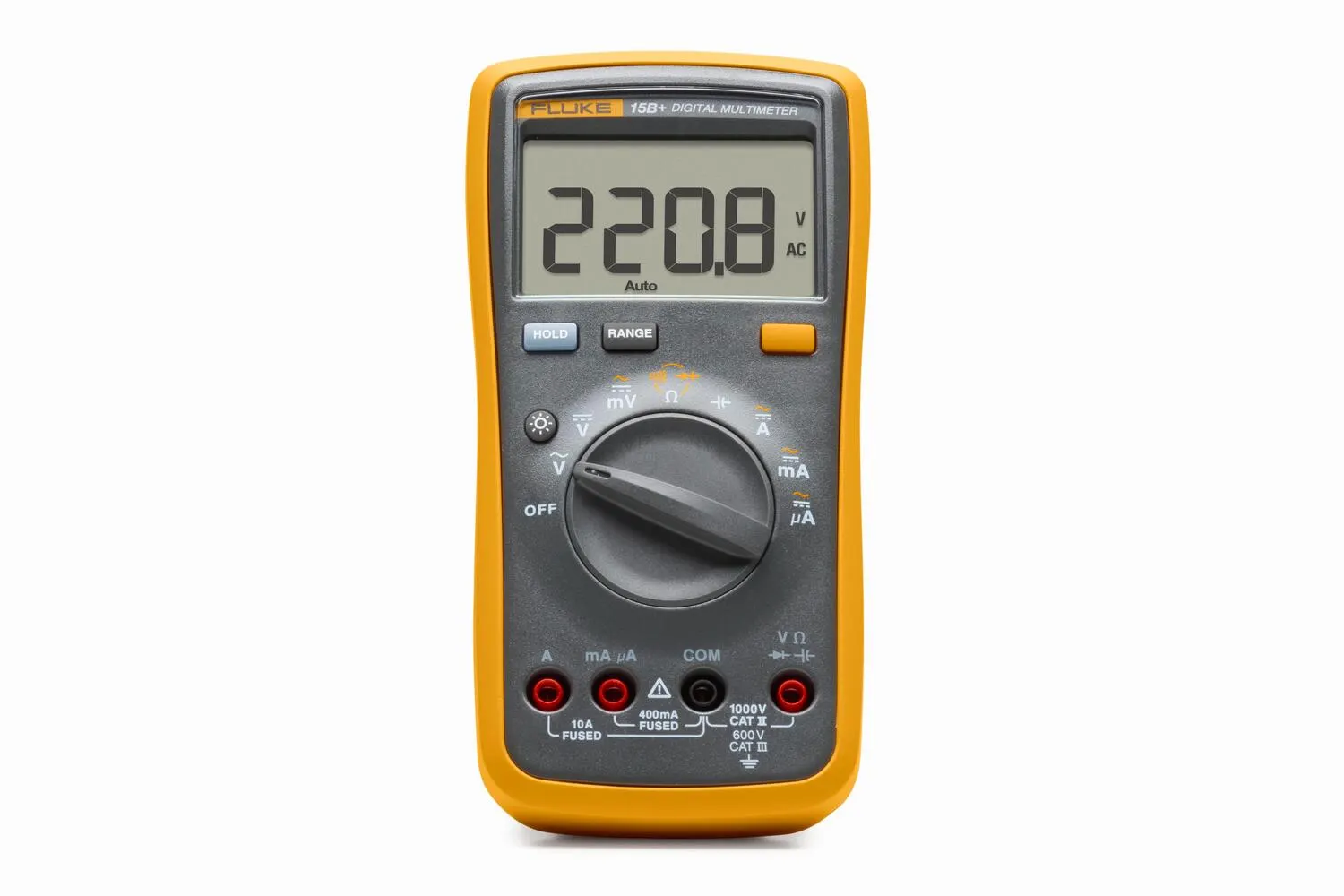
Fluke 15B+
4.3★★★★☆The 17B+ body and safety rating without frequency, temperature or MIN MAX: a plain, tough Fluke for volts, amps and ohms.
Specs side by side
| Fluke 117 | Fluke 15B+ | |
|---|---|---|
| Rating | 4.8★★★★★ | 4.3★★★★☆ |
| Accuracy | True RMS | Not stated as True RMS by Fluke |
| Safety rating | CAT III 600V | CAT III 600V / CAT II 1000V |
| Auto-ranging | Yes | Yes (manual override) |
| Best for | Electricians, serious hobbyists | Basic electrical and electronics checks |
| Display | 6,000 counts + 33-segment bar graph | 4,000 counts, backlit |
| Max voltage | 600V AC/DC | 1000V AC/DC |
| Safety rating detail | CAT III 600V | CAT III 600V and CAT II 1000V |
| Current ranges | 6A and 10A AC/DC | µA, mA and 10A AC/DC |
| Capacitance | Up to 9,999 µF | Up to 1,000 µF |
| Frequency | Up to 50 kHz | No |
| Min/Max recording | Min/Max/Average | No (Data Hold only) |
| NCV / AutoVolt / LoZ | Yes / Yes / Yes | None listed |
| Weight | 550 g | 455 g |
| Battery | One 9V, about 400 hours | 2 × AA, 500 hours minimum |
| Warranty | 3 years | 1 year (users manual) |
Specs checked against manufacturer documentation and official Amazon listings. Fluke 117 is hands-on tested by OhmSavvy; the Fluke 15B+ assessment is desk research. How we research.
Key differences
- →The 117 is True RMS; Fluke doesn't describe the 15B+ as True RMS.
- →The 117 adds VoltAlert non-contact detection, AutoVolt and a low-impedance mode; the 15B+ has none of them.
- →The 117 reads frequency to 50 kHz and records Min/Max/Average; the 15B+ has neither, only Data Hold.
- →The 15B+ has µA and mA current ranges and a 1000V voltage range; the 117 starts at a 6A range and tops out at 600V.
- →The 117's 6,000-count display and bar graph read finer than the 15B+'s 4,000 counts.
Fluke 117 vs 15B+ spec by spec
Put the two accuracy tables side by side and the basic measuring quality is close: both quote ±0.5% on DC volts and ±1.0% on AC volts, and the 15B+ is actually tighter on paper for mid-range resistance. What separates them is how each meter handles real-world signals and which ranges exist at all.
| Spec | Fluke 117 | Fluke 15B+ |
|---|---|---|
| AC response | True RMS | Not stated as True RMS |
| DC volts accuracy | ±(0.5% + 2) | ±(0.5% + 3) |
| AC volts accuracy | ±(1.0% + 3), 45 to 500 Hz | ±(1.0% + 3), 40 to 500 Hz |
| Volts input | >10 MΩ DC, >5 MΩ AC; about 3 kΩ on AutoVolt | >10 MΩ |
| Lowest current range | 6.000 A (1 mA steps) | 400.0 µA (0.1 µA steps) |
| Highest current | 10 A; 20 A for 30 s | 10.00 A |
| Resistance | 600.0 Ω to 40.00 MΩ, ±(0.9% + 1) | 400.0 Ω to 40.00 MΩ, ±(0.5% + 2) mid ranges |
| Capacitance accuracy | ±(1.9% + 2) | ±(2% + 5) to ±(5% + 5) |
| Frequency | To 50 kHz | No |
| Size | 167 × 84 × 46 mm | 183 × 91 × 49.5 mm |
Bars use a logarithmic scale: each step is ten times the last.
Bars use a logarithmic scale: each step is ten times the last.
The current ranges point in opposite directions
Both meters stop at 10 A, but they start in very different places. The 117 has no milliamp or microamp input: its smallest range is 6.000 A, so the best it can show is a step of 1 mA. The 15B+ has a separate fused mA/µA jack with a 400.0 µA range, where each step is 0.1 µA. That is a 10,000-fold difference in how small a current each can see.
The example loads show why it matters. A 100 W lamp at 120 V draws 100 ÷ 120 ≈ 0.83 A, easy for either meter. A 4–20 mA process loop is readable on the 117 only to the nearest milliamp, which is too coarse to tell 12.0 mA from 12.4 mA; the 15B+ shows it to 0.01 mA. A furnace flame sensor current of a few microamps is invisible to the 117 and well inside the 15B+'s 400 µA range. For the technique, see our guides to measuring milliamps and measuring microamps.
Choosing in three questions
01
Live wiring?
Need NCV or LoZ: 117
02
Electronic loads?
Need True RMS: 117
03
Signals?
Need frequency: 117
04
None of these
15B+ covers it
Where the 15B+ wins
Which should you buy?
| You are… | Better fit | Why |
|---|---|---|
| Residential or commercial electrician | Fluke 117 | VoltAlert, AutoVolt and LoZ for building wiring |
| Technician on drives, dimmers or LED lighting | Fluke 117 | True RMS reads distorted waveforms correctly |
| Electronics hobbyist or student | Fluke 15B+ | µA and mA ranges for LEDs, microcontrollers and sensors |
| Instrument tech checking 4–20 mA loops | Fluke 15B+ | 0.01 mA steps on the 40 mA range |
| Logging a sagging supply over time | Fluke 117 | Min/Max/Average; the 15B+ has Data Hold only |
| Equipment work between 600 V and 1000 V | Fluke 15B+ | Ranges to 1000 V with a CAT II 1000V rating |
The 117 is the meter Fluke built for electricians, and its three extras matter only on live building wiring; the Fluke 115 vs Fluke 117 comparison explains them in depth, and the Fluke 117 review covers the meter as a whole. If you like the 15B+ but want frequency and temperature too, the Fluke 17B+ is the same body with those functions added.
Safety: the 1000 V range isn't a CAT IV rating
Choose the Fluke 117 if…
- ✓You test live building wiring and want NCV, AutoVolt and LoZ
- ✓You need True RMS for drives, dimmers and LED drivers
- ✓You want frequency readings and Min/Max/Average recording
Choose the Fluke 15B+ if…
- ✓You want a straightforward Fluke for voltage, current, resistance and continuity
- ✓You need µA and mA ranges for electronics or sensor loops
- ✓You prefer a meter with almost nothing to learn
The bottom line
The Fluke 117 is the right buy for electricians and anyone measuring modern electronic loads: True RMS, NCV, AutoVolt and LoZ. The Fluke 15B+ suits students, hobbyists and technicians who want a simple, durable Fluke with µA and mA ranges and don't need those extras.
Frequently asked questions
Is the Fluke 15B+ True RMS?+
Fluke makes no True RMS claim for the 15B+, so treat it as average-responding. That is fine on clean mains voltage, resistive heaters and batteries. The 117 is True RMS, which matters on variable-speed drives, dimmers and LED drivers, where an average-responding meter can misread distorted AC by a wide margin.
Can the Fluke 15B+ measure frequency?+
No. Fluke's datasheet lists frequency and duty cycle as not available on the 15B+; they are 17B+ features, along with temperature and MIN MAX. The 117 reads frequency up to 50 kHz, enough for generator output, motor drive settings and most control signals you'll meet in electrical work.
Which is better for measuring small currents?+
The 15B+. It has a fused mA/µA input with ranges down to 400.0 µA at 0.1 µA resolution, covering sensor loops, LED current and microcontroller draw. The 117's lowest current range is 6.000 A with a best resolution of 1 mA, so it can't resolve flame-sensor or standby currents at all.
Do the Fluke 117 and 15B+ share a safety rating?+
Both are CAT III 600V, which covers outlets, branch circuits and distribution panels. The 15B+ also carries a CAT II 1000V rating and measures up to 1000V, useful on some appliance and equipment circuits. The 117 measures up to 600V. Neither is rated CAT IV for service-entrance work.
What is the difference between the 15B+ and 17B+?+
They share the same body, display and safety rating, but the 17B+ adds frequency, duty cycle, temperature, MIN MAX and relative mode. If you like the 15B+'s µA and mA ranges but also want signal and temperature readings, the 17B+ is the step up. See our 17B+ vs 15B+ comparison for details.
Related


