HOW-TO GUIDE
How to Test a Car Blower Motor Resistor With a Multimeter
By the OhmSavvy Research Team ·
Before you start
- Turn the ignition off before unplugging the resistor. Resistance readings are only valid with the part disconnected from power.
- The resistor pack can be hot enough to burn if the fan has just been running: it turns tens of watts into heat. Let it cool for several minutes.
- The pack usually sits in the air duct near the blower, often behind the glovebox. The passenger airbag and its wiring are nearby on many cars; leave yellow SRS connectors alone, and if the job means removing dash parts near the airbag, have a mechanic do it.
- A melted or scorched connector is a fire risk. Do not keep running the fan with a damaged plug; repair it first.
Symptoms and causes
The pattern of which fan speeds still work tells you most of what you need before you pick up the meter. Match your symptom to a row, then follow the numbered steps below.
| Symptom | Likely cause | How to check | Fix or who to call |
|---|---|---|---|
| Only high speed works | Open thermal fuse or resistor chain | Ohms from common to each speed terminal | Replace the resistor pack |
| One or two speeds missing | One resistor coil open, or a burnt switch contact | Ohms on each step; continuity through the switch | Replace the pack or the switch |
| No speeds work, including high | Blower fuse, relay, motor or ground | DC volts at the motor connector on high | Replace the fuse or relay; check the motor |
| New pack fails again within months | Motor drawing excess current | Motor current on high against the manual | Replace the blower motor too |
| Connector melted or brown | High-resistance terminal heating up | Visual check; voltage drop across the plug | Repair the connector with a new pigtail |
| Fan speed varies by itself (auto climate) | Electronic blower module or its control signal | Power, ground and control signal live | Service manual procedure or a mechanic |
Why the fan only works on high
In a resistor-controlled blower circuit, fan speed is set by adding resistance in series with the motor. The lowest speed routes current through the most resistance, so the motor gets the least voltage and spins slowest. Each higher setting bypasses part of the resistor chain. The top setting usually bypasses it entirely, often through a separate high-speed relay.
Because every resistor step sits in one series chain, a single open point anywhere in that chain, most often the thermal fuse, kills every speed that relies on it. The top speed keeps working because it never passes through the pack, which is why "only high works" points so strongly at the resistor.
The numbers inside the pack
The pack works as a voltage divider with the motor. Whatever voltage the resistor drops, the motor doesn't get, and the resistor turns that share of the power into heat. The worked example below uses illustrative values for a three-step pack on a 13.5 V running supply; real packs and motors differ, and a motor is not a fixed resistor, so treat it as a sketch of the principle rather than a specification.
| Speed | Pack resistance in circuit | Current (illustrative) | Volts lost in pack (I × R) | Heat in pack (V × I) |
|---|---|---|---|---|
| Low | 2.1 Ω | 4 A | 4 × 2.1 = 8.4 V | 8.4 × 4 ≈ 34 W |
| Med 1 | 0.9 Ω | 6 A | 6 × 0.9 = 5.4 V | 5.4 × 6 ≈ 32 W |
| Med 2 | 0.3 Ω | 9 A | 9 × 0.3 = 2.7 V | 2.7 × 9 ≈ 24 W |
| High | Bypassed | Full motor current | 0 V | 0 W |
Subtracting each drop from 13.5 V gives the voltage left for the motor, which is what sets its speed. Thirty-odd watts is about the heat of a small soldering iron, concentrated in a part the size of a matchbox, which is why the pack sits in the airflow and why it carries a thermal fuse. It also explains the low-speed failures: the lowest setting runs the pack hottest for the longest.
Types of blower resistor pack
Wire-wound coil pack
Coils of resistance wire on a ceramic or metal frame, sitting in the airflow to cool. A thermal fuse or link is often wired into the chain.
Board or ceramic pack
Resistor elements printed or mounted on a board, with a small thermal fuse soldered on. Compact, and the same series-chain idea.
Electronic module
A power transistor on a heat sink, driven by the climate control. Gives stepless speed and cannot be checked with ohms alone.
1Remove the pack and inspect the connector
Unplug the harness and remove the pack, usually held by two screws in the side of the blower housing. Before reaching for the meter, look closely at the connector on both halves. Browned, melted or distorted plastic, or terminals that are green or loose, are a common companion fault: a poor contact heats up under blower current and can damage a new pack. If the connector is cooked, it needs repairing along with the resistor. Look too for a broken coil, a cracked board or a visibly opened thermal fuse.
The heat at a bad terminal follows the same arithmetic as the pack. A contact that has worn to just 0.05 Ω, carrying an illustrative 12 A on high, dissipates 12² × 0.05 = 7.2 W inside a plastic housing built for a fraction of a watt. That is enough to soften the plastic, loosen the terminal further and repeat the cycle, which is why replacing the pigtail matters as much as replacing the pack.
2Measure the resistance between terminals
Set the meter to its lowest ohms range and touch the leads together to note their own resistance; on readings this small, a few tenths of an ohm of lead resistance is a large share of the result. Identify the common terminal, the one that feeds the motor, from the wiring diagram or by finding the terminal that has continuity to all the others. Then measure from that common terminal to each speed terminal in turn.
Every reading should be low and finite, typically from a fraction of an ohm to a few ohms, and should step up as you move toward the lowest speed terminal, because that path passes through more of the chain. The exact values depend on the vehicle and are listed in the service manual; what matters most is that no step reads open and that the steps rise in order.
| Reading | What it means |
|---|---|
| Low, finite and rising toward low speed | Resistor chain intact |
| OL on every step | Thermal fuse or common path open |
| OL on some steps only | One coil or element open |
| Two steps read the same | Possible short between elements |
3Check the thermal fuse
Where you can reach the thermal fuse's two legs, measure straight across it: it should read near zero ohms or beep for continuity. An open thermal fuse shows OL, the meter's over-limit display explained in our guide to what OL means. The test is the same as for any standalone thermal fuse.
Ask why the fuse opened
4Check the blower motor and speed switch
If the resistor reads correctly but speeds are still missing, check the other parts of the circuit. With the pack plugged in and the fan set to each speed, back-probe the motor connector on DC volts: the voltage should rise with each setting, much like the chart above. If no speed works at all, including high, the problem is more likely the blower fuse, the high-speed relay, the motor or its ground. With high selected and battery voltage at the motor but no rotation, check the ground side, then the motor itself; a motor winding check rules out a shorted armature.
To check the motor's current draw, compare it with the figure in the service manual. Most blower motors draw more than a meter's 10 A input should carry for long, so measure it with a DC clamp meter, or estimate it from the voltage drop across the blower fuse. Our guide on measuring current without breaking the circuit explains both methods.
The fan speed selector on many older cars is a rotary switch. With it unplugged, each position should show continuity from its input to the matching output terminal; our guide to testing a rotary switch covers the method. A switch with burnt contacts can lose individual speeds just like a failed resistor.
01
Which speeds work?
High only points to the pack
02
Connector
Melted or loose terminals
03
Pack ohms
Each step finite and rising
04
Motor
Volts per speed, current on high
05
Switch
Continuity in each position
5Diagnose an electronic blower module
Many cars with automatic climate control use an electronic blower module instead of a resistor pack. It contains a power transistor that varies motor speed smoothly in response to a control signal. A resistance test across its terminals gives no meaningful pass or fail, because the module only works when powered and driven. Diagnosis means checking its power feed, ground and control signal with the circuit live, following the service manual's procedure for that vehicle. If the control signal comes from a climate module that needs a scan tool to command, that is a job for a mechanic or an auto electrician.
Meters for this job
Any meter with a low ohms range handles the pack itself. The harder reading is the blower motor's current, which is where these picks from our verified list differ.
Meters for resistor packs and blower current
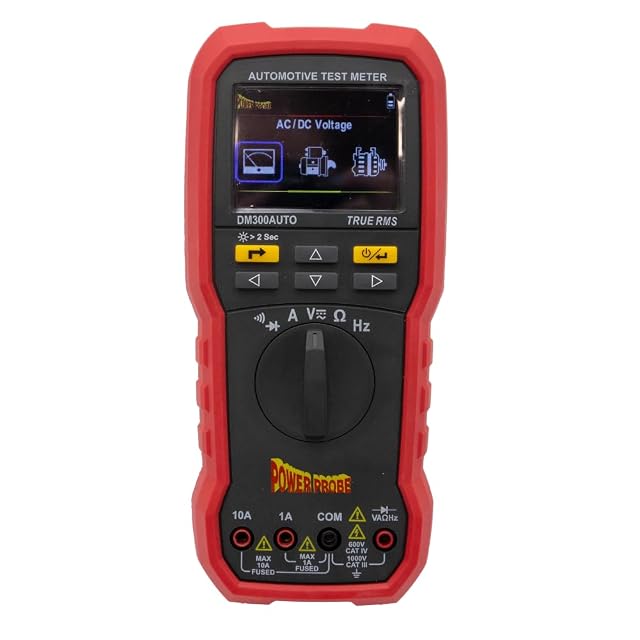
Fuse-current mode estimates current through MINI, ATC and MAXI fuses up to 80 A from the voltage drop, without pulling the fuse.

Rated 10 A continuous and 20 A for 30 seconds, with Min/Max/Average recording. Average-responding, not True RMS.
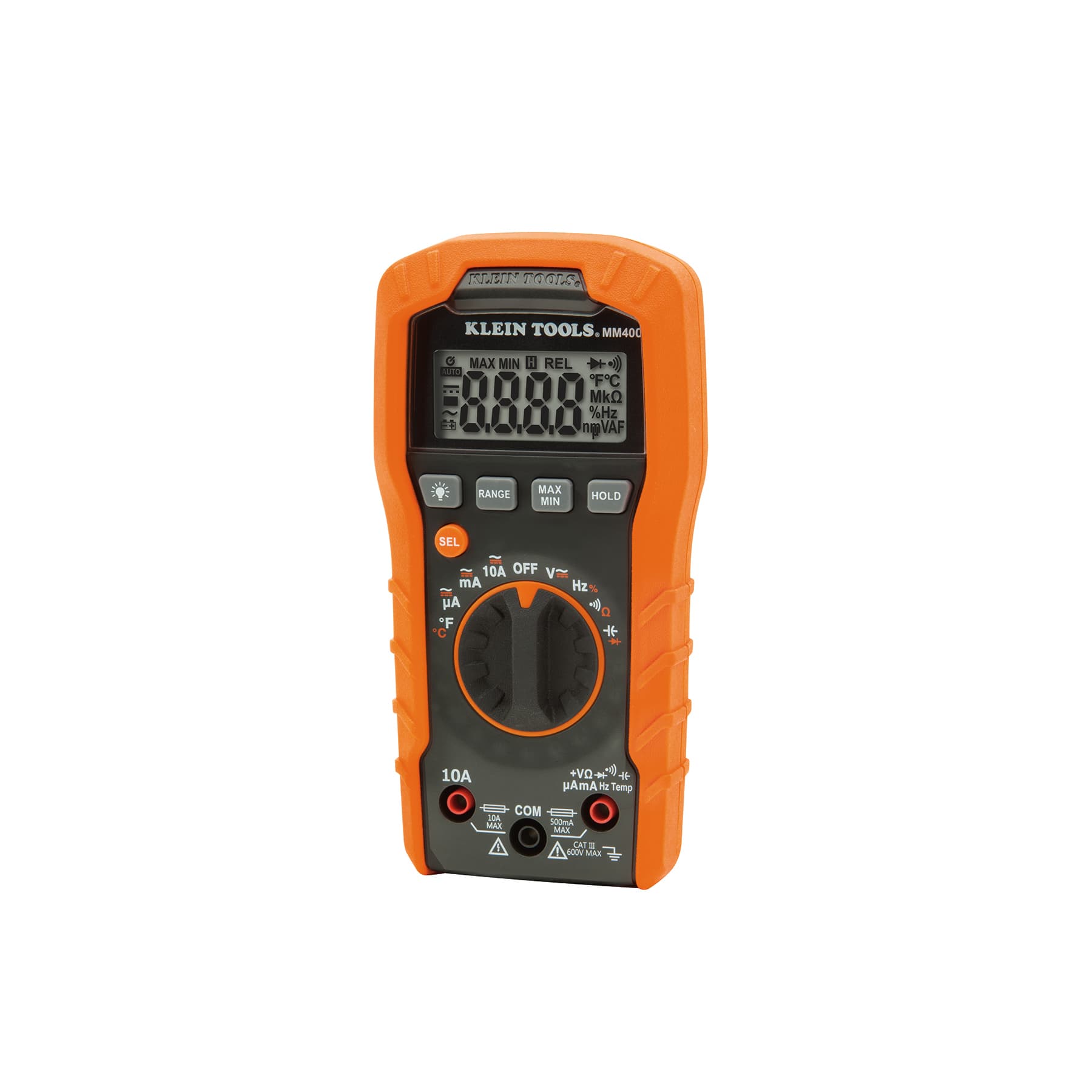
Auto-ranging CAT III 600V meter with min/max, range hold and a backlight. Not True RMS, and discontinued by Klein.
As an Amazon Associate I earn from qualifying purchases. Prices and availability are shown on Amazon.
Frequently asked questions
Why does my car heater fan only work on the highest setting?
On most cars with a resistor-type blower circuit, the top speed sends current straight to the motor through a relay or switch contact and skips the resistor pack. Every lower speed passes through the pack. So when the pack's thermal fuse or a resistor coil opens, the lower speeds stop and only the top speed is left, which makes the resistor the first suspect.
What resistance should a blower motor resistor read?
Low values, usually somewhere from a fraction of an ohm up to a few ohms per step, rising as you measure toward the lowest fan speed because that path passes through more of the chain. The exact values vary by vehicle and are in the service manual. OL on any step means that path is open, and two steps reading identical can mean a shorted element.
Can I replace just the thermal fuse on the resistor pack?
On most packs the thermal fuse is built into the assembly and not sold separately, so the pack is replaced as a unit. More importantly, the fuse usually opens because something made the resistor run hot, such as a blower motor drawing too much current or a blocked cabin air filter, so find that cause before fitting a new pack.
Why does my new blower motor resistor keep failing?
Repeated failures usually mean the blower motor is drawing more current than it should because its bearings are worn or its brushes are tired, or the pack is not getting enough airflow to cool it. A melted connector can also overheat a new pack. Check the motor's current draw against the manual and inspect the connector before fitting another one.
Can a bad blower motor resistor drain the battery?
It is unusual. The blower circuit is normally fed only with the ignition on, so a failed resistor stops the fan rather than draining the battery. If the fan keeps running with the key out, suspect a stuck blower relay or a module fault instead, and measure the parked current draw to confirm before replacing parts.
Is it safe to drive with a bad blower motor resistor?
The car itself is unaffected, but without low and middle fan speeds the windshield may not demist properly, which is a visibility hazard in cold or wet weather. Running the fan on high clears the glass in the meantime. Fix it before winter, and do not bypass the pack with a wire, which can overheat the motor circuit.
Where to go next
How to Test a Thermal Fuse With a Multimeter →
The same one-shot thermal fuse found in many resistor packs, tested on its own.
How to Test a Rotary Switch With a Multimeter →
Check each position of the fan speed selector for continuity.
How to Check a Motor Winding for a Short →
Rule out a shorted blower motor before fitting another resistor pack.



