HOW-TO GUIDE
How to Test a Solenoid Coil With a Multimeter
By the OhmSavvy Research Team ·

Isolate before you test
- Resistance checks need the coil disconnected from power. On a car, disconnect the battery negative terminal before touching the starter: the B terminal is always live and can deliver hundreds of amps into a dropped spanner.
- For mains-powered equipment with AC solenoids (230 V in the UK, 120 V in North America), switch off and lock out the supply, and confirm it is dead with your meter before handling terminals.
What you are testing in a solenoid
A solenoid is a coil of insulated copper wire wrapped around a movable iron plunger. Energise the coil and the magnetic field pulls the plunger in; remove power and a spring pushes it back. The coil can fail in three ways: a broken wire (open circuit), insulation breakdown between turns (shorted turns), or insulation breakdown to the metal frame. A multimeter can find all three. Water-valve coils have their own guide, how to test a solenoid valve coil's resistance, so this page sticks to linear actuators and starter solenoids.
Linear push-pull
Open-frame and tubular solenoids in vending machines, latches and pinball flippers.
Lock actuators
Electric strikes, cabinet locks and some car door locks. Many modern car door locks use a small DC motor instead.
Starter solenoids
Mounted on the starter motor, with two windings and a heavy battery contact.
1Isolate the solenoid
Unplug the coil connector or remove one of its wires, so the meter sees only the winding. Anything left connected, such as a driver transistor, can change the reading. Photograph the wiring before disconnecting it, and note the polarity if the coil is marked with + and −.
2Work out the rated coil resistance
If the datasheet or coil label gives a resistance, use that. Otherwise, calculate it with Ohm's law: rated voltage ÷ rated current, or voltage² ÷ power. The table shows typical values for common DC coil ratings at room temperature. Real coils typically sit within about ±10% of nominal.
| Coil rating | Calculated resistance | Typical current |
|---|---|---|
| 12 V DC, 5 W | ≈ 28.8 Ω | ≈ 0.42 A |
| 12 V DC, 10 W | ≈ 14.4 Ω | ≈ 0.83 A |
| 12 V DC, 25 W | ≈ 5.8 Ω | ≈ 2.1 A |
| 24 V DC, 10 W | ≈ 57.6 Ω | ≈ 0.42 A |
| 24 V DC, 20 W | ≈ 28.8 Ω | ≈ 0.83 A |
3Measure the coil resistance
Set the meter to Ω, touch the leads together and note the lead resistance (often 0.1 to 0.3 Ω), then measure across the coil terminals and subtract it. On low-resistance coils that offset matters.
| Reading | What it usually means |
|---|---|
| Within about ±10% of the rating | Winding is good |
| OL on every range | Open winding or broken lead-out wire |
| Well below the rating, but above 0 Ω | Partial short between turns; coil runs hot and pulls weakly |
| Near 0 Ω | Hard short in the coil, or a shorted diode or wiring still connected |
4Check insulation from coil to frame
On the highest resistance range, measure from each coil terminal to the metal housing or mounting bracket. A sound coil reads OL. Any steady reading, even in the megohm range, shows the insulation is breaking down and the coil may leak current to the frame, especially when damp. On mains-voltage coils, an insulation resistance tester is more conclusive. Skip this check on a starter solenoid's hold-in winding, which is grounded to the case by design.
5Do a magnetic pull test with power applied
A coil can read correctly and still be weak, so finish with a functional check. Connect the rated DC voltage through fused leads (a bench supply with current limiting is ideal), and hold the tip of a steel screwdriver near the plunger end. You should feel a firm pull, and a free plunger should snap in with a click. A weak pull alongside a low resistance reading confirms shorted turns. Keep it brief on intermittent-duty coils.
Testing solenoid coils with flyback diodes
Many DC solenoids have a flyback (suppression) diode across the coil, either molded into the connector or fitted on the driver board. It absorbs the voltage spike when the coil switches off. On a low-resistance coil the diode barely changes an ohms reading, because the meter's small test voltage cannot turn it on. On higher-resistance coils it can, so a reading that changes when you swap the leads usually means a diode is fitted. To check the diode itself, free one of its ends and use diode mode: typically about 0.5 to 0.7 V one way and OL the other. The diode also makes the coil polarity-sensitive: wiring it backwards shorts the supply through the diode, so match the + and − markings when you do the pull test.
How to test a car starter solenoid with a multimeter
A starter solenoid has three main terminals: B (battery cable), M (the strap or cable to the starter motor) and the small S terminal fed by the ignition switch or starter relay. Inside are two windings. The pull-in winding runs from S to M and returns to ground through the motor; the hold-in winding runs from S directly to the case. Once the contact disc closes, the pull-in winding is bypassed and the hold-in winding keeps the plunger engaged.
With the battery disconnected, measure S to ground (the solenoid case) and S to M. Both windings are low resistance, typically around an ohm or less, with the pull-in winding usually the lower of the two because it uses heavier wire. The value of the test is finding an open: OL on either measurement means a failed winding or a broken internal connection. Exact figures vary by starter, so use the service data where it is available.
The classic symptom of worn contacts is click but no crank. Reconnect the battery and set the meter to DC volts, then measure across B and M while a helper turns the key. A healthy solenoid typically drops a few tenths of a volt or less; a reading close to battery voltage means the contacts are not passing current. Also check that S receives close to battery voltage while cranking. If it doesn't, the problem is upstream, and testing the starter relay is the next step. A full voltage drop check on the car rules out the cables and grounds.
Which multimeter to use for solenoid testing
A meter with 0.1 Ω resolution and a diode mode handles most coils. If you are new to the ranges, start with how to use a multimeter, or compare models in our best multimeters roundup.
Meters in our reviews
True RMS, CAT III 600V, auto-ranging, with built-in non-contact voltage detection.
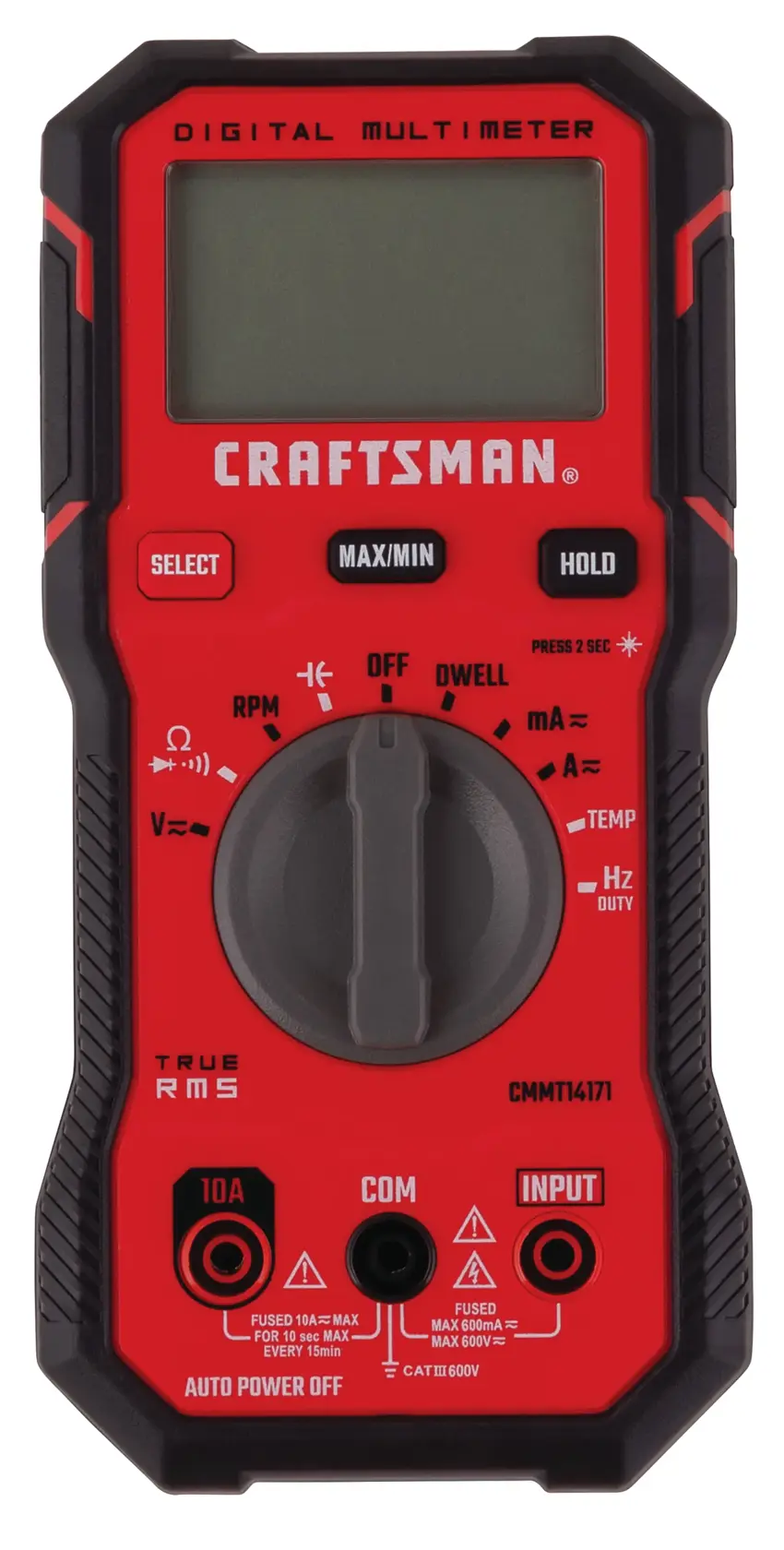
True RMS, CAT III 600V, plus RPM, dwell and duty-cycle functions for automotive work.
As an Amazon Associate I earn from qualifying purchases. Prices and availability are shown on Amazon.
Frequently asked questions
What resistance should a 12 V solenoid coil have?
It depends on its power rating. Divide the voltage squared by the wattage: a 12 V, 10 W coil should read about 14.4 Ω, and a 12 V, 5 W coil about 28.8 Ω, typically at 20 to 25 °C. Where the coil or datasheet prints a resistance, use that figure instead.
Why does a solenoid coil read higher when it is hot?
Copper's resistance rises with temperature, by roughly 0.4% per °C. A coil that has just been running at 60 °C can read around 15% higher than at room temperature. That is normal. Let the coil cool before comparing it with the rating.
Can a solenoid coil test good but still not work?
Yes. The winding may read correctly while the plunger is sticking, worn or bent, or the return spring has failed. The supply may also sag under load because of a weak battery, a corroded connector or a poor ground. Check the voltage at the coil while it is energised, then free and clean the plunger before replacing the coil.
How do I test a starter solenoid that only clicks?
A click shows the windings are pulling the plunger in, so the coil is probably fine. Measure the voltage across the large B and M terminals while someone turns the key. A drop of more than a few tenths of a volt points to burnt contacts. Also check battery voltage while cranking, because a flat battery causes the same click.
Is an AC solenoid coil tested the same way?
The open, short and insulation checks are the same. The difference is the expected value: an AC coil's DC resistance is much lower than its rated voltage divided by its current, because inductance limits the current in use. Compare an AC coil with its datasheet resistance or a known-good identical coil rather than calculating it.


