COMPARISON · MULTIMETERS
Fluke 101 vs AstroAI DM6000AR: Which Is Better for Home Use?
Buy the AstroAI DM6000AR if your home jobs include the car, batteries, gadgets or anything where you need amps or temperature; buy the Fluke 101 if you mainly check outlets, breakers and appliance cords and want a meter with a published CAT III 600V rating. When we checked Amazon the Fluke cost roughly twice as much, yet it does less: it has no current function at all. What the extra money buys is a safety rating AstroAI doesn't state, published accuracy and a 160 g body.
By the OhmSavvy Research Team ·
Disclosure: OhmSavvy earns a commission from qualifying Amazon purchases made through these links, at no extra cost to you. How we're funded.
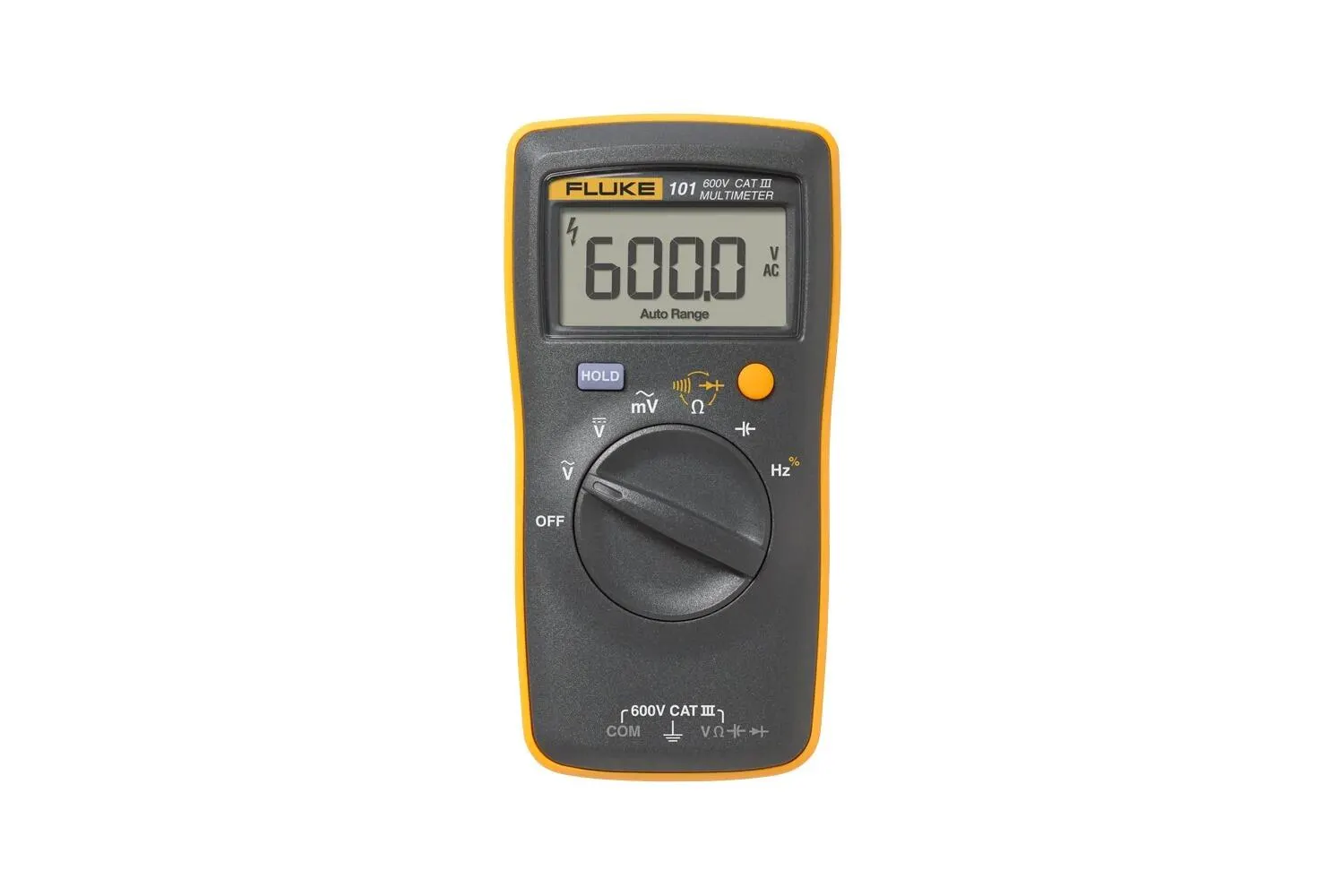
Fluke 101
4.1★★★★☆Fluke's smallest, simplest meter: volts, ohms, capacitance and frequency in 160 g, but no current measurement at all.
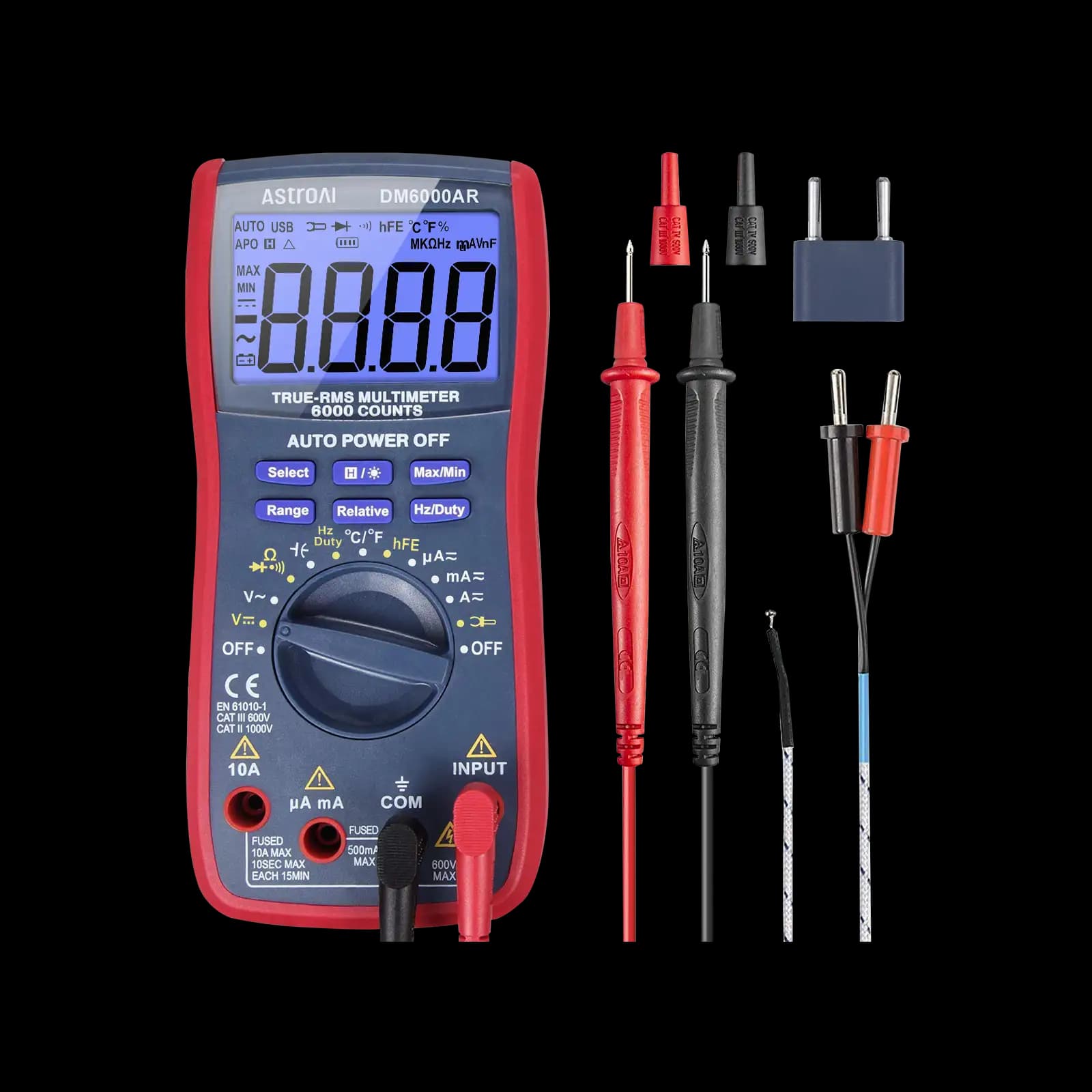
AstroAI DM6000AR
4.3★★★★☆The go-to recommendation for Arduino and Raspberry Pi tinkering — cheap enough not to worry about.
Specs side by side
| Fluke 101 | AstroAI DM6000AR | |
|---|---|---|
| Rating | 4.1★★★★☆ | 4.3★★★★☆ |
| Accuracy | Not stated as True RMS by Fluke | True RMS, 6,000-count |
| Safety rating | CAT III 600V | Not stated by AstroAI |
| Auto-ranging | Yes | Yes |
| Best for | Voltage and continuity checks only | Microcontroller & electronics projects |
| Display | 6,000 counts, no backlight listed | 6,000 counts, backlit |
| True RMS | Not claimed by Fluke | Yes, on AC volts and AC amps (Amazon listing) |
| Voltage | 600V AC/DC | 750V AC / 1000V DC display ranges |
| Stated CAT rating | CAT III 600V | Not stated by AstroAI |
| Current | None (two input jacks) | AC/DC; fused 400 mA and 10 A inputs (ranges not stated) |
| Temperature | No | Yes (no probe named in the box contents) |
| DC volts accuracy | ±(0.5% + 3) | Not stated on the pages we checked |
| Data hold | No (per Fluke India page) | Yes |
| Battery | 2 × AAA | One 9V (6F22) |
| Weight | 160 g | 12.59 oz (357 g) on astroai.com; 492 g on Amazon |
| Warranty | 1 year | Not stated |
Specs checked against manufacturer documentation and official Amazon listings. Desk research, not bench testing. How we research.
Key differences
- →The AstroAI measures AC and DC current through fused 400 mA and 10 A inputs; the Fluke 101 has only two jacks and cannot measure current at all.
- →Fluke rates the 101 CAT III 600V; neither AstroAI's product page nor its Amazon listing states a CAT rating for the DM6000AR.
- →The AstroAI is True RMS on AC, per its listing; Fluke makes no True RMS claim for the 101.
- →The AstroAI adds temperature, data hold and a backlit display; the 101 lists none of the three.
- →The 101 weighs 160 g and runs on two AAA cells; the AstroAI is a full-size meter on a 9V battery.
- →Fluke publishes accuracy for every range; the AstroAI pages we checked give no accuracy figures.
Amps or no amps: the 101's missing current jack
This one difference settles the choice for most households. The Fluke 101 has a COM jack and a V/Ω jack and nothing else, so there is no circuit inside it for current to pass through. The DM6000AR carries two extra fused inputs, a 400 mA ceramic fuse and a 10 A one per its Amazon listing, which tells you it has a milliamp input and a high-current input. AstroAI doesn't publish the individual current ranges or their accuracy on the pages we checked, so treat it as a capable current meter without a spec sheet to prove how capable.
The count is DC volts, AC volts, resistance, continuity, diode, capacitance, frequency and duty cycle for the 101, with DC amps, AC amps and temperature on top for the AstroAI. Function count isn't quality, but the three missing functions are exactly the ones home users reach for when a car battery keeps going flat or a freezer seems warm.
Worked scenario: a car battery that dies overnight
A battery that is healthy but flat every morning usually points to something drawing current with the ignition off. The standard check puts the meter in series between the negative battery post and its cable, then pulls fuses one at a time until the reading drops. Allowances for this standby draw vary by vehicle, and many service manuals put them in the tens of milliamps, so the 400 mA input is the right place to start once the modules have gone to sleep.
| Step | AstroAI DM6000AR | Fluke 101 |
|---|---|---|
| Check resting battery voltage | Yes, DC volts | Yes, DC volts with ±(0.5% + 3) published |
| Measure ignition-off draw in series | Yes, through the fused 400 mA input | Not possible: no current input |
| Watch the reading fall as fuses are pulled | Yes; data hold freezes a reading | Not possible |
| Check a fuse for continuity once removed | Yes, continuity | Yes, continuity with buzzer |
With a 101 you can confirm that the battery is low, but not why. Your options are a clamp meter or a different multimeter, which is why we don't recommend the 101 as anyone's only meter if they keep a car. Our step-by-step guide to measuring parasitic battery drain covers the procedure, including why you keep the start-up surge away from the milliamp fuse.
Worked scenario: checking a dead kitchen outlet
Now flip the job. A countertop receptacle has gone dead and you want to know whether it has 120V before you start resetting GFCIs. Both meters can display the voltage. The difference is what each maker is willing to put in writing about the meter surviving a transient on that circuit. Fluke states CAT III 600V, the category that covers receptacles, branch wiring and the panel itself. AstroAI states no category, and its fuses are marked 600V, which is a fuse rating, not a meter rating.
Accuracy tells a similar story. On the 101's 600.0V AC range, Fluke's ±(1.0% + 3) works out to ±(1.20 + 0.3) = ±1.5V on a 120.0V reading, so a display between 118.5V and 121.5V is consistent with a true 120.0V. On a 12.60V car battery the DC spec gives ±(0.063 + 0.03) ≈ ±0.09V on the 60.00V range. AstroAI publishes no figures to run the same arithmetic on, so you can't say how far its reading may drift.
Mains work needs a stated rating
Which home user should buy which?
| Your home jobs | Better fit | Deciding reason |
|---|---|---|
| Outlets, breakers, extension cords | Fluke 101 | Stated CAT III 600V and published accuracy |
| Car battery drain, fuses and charging | AstroAI DM6000AR | Has current inputs; the 101 has none |
| Arduino, USB gadgets, LED strips | AstroAI DM6000AR | Reads milliamps and has a backlight for bench work |
| Oven, fridge or HVAC vent temperatures | AstroAI DM6000AR | Temperature function; confirm a probe is supplied |
| A small meter kept in a drawer or pocket | Fluke 101 | 160 g on two AAA cells |
| Both mains work and current | Neither alone | See the Neither box below |
When the cheaper meter is the right call
Two buying notes. The Fluke 101 isn't sold on Fluke's US site, and on Amazon it came from a third-party seller. Its warranty is one year, against two years on the Fluke 107 and three on the 115. The AstroAI is sold by AstroAI's own store on Amazon, but the two sources disagree on its weight (12.59 oz on astroai.com, 492 g on Amazon), and AstroAI states no warranty term. If you want a Fluke that also reads amps, compare the Fluke 115 vs Fluke 101; for broader picks, see our best multimeter for home use guide.
Choose the Fluke 101 if…
- ✓Most of your testing is on 120V or 240V household circuits, where a stated CAT III 600V rating matters
- ✓You want a meter small enough for a jacket pocket or kitchen drawer: 160 g
- ✓Volts, continuity, resistance and capacitance cover everything you plan to do
Choose the AstroAI DM6000AR if…
- ✓You want to measure current, such as a car's parasitic battery drain or a USB gadget's draw
- ✓You want temperature, a backlight and data hold, none of which the 101 lists
- ✓Your work stays on batteries, 12V systems and low-voltage electronics
Neither if…
You want one meter for both house wiring and current measurement. The UNI-T UT139C pairs a stated CAT III 600V rating with True RMS and 10 A current, and the Fluke 115 does the same with Fluke's 3-year warranty.
The bottom line
For most homes the AstroAI DM6000AR is the better value: it costs about half as much and adds current, temperature, data hold and a backlight. Choose the Fluke 101 only if your testing is mostly 120V and 240V circuits and you want a stated CAT III 600V rating in a 160 g meter, accepting that it can never read amps.
Frequently asked questions
Can the Fluke 101 test a car battery?+
It can read the battery's voltage, and Fluke publishes ±(0.5% + 3) accuracy on DC volts, so a resting-voltage check is well within its abilities. It cannot measure parasitic drain or any other current, because it has no current input. For battery drain you need the AstroAI DM6000AR, another meter with a milliamp range, or a clamp meter.
Is the AstroAI DM6000AR safe for household outlets?+
AstroAI doesn't state a CAT rating on its product page or its Amazon listing, so we can't confirm what transient it is built to survive. Its fuses are marked 600V, but that rates the fuse, not the meter. For outlets and breaker panels we recommend a meter with a stated rating, such as the Fluke 101's CAT III 600V.
Why is the Fluke 101 more expensive when it does less?+
You're paying for a stated CAT III 600V safety rating, published accuracy on every range, a 1 m drop rating and a 160 g body, rather than for functions. When we checked Amazon it cost roughly twice as much as the AstroAI. Whether that's worth it depends on how much of your testing is on mains wiring.
Does the AstroAI DM6000AR come with a temperature probe?+
Both AstroAI's page and the Amazon listing list temperature as a function, but the listing's included-components line names test leads, a 9V battery, a multi-function socket and a manual, with no thermocouple. Check the current listing or ask the seller before buying it for temperature work. The Fluke 101 has no temperature function at all.
Which is better for Arduino and electronics projects?+
The AstroAI. It reads current through its 400 mA fused input, so you can check how much a board draws, and it adds a backlight and data hold for bench work. The Fluke 101 handles voltage, resistance, diode and continuity checks on a board, but it can't tell you whether a project is drawing 20 mA or 200 mA.
Is the Fluke 101 True RMS?+
Fluke doesn't describe it as True RMS, so assume it's average-responding. On ordinary utility voltage that makes little difference, because the waveform is close to a sine. It matters on the output of dimmers, inverters and variable-speed drives. The AstroAI's Amazon listing says it is True RMS on AC voltage and AC current.
Related



